
Top 7 Challenges GCC Leaders Face — and How to Solve Them
24/11/2025
Understanding the Employer Employee Relationship
25/11/2025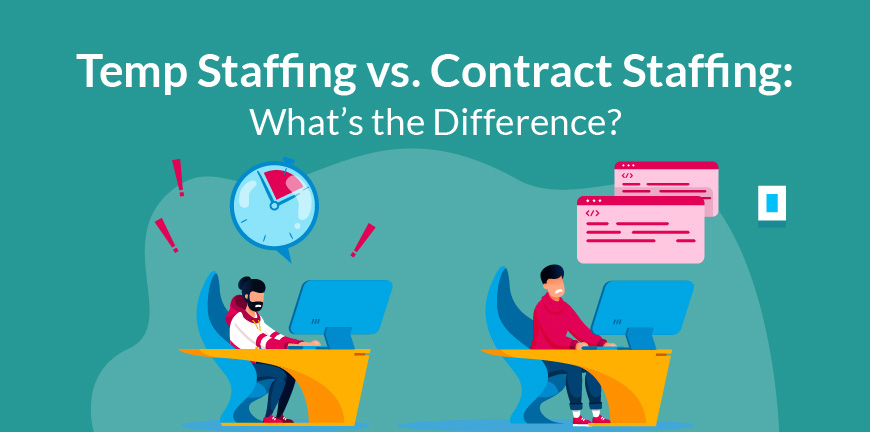
Many companies interchangeably use the words contractor and employee, though they mean two very different things. A temp worker just adds to the confusion. What is the difference between all three of them, if there is a difference at all? Temp staffing and contract staffing too may be used interchangeably in some companies, especially because both involve non-permanent employees. But there are several differences between them contract staffing and temp staffing.
To begin with, a contractor is hired on contract for a specified duration whereas employees serve the company full-time. Temp workers are sourced for temporary jobs just like contractors but lack most of the benefits and compensations awarded to full-time employees.
Let us now look at individual definitions, beginning with that of staffing itself and then these two types of staffing, temporary and contract, before we delve into the differences.
What is Staffing?
the process of attracting, selecting, assessing, and then hiring individuals from a specific industry to fulfil the temporary, seasonal or contractual needs of companies, in tech or non-tech sectors is referred to as staffing.
Staffing differs from recruitment in the fact that recruitment happens for full-time permanent roles whereas staffing happens for temporary roles. Both temp and contract staffing have their benefits and cannot be used interchangeably.
What is Temp Staffing?
The process of attracting, selecting, and onboarding individuals for specific temporary roles through a recruiter, where the responsibility of managing payroll lies with the staffing company, is called temp or temporary staffing.
What is Contract Staffing?
The process of attracting, selecting and absorbing individuals for temporary or contract work, on the main company’s payroll is called contract staffing.
What is the Difference between Temp Staffing and Contract Staffing?
| Aspect | Temp Staffing | Contract Staffing |
| Employment Duration | Short-term, often for days, weeks, or a few months | Medium to long-term; tied to project duration or a fixed contract |
| Purpose | To fill immediate or seasonal workforce gaps | To fulfil specific skill-based or project-based requirements |
| Hiring Source | Employees are usually provided by a staffing agency and remain on their payroll. | Employees may be on the staffing agency’s payroll or hired directly for the contract duration. |
| Skill Level | Often, entry-level or general support roles | Typically skilled professionals or specialists |
| Cost Structure | Lower cost due to shorter engagement | Higher cost due to expertise and longer-term involvement |
| Work Scope | More task-based and routine work | Defined responsibilities tied to project goals or technical needs |
| Management Control | Day-to-day supervision is handled by the company. | The company manages work, but employment terms remain tied to the contract. |
| Benefits & Compliance | Handled primarily by the staffing agency | Can be shared between the agency and the company, depending on the agreement |
| Flexibility Level | High flexibility for quick workforce adjustments | Flexible but within the scope and duration of the contract |
| Common Use Cases | Seasonal demand, sudden employee absences, short-term tasks | IT projects, engineering roles, consulting, long-term assignments |
What are the Benefits of Temp Staffing?
Temp staffing is the new go-to standard to pick for any temporary job by most employers, and there are reasons for the same. Let us look at some of the benefits of temp staffing.
- There is no need to award the leaves or other compensation, generally provided to full-time employees, for temp workers.
- There is no need to register the temp worker on the company’s payroll and generally no need to provide any guidance or training, as most modern temp staffing companies do this anyway.
- Saves a lot of money for the company as the temp worker can be hired for specific jobs or in markets where talent is not very expensive.
- Provides flexibility to the company of terminating the contract with the temp worker, when they feel it is not feasible to move forward with it anymore, without asking worker to serve a notice period.
What are the Benefits of Contract Staffing?
Though temp staffing may seem like the more beneficial choice for the employer, contract staffing has its own set of benefits, too. The following are a few important benefits of contract staffing.
- Visibility into the future of work at the company for the period specified in the contract without having to manage the employees full-time.
- Recruitment for specific skills that are much in demand and impossible to recruit otherwise.
- Saves a lot of time for the employer, as they can hire for project-critical rules very quickly.
Should You Opt for Temp Staffing or Contract Staffing?
As a business, which of these two must you opt for? This is a tactical decision and one that is best helped by working in tandem with an HR consulting company as a staffing partner. Your staffing partner will advise you on whether a particular position or list of positions must be temp staffed or not.
Generally, those positions that require a lot of expertise are better served by contract staffing whereas those that will have low commitment levels from the business are served best by temp staffing.
What are the latest Trends in Temporary and Contract Staffing?
The job market constantly experiences transformation with fluctuating demands and evolving technologies, and trends. Let us explore some of the emerging trends:
1. AI and Automation
Automated recruitment systems are enhancing efficiency. AI-driven tools are being used to screen, interview and select professionals
2. Focus on Skill-based Hiring
Recruiters and employers are prioritising real and practical skills over high-end degrees. This enables employers to dive into a broader and diverse talent pool, selecting specialised talent for niche needs.
3. Surge in Remote and Hybrid Work Modes
The model is gaining momentum among contract and temp workers, as it gives them the flexibility to perform tasks efficiently. It enables employers to select suitable talent from a global talent pool.
4. Focus on Worker Welfare and Retention
There is a spike in employers focusing on the well-being of temporary and contract manpower, with staffing companies offering advantages like mental wellness programs, flexible timings, work-life balance, etc.
Are You Looking for a Staffing Partner?
If you are undecided about what staffing type to pick to bring talent onboard, and are also on the fence about which HR company would be best for you, then decide on what you are expecting from the staffing partner – how many positions you want to close and how much time and money you are willing to spend on talent acquisition and management and what demography you are looking at.
Once you are sure of these things search for the best HR company that satisfies these criteria or opt for the services of a 25-year-old reputed company in HR services, Alp Consulting. Talk to us today, to know more.
Key Takeaways
- Temp Staffing and Contract Staffing Serve Different Needs
- Temp Staffing Reduces Cost and Increases Flexibility
- Contract Staffing Ensures Access to Specialised Talent
- Staffing Trends Are Evolving with Technology and Worker Expectations
- Choosing the Right Staffing Model Requires Strategic Evaluation
Frequently Asked Questions
1. What is the difference between temporary and contract staffing?
The most important difference is that temporary staffing usually manages short-term tasks or projects, while contract staffing refers to handling a longer-term project based on signing an agreement.
2. Which is more cost-effective — temp or contract staffing?
Temporary staffing is more cost-efficient as the tasks and projects are short-term, allowing employers to save on benefits, payroll, taxes, etc.
3. Do temporary or contract employees get benefits?
Contract or temporary workers usually do not get any benefits from their employers. They are responsible for their own benefits, unlike permanent workers.
4. How can ALP Consulting help with staffing?
Alp Consulting helps in staffing by providing comprehensive staffing services like permanent, contract, temp, IT staff augmentation, and recruitment process outsourcing.
5. Which is better for businesses — temporary or contract staffing?
The correct choice of staffing depends on the business requirements, project type, budget factors, etc.
6. What are the current trends in temporary and contract staffing?
The emerging trends of temporary and contract staffing include the rise of the gig economy and project-based work, increased use of AI in recruitment, and a shift toward skills-based hiring over traditional qualifications.
Contact Us For Business Enquiry

Kasthuri R
Kasthuri R is the Co-Founder & Executive Director at ALP Consulting, bringing over 23 years of experience in search, staffing, and HR consulting. She has been instrumental in driving ALP’s recruitment, employee leasing, and executive search practices across diverse industry verticals. With deep expertise in talent acquisition, HR strategy, and operational management, Kasthuri has built scalable, client-focused solutions that enhance workforce efficiency. Her strategic leadership continues to steer ALP Consulting toward innovation and excellence in people management.