
Compliances for Private Limited Company in India: Complete Annual Checklist
27/12/2025
What Is a Payroll Management System? A Complete Guide in 2026
27/12/2025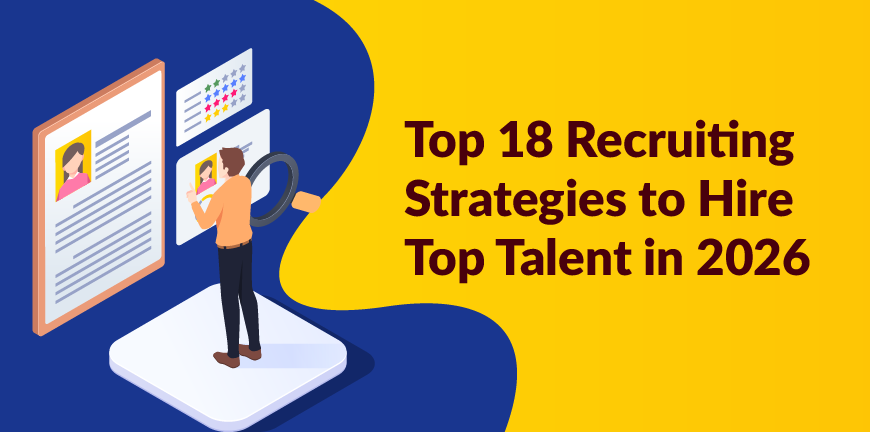
Low employment, high candidate expectations, & market competition have pushed business leaders to go beyond job postings and frame critical recruitment strategies to help identify, hire, & retain talent. No matter what sort of business you run, you may have built recruitment strategies, but it is time for you to re-evaluate them.
What is a Recruitment Strategy?
A recruitment strategy is an ongoing process that the HR teams use to attract, hire, & retain talent to boost organisational growth & success. A comprehensive recruitment strategy helps align business goals with candidate expectations, skills, & culture. Recruitment strategy involves various technological tools and platforms to tap qualified talent.
Key Recruitment Challenges in India (2026)
The dynamic business landscape, competitive talent market, modern workforce models, new candidate expectations, & data-driven decision-making have presented major challenges for hiring teams in 2026. Let’s dive into 5 major challenges.
1. Talent Gaps
Skills are key to career development and supporting business growth. Organisations with legacy recruitment systems can lead to skill gaps, workflow delays, & poor employee performance. Outdated recruitment strategies do not provide updated skill trends, salary benchmarks, & market insights.
2. Candidate Expectations
Employees today need an experience at the workplace as they do on online shopping sites. Legacy recruitment models lack dashboards that hinder employees from gaining real-time access to company information, attendance, performance, & explore growth opportunities. This can lead to demotivation & disengaged workforce.
3. Diversity & Inclusion
Innovation and scaling are key to business success. As business leaders focus on DEI, an outdated recruitment approach may resist multi-location and multi-generational talent. This can reduce representation & lead to heavy reliance on internal mobility.
4. Remote / Hybrid Workforce Model
Recruitment strategies must focus on skill-first hiring. In the process, they also support hiring remote & hybrid talent to support business scaling and reduce operational costs. They also help HR teams manage synchronised communications, workforce planning, & increase operational resilience, product innovation, & global business competitiveness.
5. Employer Branding
Beyond salary & benefits, recruitment strategies in India must focus on employee engagement & workforce planning. Non-technical hiring strategies lack psychometric, project-based skill matching, & growth negotiation capabilities. This can lead to poor employer branding & talent management.
Top Recruitment Strategies for 2026
Cost-to-hire, specialised talent, operational efficiency, & retention define organisational success. But if your recruitment strategies for businesses lack market & industry intelligence to attract top talent in India, here are 5 key trends to follow in 2026.
1. Skill-focused Talent
Organisational success is now based on skill depth rather than volume. Leaders look for outcome-driven professionals & domain-specific talent, hence focus on a skill-first recruitment model to support business scaling needs.
2. Contract Staffing to Core Teams
Contract staffing is no longer a trend but a core workforce. To support business scaling & respond to dynamic global market competition, core team recruitment is poised to reduce overhead costs & support scaling.
3. AI-driven Recruitment
Skill depth matters highly to all industries. So, deploying AI to assess, screen and evaluate talent quality helps organisations with the final talent that is both technically & culturally aligned. Use cloud, ATS, voice test, & pattern detection.
4. Compliance & Payroll Management
Companies of all sizes come under intense compliance scrutiny. To avoid operational disruption or reputational risks, we must shift to compliance-led recruitment by:
- Aligning workforce practices with updated labour laws
- Maintaining time-stamped audit reports & digital trails
- Managing accurate payroll management with strategic reporting
5. DEI Workforce
Global companies look at DEI as fundamental to workforce innovation, stability & leadership. Understanding the need, leaders must focus on multi-generational & multi-location talent using advanced job search portals and professional networking websites.
Recruitment Process Framework (Step-by-Step)
By implementing end-to-end recruitment strategies in HRM, we support companies with high-quality & culturally aligned talent.
1. End-to-End Effective Recruitment Strategies
From sourcing, vetting, screening, to onboarding, we ensure candidates meet the desired role specifications, skill requirements, cultural alignment, & business goals of the companies.
2. Key Roles
As part of our recruitment strategies for hiring employees, we focus on specialised & in-demand roles in engineering, retail, healthcare, E-commerce, & ITes sectors. By hiring professionals like Data Analysts, Product Engineers, Software Engineers, DevOps Engineers, Blockchain specialists, IoT Engineers, & SaaS sales professionals, we support global operations & growth.
3. Structured Methodology
By following a structured recruitment process to tap candidates with defined hiring stages, advanced tech tools, evaluation tools, & data-driven metrics.
Common Mistakes in Recruitment
Building recruitment strategies in India is a complex process, but if you follow a reactive approach, you might end up hiring the wrong talent for the role. Here are a few mistakes recruitment teams can avoid.
- Prioritising speed over quality can cut corners. Unstructured recruitment strategies can result in wrong talent decisions as the candidate’s profile is deeply vetted.
- Using legacy recruitment technologies may attract poor-quality candidates. So, using programmatic ads might help tap qualified talent.
- Lack of a feedback mechanism in the recruitment strategies to hire top talent can block space for improvement. Feedback data is critical to building a positive candidate experience.
- Broad recruitment strategies can cause hiring delays if job ads are posted everywhere without any targeted channels.
- Using instinctive evaluations in your recruitment strategy may fail to give you actionable insights to find the right fit.
How Alp Consulting Helps with Recruitment
Alp Consulting Ltd, India’s leading recruitment firm, gives you the ability to hire better and faster. Alp’s suite of automated recruitment solutions is designed to tap top talent. Our modern recruitment strategies 2026 & assessments help you achieve high-quality talent decisions and build a diverse workforce of tomorrow. Alp has processed over 10 million candidates, and analysing these data helps us deliver actionable insights to zero in on candidates who meet your business needs and growth.
How we helped a GCC company hire 50+ engineers in 60 days
A leading tech product and services company in the US, producing highly specialised equipment for agriculture, construction, forestry, and the electronics faced a talent crunch for niche roles beyond internal talent limits.
When the company approached Alp Consulting, a global leader in recruitment and other HR services, its talent game changed forever. To understand the impact of Alp Consulting recruitment services, watch the transformation our client experienced below.
Outcomes by leveraging our best recruitment techniques.
- Hiring cycles improved 3X with access to 1000+ qualified and role-based talent.
- Quick cultural immersion through automated and streamlined external recruitment communication & onboarding experience.
- Boost operational productivity 5X from Day One by reducing time and resources on additional training & development programs.
- Business scalability increased 30% due to talent diversity employed for key roles.
- Avoided internal growth conflicts and levelled up hiring transparency, maintaining employee morale.
If you are a global company with GCCs grappling to tap the right & qualified talent to boost operations, improve retention, and fuel business continuity. We are here to help you visualise similar outcomes.
Reach out to us or visit us @ https://alp.consulting/
Frequently Asked Questions (FAQs)
1. What is the best recruitment strategy?
The best recruitment strategy aligns business goals with talent needs, leveraging data-led sourcing, strong employer branding, & proactive talent pipelines to attract, engage, & retain high-performing talent.
2. How to improve hiring efficiency?
Improve hiring efficiency by streamlining processes through automation & AI tools, refining job descriptions, leveraging data analytics, & enhancing collaboration between HR & hiring managers to reduce time-to-hire.
3. What are modern hiring techniques?
Modern hiring techniques include AI-driven screening, social media recruiting, skill-based assessments, virtual interviews, employer branding, & leveraging talent analytics to spot & hire top-quality talent.
4. How do IT companies hire in India?
IT companies in India hire through campus placements, job portals, employee referrals, recruitment agencies, & hackathons. They combine technical assessments & interviews to tap skilled and culturally aligned candidates effortlessly.
5. What are the biggest challenges in recruitment today?
Some of the significant challenges in the recruitment process today are fast-evolving skill demands, candidate expectations, lengthy hiring cycles, strong employer branding & data-driven decision making.
Contact Us For Business Enquiry

Amit Saproo
Amit Saproo is the Head of Operations at ALP Consulting with nearly 17 years of experience in Executive Search, RPO, Leadership, and IT & Engineering recruitment. He leads nationwide recruitment programs across Technology, BFSI, and R&D domains, driving strategic hiring solutions for diverse client needs. Amit excels in building and managing high-performance teams that deliver scalable, end-to-end recruitment and consulting services.