
Why AI-Generated Job Posts Often Fail to Engage Candidates?
09/02/2026
Statutory Compliance Checklist for Telangana
12/02/2026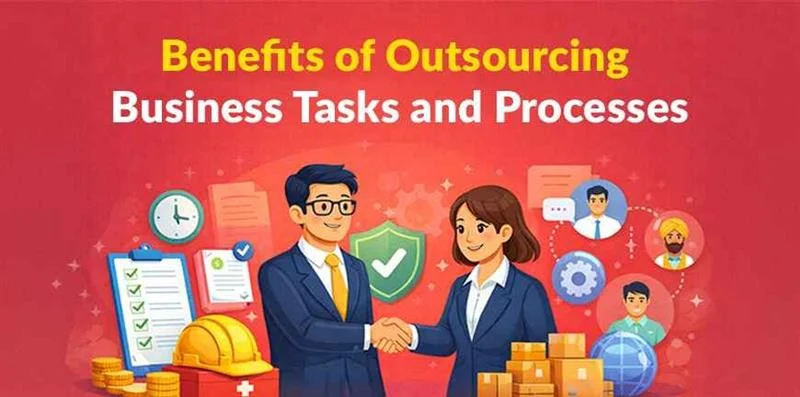
“Master your strengths, outsource your weaknesses.”- Josh Steimle (CEO of MWI)
In the current dynamic market where time is of the essence, developing internal teams for running all business operations is not at all feasible. The risks vs rewards ratio seems to nosedive in such work setups, resulting in higher costs and reduced productivity in the long run.
Therefore, outsourcing core or non-core activities based on business goals and project requirements seems to be the best bet for achieving the desired results with reduced investments.
However, how beneficial is outsourcing in the real world? Let’s answer this million-dollar question by discussing the benefits of outsourcing in-depth!
What is Outsourcing? Meaning & Definition
Outsourcing is defined as “the process of delegating business tasks or a set of operations that were previously run internally to external providers to improve efficiency, reduce costs, & focus on core operations.”
Let’s take the example of Apple Inc. Company to understand the impact of outsourcing in the real world.
From the late 1990s onwards, Apple Inc. decided to outsource most of its manufacturing to vendors like Foxconn, Pegatron, Samsung Electronics, Sony Group Corporation, etc. Instead of spending huge resources on its own factories, Apple focused on product design, software, & innovation.
This outsourcing strategy turned out to be a masterstroke that took Apple to a whole different pedigree, allowing it to scale production rapidly, reduce operational costs, & bring products like the iPhone to market faster. Simply put, outsourcing played a pivotal role in Apple becoming one of the world’s most valuable companies with a current market cap of $4.06 Trillion in 2026.
How Does an Outsourcing Model Work?
An outsourcing model is a structured framework that companies leverage to delegate specific tasks or processes to external experts without losing operational & decision-making control. In the current dynamic market where rapid scaling is the norm, outsourcing has become an indispensable part of business expansion, like the main cog in the business growth wheel.
This is because outsourcing solutions improves efficiency, reduces operational costs, provides access to specialized skills, & allows companies to focus on core growth strategies rather than wasting hours of their valuable time in mundane administration tasks.
Additionally, startups and SMEs can only manage to stay competitive by outsourcing critical operations like recruitment, payroll, compliance, back office, IT administration, etc., as hiring in-house can be very expensive & can create operational disruptions.
Here are the steps taken by businesses to engage with an outsourcing business model:
Step 1: Correctly Define Outsourcing Objectives
Businesses will segregate core & non-core activities on a priority basis, leaving nothing in the wiggle room. They clarify goals, assess internal capabilities, & run budget estimations. Once this is done, they determine which tasks can be outsourced with full confidence and minimal data leakage threats to boost cost efficiency, scalability, & strategic focus.
Example: A growing e-commerce rookie firm finalises payroll & recruitment as outsourcing business processes, sets cost reduction goals, reviews internal workload, allocates monetary resources, & outsources these tasks to specialists like Alp Consulting Ltd to boost efficiency & scalability.
SMEs have reported that they are experiencing an over 20% increase in production efficiency simply by offloading administrative tasks like payroll & HR.
Step 2: Research & Select the Right Vendor
The leadership & HR team will leave nothing to chance & conduct a thorough vetting of the outsourcing providers by reviewing expertise, industry experience, service offerings, pricing frameworks (may be revenue sharing can also be the way to go), compliance protocols, & client feedback. Once all the assessments come back as positive, then only do they say go ahead to the next stage of creating a long-term partnership.
Example: The company compares 3 to 4 potential payroll vendors, reviews certifications & clientele served, & selects the most compliant-ready among the probable. Once approved, the company will move forward with closing the deal via a formal agreement.
Step 3: Establish Contracts & Service Agreements
Both parties, after reaching a consensus, will strike a deal and make it official. They will define scope, deliverables, timelines, KPIs, data privacy terms, & communication protocols. This ensures clear expectations & accountability via enforceable SLAs.
Example: The company & vendor sign an agreement outlining payroll scope, delivery timelines, service levels, confidentiality clauses, & communication rules to establish accountability.
Step 4: Implement Transition & Knowledge Transfer
Organizations will collaborate with vendors for KT (Knowledge Transfer), train teams, integrate systems, & establish workflows. This ensures a smooth transition like clockwork without derailing ongoing operations or service quality whatsoever.
Example: The company shares process documents, trains the vendor team, integrates payroll software, & gradually transfers responsibilities to ensure uninterrupted operations & service continuity.
Step 5: Monitor Performance & Optimize Continuously
Businesses will track vendor performance using KPIs, conduct regular reviews, resolve issues relentlessly, & refine strategies to maximize value, strengthen partnerships, & support long-term growth.
The company reviews monthly vendor reports, tracks service KPIs, addresses performance gaps, refines workflows, & strengthens collaboration to enhance long-term outcomes.
Top 12 Benefits of Outsourcing Business Tasks and Processes
Here are the top 12 benefits of outsourcing that make every business go for it, at least to manage one of their operations, if not all:
1. Cost Optimization & Financial Efficiency
Outsourcing services for businesses brings down operational expenses in the long run by getting rid of recruitment, infrastructure, & training costs. This empowers businesses to transform fixed expenses into a variable pricing model while improving budget control & overall financial efficiency.
Companies transitioning to a full-service outsourcing model in 2026 will experience a 25% to 40% reduction in TOC (total operational costs).
2. Access to Specialized Expertise
Companies gain on-demand access to industry specialists (both regular and niche expertise) & advanced skills without surrendering to exhaustive hiring cycles. This approach ensures professional execution of complex tasks & higher service quality across outsourced elements.
74% of companies across India specifically outsource to get their hands on specialized knowledge & “intellectual capital” that is not available within their own walls.
3. Enhanced Focus on Core Business Activities
Delegating non-core processes or tasks that necessitate expertise missing in-house to a reliable outsourcing agency like Alp Consulting Ltd frees up internal teams big time. Now, they can direct maximum billable hours on strategic priorities, innovation, & revenue-generating initiatives that accelerate long-term business growth & competitiveness.
In sectors like wealth management or sales, where human interaction and constant empathetic conversations take centre stage, relationship managers often spend only 43% of their time on revenue-generating tasks. Outsourcing the administration can boost this “golden time” by up to 30-40%.
4. Improved Operational Scalability
Businesses bring out outsourcing from the quiver of strategies to scale operations up or down quickly based on demand. This negates the delicate challenges of hiring or downsizing internal staff when the company is going through a lean patch in terms of revenue or projects.
Outsourcing can speed up team deployment by 50%-80%. While building an in-house team typically takes up 2–4 months, established partners can bring together a pre-vetted team in 1–4 weeks.
5. Faster Turnaround and Productivity Gains
Experienced outsourcing partners who have all their cards up at sleeve streamline workflows using cutting-edge processes & technology. These arrangements fast-track task accomplishment while skyrocketing overall operational productivity & delivery timelines.
Companies that take the route of engaging with specialized outsourcing partners report a 25% to 30% faster time-to-market for new products & services.
6. Access to Advanced Technology and Tools
Outsourcing providers invest heavily in modern tools, automation, & platforms since service quality and speed are their USPs. These ready-to-deploy services give businesses access to cutting-edge technology without significant capital expenditure or ongoing maintenance responsibilities.
With a 30% shortage in cybersecurity talent globally, 93% of organizations now entrust their cyber defense to specialized service providers.
7. Risk Mitigation and Compliance Support
Professional vendors stay updated with regulatory requirements (e.g., latest labour code amendments launched in Nov 2025). This acumen makes businesses more agile & reduce compliance risks, legal exposure, &operational errors via expert oversight & standardized practices.
Employers are seeing an unprecedented rise in social security costs due to the new, uniform definition of “wages.” This often requires restructuring entire salary stacks to ensure PF & Gratuity compliance & can be done effectively only via an expert payroll outsourcing service provider.
8. Global Talent and Market Reach
Outsourcing has an innate ability to connect organizations with global talent pools & market insights. This supports expansion strategies & enhancing service capabilities across international regions.
Global recruitment outsourcing (RPO) can bring down time-to-hire by an average of 27% by leveraging 24/7 “Follow-the-Sun” talent sourcing teams.
9. Greater Business Flexibility & Agility
External partnerships allow companies to be agile & adapt quickly to changing priorities, market disruptions, & emerging opportunities without restructuring internal teams.
During the transition to the new 2025 Labour Codes, organizations operated on their toes and used outsourcing partners to restructure compliance frameworks in weeks. On the other hand, internal HR departments took an average of 5 months to achieve the same readiness, which can potentially push businesses into chaos.
10. Improved Service Quality and Consistency
Dedicated outsourcing teams have no-compromise policies & follow performance benchmarks & quality standards to the core. This ensures consistent service delivery & measurable improvements over time.
Specialized payroll & HR providers target a 99.9% accuracy rate. On the contrary, research shows that nearly 20% of in-house payrolls are cluttered with errors due to manual processing and local regulation confusion.
11. Enhanced Innovation and Strategic Insight
Experienced vendors bring fresh perspectives, industry best practices, & process innovations that help organizations modernize their business operations & always remain competitive.
According to McKinsey Digital, outsourcing IT services can aid organizations in adopting advanced technologies such as generative AI & cloud-native development up to 40% faster than relying solely on in-house teams.
12. Stronger Business Continuity and Operational Resilience
Outsourcing acts as a catalyst to maintain stronger business continuity by ensuring critical processes run uninterrupted and free of any surprise incidents. This is achieved via dedicated backup teams, standardized workflows, & disaster recovery frameworks. Moreover, outsourcing protects operations from unexpected disruptions, workforce gaps, & system failures.
For large-scale enterprises, even 1 hour of unplanned downtime can cost an average of $1.4 million ($23,750 per minute), making outsourcing paramount for disruption-free business operations.
What are the 5 Challenges of Outsourcing Services?
Here are the 5 key challenges of outsourcing:
1. Communication and Cultural Barriers
Language barriers, time zone variations, & workplace culture can bring instances of miscommunication, heated arguments, slow collaboration, & create synchronization issues between internal teams & outsourcing partners during critical project executions.
Recent studies reveal that 25% of project failures due to outsourcing are directly linked to poor communication (16%) & cross-cultural issues (9%).
2. Quality Control and Performance Risks
Maintaining service quality throughout the engagement cycle can be arduous if expectations, standards, & performance KPIs are unclear. This leads to delays, rework, or dissatisfaction with outsourced deliverables.
According to 2024–2026 reports, over 63% of firms that failed in their outsourcing efforts had not framed clear performance indicators (KPIs) right from the first official engagement.
3. Data Security & Confidentiality Concerns
Sharing sensitive business information with external vendors can make companies vulnerable to serious cybersecurity risks. To negate this, strict data protection measures, compliance protocols, & carefully structured confidentiality agreements might be necessary.
In 2026, data breaches involving TPAs cost an average of $4.91 million, which is nearly 40% more than the cost of remediating a purely internal breach.
4. Reduced Direct Control Over Processes
Outsourcing shifts operational control to third-party service providers (although not 100%), making it arduous for businesses to oversee daily activities & enforce immediate changes when priorities shift.
5. Vendor Dependency and Relationship Management
Overreliance on a single outsourcing provider can create dependency risks, necessitating active relationship management & contingency planning to eliminate operational disruptions.
How Alp Consulting Helps Businesses Through Tailored Outsourcing Services?
Alp Consulting Ltd delivers tailored outsourcing services that help businesses streamline operations, strengthen compliance, and scale efficiently. By combining deep domain expertise in payroll, HR, recruitment, compliance management, & GCC with technology-driven processes, Alp Consulting Ltd enables organizations to minimise operational risks to almost zero & improve productivity.
Moreover, Alp’s customized service models adapt to each client’s needs, ensuring seamless execution, consistent quality, & measurable business outcomes while allowing leadership teams to focus on strategic growth and long-term success.
Key Takeaways
- Outsourcing helps businesses reduce operational costs, improve efficiency, & focus resources on core growth priorities.
- Access to specialized expertise through outsourcing enhances service quality & accelerates innovation and scalability.
- A structured outsourcing model ensures smooth transitions, accountability, & measurable long-term business outcomes.
- While outsourcing offers major benefits, managing risks requires clear communication, strong governance, & reliable vendor partnerships.
- Strategic outsourcing strengthens resilience, supports growth, & enables businesses to adapt quickly in competitive markets.
FAQs
1. What is the difference between Outsourcing and Offshoring?
Outsourcing delegates tasks to external providers, while offshoring relocates work to another country, focusing primarily on geographic cost & talent advantages.
2. Why do businesses choose outsourcing services?
Businesses choose outsourcing to reduce operational costs, access specialized expertise, improve efficiency, & focus internal resources on core strategic growth initiatives.
3. What processes are commonly outsourced by startups and SMEs?
Startups & SMEs commonly outsource payroll, recruitment, IT support, payroll accounting, compliance management, & customer service to streamline operations and reduce overhead.
4. Does outsourcing affect data security and compliance?
Outsourcing can affect data security, but strong compliance frameworks, encryption standards, & vendor audits significantly reduce risks & protect sensitive information.
5. Is outsourcing suitable for small and growing businesses?
Outsourcing is ideal for small businesses because it lowers costs, provides expertise, & supports scalable growth without heavy internal hiring investments.
Contact Us For Business Enquiry

Amit Saproo
Amit Saproo is the Head of Operations at ALP Consulting with nearly 17 years of experience in Executive Search, RPO, Leadership, and IT & Engineering recruitment. He leads nationwide recruitment programs across Technology, BFSI, and R&D domains, driving strategic hiring solutions for diverse client needs. Amit excels in building and managing high-performance teams that deliver scalable, end-to-end recruitment and consulting services.