
How to Build a New Workforce in the Semiconductor Industry
17/02/2026
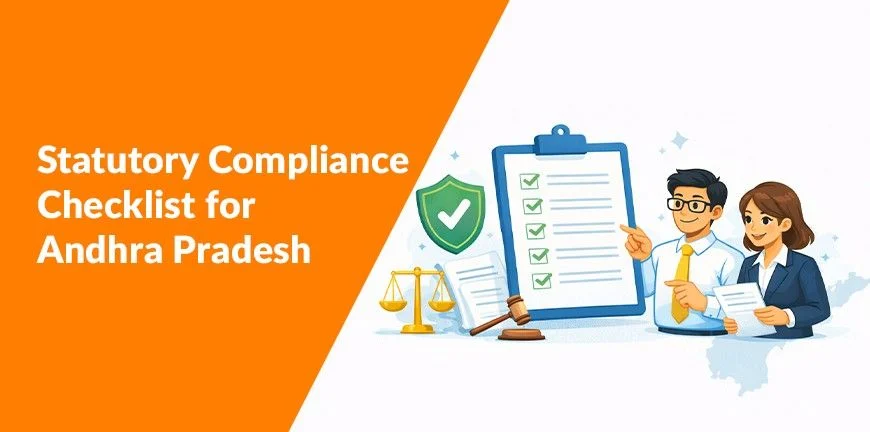
Statutory Compliance Checklist for Andhra Pradesh
18/02/2026
Is your business fully compliant with UP Laws?
As Uttar Pradesh is a big state, businesses might face regular & unique challenges in achieving 100% statutory compliance, especially when operating in multiple jurisdictions. Also, the government agencies in UP are very strict & don’t hesitate to impose hefty fines and invoke cancellation of Consent to Operate (CTO), or factory shutdown notices.
The best way to achieve desirable outcomes with reduced expenses is to deploy a robust statutory compliance checklist for Uttar Pradesh and compelling internal teams to follow the guidelines mentioned in it without any compromise. So, what must be included in the statutory checklist for employers in UP for achieving that can guarantee 100% compliance throughout the year? Let’s decipher and get the right answers through this detailed discussion.
What Is Statutory Compliance in Uttar Pradesh?
As of February 2026, active registered companies in UP have reached a whopping 1.98 lakh, representing a 27% growth over the last 5 years. This means attaining high ratings on statutory compliance becomes paramount for companies to stand out & improve their brand value.
Statutory compliance in Uttar Pradesh refers to a legal state where companies operating within the jurisdiction of the state (single/multiple locations) must sync their processes, procedures, & policies within the legal framework approved by the state & central government, leaving no wiggle room for mishaps or malpractices.
Example: In September 2025, Triveni Engineering & Industries, Muzaffarnagar, UP, faced strict action from the NGT & UPPCB. The allegations include illegal effluent discharge, data tampering, & failure to maintain mandatory ETP records. As a punishment, the company was slapped with a fine of Rs. 18 crores (2% of its annual turnover) & issued a 15-day improvement notice, risking cancellation of its Consent to Operate (CTO) in Uttar Pradesh.
Statutory Compliance Checklist for Employers in Uttar Pradesh
Here is a detailed statutory Compliance Checklist for Uttar Pradesh:
1. Shops & Establishment Registration
Companies must make sure they register their business under the Uttar Pradesh S& E (Shops & Commercial Establishments) Act. Also, the companies must inculcate the practice of displaying the registration certificate prominently at the business premises.
Note: A valid S&E registration is now a mandatory “pre-qualification” filter on the UP Tenders portal. Over 12,000 bids were disqualified in the last year due to expired or mismatched S&E data.
2. Factory License & Renewals
As per the UP labour law compliance checklist, companies must obtain & periodically renew factory license approvals. This process helps in maintaining compliance with prescribed safety standards & operational requirements.
Note: Through the Nivesh Mitra portal, the average processing time for a new Factory License has now been optimized to 15–30 days, provided all “Stability Certificates” are in order. Additionally, if a factory renewal application is flagged for errors & not rectified within 30 days, the system now triggers an automatic rejection response via SMS/Email, which can lead to a “Deemed Closure” of the site.
3. EPF & ESI Registration
Companies running businesses and establishments in Uttar Pradesh must register eligible employees under EPF & ESI, deposit contributions on time, & file monthly and annual statutory returns accurately.
| Contribution Type | Rate (% of Wages/Basic + DA) | Notes |
| EPF – Employee Contribution | 12% | Deducted from the employee’s basic salary + DA. |
| EPF – Employer Contribution (Total) | 12% | Split into EPS (8.33%) and EPF (3.67%). |
| EPF – Employer Admin Charges | 0.50% | The employer also pays admin charges on PF wages. |
| EPF – EDLI Charge (Employer) | 0.50% | Employer contributes to Deposit-Linked Insurance. |
| ESI – Employee Contribution | 0.75% | Applicable if gross wages ≤ Rs. 21,000/month. |
| ESI – Employer Contribution | 3.25% | Contributed on the same wage base. |
4. Maintenance of Statutory Registers
As a critical step of the statutory compliance checklist for Uttar Pradesh, employers must maintain updated attendance, wage, overtime, leave, bonus, & inspection registers in prescribed formats for labour department verification.
Before 2025, UP employers maintained up to 78 statutory registers. By 2026, consolidated rules reduced paperwork by 94%, requiring only 5–8 core digital labour registers.
5. Minimum Wages & Payroll Compliance
The employers in UP must ensure employees are paid at least the state-notified minimum wages, with proper payslips, wage records, & bank transfer documentation.
Current Minimum Wage Rates Applicable in Uttar Pradesh
| Skill Category | Basic (Rs/month) | VDA (Rs/month) | Total (Rs/month) | Total (Rs/day) |
| Unskilled | 5,750 | 5,271 | 11,021 | 423.88 |
| Semi-skilled | 6,325 | 5,798 | 12,123 | 466.26 |
| Skilled | 7,085 | 6,495 | 13,580 | 522.30 |
6. Contract Labour Compliance
The employers managing business in UP must obtain contractor licenses wherever applicable. Additionally, they must ensure principal employer registrations, wage compliance, & statutory benefit adherence for contract workers.
As of 2026, a contractor can obtain a single Pan-India license for 5 years. However, the principal employer in UP must still ensure the contractor is specifically mapped to their site on the Shram Suvidha or Nivesh Mitra portals.
7. Fire Safety NOC
The employers in UP must secure Fire Department NOC, install approved firefighting equipment, & conduct periodic fire safety audits & drills.
Under the UP-Fire Service Act, authorities can now seal a premises within 24 hours if “imminent danger” (like blocked emergency exits or dry fire hydrants) is detected. Penalties for operating without a valid Fire NOC or with non-functional equipment now range from Rs. 25,000 to Rs. 5,00,000, depending on the building’s hazard category.
8. Pollution Control Consent
Employers in UP must obtain Consent to Establish (CTE) & Consent to Operate (CTO) from the Pollution Control Board, & it is non-negotiable. This ensures ESG (environmental) compliance standards are met with flying colours.
In January 2026, the Commission for Air Quality Management ordered the shutdown of 16 industrial units on immediate notice in the NCR region (including UP). The main reason for closures was operating without a valid CTE/CTO or using unapproved fuels.
9. Timely Filing of Returns & Renewals
The businesses in Uttar Pradesh must track all statutory filing deadlines, renewal dates, & compliance updates. This element of the compliance audit checklist for Uttar Pradesh negates penalties, notices, or suspension of business operations.
UP’s industrial policies (like the Bio-Energy Policy 2022) tie subsidies to the level of compliance. A single late statutory filing can result in the permanent forfeiture of state capital interest subsidies or electricity duty exemptions.
What Are the 5 Benefits of Using a Statutory Compliance Checklist in Uttar Pradesh?
Here are the 5 top benefits of leveraging a Statutory Compliance Checklist for Uttar Pradesh for running end-to-end business operations:
1. Brings Down Legal & Financial Risk
A well-churned-out statutory compliance checklist for Uttar Pradesh employers acts as a tracking device to check the health of mandatory registrations, renewals, and filings. This minimizes the probability of penalties, prosecution risks, & costly disruptions from non-compliance with UP regulations.
2. Ensures Renewals & Filings are Remitted On Time
As multiple licenses like Shops Act, Factory License, & Fire NOC necessitate renewal every once in a while, a statutory checklist for employers in UP will come in handy and help in preventing missed deadlines and last-minute compliance chaos.
3. Brings Audit Readiness into Play
Strict deployment of the compliance audit checklist in Uttar Pradesh for maintaining statutory registers, inspection records, & approvals brings audit readiness into play. Such measures can help companies tackle surprise government inspections & audits with utmost ease.
4. Takes Operational Stability to a Higher Level
Monitoring operations and tasks through a solid statutory compliance checklist in Uttar Pradesh brings down the likelihood of license suspension, shutdown notices, or cancellation of Consent to Operate, the enemies that can decelerate business growth.
5. Employer Brand & Credibility Gets Supercharged
Demonstrating process alignment with the aid of the UP-labour law compliance checklist builds trust with investors, clients, and employees. Additionally, the branding and credibility get enhanced, leading to increased chances of getting government projects and funding for business expansion.
What are the 5 Major Statutory Compliance Challenges in Uttar Pradesh?
Here are 5 key statutory compliance challenges faced by businesses operating in UP regions:
1. Local Amendments & Notifications on the Rise
UP government agencies stay put and issue circulars and procedural updates on a regular basis. This is especially more in the case of labour and industrial laws, making it difficult for businesses to stay continuously updated & aligned.
In 2025 alone, the UP-Labour Department & related industrial bodies ran 350+ circulars, advisories, & notifications, averaging nearly one update every calendar day.
2. Multi-Department Approvals are a Big Headache
Companies operating in UP typically require approvals from multiple authorities as a prerequisite to run business. The approving agencies include the Labour Department, Pollution Control Board, Fire Department, Development Authorities, & Municipal Corporations. This triggers overlapping inspections & compliance complexity.
Nivesh Mitra now integrates over 32 Central & 32 State departments, offering access to more than 7,435 state approvals. However, even with this model, businesses in UP still face challenges in getting multiple department approvals due to a lack of information & communication between different government agencies.
3. Strict Pollution & Industrial Monitoring
Industrial clusters like Noida, Ghaziabad, Kanpur, & Muzaffarnagar face stringent monitoring by UPPCB, including digital effluent tracking & surprise inspections, making it a herculean task for businesses when it comes to securing NOCs.
As of February 2026, the OCEMS Cell has recommended notices in 530 cases across the NCR for data supply failures.
4. Complex Land & Building Clearances
Under the orders of development authorities like NOIDA, YEIDA, & UPSIDA, businesses in UP must comply with zoning laws, building approvals, & land-use norms that vary by industrial region. This creates headaches for companies to standardise their approval processes.
NOIDA and Greater Noida often have higher FAR allowances than YEIDA, necessitating companies to redesign blueprints when moving between regions.
5. Stakes Become High Due to Penalties & License Suspension Risks
Recent enforcement trends in UP show companies experiencing revenue-linked fines, environmental compensation, & risk of cancellation of Consent to Operate (CTO). These profit-eating penalties increase financial and operational exposure.
| Industry Scale | Typical Non-Compliance | Penalty Range (2025-26 Trend) |
| Large Industrial | Violation of EC conditions | Rs. 1 Crore – Rs.10 Crore+ (Often 1-2% of Project Cost) |
| Medium Scale | Improper ETP/STP operation | Rs. 25 Lakh – Rs. 1 Crore |
| Small/Micro | Late CTO renewal | 100% of the standard fee as a late penalty |
What are the 5 Best Practices to Ensure 100% Statutory Compliance in Uttar Pradesh?
Here are 5 best practices that will come in handy for employers in their quest for achieving 100% statutory compliance in Uttar Pradesh:
1. Device a Centralized Compliance Calendar
Run statutory compliance checklist for Uttar Pradesh to keep tabs on registrations, renewals, returns, & inspection schedules w.r.t to labour, fire, pollution, & industrial laws. These meticulous arrangements act as reminders in preventing penalties & missed deadlines.
2. Perform Audits Every Quarter
Companies must run a detailed compliance audit checklist in Uttar Pradesh every quarter and review statutory registers, licenses, ETP logs, payroll records, & safety documentation. This helps companies identify gaps before they get picked by state authorities, which can result in serious escalations.
3. Run Statutory Registers & Documentation Digitally
Companies running businesses within UP state jurisdiction must ensure approvals, challans, returns, & inspection reports are backed up digitally to facilitate easy retrieval during surprise audits and departmental verifications.
4. Strike a Partnership with Local Compliance Experts
Strike a long-term partnership with consultants like Alp Consulting who are familiar with Uttar Pradesh-specific laws, industrial authorities, & enforcement practices. This arrangement helps companies operating in UP navigate procedural complexities with much more ease.
5. HR & Operations Teams
Employers in Uttar Pradesh must regularly train internal departments about state amendments, labour code changes, & ESG (Environmental, Social, and Governance) obligations. Additionally, the learnings acquired from regular training must be adopted in day-to-day operations to achieve all-around compliance.
How Alp Consulting Helps Businesses Manage Statutory Compliance in Uttar Pradesh?
Alp Consulting Ltd, a grandmaster in compliance management with 30 years of expertise serving over 400 reputed clients across the globe, supports businesses in Uttar Pradesh with A-Z statutory compliance handling across labour, payroll, industrial, & regulatory frameworks.
From S&E registrations & factory compliance to EPF, ESI, & contractor licensing, Alp ensures timely filings & audit readiness. Our seasoned compliance team monitors state amendments like a hawk, maintains statutory registers, & coordinates with local authorities relentlessly to bring down penalty risks like never before. With a structured statutory compliance checklist for Uttar Pradesh & proactive reporting, Alp Consulting Ltd helps companies operate confidently & uninterrupted across the state.
Key Takeaways
- Uttar Pradesh businesses are facing strict enforcement, heavy penalties, & CTO cancellation risks for non-compliance.
- A structured statutory compliance checklist for Uttar Pradesh reduces risks, ensures renewals, & strengthens audit readiness.
- Multi-department approvals & frequent state notifications increase compliance complexity across UP industrial regions.
- Digital registers & quarterly audits significantly improve operational stability and regulatory preparedness.
- Partnering with experienced compliance experts like Alp Consulting Ltd ensures timely filings and uninterrupted business operations statewide.
FAQS
1. What is statutory compliance in Uttar Pradesh?
Statutory compliance in Uttar Pradesh refers to a mandatory process of adhering to state and central labour, environmental, tax, & industrial regulations applicable to businesses.
2. Which labour laws apply to employers in Uttar Pradesh?
Employers in Uttar Pradesh must follow the Shops Act, Factories Rules, Industrial Disputes Act, EPF, ESI, Minimum Wages, Contract Labour, & other applicable regulations.
3. What registers and records must be maintained for compliance audits in Uttar Pradesh?
Employers must maintain wage registers, attendance records, leave registers, bonus records, ETP logs, inspection books, & statutory returns for the smooth execution of the compliance audit checklist in Uttar Pradesh.
4. How often do statutory compliance rules change in Uttar Pradesh?
Compliance rules change frequently via state notifications, wage revisions, labour code updates, & departmental circulars issued periodically.
5. How can businesses ensure 100% statutory compliance in Uttar Pradesh?
Businesses in UP can ensure statutory compliance via audits, digital tracking, expert consultation, timely filings, employee training, & structured compliance calendars.
6. Is Professional Tax payment applicable in Uttar Pradesh?
No, Professional Tax is currently not levied in Uttar Pradesh, so employers are not required to deduct or deposit it.
Contact Us For Business Enquiry

Hariharan Iyer
Hariharan Iyer is the Vice President – Operations at ALP Consulting, bringing over 40+ years of experience in HR outsourcing and labour law compliance. He leads end-to-end HRO operations, ensuring process efficiency, statutory compliance, and seamless service delivery for clients across industries. With a strong background in labour law governance and workforce management, Hariharan plays a key role in driving operational excellence and compliance-led HR solutions at ALP Consulting.