Is Payroll a Part of HR or Accounting?
24/02/2026
What Is HR Technology? Guide, Benefits, Types and Trends
24/02/2026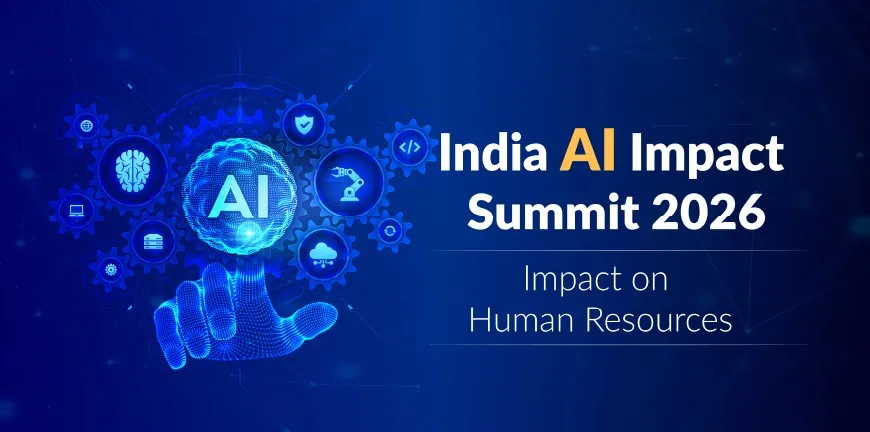
Shri Narendra Modi, Hon’ble Prime Minister of India- “India looks forward to welcoming the world to the AI Impact Summit in February 2026. We have picked the theme of Sarvajana Hitaya, Sarvajana Sukhaya or welfare for all, happiness for all.”
AI is a transformative agent that has evolved from mere experimentation to fuel innovation to a completely new strategy that is taking enterprises to new heights. The Government of India has identified the significance and the far-reaching potential of AI, resulting in the India AI Impact Summit 2026.
The global summit held in New Delhi was more than a tech hub or conference. It was designed to create a smart platform to foster Artificial Intelligence in a way that is collaborative, inclusive and responsible in the future. The summit promoted a people-first, “AI for All” agenda and produced the New Delhi Declaration on responsible, inclusive AI.
Are you wondering what it means for Human Resources? If you are an HR leader, it will matter to you, as the commitment made at the summit focuses on skilling, easy access to data, and ethical governance, which will enhance how recruitment & staffing service companies and organisations recruit, train, govern, and design work systems and structures.
What are the Objectives of the India AI Impact Summit 2026
As AI is incorporated into the very core of society, its transformative abilities are revolutionising systems and structures. India, one of the top AI players in the world, took charge and crafted a path to utilise the power of AI to help humanity with people-focused innovations, inclusive development, and many more. Let us look at some of the objectives:
1. AI for All
The focus is on promoting the thought process of making AI accessible to everyone, and not just large-scale enterprises, and the technology must be beneficial to small and medium businesses and every stratum of society.
2. Accelerate Global Collaboration
The summit emphasised nurturing international partnerships and making collaborations count by sharing insights and data on AI governance, benchmarks, research, etc., establishing India as a responsible leader globally.
3. Nurture Talent & Foster Manpower Reskilling
Preparing the labour force of India to gear up for AI transformation is an important step that HR firms and organisations must adopt. The initiatives involve developing talent through comprehensive upskilling and reskilling programs, courses on AI literacy, industry and academia partnerships, etc.
4. Focus on Robust AI Surveillance
The focus must be on creating frameworks and structures that are transparent, ethical and facilitate the mitigation of any kind of unfair policies, data safeguard and involvement of humans in overseeing AI systems and software.
5. Promote AI adoption Across Industries.
AI must be integrated across systems and sectors in India, and AI-powered innovation must influence every aspect of various industries to shape policies, framework and operations smartly and effectively.
How is AI Transforming HR?
The concept of AI integration in HR is no longer a future deal. It is happening now and is very rapidly re-generating how companies are acquiring talent in terms of drawing, handling and developing talent. HR leaders and businesses must know how AI is impacting human resources. Let us find out how:
1. Smart Recruitment & Screening
AI tools and software today are metamorphosing the process of hiring skilled talent, and volumes of CVs and candidate profiles can be scanned and shortlisted by these tools, catering to the required job suitability. They can also evaluate soft skills through smart analytics processes, expediting recruitment life cycles.
2. Data- Led Workforce Planning
AI utilises employee data to analyse and predict the current and future workforce needs and trends by identifying employees who are planning to quit. AI anticipates workforce requirements aligning with business growth. The data-driven methods help in designing effective plans to retain individuals.
3. Tailored Talent Development
Platforms enabled by AI assess employee performance, skill quality, aspiration levels, etc, to identify the career development programs suitable for them. The platforms recommend methods that are adaptive for employees, certification programs, etc. AI software also helps in tracking how employees are performing in real time.
4. Elevated Employee Engagement
The work of HR teams and managers becomes easier as AI tools and software analyse and review the sentiments of employees along with assessment of their behavioural patterns, communication style, etc., making HR managers and organisations understand the company morale, and they can accordingly make strategies to enhance employee engagement.
5. Unbiased Decision Making
AI can help eliminate or diminish unfair practices and bias in HR processes and deliver robust and accurate recruitment services. The skill evaluations are systematised by AI along with standardised performance assessments, making it easy for recruiters and businesses to decide smartly.
Key Implications for HR
| Area | Focus | Key Actions | Strategic Outcome |
| A. Talent Strategy & Workforce Planning | Skill Mapping & Role Redesign | Map new AI-driven skill demand vs existing workforce capabilities. Identify automation-prone roles and AI-augmented roles. Create new role families (e.g., AI-augmented analysts, human-centric designers, AI governance leads). | Future-ready workforce aligned with AI transformation. |
| Adjacent Upskilling Pathways | Develop lateral career transitions (e.g., Customer Support → AI-Assisted Support Specialist). Focus on skill adjacency instead of complete retraining. | Reduced displacement risk & higher internal mobility | |
| Public–Private Skilling Partnerships | Collaborate with government bodies, industry associations, and summit-led initiatives to build apprenticeships and micro-credentials. | Expanded talent pipeline & shared skilling ecosystem | |
| B. Learning & Development | Micro-Credential Stacks | Implement bite-sized, applied learning modules tied to real projects. Emphasise outcome-based certifications over attendance-based completion. | Continuous skill evolution & measurable ROI on learning |
| AI-Enabled Hybrid Learning | Pilot AI tutors, adaptive learning platforms, and virtual coaching tools. Monitor for bias, fairness, and accuracy. | Personalised learning at scale | |
| C. Recruitment & Assessment | Responsible AI in Hiring | Ensure AI tools used in screening/ranking are explainable. Maintain human oversight and conduct regular bias audits. Update job descriptions to reflect AI collaboration. | Fair, transparent, and compliant hiring processes |
| Human-Centric Skill Evaluation | Redesign hiring rubrics to emphasise judgment, ethical reasoning, creativity, emotional intelligence, and stakeholder management. | Stronger human-AI collaboration capability | |
| D. People Data, Privacy & Governance | HR AI Governance Playbooks | Document every AI system used in HR. Define data lineage, validation metrics (fairness, calibration), and escalation protocols. Maintain human review gates. | Regulatory readiness & ethical AI deployment |
| E. Organisation Design & Leadership | Hybrid Role Structures | Redesign organisation charts to integrate AI-enabled roles. Measure AI-human productivity rather than just headcount. | Agile and innovation-driven organisation |
| Leadership Metrics & Culture | Dev |
Contact Us For Business Enquiry

Amit Saproo
Amit Saproo is the Head of Operations at ALP Consulting with nearly 17 years of experience in Executive Search, RPO, Leadership, and IT & Engineering recruitment. He leads nationwide recruitment programs across Technology, BFSI, and R&D domains, driving strategic hiring solutions for diverse client needs. Amit excels in building and managing high-performance teams that deliver scalable, end-to-end recruitment and consulting services.