

What is Retained Search Recruitment?
26/02/2026
Employee Recognition Ideas: The Ultimate Guide
26/02/2026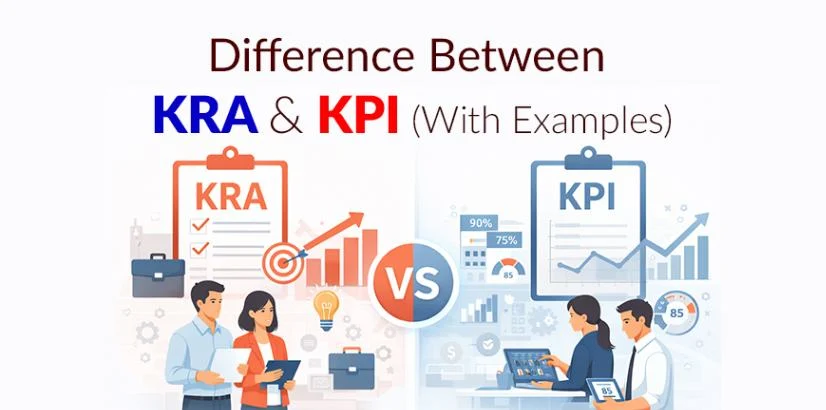
Introduction
Performance management is a continuous & strategic communication process between managers and employees to review responsibilities, goals, business objectives, & improve strategies. The two key parameters business managers use to measure growth, performance, & success are KRAs and KPIs. While both parameters aim at boosting business growth & success, it is useful to understand the difference between KRAs and KPIs in HR management. Best recruitment agencies build strong KRAs and KPIs to help companies make informed career decisions, & efficiently manage appraisals, retention, & dismissals.
Differences between KRAs and KPIs in HR: Why it matters?
Defining KRAs and KPIs in HR is essential before, before we explore the differences between KRAs and KPIs.
KRAs
Key Result Areas are qualitative performance indicators that help employees understand key roles & responsibilities and achieve them within a set time frame. KRAs are based on business goals, time zone, job profile, & location of the employee.
KPIs
Key Performance Indicators or KPIs are quantitative indicators that help executives measure the progress of employees in achieving targeted goals. Executives use currencies, indices, numbers, & values to measure the performance. Understanding the difference between KRAs and KPIs would give a clear understanding of their purpose and functions.
| Point of Difference | KRAs | KPIs |
| Goal | The metric defines the core responsibilities of a role and expects consistent results from the role. They usually cascade from the organisation to the departments. | The metric is used to measure how the goals are achieved in that defined responsibility & role. |
| Nature | The metrics are more qualitative & descriptive as they focus more on goals or outcomes in the defined job area. | This metric is more quantitative & measures progress at every stage, financially or non-financially. |
| Scope | KRA demands intense effort and accountability. | KPIs indicate the performance level achieved in that area. |
| Usability | KRAs are usually referenced regularly for strategic planning | KPIs are conducted regularly to spot new trends |
| Reliability | KRAs do not change unless there is a change in role and responsibilities. | KPIs change often in tandem with the projects, roles, or business cycles. |
How do KRAs and KPIs in HR help Performance Management?
The key responsibility of a recruitment team is to set a strategic direction and scale performance. Smart HR teams achieve this goal integrate KRAs and KPIs to scale business success. Let’s understand where these two indicators work.
1. Customer Success
Customers are key to business success in any organisation. Boosting customer experience & driving sales requires strategic KRAs. On the other hand, to achieve 80% customer satisfaction, reduce sales complaints by 50%, & improve sales by 100%, you need quantitative metrics, which is possible through KPIs.
2. Increases Business Goal Tangibility
Clearly defined KPI metrics like monthly revenue growth, new customer acquisition rate, new project deals, & lead conversions make KRAs more outcome-focused. This also helps managers to build flexible roles like marketing, external partnerships, & sales to achieve strategic objectives.
3. Business Success Needs KRA-KPI Collaboration
KRAs and KPIs in HR demand a collaborative effort. While executives define their KRAs and managers engage in building the KPIs, every employee will understand the effort and outcome that he/she needs to achieve that KRA. By collaborating KRA with KPI metrics, organisations can ensure that both the manager and the employee are working toward the same goal.
How do KRAs and KPIs in HR drive Employee Performance?
In most cases, companies struggle to match employee performance with organisational goals. Particularly during the appraisal season, HR teams come under pressure. But organisations that use defined KRAs and KPIs in HR system process appraisals more efficiently.
Three Reasons how KRAs make an impact on Employee Performance
- They reduce confusion and misalignment by giving employees clarity in their roles & responsibilities.
- They ensure employees work toward focused & measurable outcomes.
- They bring strategic alignment by connecting everyday activities with broad organisational goals.
Three Reasons How KPIs are impacting Employee Performance
- Ensures quantitative data to support appraisal processes by removing any bias.
- Since it is data-driven, it allows employers and employees to track goals & focus on outcomes.
- Clearly defined KPIs boost accountability & performance improvement among employees.
What Are the Key Benefits of Using KRAs and KPIs in HR?
Business success depends on two engines: ROI & employee performance. Integrating KRAs and KPIs in HR can help both management and employees achieve strategic objectives. Let’s find out how it works.
1. KRAs & KPIs in HR foster Goal Alignment
The advantage of integrating KPIs and KRAs is that they foster strategic alignment. When the C-suite designs and communicates KRAs, they cascade down to the departments. Managers and executives build KPIs that meet these strategic goals. Aligning organisational goals with individual priorities drives business success.
2. Key Result Areas boost Direction
When KRAs and KPIs are defined clearly, they enable employees to stay focused on their goals. This reduces overheads, administrative costs, & provide a clear mission to the employees. When KPIs are measured, it does not consider descriptive explanations, except for quantifiable results. So, KRAs and KPIs are two engines that drive performance & set a clear direction.
3. Employee Engagement is key to KRA & KPI
Tracking the progress of employees in real time and providing active feedback and improvement strategies using various KRA and KPI metrics boosts their engagement and learning. The key metrics allow employees to take pride in their work and work competitively towards the target.
4. KPIs and KRAs support Business Evolution
Businesses are not static, but dynamic. Continuous tracking helps the HR teams to identify the KRA and KPI gaps and revise metrics to the changing business conditions. For instance, if customer experience is high but sales remain stagnant, this calls for a change in the KRA. So diligent KRA and KPI tracking brings in alignment, motivation, & continuous improvement to support business evolution.
What Are the Common Challenges When Defining KRAs and KPIs?
Building KRAs and KPIs that lack clarity, accountability, & flexibility can dilute your organisational performance. Some of the common challenges HR teams face while defining KRAs and KPIs are:
1. KRAs & KPIs turning into Fear-based Score Card
Employees know their performance directly impacts appraisals, hence framing KRAs and KPIs as a stretching target rather than learning innovation has become a huge challenge.
2. Predefined Metrics
Encouraging employees to follow predetermined metrics may hinder growth and innovation. Business success does not solely depend on metrics but experimentation, risk-taking, & innovation.
3. Excessive KRAs & KPIs lead to information Overload
Excessive metrics might create information overload. This will divide the focus among employees, remove strategic foresight, & poor reporting.
4. Misalignment due to Poor Communication
Poorly defined KRAs & KPIs can result in poor workflow, communication gaps, & strategic misalignment. This can also lead teams to duplicate efforts and waste energy on low-impact tasks.
What Are the Best Practices for Setting Effective KRAs and KPIs?
KRAs & KPIs are a strategic asset to business leaders. To make these indicators deliver better results, we bring you some best practices for 2026.
1. Upgrade Your Technology Use
Use performance management systems to track key results on a single dashboard.
2. Project Management Tool
Optimize the power of project management tools to build alignment between team efforts and results.
3. Consistent Reviews
Conduct continuous reviews of the KRAs and KPIs to identify key result areas
4. Encourage Employee Feedback
Conduct employee surveys to assess the sentiment of employees on the relevance of the KRAs and KPIs.
5. Perform Market Analysis
Competitor analysis is a powerful tool for you to stay aligned with the industry benchmarks. Designing your KRAs & KPIs on those standards can help your business stay resilient & competitive.
What Are the Common Mistakes to Avoid While Defining KRAs and KPIs?
Every C-level manager or employee knows how it feels to be buried under loads of metrics and data. We tend to establish KRAs and KPIs for different projects, but ensure they are tested to drive better decisions. Some of the common mistakes organisations encounter while designing KPIs and KRAs are:
1. Setting too many KRAs and KPIs
Setting too many metrics can often lead to information overload & focus distractions. Focusing on key metrics can help you achieve high business success.
2. Irrelevant Metrics
Follow the SMART criteria while building KRAs and KPIs. They help you stay specific, measurable, achievable, relevant, & time bound.
3. Avoiding Holistic Indicators
Solely focusing on financial metrics would not support organisational performance. Teams, while designing KRAs and KPIs, should include employees and processes in the picture.
4. Neglecting Metric Reviews
Teams neglecting the outdated metrics may not support business processes efficiently. Timely improvement and review of legacy metrics can help you meet the evolving business goals.
5. Avoiding Industry Benchmarks
If you are not setting industry benchmarks, you will get the wrong performance insight. Conducting competitor research can help you establish strong KRAs and KPIs to gain an industry edge.
What Are the Future Trends in KRAs and KPIs for Performance Management?
As a futuristic HR leader, we bring you 5 future trends that will reshape performance management across industries.
- Focus on Continuous Performance Models that help real-time goal alignment.
- Use Predictive Analytics & AI to power performance management that provides real-time progress, identifies risks, & conducts bias-free evaluation.
- Integrate outcome-led KRA/KPI metrics that focus on revenue, customer experience, & strategic outcomes.
- Make KRAs & KPIs more skill-centric to transform your employees into a future-ready workforce.
- Integrating ESG into KRA/KPI metrics will ensure diversity & inclusion goals are achieved.
What Are Real-World Examples of KRAs and KPIs Across Job Roles?
Clarity is the driver behind most successful organisations. When roles lack clarity, the workflow loses impact. To transform this performance gap, KRAs and KPIs become a differentiator. Some of the key roles where KRAs and KPIs are making a difference are:
| Role | KRAs | KPIs |
| Sales Manager | Revenue growth, Business Acquisition, Learning & Development | Achieve 15% YoY sales, Tap 10 new clients with a value of $2 M each, & reduce client complaints by 20%. |
| Human Resource | Employee Experience & retention. | Increase resource satisfaction by 85% and reduce turnover by 50%. |
| Finance Manager | Strengthen financial health & compliance | Maintain EBITDA above 40% and zero-error financial closing in 3 days. |
| Marketing Manager | Boost brand presence & lead generation | Increase brand recall by 20% & client acquisition cost by 30%. |
Frequently Asked Questions
1. What is the main difference between KRAs and KPIs?
KRAs are performance indicators that define the job & responsibilities of an employee that are aligned with the organisational goals, whereas KPIs are quantifiable metrics that measure the performance in those areas.
2. Are KRAs and KPIs the same thing?
KRAs are not the same as KPIs. KRAs are performance indicators that focus on roles & responsibilities, and KPIs focus on how departmental goals are achieved through tangible metrics.
3. Can KPIs exist without KRAs?
KRAs cannot exist without KPIs, as KPIs provide measurable indicators against those key defined roles and responsibilities. Without quantitative metrics, KRAs alone might dilute performance and poor accountability in achieving business goals.
4. Who defines KRAs and KPIs in an organisation?
KRAs are usually defined by the C-suite or Executive Managers & they cascade down to the lower managers and employees. On the other hand, KPIs are key targets set by executive managers in consultation with the teams to ensure that operations meet outcomes.
5. How often should KRAs and KPIs be reviewed or updated?
On average, the KRAs and KPIs should be reviewed quarterly or annual basis. This review helps to modify outdated strategies to meet new business goals.
Contact Us For Business Enquiry

Hariharan Iyer
Hariharan Iyer is the Vice President – Operations at ALP Consulting, bringing over 40+ years of experience in HR outsourcing and labour law compliance. He leads end-to-end HRO operations, ensuring process efficiency, statutory compliance, and seamless service delivery for clients across industries. With a strong background in labour law governance and workforce management, Hariharan plays a key role in driving operational excellence and compliance-led HR solutions at ALP Consulting.