
What is an Administrative Services Organization (ASO)? Definition, Pros & Cons
28/01/2026
Withholding Tax: What It Is, Types, and How It’s Calculated
02/02/2026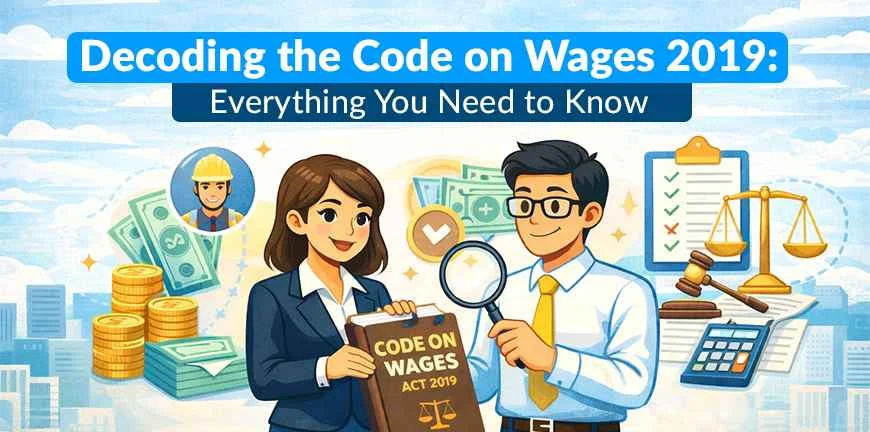
Is your payroll structure aligned with the 50% wage rule under the Code on Wages 2019?
The payroll management game has completely changed with the introduction of Code on Wages 2019. Businesses that gain complete acumen of this code can stay ahead of the competition, make their payroll process more efficient, and be compliant with the latest regulations simultaneously.
Additionally, employees must also be aware of the changes made to their existing salary structure and statutory benefits so that they can make necessary adjustments to ensure their financial well-being. Let’s decipher Code on Wages 2019 and help businesses and employees be mentally ready to accept the amendments and adjust their payroll management strategies accordingly.
Why the Code on Wages 2019 Was Introduced?
Before diving into the nitty-gritty of Code on Wages 2019, let’s get the impact of this code through a small hypothetical story:
Ravi, a payroll manager at a manufacturing firm in Pune, struggled with inconsistent wage definitions, causing audit issues and payroll errors. After the deployment of Code on Wages, 2019, wage calculations were standardised, compliance became simpler, faster, & more accurate.
Inference: Code on Wages 2019 makes payroll management much more streamlined.
The Code on Wages 2019 was launched publicly in the Lok Sabha by Mr Santosh Gangwar, Minister of Labour, on July 23, 2019. It modernises India’s wage laws, ensuring uniform definitions, fair pay standards, simplified compliance, & stronger workforce protection nationwide. The Code on Wages 2019 will seemingly replace the 4 laws, including:
- Payment of Wages Act, 1936
- Minimum Wages Act, 1948
- Payment of Bonus Act, 1965
- Equal Remuneration Act, 1976
Here are 5 reasons that highlight the importance of introducing the Code on Wages 2019:
1. Unified Labour Law Framework
The Wage Code 2019 uncomplicates fragmented labour laws by clubbing multiple wage laws into one unified framework. This brings down compliance complexity, legal ambiguity, & administrative burden for businesses nationwide.
2. Standardised Wage Definition
The Code firmly establishes a uniform definition of wages across industries. It eliminates interpretation disputes, improves payroll transparency, ensures consistent statutory calculations, & creates a level playing field by strengthening regulatory clarity for employers & employees alike.
3. Universal Minimum Wage Coverage
The Code on Wages 2019 ensures universal minimum wage coverage for organized & unorganized sectors. It protects worker income security, narrows down wage inequality, & promotes inclusive economic growth across all employment categories.
4. Stronger Compliance Enforcement
The Code enhances enforcement efficiency through digital records, inspector-cum-facilitator mechanisms, faster dispute resolution, & stronger penalty structures. These additions improve overall compliance culture & governance standards across businesses.
5. Ease of Doing Business
The Wage Code acts as an anchor in aligning India’s labour ecosystem with modern workforce realities. It supports formalisation, brings ease of doing business to the forefront, encourages investment confidence, & enables sustainable workforce scalability for enterprises.
What are the Objectives of the Code on Wages, 2019?
Here are 5 key objectives of implementing the Code on Wages Act as per the latest amendments launched in November 2025:
1. National Wage Consistency Across States
To create consistent wage governance across states by harmonizing central and state wage standards, minimizing regional disparities, & improving predictability for multi-location employers operating nationwide.
Example: Multi-state employers spend an average of 67% more on payroll administration due to the need for localized legal tracking and manual adjustments. With a consistent wage structure across all states, these complexities can be reduced drastically.
2. Transparent Salary Structuring and Compliance Accuracy
To bring greater transparency in salary breakups, limit excessive allowance manipulation, strengthen statutory contribution accuracy, & ensure payroll structures remain audit-ready under revised wage calculation norms.
Example: Organizations are now legally obligated to ensure that the “Basic Pay” component constitutes at least 50% of the total CTC.
3. Worker Financial Stability and Income Assurance
To safeguard employee earnings via predictable minimum wages, timely disbursements, regulated deductions, & strengthened protections supporting financial security, livelihood continuity, and workforce confidence.
Example: A mindboggling 78% of workers would experience significant financial difficulty if their paycheck were delayed by just one week. Hence Wages Code 2019 helps in ensuring employees are paid on time with no delays whatsoever.
4. Digitized Monitoring and Faster Regulatory Oversight
To leverage technology-enabled inspections, centralized reporting, & electronic registers. This enables faster compliance monitoring, improved regulatory responsiveness, & reduced manual intervention under amended enforcement frameworks.
Example: Authorities are now leveraging data analytics to identify non-compliance patterns before they even visit a site, making inspections 4x more likely to pinpoint a legitimate violation than random physical visits.
5. Long-Term Workforce Formalization and Policy Modernization
To accelerate workforce formalization, modernize employment governance, integrate emerging workforce models, & build scalable labour compliance ecosystems that align with amendment on code of wages. These support economic expansion & organized employment growth.
Example: Roughly 61% of new formal enrollees are below the age of 29, indicating that Gen Z is entering the workforce with a high expectation for formal benefits & legal protections.
What are the Key Acts Consolidated Under the Code on Wages 2019?
Here are the 4 acts consolidated under the Code of Wages 2019:
1. The Payment of Wages Act, 1936
This Act regulated how salaries must be credited to employees & set strict guidelines on timely disbursement & authorised deductions from wages. However, it has now been repealed, & its provisions merged into the Code on Wages 2019.
Previously, the Payment of Wages Act, 1936, only offered protection for employees earning below a certain threshold (most recently, Rs. 24,000 per month).
2. The Minimum Wages Act, 1948
Previously, this act regulated fixed minimum wage rates for different categories of workers in scheduled employment. Under the Code on Wages 2019, minimum wage provisions apply universally across sectors & employee categories.
In yesteryears, only about 30% of the Indian workforce was covered by the Minimum Wages Act. Under the new labour code, coverage is universal, extending to all employees in both the organized & unorganized sectors.
3. The Payment of Bonus Act, 1965
This act governed eligibility & calculation of the statutory bonus for employees based on profits or productivity. Its framework is now part of the Code on Wages 2019.
The bonus provisions are now applicable to all establishments employing 20 or more workers on any day during the accounting year, regardless of the industry type.
4. The Equal Remuneration Act, 1976
It mandates equal pay for equal work & prohibits gender-based wage discrimination of any kind. Its key principles & provisions are now integrated into the Code on Wages 2019.
Unlike the 1976 Act, which gave emphasis on the “men & women” binary, the Code on Wages 2019 prohibits discrimination against all genders. This rule change explicitly brings transgender employees under the umbrella of equal pay protection.
What is the Applicability and Coverage of the Code on Wages 2019?
| Aspect | Coverage / Applicability |
| Who is covered? | Applies to all employees, regardless of sector or category (organized or unorganized). |
| Types of workers included | Covers permanent, temporary, casual, daily-wage, contractual, part-time, and other wage earners. |
| Employments included | Applies to all establishments and industries where any trade, business, industry, or manufacturing is carried out. |
| Scheduled employment concept | Eliminated under the Code, unlike earlier laws such as the Minimum Wages Act, which applied only to “scheduled employments.” |
| Minimum wages coverage | Statutory minimum wage protection for all employees across the organized and unorganized sectors. |
| Decision-making authority | For certain employments such as railways, mines, oil fields, etc., the Central Government decides wage matters; for others, State Governments decide within their jurisdictions. |
| Wages definition applicability | Applies to all components of wage, including salary, allowances, and other monetary benefits for employees, irrespective of level. |
What are the Components Included and Excluded from Wages Codes 2019?
Components Included in Wages Under Code on Wages, 2019
1. Basic Pay
It is the core salary paid for work performed, forming the bedrock for statutory wage calculations & compliance benefits.
2. Dearness Allowance (DA)
It is the cost-of-living allowance paid to offset inflation & maintain employees’ real purchasing power.
3. Retaining Allowance
It is the payment made to retain employees during off-season or periods of temporary inactivity, counted as wages.
4. Monetary Remuneration Under Employment Contract
All contractual cash payments directly linked to employment responsibilities are considered wages under the law.
5. Excess Allowances Under the 50% Rule
If exclusions exceed 50% percent of remuneration, the excess becomes part of statutory wages.
Components Excluded from Wages Under Code on Wages, 2019
1. House Rent Allowance (HRA)
Housing allowance is paid to employees as accommodation expenses, and it is excluded from wage calculations.
2. Conveyance and Travel Allowance
These are payments made for commuting or official travel expenses, which are excluded from the wage definition.
3. Bonus Payments
Performance or statutory bonus payments are excluded unless adjusted through the 50% percent rule.
4. Overtime Allowance
It is extra compensation for work beyond standard hours & does not form part of wages.
5. Commission and Incentive Payments
Variable earnings linked to sales or productivity are excluded from the statutory wage computation under the Code of Wages 2019.
6. Employer Provident Fund and Pension Contributions
It is employer contributions toward social security schemes are excluded from wage calculation.
7. Gratuity Payments
The terminal benefit paid upon retirement or service completion is excluded from the wage definition.
8. Retrenchment Compensation
Severance payments during workforce reduction are excluded from statutory wages.
9. Medical, Utility, and Special Allowances
These are allowances provided for convenience, welfare, or reimbursements and remain excluded from wages.
What is the Impact of Wage Definition on Payroll Structuring?
Here are 5 ways Code on Wages 2019 is impacting payroll structuring:
1. Restructuring Salary Components
The Wage Code 2019 mandates higher basic wages by limiting allowances, compelling organisations to redesign salary structures to comply with the 50% wage definition rule.
Example: Basic Pay + Dearness Allowance (DA) + Retaining Allowance must now be at least half of the total remuneration.
2. Increased Statutory Contributions
A broader wage definition elevates the base for PF, gratuity, & bonus calculations, raising employer statutory liabilities and payroll costs.
Example: Previously, employees needed 5 years of service to be eligible for gratuity. Now, Fixed-Term Employees are eligible for gratuity after just 1 year of service.
3. Reduced Flexibility in Allowance Design
Employers can no longer excessively split salaries into allowances, ensuring transparent, standardised, & regulation-aligned payroll structures.
Example: Under the Wage Code 2019, the sum of “Exclusions” (HRA, conveyance, travel allowance, etc.) cannot exceed 50% of the total remuneration.
4. Improved Payroll Compliance and Audit Readiness
Uniform wage definitions make compliance audits less complicated, reduce disputes, & enhance payroll accuracy across states and industries.
Example: Automated, web-based inspections now leverage risk-based algorithms, reducing the frequency of physical audits by an estimated 30% to 50% for compliant organizations.
5. Greater Payroll Technology Dependency
Organisations must adopt advanced payroll management systems to monitor wage thresholds, automate calculations, & prevent non-compliance risks.
Example: Approximately 25% of large enterprises have now integrated AI-driven “Predictive Compliance” tools that flag potential wage-code violations before the salary is even processed.
What are the 5 Key Challenges in Code on Wages Implementation for Businesses?
Here are 5 major challenges faced by businesses during code on wages implementation in their payroll system:
1. Salary Restructuring Complexity
Organizations must rejig their salary structures to comply with the 50% wage rule. This impacts CTC planning, employee take-home pay, & long-term compensation strategies.
2. Increased Payroll and Statutory Cost Burden
The expanded wage definition increases PF, gratuity, & bonus liabilities. This will raise operational costs & affect profitability, especially for labour-intensive businesses & SMEs.
3. Payroll System and Technology Upgrades
A legacy payroll management system may not support dynamic wage calculations, compliance tracking, & automated reporting required under the new labour code on wages framework.
4. Multi-State Compliance Interpretation Challenges
Different state rules & notifications create a conundrum, requiring continuous monitoring, legal interpretation, and operational adjustments to maintain nationwide payroll consistency.
5. Employee Communication and Change Management
Employees may resist salary restructuring due to perceived income impact. This requires transparent communication, policy education, & stakeholder alignment to avoid dissatisfaction.
What are the 5 Best Practices for Code on Wages 2019 Compliance?
Here are 5 best practices to ensure 100% compliance with Code on Wages 2019:
1. Restructure Salary Components Strategically
Align basic pay and allowances with the 50% wage rule. This ensures statutory compliance without disrupting employee compensation balance or organisational payroll budgets.
2. Upgrade Payroll Automation Systems
Install a payroll management system capable of automated wage calculations, statutory deductions, real-time compliance tracking, audit reporting, & multi-state regulatory updates.
3. Monitor State Notifications Continuously
Track central & state labour notifications regularly to adapt wage thresholds, working definitions, & payroll practices across locations promptly and accurately.
4. Strengthen Documentation and Audit Readiness
Maintain structured payroll records, salary breakups, wage registers, & policy documentation to ease the road for inspections, audits, & regulatory reporting requirements.
5. Educate Employees and HR Stakeholders
Train HR teams & communicate changes transparently to employees, clarifying salary restructuring impacts, statutory benefits, & compliance obligations effectively.
Code on Wages 2019 Readiness Checklist for Employers
| Compliance Area | Checklist Item | Action Required | Status (✔ / ✖) |
| Salary Structuring | Validate 50% wage rule compliance | Ensure basic pay and DA form at least 50% of total remuneration. | |
| Re-align allowances | Reduce excessive allowances to avoid non-compliance and statutory exposure. | ||
| Update CTC structures | Revise offer letters and payroll templates accordingly. | ||
| Payroll Systems | Upgrade payroll software | Enable automated wage calculations and statutory compliance tracking. | |
| Configure wage components | Map included and excluded wage elements correctly. | ||
| Automate statutory deductions | Ensure PF, gratuity, and bonus calculations reflect the new wage definition. | ||
| Statutory Compliance | Review the minimum wage applicability | Align salaries with the central and state minimum wage notifications. | |
| Update wage registers | Maintain digital registers as prescribed by labour authorities. | ||
| Audit payroll compliance | Conduct internal audits to identify gaps. | ||
| Policy Documentation | Update HR payroll policies | Align reimbursement, allowance, and wage policies with Code provisions. | |
| Communicate policy changes | Inform employees and stakeholders proactively. | ||
| Update employment contracts | Modify clauses referencing wage definitions and benefits. | ||
| Multi-State Operations | Track state rules | Monitor state-specific rules and effective dates. | |
| Standardize payroll practices | Ensure uniform compliance across all locations. | ||
| Employee Communication | Conduct awareness sessions | Train HR teams and managers on compliance requirements. | |
| Address employee queries | Clarify salary restructuring impact and statutory benefits. | ||
| Audit & Governance | Strengthen documentation | Maintain payslips, attendance records, and approvals securely. | |
| Enable inspection readiness | Prepare for labour audits and inspections. | ||
| Assign compliance ownership | Designate a responsible compliance officer or team. |
How can Alp Consulting help with the implementation of Code on Wages 2019?
Alp Consulting simplifies Code on Wages 2019 implementation by restructuring salary components, aligning payroll systems with the 50% wage rule, & ensuring accurate statutory compliance across multi-state operations. Our top-notch payroll experts automate wage calculations, PF, gratuity, & bonus processing while updating HR policies & employment contracts to align with the latest labour code on wages.
Moreover, we provide continuous regulatory monitoring, audit-ready documentation, & employee communication support, enabling clients to achieve seamless compliance, reduced operational risk, improved payroll accuracy, & scalable workforce governance with confidence. Connect with us if you are looking for an expert payroll management provider.
Key Takeaways
- Code on Wages 2019 unifies labour laws, simplifying payroll compliance, wage governance, and regulatory consistency nationwide.
- Standardised wage definition mandates salary restructuring, increasing statutory contributions, & limiting excessive allowance manipulation.
- Universal minimum wage coverage protects workers across organised and unorganised sectors, strengthening income security and workforce stability.
- Digital inspections, automated payroll systems, & real-time monitoring improve compliance accuracy and audit readiness significantly.
- Proactive compliance strategy, payroll automation, & expert advisory support ensure seamless Code on Wages implementation for businesses.
FAQs
1. When will the Code on Wages 2019 be implemented across all Indian states?
Code on Wages 2019 is being phased in; most provisions are already notified, with full implementation varying by state as notifications are issued.
2. How does the new definition of wages impact salary structure and statutory contributions?
Wage Code 2019 broadens the wage base, increases PF, gratuity, and bonus liability, & requires salary component restructuring to comply with statutory definitions.
3. What changes should employers make to ensure minimum wage compliance under the Code on Wages 2019?
Update payroll structures, monitor state wage notifications, ensure basic pay meets statutory minimums, and adjust allowances accordingly to ensure compliance under the Code on Wages 2019.
4. How will bonus eligibility and calculation differ under the Code on Wages, 2019?
Bonus becomes linked to the expanded wage definition, impacting eligibility thresholds, calculation bases, and consistency across sectors under the Code on Wages 2019.
5. What penalties can businesses face for non-compliance with the Code on Wages?
Fines, prosecution, penalties under labour law, and reputational damage will be on the cards for delayed wages, incorrect calculations, or regulatory violations under the Code on Wages 2019.
6. What are the key benefits of Code on Wages 2019?
The key benefits of Code on Wages include unified wage laws, transparent salary structures, universal minimum wage coverage, simplified compliance, stronger enforcement mechanisms, & improved workforce protection nationwide.
Contact Us For Business Enquiry

Hariharan Iyer
Hariharan Iyer is the Vice President – Operations at ALP Consulting, bringing over 40+ years of experience in HR outsourcing and labour law compliance. He leads end-to-end HRO operations, ensuring process efficiency, statutory compliance, and seamless service delivery for clients across industries. With a strong background in labour law governance and workforce management, Hariharan plays a key role in driving operational excellence and compliance-led HR solutions at ALP Consulting.