
How Does Unlimited PTO Work? Learn the Pros and Cons
29/03/2026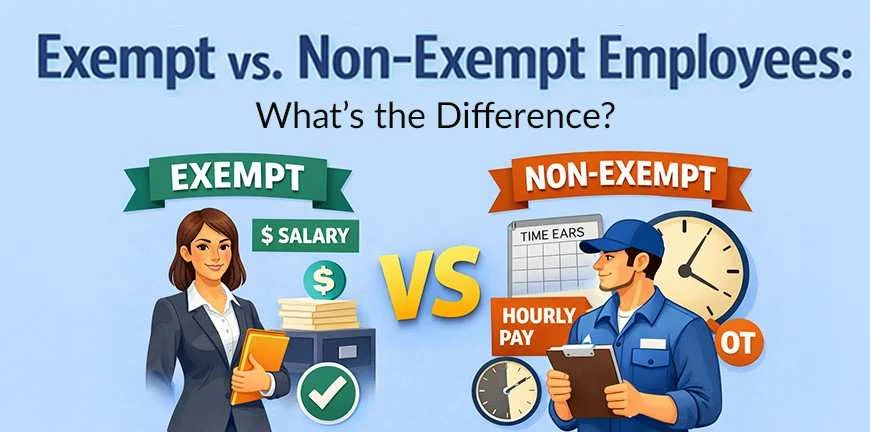
Are you rethinking structuring your workforce framework? Knowing the difference between exempt and non-exempt employees in your organisation and where they stand will enable you to comprehend your team and work expectations, levels of job flexibility, and ensure fair practices, transparency, and adherence to regular compliance.
What are Exempt Employees?
Exempt employees are those employees who get a fixed salary and are not subject to overtime pay. Employers do not have to comply with any overtime regulations with exempt employees, and these workers do not receive any hourly wages as they have a fixed salary. These employees are usually high-profile executives or hold a high designation in administrative roles.
What Are Non-Exempt Employees?
A non-exempt employee is a worker who is eligible for hourly wages and is entitled to overtime. These employees do not get fixed salaries and do not have to cater to any overtime regulations. Employees working in service, retail, sales, etc, fall in the category of non-exempt employees.
What is the Difference Between Exempt and non-exempt employees?
| Basis | Exempt Employees | Non-Exempt Employees |
| Definition | These are workers who are not entitled to overtime pay as per labour laws. | These workers are supposed to receive overtime pay. |
| Overtime Pay | These employees are not eligible for overtime pay | These workers must receive overtime payment (usually 1.5× regular rate) |
| Salary Structure | These workers get a fixed salary regardless of hours worked | These workers are usually paid hourly but can get salaries if eligible after working overtime. |
| Work Hours | These employees are expected to complete tasks irrespective of working hours. | These workers get paid according to the number of hours they have worked. |
| Minimum Wage Laws | These workers must cater to the minimum salary threshold | These employees must receive minimum wage |
| Job Roles | Executive, administrative, professional roles (e.g., managers, HR, engineers) | Clerical, technical, manual, and support roles |
| Flexibility | These employees are more flexible in terms of working hours | It is not so flexible for the non-exempt employees, as they have to stick to their hours, which can also be tracked. |
| Time Tracking | This case does not require time tracking | It is mandatory to track time for non-exempt workers |
Who is Eligible for Overtime Pay?
In India, there are certain rules and polices that HR teams, employers and employees have to adhere to in terms of overtime pay. Let us find out what the eligibility criteria are:
1. Employees in Factories
This falls under the Factories Act, 1948. Here, if workers work more than 9 hours per day or 48 hours per week, they are eligible for overtime pay.
2. Commercial Workers
Workers who fall under the state Shops and Establishments Acts, covering offices, shops, and commercial establishments, are eligible.
3. Non-Exempt Staff
Workers who are working as clerks, in non-managerial posts, are qualified for overtime pay. People who hold a high position or a position of trust are deemed from overtime pay.
4. Minimum Wage Staff
Workers who are protected under the Minimum Wages Act, 1948, are entitled to overtime if they work beyond regular working hours.
How Are Employees Classified?
The classification of employees is influenced by various factors, including the hours they work, their legal situation, roles and responsibilities. These factors determine an employee’s eligibility for specific salaries, benefits, bonuses, tax adherence, etc. Let us find out the general employee classification:
1. Permanent Employees
These are workers who work full-time and are recruited through permanent recruitment methods. They work an average of 30 to 40 hours per week and are entitled to benefits.
2. Par Time Employees
These employees work for less than 30 to 35 hours per week and work for specific hours, making them ineligible for all benefits and perks.
3. Temporary Workers
These employees are hired temporarily for specific projects or tasks when there is sudden or seasonal demand or requirement. These workers are not eligible for standard benefits.
4. Exempt Workers
These workers are salaried employees who do not fall under the category of complying with FLSA minimum wage and overtime regulations.
5. Non-Exempt Workers
These employees are eligible for overtime pay on an hourly basis.
What Are Common Misclassification Mistakes?
If you are an employer, you must be cautious while classifying employees, as a little mistake can be challenging and cost you heavy penalties and legal consequences. Let us check out some of the common errors made by employers:
1. Improper Classification of Contractors
Employers often end up treating independent contractors like employees, providing them with company perks, training provisions, equipment, etc, establishing an employment association.
2. Job Title Cannot Define Status.
A worker holding the title of a manager can be non-exempt if they perform operational duties rather than handling managerial tasks and work.
3. Exercising Stringent Governance
If an employer starts dictating rules and becomes rigid in delegating duties to independent workers, rather than focusing on outcomes, the contractors must be treated as employees.
4. Hiring Long-Term Contractors
Recruiting contractors for a long term and integrating them into workflows and daily work systems, core activities might make it look like they are employees.
5. Inaccurate Intern Classification
Not all temporary or part-time workers are contractors, and employers sometimes misclassify workers like interns and casual workers as contractors.
6. Misuse of Titles
Some Employers often make the mistake of misusing titles and designations, even though the workers perform operational duties like non-exempt workers and are supposed to get hourly wages.
Why Is Employee Classification Important?
It is essential for you as an employer to classify employees accurately, catering to all the labour laws and regulations, adhering to the tax authorities, to prevent facing legal action and thoroughly understand the difference between exempt and non-exempt workers. Here are some of the reasons why employee classification is significant:
1. Lawful Adherence
Employee classification drives companies to maintain their legal stance, complying with the necessary rules and laws, eliminating challenges of heavy fines and legal consequences. Misclassification can lead to dire business consequences and a tarnished brand reputation.
2. Properly Defined Tax Compliance
Proper classification of employees ensures accurate reporting of taxes and withholding in adherence to the IRS and the required tax authorities and state agencies.
3. Remuneration & Work Hour Regulations
An accurate classification can establish the structure for guidelines on overtime payment and the requirements for minimum salary, as per the central and state labour law codes.
4. Benefits Qualification Criteria
The classification highlights the eligibility criteria of workers, determining the kind of company benefits they are entitled to, like insurance, pension, paid time off, etc.
5. Uplifts Employee Morale
A comprehensive and correct employee classification drives employees to feel valued, boosting their spirits and focus more on productivity, contributing better to the company’s progress. It also enhances the company’s reputation, drawing top talent.
Key Takeaways
- Pay Structure is Clearly Distinguishable
- Vital Difference is Overtime Eligibility
- Job Roles and Responsibilities are Essential Elements
- Misclassification Can Lead to Legal Challenges
- Accurate Classification Powers Compliance and Fairness
Frequently Asked Questions
1. What are exempt employees?
Exempt employees are salaried professionals who are not entitled to payments like overtime under labour laws like the Factories Act, etc.
2. What are non-exempt employees?
Non-exempt employees are professionals entitled to overtime pay for working beyond standard hours. The workers usually are in job categories like blue-collar, clerical, or manual staff.
3. Who qualifies for overtime pay?
Employees, especially those classified as workers under the Factories Act, 1948, or similar state-specific Shops and Establishments Acts, qualify for overtime pay if they work more than 9 hours a day or 48 hours a week.
4. What is the difference between exempt and non-exempt?
Non-exempt workers are staff who get paid hourly and are entitled to overtime pay for working beyond standard hours, while exempt employees, usually senior or administrative staff, receive a fixed salary regardless of hours worked.
5. How are employees classified legally?
Legal employee classification determines worker rights, benefits, and tax obligations, primarily distinguishing between employees and independent contractors.
6. Can an employee switch classification?
Employees can switch classification, like blue collar to managerial levels, etc, primarily through job role changes, promotions, or company transfers.
Contact Us For Business Enquiry

Hariharan Iyer
Hariharan Iyer is the Vice President – Operations at ALP Consulting, bringing over 40+ years of experience in HR outsourcing and labour law compliance. He leads end-to-end HRO operations, ensuring process efficiency, statutory compliance, and seamless service delivery for clients across industries. With a strong background in labour law governance and workforce management, Hariharan plays a key role in driving operational excellence and compliance-led HR solutions at ALP Consulting.