
How much does it cost to set up a GCC in India?
09/03/2026
Top 7 RPO Strategies for Successful Mass Hiring
10/03/2026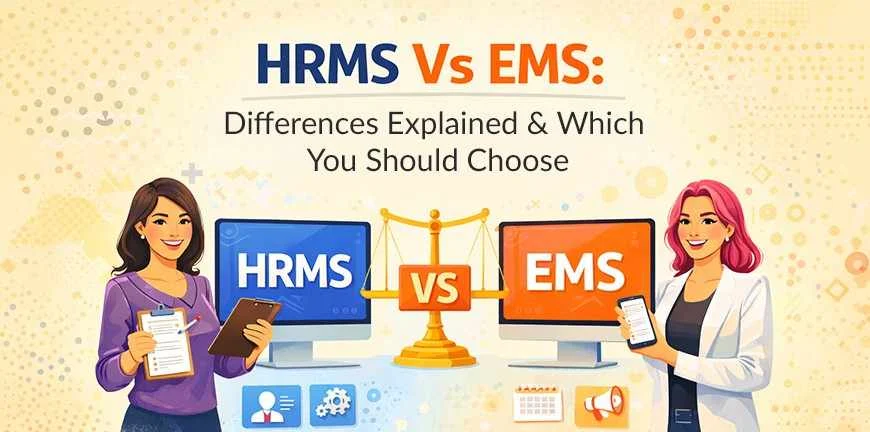
Today, with organisations growing and work dynamics evolving regularly, there is plenty of manual and paperwork that is a tall order to manage. Are you facing the same challenge? It is time for you to switch to digital platforms to streamline HR functions seamlessly. HRMS or Human Resource Management System, and EMS or Employee Management System are two significant components that can help you out.
What Is an HRMS (Human Resource Management System)?
HRMS is a high-end digital software that has an array of applications that automate, digitises and centralise fundamental HR processes. It supports HR professionals with handling the entire recruitment cycle, from payroll to talent management, handling employee data, etc.
What Is an EMS (Employee Management System)?
EMS is a digital tool that enables HR operations to become smooth by automating them and making work easier by reducing manual labour and paperwork. This system helps with handling labour force data, performance tracking, payroll, benefits, etc.
What Is the Difference Between HRMS and EMS?
The objective of HRMs and EMS is to streamline tasks; however, they have different focuses. Let us find out the difference: HRMS vs EMS.
| Basis of Comparison | HRMS (Human Resource Management System) | EMS (Employee Management System) |
| Meaning | A comprehensive software platform that manages the entire HR lifecycle, including recruitment, payroll, performance, and workforce analytics. | A system designed to manage employee information and basic administrative tasks within an organisation. |
| Scope | Broad and strategic, covering multiple HR processes and functions. | Limited to core employee administration and record management. |
| Primary Purpose | To streamline HR operations and support strategic workforce planning. | To organise and manage employee data and routine HR activities. |
| Key Features | Recruitment management, onboarding, payroll processing, performance management, learning & development, compliance tracking, and analytics. | Employee database, attendance tracking, leave management, employee profiles, and basic reports. |
| Analytics & Reporting | Offers advanced analytics, dashboards, and workforce insights for decision-making. | Provides basic reports mainly related to attendance and employee records. |
| Integration Capabilities | Often integrates with ERP systems, payroll software, accounting tools, and recruitment platforms. | Typically has limited integration with other enterprise systems. |
| Best Suited For | Medium to large organisations with complex HR needs. | Small businesses or organisations requiring basic employee management tools. |
| Business Value | Enhances strategic HR management, productivity, and organisational growth. | Improves efficiency in handling employee records and administrative HR tasks. |
What Are the Key Features of HRMS vs EMS?
HRMs and EMS are both designed to expedite and make HR procedures easier. They, however, have different scopes and focus; Let us find out what their key features are:
HRMS Features:
- Consolidated payroll and Benefit Handling – The system handlestax filings, salary calculations, automating them.
- Talent Hunt- Handles the entire talent and recruiting procedure to onboard them.
- Attendance & Time- The system manages leaves, attendance systems, tracks time, working hours, etc.
- Handles Compliance- One of the major HRMS features is that it handles compliance effectively, ensuring that organisations comply with laws and regulations accurately.
- People’s Analytics – The software helps in generating data-powered insights that enable enterprises to make smart decisions.
EMS Features:
- Handle Performance & Appraisal- This software enables businesses to set goals, KRAs, and conduct comprehensive performance evaluations.
- Handle Projects &Tasks- digital platforms enable prompt and accurate tracking of projects and tasks, their progress rates and resource allocation.
- Employee Engagement & Recognition- EMS tools are designed to conduct employee surveys, collect employee feedback, peer recognition, etc.
- Real-time tracking features- Activities and patterns can be tracked in real time, facilitating accurate performance and productivity monitoring.
Which Is Better for Small Businesses: HRMS or EMS?
HRMS is better for small businesses than EMS, as it offers an end-to-end solution to all the HR functions entailing payroll, compliance, and many more, at a reasonable cost. Let us see why HRMS is more beneficial:
- Comprehensive Solutions- EMS platforms are helpful for smaller businesses as they can integrate various systems into a centralised system, avoiding multiple software systems.
- Compliance Efficiency- Smaller businesses in India sometimes struggle to manage complex labour laws and other adherences like PF, ESI, etc, when EMS come to their rescue.
- Cost Efficiency- Modern cloud-fuelled EMS platforms today are cost-effective and scalable for small businesses.
- Self-Service Portals- Ems systems enable employees to handle their own pay slips, attendance, and personal details, helping business owners to focus on core activities.
Which Is Better for Growing or Enterprise Companies?
Growing and enterprise companies can gain from an HRMS, the full form of HRMS is Human Resource Management System, as it can integrate all systems and help in managing complex workforce requirements. Let us check out its benefits for growing and enterprise businesses:
- Adjustable & Future Secured- HRMS systems are adjustable and can easily be incorporated into systems of growing businesses as they step into new territories or hire new employees.
- Comprehensive Integration- HRMS has a unified cloud-enabled structure that integrates all the systems of payroll, leave management, compliance, etc., making it easier for enterprises to avoid too many tools, reducing their expenses.
- Risk Mitigation- Growing and large businesses are usually in regulated sectors, and HRMS is a platform that provides automated compliance updates and keeps data secure in secure centralised systems.
- Smart Data Analytics- HRMS systems translate employee data into impactful information regarding employee engagement, performance, attendance, etc.
How Does HRMS vs EMS Compare in Terms of Cost?
| Cost Factor | HRMS (Human Resource Management System) | EMS (Employee Management System) |
| Initial Implementation Cost | Higher due to multiple modules such as payroll, recruitment, performance management, and analytics. | Lower because it focuses mainly on employee records and basic HR tasks. |
| Subscription / Licensing Cost | Typically priced per employee per month; usually ranges from ₹20 to ₹150 per employee monthly, depending on features and vendor. | Generally cheaper because it includes fewer modules and simpler functionality. |
| Customization Cost | May require additional costs for customisation, integrations, and advanced modules. | Minimal customisation cost since features are basic and limited. |
| Maintenance & Support | Higher maintenance costs due to system integrations, updates, and feature expansion. | Lower maintenance costs because the system is simpler and has fewer integrations. |
| Scalability Cost | Costs may increase as more modules, users, and advanced analytics are added. | Scaling costs remain relatively low, but functionality may become limited as the organisation grows. |
| Return on Investment (ROI) | Higher long-term ROI due to automation, workforce analytics, and strategic HR capabilities. | ROI mainly comes from improved administrative efficiency and record management. |
| Best Fit Based on Budget | Suitable for mid-sized and large organisations with complex HR needs and larger budgets. | Ideal for small businesses or startups looking for a cost-effective employee management tool. |
What Are the Pros and Cons of HRMS vs EMS?
Both HRMS and EMS are two peas in a pod and drive HR operations efficiently. However, they are more beneficial for certain businesses than others. Let’s check out their pros and cons.
HRMS Pros:
- Good for mid and large-sized businesses
- Unified system
- Consolidated Solutions
- High End Technology
- Top-notch Compliance Solutions
Cons:
- Complex & High Expenses
- Less Useful for Small Teams
- Staff Training Required
EMS Pros:
- Good for Small Businesses
- Convenient & User-friendly
- Engagement and Collaboration Focused
- Cost-Effective
Cons:
- Lack of Scope
- Integration Hurdles
When Should a Business Upgrade from EMS to HRMS?
An organisation must upgrade from Ems to HRMS when there is an expansion in terms of workforce and employees are increasing, with a rise in more paperwork, manual labour and complexities.
An upgrade is also required when the existing system is unable to manage the compliance complications with the rapidly evolving regulatory changes. There can also be issues with erratic and inaccurate HR related data, resulting in delayed reporting. When there is a dire need of integrating systems like payroll, enhancement, and performance systems in one central database.
What Are the Latest Trends in HRMS vs EMS in 2026?
- AI Leap– There is a new era of AOI where there are AI agents that do more than follow prompts. These agents can plan, collaborate, and coordinate HR functions, multitasking without human involvement.
- Strategic Focus in HRMS– HRMS today focuses on skill graphs designed by AI to identify talent gaps fuelling internal marketplaces. There is a rise in concentration on employee experience to enhance retention.
- Outcome Focus in EMS– Modern EMS platforms today focus on integrating various tools to monitor productivity accurately. GPS, geo-fencing, and biometric face recognition are being increasingly used to review attendance.
- The Glocal Initiative– According to various reports, in 2026, 64% of IT leaders are predicting a merger of HR and IT departments to co-create a secure, AI-powered digital ecosystem.
Local servers are utilised today to manage global teams following strict data security protocols, ensuring stringent data safeguard methods. Rigid regulations are enabling transparent monitoring, allowing employees to check their own performance data.
Key Takeaways
- HRMS and EMS serve different purposes in HR management.
- HRMS offers broader functionality than EMS
- EMS is generally more suitable for small businesses
- HRMS is ideal for growing and enterprise organisations
- Modern HR systems are increasingly driven by technology trends
Frequently Asked Questions
1. What is the full form of HRMS and EMS?
The full form of HRMS is Human Resource Management System, and the full form of EMS is Employee Management System.
2. What is the main difference between HRMS and EMS?
The primary difference is that a Human Resource Management System (HRMS) focuses on automating administrative HR tasks while an Employee Management System (EMS) focuses more broadly on employee productivity, performance, and engagement.
3. Is HRMS better than EMS?
HRMS is generally better for comprehensive, company-wide HR, payroll, and compliance, while EMS is often better for day-to-day employee tracking and operational efficiency.
4. Can a small business use EMS instead of HRMS?
A small business can use an EMS instead of a comprehensive HRMS, particularly if it is in the early stages of growth and needs to manage basic HR functions.
5. Does EMS include payroll?
An Employee Management System often includes payroll operations as part of its functions to automate HR tasks.
6. When should a company switch to HRMS?
A company should switch to a Human Resource Management System (HRMS) when manual processes become too time-consuming, error-prone, or insecure.
7. Is HRMS more expensive than EMS?
HRMS are generally more expensive than EMS or basic HR software due to their comprehensive and integrated features.
Contact Us For Business Enquiry

Amit Saproo
Amit Saproo is the Head of Operations at ALP Consulting with nearly 17 years of experience in Executive Search, RPO, Leadership, and IT & Engineering recruitment. He leads nationwide recruitment programs across Technology, BFSI, and R&D domains, driving strategic hiring solutions for diverse client needs. Amit excels in building and managing high-performance teams that deliver scalable, end-to-end recruitment and consulting services.