
5 Key Leadership Principles for Effective Team Management
13/07/2026
How Global Capability Centres Recruit Skilled Talent in India?
15/07/2026
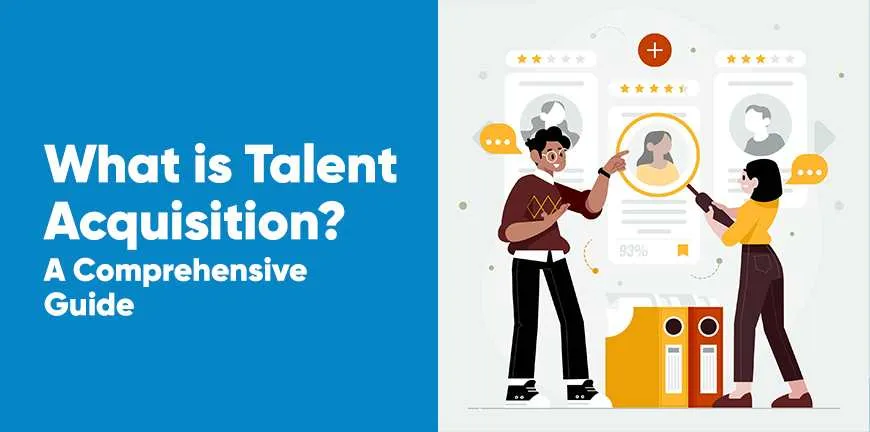
Today, Artificial Intelligence (AI) is revolutionising talent acquisition processes by using a data-led approach to help HR managers make intelligent hiring decisions.
With businesses facing challenges such as talent gaps, rising hiring volumes, and widening skills gaps, AI-enabled hiring has become critical for sourcing, identifying, engaging, and effectively tapping premier talent.
According to Forbes, up to 37% of enterprise organisations are experimenting with or integrating generative AI into their hiring systems specifically to transform their talent acquisition workflows.
Let us find out how AI influences recruitment processes and how businesses can benefit from AI-driven talent acquisition.
Key Takeaways
- AI accelerates talent acquisition by automating hiring processes
- Data-driven insights improve hiring decisions
- AI enhances the candidate experience through personalised communication, faster responses, and seamless recruitment workflows.
- Responsible AI supports fair hiring by promoting skills-based candidate evaluation
- Combining AI with recruiter expertise enables organisations to reduce time-to-hire and improve hiring quality
What is Artificial Intelligence (AI) in Talent Acquisition?
AI in Talent Acquisition (TA) refers to the use of artificial intelligence tools and platforms in the hiring process, from sourcing to onboarding new employees. AI tools not only manage and accelerate the mundane tasks of the recruitment process but also enable HR teams to concentrate on designing smart strategies and making focused decisions.
What Are the 8 Ways AI Is Changing the Talent Acquisition Process?
1. Expedites Talent Sourcing
AI tools and platforms can easily scan bulk applications from huge databases, job boards, and social media channels to identify skilled professionals. This results in reduced time to hire and enables recruiters to access niche talent networks.
2. Accelerates Resume Parsing
AI-driven screening tools streamline the process of reviewing candidate resumes. The tools analyse the candidate profiles based on skills, qualifications and experience, along with job needs, driving recruiters to choose appropriate and relevant candidates more accurately and faster.
3. Improves Candidate Job Matching
Candidates are matched easily with job roles with the help of AI as they utilise machine learning algorithms to complete the process. The roles are matched based on proficiencies, experience, career growth and cultural alignment. This enhances hiring quality as there is a very low possibility of candidate mismatch.
4. Automates Recruitment Operations
AI tools automate tasks, eliminating the chances of inaccuracy and inefficiency. They streamline and track candidate performance, schedule automated interviews, and support recruitment frameworks. This helps in a faster recruitment process, enabling recruiters to focus on employer branding and engaging skilled talent.
5. Supports Data-Backed Hiring Decisions
AI offers data-powered information through hiring analytics, enabling organisations to gauge significant metrics like hiring performance, anticipate candidate hiring success, identify market and talent trends, and enhance recruitment plans.
6. Enhance the Candidate Experience
Tools like AI chatbots and other communication platforms respond instantly to candidates. They also provide personalised updates like job recommendations, application status, and reminders regarding interviews, making the candidate journey positive and efficient.
7. Forecast Workforce Planning
AI can assess hiring data, changing labour market scenarios and trends, and predict business progress, forecasting future talent needs. This helps recruiters identify skill gaps and plan the workforce efficiently.
8. Supports Diversity & Inclusivity (DEI)
AI helps reduce workforce bias by promoting DEI practices and focusing on selecting candidates based on their skills rather than their cultural background. A well-thought-out AI integration in organisations prevents bias, reinforcing the organisation’s commitment to fair hiring.
Key Metrics
| Metric / Insight | Significance |
| ~$64 Billion & 2M+ Jobs | Global Capability Centres (GCCs) in India have shifted from cost reduction to capability hubs using AI to scale senior engineering hubs by accelerating recruitment. |
| 64% | The percentage of organisations that have increased their AI talent budgets compared to last year to secure specialised intelligence infrastructure. |
| 69% | The percentage of professionals who report that their employers take too long to hire. This is prompting companies to use AI to expedite background and evaluation cycles. |
| Only 42% | The proportion of new AI-focused roles being filled by traditional full-time employees. The rest are sourced via contractors and embedded teams to pivot quickly as tech evolves. |
Conclusion
AI has become a vital driver for recruiters, powering them to work more effectively and deliver recruitment outcomes where they attract and hire qualified professionals. AI-driven tools and platforms facilitate top-level automation, enable better decision-making, and ensure fair recruitment.
Frequently Asked Questions
1. How can AI improve our talent acquisition process?
AI can improve your talent acquisition process by automating hiring, enhancing candidate matching, reducing hiring time, and improving recruitment decisions.
2. Which recruitment activities should we automate using AI?
You should automate functions like resume screening, candidate sourcing, interview scheduling, candidate communication, job postings, and recruitment analytics using AI.
3. How can AI help us reduce time-to-hire without compromising quality?
AI can help you to reduce time-to-hire by automating screening, matching qualified candidates faster, and streamlining recruitment workflows efficiently.
4. Can AI help us identify better candidates for hard-to-fill roles?
AI can help you identify qualified candidates for hard-to-fill roles by analysing skills, experience, and niche talent pools efficiently.
5. How do you combine AI with human expertise during recruitment?
AI automates recruitment tasks, while recruiters provide human judgment, relationship-building, and final hiring decisions.
6. How can we use AI without introducing bias into our hiring process?
You can use AI without introducing bias into your hiring process by using it responsibly with regular audits, diverse data, human oversight, and transparent, skills-based hiring practices.
7. Can AI improve candidate screening and shortlisting accuracy?
AI can improve screening and shortlisting accuracy by evaluating skills, experience, and job-role compatibility objectively.
8. How can AI support high-volume hiring without affecting candidate experience?
AI automates high-volume hiring by delivering fast communication, personalised updates, and efficient candidate screening at scale without affecting the candidate experience.
9. What should we consider before implementing AI in talent acquisition?
Before implementing AI in talent acquisition, we must prioritise data quality, ethical AI practices, human oversight, compliance, and seamless integration with existing recruitment systems.
10. How can AI help us make better hiring decisions while staying compliant?
AI can help you make better hiring decisions by providing data-driven insights, supporting compliant hiring practices, and enabling fair, consistent, and informed hiring decisions.
Contact Us For Business Enquiry

Neelakantayya Hiremath
Neelakantayya Hiremath serves as the Operations Head – Talent Acquisition at Alp Consulting Ltd., with over 18 years of extensive experience in recruitment operations, workforce strategy, and leadership hiring across technical and non-technical domains. He has successfully led large-scale talent acquisition programs across infrastructure, energy, BFSI, and technology sectors. With deep expertise in RPO delivery, client engagement, and strategic hiring, Neelakantayya drives efficient, business-aligned recruitment solutions that adapt to evolving industry dynamics and organizational goals.