
8 Healthcare Staffing Trends to Watch in 2026
22/12/2025
What Is the NATS National Apprenticeship Training Scheme?
24/12/2025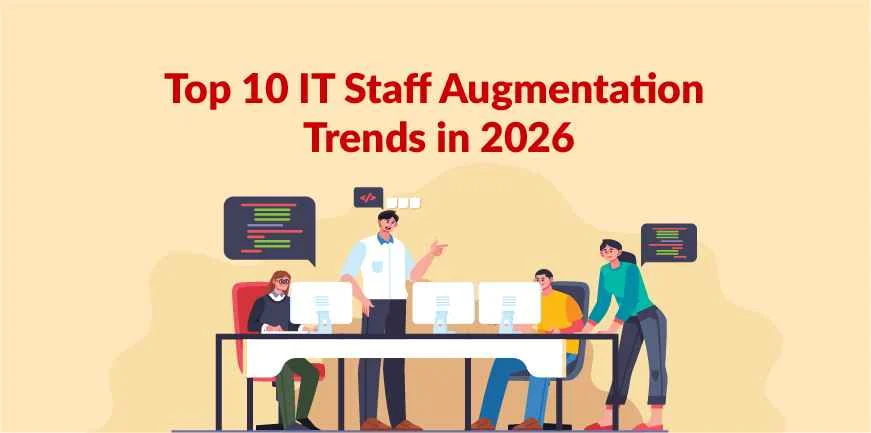
The digital revolution is growing by the day, leading to a demand for complex technology in organizations. IT staff augmentation is a strategy that has been working in favour of organizations looking for agility, as well as access to specialized IT talent. The right skills at the right time are the need of the hour in the IT industry at present. This article explores the top IT staff augmentation trends in 2026 that organizations must embrace and adopt to stay competitive and sustain growth.
What is IT Staff Augmentation?
Staff augmentation is a flexible hiring model that which organizations outsource their recruitment processes to external agencies to fulfil their specific IT job requirements, filling roles temporarily.
Market Overview
According to market reports, the global IT Staff Augmentation market value is slated to reach USD 857.2 billion by 2031, marking a CAGR of 13.2% from 2024 to 2031. But what’s driving this growth? It is the need for organizations to adopt new technologies like AI, Cloud computing, and cybersecurity solutions. And as if this wasn’t enough, there is a looming challenge of global talent shortages and varied project requirements.
Top 10 IT Staff Augmentation Trends in 2026
Let us take you through some of the latest IT staff augmentation trends of 2026:
1. AI and Advanced Tech Integration
AI-driven recruitment is no longer a backstage activity; it is now a full-blown and mainstream approach that recruiters and organizations are adopting. The integration of AI-led tools and systems-
- enables a faster and better screening and assessment process, matching skill sets with proper project needs
- Future workforce requirements can be predicted with these tools.
- Chatbots and automation can make way for easy candidate communication
2. Growth of Hybrid Workforce Models
An ISACA study revealed that 75% of employees prefer hybrid work models. This has indicated a necessary shift requiring organizations to offer hybrid models. This is not only about utilizing smart recruitment methods but also adopting approaches that are cost-efficient.
- Talent hubs in Eastern Europe, Latin America, Asia, and the GCC region will play crucial roles.
- Organizations will be able to hire the best of the best developers, engineers, and cybersecurity experts.
- Not only will work-life balance be achieved, but it can also result in greater productivity.
3. Increase in offshore and nearshore professionals
One of the recent staff augmentation trends that has been gaining traction is the staffing of offshore and nearshore professionals. The offshore market is expected to reach USD 525.23 billion by 2030 with a CAGR of 9.8% from 2025 to 2030. (grandviewresearch). From offshoring to nearshoring,
- organizations are focused on balancing factors like risk, time zone compatibility, and cultural affinity.
- There is a significant reduction in operational costs.
4. Niche-skilled-based Augmentation
Instead of hiring based on job titles, organizations seek skills in this competitive landscape. One of the crucial current IT staff augmentation trends is hiring individuals with specific skills or a combination of skills,
- Hiring individuals with a mix of skills such as Python microservices, cloud security certifications, or AI ethics expertise.
- Some of the top in-demand skills are Blockchain development, cloud engineering, cybersecurity, DevOps and automation.
IT Staff Augmentation trends in 2026 is all about choosing the best-in-class professionals for your special needs.
5. Communication and Cultural Fit Key
Technical skills are, of course, essential, but along with them, important skills like communication and collaboration, and staying in tune and in sync with the cultural aspects of the company matter. With remote work rising,
- Soft skills like collaboration facilitate smooth operations across nations.
- Can adapt to a changing and fast-moving technology environment quickly.
During the selection of IT staff, these skills are being prioritised for project success.
6. Prioritising Compliance and Privacy
With cyber threats escalating and data privacy evolving and with IT companies working with professionals globally, and executing operations remotely.
- Organizations are hiring security professionals and embedding them into augmented teams.
- The augmented staff is trained in cybersecurity.
- Staff augmentation companies help organizations prioritize protecting data and securing it by stringent measures, along with maintaining compliance with laws and regulations like GDPR and HIPAA.
7. Outcome-based engagement and contract-based roles
Traditional models where the number of hours worked mattered more are no longer the trend. Contract-based roles and outcome-driven engagement is what organizations seek.
- Outcome-based contracts ensure that businesses only pay for results, improving business efficiency while giving professionals the autonomy they seek.
- Lesser financial risks for businesses
- Better transparency in the billing models and are more value-driven
8. Evolving Skill Advancement
As per the new IT staff augmentation trends, organizations are creating systems to facilitate continuous upliftment and upgradation of workers.
- IT teams go through several training programs
- manpower is updated with the new and developing modern technologies.
- preparation of future-ready teams and diminishes reliance on outside hiring.
9. Rise of Staff Augmentation Platforms
The development of new AI-powered platforms is connecting businesses with vetted IT professionals in record numbers. Reliable staff augmentation providers like Alp Consulting provide on-demand tech talent,
- AI matching systems that allow for instant recruiting
- On-demand tech talent delivered at faster hiring speeds
- Augmented Staff can be managed easily
10. Focus on Eco-Responsible Approaches
One of the trending IT Staff Augmentation practices today is about honing technical expertise and smart recruitment.
- considering the social and ethical impacts.
- emphasising DEI initiatives, conforming to labour laws and global benchmarks,
- putting effort towards environment-friendly initiatives, and reducing the carbon footprint, etc.
- Diverse talent pools enable global workforce inclusion
What are the Growth Drivers of IT Staff Augmentation in 2026?
The demand for IT staff augmentation is constantly rising due to the changing trends, market forces, and growing competition. Let us check out the significant factors driving the demand:
1. Worldwide Talent Scarcity
There is a global dearth of niche-skilled professionals for specialized domains in the IT sector. Local talent pools sometimes do not have the supply of specialized talent, driving organizations to resort to staff augmentation, where they can hire skilled professionals temporarily to complete niche tasks or projects.
2. Remote and Hybrid Work Modules
The advancement of flexible job roles and work modes has made it convenient to build IT teams and manage them across borders. This system enables fostering smooth communication and collaboration.
3. Cost Effectiveness
Firms can cut costs by avoiding maintaining and investing in large in-house teams. They can easily hire from a third party as and when they require skilled labour. This reduces the overhead costs as the work contracts are fixed for a specific period.
4. Niche Talent Access
Organizations can now access niche IT professionals whenever they desire through staff augmentation. They can dive into the global pool and select suitable IT professionals who can temporarily fill roles in niche domains.
5. Project Control Maintenance
Internal project managers can directly monitor the operations of a project when staff is augmented, without losing control over the execution and work plans. This is not possible with full outsourcing.
What are the Benefits of IT Staff Augmentation in 2026?
The benefits of IT staff augmentation span from saving costs to accessing top talent. However, to ensure that the full potential of staff augmentation is being met, organizations must follow the top IT staff augmentation trends.
1. Simplified Administrative Workloads
Organizations partnering with staff augmentation providers are usually unburdened of extra administrative work, as the providers often manage payroll and Hr centric tasks, diminishing costs and saving resources.
2. Reduced Hiring Uncertainty
With the staff augmentation approach, businesses can hire professionals when required and not worry about long-term commitments or contracts. There is a lower risk of bad hires as skilled and specialised individuals are recruited for specific projects or tasks.
3. Embracing New Technology
By utilizing project-based skilled individuals, businesses can experiment and explore innovations and advanced tech without the risk of investing in large-scale solutions. They can hire expertise and test technologies as and when required.
4. Worldwide Skill Access
Businesses can explore a wide range of global talent with staff augmentation. They can venture into new and diverse markets and select the best-in-class professionals from any region or time zone.
5. Prioritize Mission Critical Operations
With staff augmentation services, the internal teams of businesses can focus on significant and strategic activities related to business growth.
What is the Future of IT Staff Augmentation?
The future of Staff Augmentation looks bright and full of potential, with companies evolving and adopting flexible models that perfectly balance cost optimization and an agile approach.
Following the modern IT staff augmentation trends, organizations are moving beyond bridging skill gaps to create robust ecosystems where talent thrives by blending various working models, ensuring flexibility and efficiency.
With ever-changing and growing tech advancements in niche IT domains, the demand for unique skills is at its peak. This makes factors like upgrading knowledge, catering to cultural aspects, and adjusting to several time zones critical.
Businesses are simultaneously practicing ethical approaches, prioritizing DEI, and sustainability while selecting staff augmentation partners.
IT workforce Staff augmentation is not just a temporary trend but the epitome of innovative ideas, scalable solutions, and the ultimate force that will change the face of recruitment in the transformative digital landscape.
Here is a look at the anticipated growth prospects:
| Category | Statistics | Details |
| Hiring / Workforce Growth Intent | Percentage of employers planning to grow workforce in H1 FY25 | 56% of surveyed employers across ~20 cities expect their workforce to increase in the first half of FY25 |
| Hiring / Workforce Forecast | Net Employment Outlook Jan-Mar 2024 | ~37% of employers in India intended to increase staff strength by that quarter. IBEF+1
|
| Skill Shortage | Employers are reporting difficulty finding skilled talent | 81% of Indian employers said they had difficulty filling open roles, including in the IT sector.
|
| IT Services Market Size & Growth | India IT Services market (2025 → 2030 forecast) | USD 37.03 billion in 2025, expected to grow at ~9.06% CAGR to reach USD 57.13 billion by 2030. |
| Demand for Specialists / Niche Skills | Trend emphasis | Indian companies increasingly favour specialists (AI/ML, cloud, cybersecurity) over generalists. |
| Cost Advantage | Relative cost of Indian IT talent vs US/Europe | Hiring a software developer in India can cost 50-70% less than in the U.S./Europe. |
Key Takeaways
- Integration processes to embed external talent as effective team members.
- AI recruitment and workforce management tools can ensure precise hiring and productive collaboration.
- Prioritize security and compliance expertise embedded in all augmented roles.
- Adopt flexible contracts emphasizing outcomes, innovation, and accountability.
- Partner with staffing providers offering geographic diversity, rapid scaling, and niche skill access.
FAQs- Frequently Asked Questions
1. What is IT Staff Augmentation?
IT Staff augmentation is a staffing model that allows companies to enhance their team’s capabilities by augmenting it with skilled external personnel while maintaining complete control over the augmented staff and the projects.
2. How does IT staff augmentation help organizations save costs?
IT staff augmentation offers a cost-effective alternative as it prevents organizations from having to hire full-time employees while providing access to top talent.
3. What types of IT roles are most commonly hired through staff augmentation?
Blockchain development, cloud engineering, cybersecurity, DevOps, and automation roles are hired for through staff augmentation.
4. What are the biggest challenges in IT staff augmentation?
Cultural clashes, communication barriers, team integrations, legal and compliance issues, technical challenges, and varied expectations are the biggest challenges in IT staff augmentation.
5. How do staff augmentation providers ensure talent quality?
Staff augmentation providers ensure talent quality through rigorous vetting (skill tests, interviews), accessing a large talent pool, clear requirement matching, effective onboarding, continuous performance monitoring with KPIs, and maintaining open communication.
Contact Us For Business Enquiry

Kasthuri R
Kasthuri R is the Co-Founder & Executive Director at ALP Consulting, bringing over 23 years of experience in search, staffing, and HR consulting. She has been instrumental in driving ALP’s recruitment, employee leasing, and executive search practices across diverse industry verticals. With deep expertise in talent acquisition, HR strategy, and operational management, Kasthuri has built scalable, client-focused solutions that enhance workforce efficiency. Her strategic leadership continues to steer ALP Consulting toward innovation and excellence in people management.