What Is a Payroll Management System? A Complete Guide in 2026
27/12/2025
10 Latest Performance Appraisal Trends in 2026
28/12/2025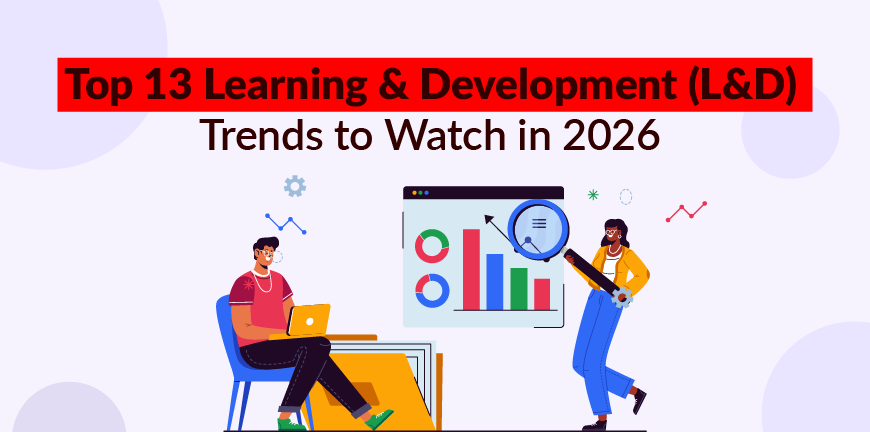
Business and technology are fast-moving phenomena, driving future trends in learning and development to shift from administrative tasks to propellers for operational success. Are you eager to revamp your training programs and enhance your learning and development modules? You must craft a personalised experience that fosters resilience, innovation and a competitive edge. The L&D ecosystem is evolving rapidly, and you can be a CHRO or a leader on the learning curve; you must unlock the potential of your team, ensuring it thrives in the changing business environment.
As Albert Einstein once said, “Once you stop learning, you start dying.”
Why Learning and Development Trends Matter for Organisations?
According to the latest surveys, 2026 dashboards focus on “Time to Proficiency” and “Impact on Productivity” rather than course completion rates.
In the new age, L&D trends matter, as with the changing business landscape as they engineer business success. Now, let us check out why they are significant:
1. Future Ready Teams
Employees continuously need to evolve by upskilling and reskilling as technology and automation penetrate systems, and there is a demand for ongoing learning processes. The learning enables employees to adapt and adjust to new, innovative systems and patterns, and not become obsolete.
2. Enhance Skill Development
Many organisations today are facing the issue of skills not matching the actual requirements. Modern L&D modules facilitate skill-enabled learning patterns and role-centric academic pursuits, enabling bridging of the skill gaps faster and cost effectively.
3. Accelerate productivity and Outcomes.
A well-designed and focused learning system that is personalised automatically improves the performance of employees as they receive learning opportunities that are relevant and time-effective. This encourages them and motivates them to contribute better towards the company’s growth and goals.
4. Improve Employee Engagement
Employees who experience and are encouraged to follow the right career path by providing them with quality learning systems are likely to be loyal, getting an incentive to work harder and stay longer.
5. Enablers of Quality Leadership
The current trends in learning and development foster a framework of nurturing and developing high-end leaders. These leaders are not just created for top category job positions. The leadership building process focuses on providing strong decision-making skills and cognitive abilities across job levels and departments.
Case Study- ( Alp Consulting partnered with British Telecom to enhance employee branding through live sessions and events, developing talent across leadership levels.) L&D for impactful leaders
Top 13 Learning and Development Trends to Watch
Let us take you through some of the impactful corporate learning and development trends that are shaping how enterprises design training systems that engage, and make teams future prepared:
1. AI Agents and AI-Powered Learning
AI is surging as one of the most powerful emerging trends in learning and development. Today, modern and smart AI agents are not just playing the role of assistants, but they are guiding, coaching, and personalising the learning journey. Additionally, they are adapting to new learning patterns and outcomes.
2. Workflow Learning Systems
Training today is not something you need to acquire separately. It is embedded in your work systems via tools and productivity platforms that are already in use. This diminishes the chances of switching contexts and improves the scope of skill application while doing your job.
3. Skill-enabled Career Marketplaces
Internal talent mobility is increasingly being initiated by enterprises where employee skills are being showcased, along with willing employees working on projects that enable them to grow. Organisations are also using AI to find matches catering to roles and jobs.
4. Robust Skills Structures
Today, the skill architecture is designed in a way that defines a clear pathway that charts roles that cater to the demanded skills and proficiency. This provides employees with a guided and focused career blueprint and learning curve, honing their potential and capabilities.
5. Real World Learning Experiences
Advanced technologies like immersive experiences, AI-enabled tools help employees to understand the real-world workplace obstacles that daily impact work. The tools enable employees to manage challenges and assess their work for better outcomes.
6. Analytics-Driven Business Performance Engines
Earlier, the success of L&D was gauged by the completion of courses, the rate of attendance, etc. These benchmarks are important as they demonstrate the participation aspects. However, today the focus has shifted to business outcomes that are measured effectively.
7. Adaptive Learning Journeys
Modern learning platforms are getting easier for employees to adapt easily, with formats that cater to the pace at which an individual is progressing, and the content is based on an employee’s role and objective. These are highly personalised methods backed by data and analytics evaluating outcomes, engagement patterns, etc.
8. Core Human Capability Development
The human ability building becomes integral to learning patterns today, as the technological revolution might automate processes, deliver data easily, but the need for human control also becomes imperative.
9. Learning as a Growth Enabler
Learning and development methods are not back-office or support activities, but are deeply rooted in business operations today, driving strategic plans and actions impacting directly on the success and growth trajectory of businesses.
10. Prioritising Skills in Learning
Traditional course-oriented learning is not considered now. It is the age where focus is on skills, where pipelines are created, and a process of continuous learning based on skills is prioritised. It is a structured and organised process of capability building and growth progress assessments that is fostered over time.
11. Unified Learning Ecosystem
Learning systems that were solely designed to conduct courses and assess completion patterns are now converting into systems that connect to other integrated learning landscapes with how individuals actually work.
12. Microlearning
Microlearning offers a novel approach to traditional learning methods by delivering content in short, easily understandable, perceivable elements to achieve a desirable learning experience. Learning large topics through traditional methods can get draining and difficult to grasp. Breaking them down into smaller modules eases the process as it enhances flexibility and personalisation.
13. Gamification
Gamification has gained a lot of traction over the years and has shown some truly promising prospects. Educators and trainers have the chance to engage kids more by integrating game elements like challenges, rewards, and competition. This could give students a chance to progress and learn at their own pace with personalised learning experiences.
What are the Challenges Organisations Face in Adopting L&D Trends?
The latest trends in learning and development are changing the face of organisational environments; however, the adoption of trends can be a hurdle due to various reasons. Let us find out about them so you, as a business, can overcome them and adapt easily:
1. Change Resistance
Leaders and organisational heads might find it difficult to adapt to new learning and development techniques with modern technology, making them sceptical about getting to know the modern norms.
2. Inadequate Leadership backing
Senior leaders sometimes fail to provide the support that they are meant to give. Without sufficient sponsorships from leaders and top-tier managers, it is difficult to initiate or implement modern learning systems.
3. Resource and Budget Limitations
There is a substantial amount of funding required for investing in modern tools, analytical systems, It becomes difficult for many companies to justify the initial upfront expenses and hence are apprehensive in making investments in the first place.
4. Data Inaccuracy and Skills Prominence
A personalised learning system depends on how accurate and authentic the data is. Many companies have a dearth of a structured framework that comprises proper skill information or an employee profile, resulting in incorrect and erratic learning modules.
5. Technology Integration Lapses
There might be hurdles when it’s time to integrate various advanced tools and platforms into the existing systems and collaborative platforms. Systems that are disconnected lead to dissatisfied learner journeys and misunderstood technologies.
6. Learner Engagement Issues
Employees sometimes are under immense work pressure and busy with other work commitments, not getting enough time to engage with learning modules, and this is when the best learning programs also fail to sustain.
Are You Looking to Strengthen Your Learning and Development Programs?
Do you want to accelerate your learning and development programming game? Are you aiming to keep up with the changing market scenarios, technology, and build future prepared teams? Then you need to follow a robust learning and development guide.
You must today align learning plans to growth prospects, manpower planning structure, and initiatives that propel transformation. To assist you with top-class L&D strategies and development strategies, and immaculate organisational learning and development trends, Alp Consulting Ltd is the perfect solution. We will collaborate with you to deliver outcome-focused, skill-centric L&D programs and sessions. We will help you churn out results from learning that will provide you with a competitive edge.
Closing Words
The fact of the matter is, L&D is undergoing a massive change, and the metamorphosis is essentially being influenced by the advent of modern tech, AI-powered tools and other factors. To stay ahead of the curve and incorporate the best L&D in your company, you must lean towards adopting the latest trends, driving you to inch towards success.
Key Takeaways
- L&D shifted from administrative tasks to growth engineers
- Not courses but skills are the new learning enablers
- AI, Immersive and personalised learning rule
- Leadership and Human abilities are critical
- Integrated ecosystem and leadership support are vital for L&D
Frequently Asked Questions
1. What are the latest learning and development trends?
The latest trends in learning and development entail AI-enabled personalisation, immersive journeys, skill-based development, etc.
2. Why are learning and development trends important?
Learning trends are vital as they equip workforces with skills essential during rapid changes, accelerate innovation, improve retention, etc.
3. How is AI transforming learning and development?
AI is transforming learning and development by optimising and personalising L&D processes, enabling adaptive learning pathways, enhancing efficiency, automating tasks, etc.
4. What is the role of reskilling and upskilling in L&D?
In L&D, reskilling and upskilling play a major role in creating future-ready teams, building an adaptable workforce, boosting productivity, retaining talent during rapid transformation, etc.
5. How can companies improve their learning and development strategies?
To elevate their learning and development strategies, companies can align learning processes with their fundamental company objectives, conduct assessments regarding skill gaps, nurture a culture of continuous learning, etc.
Contact Us For Business Enquiry

Suresh Ramkrishna
Suresh Ramkrishna is the Operations Manager at Alp Consulting Ltd., with over 30 years of extensive experience spanning recruitment operations, sourcing, supply chain management, and client relations. At Alp, he leads the Search & Staffing Practice, specializing in bilingual and niche skill hiring while overseeing Japanese language and TITP (Technical Intern Training Program) initiatives. He also manages NAPS (National Apprenticeship Promotion Scheme) training programs, fostering skill development and workforce readiness across industries. Previously, he spent over two decades in the apparel export industry, managing vendor development and international sourcing for top global brands. Suresh’s leadership blends strategic talent acquisition with operational excellence across diverse industries.