
5 Reasons Why Compliance is Important in Business
08/12/2025
Manual Payroll vs. Automated Payroll System: Pros and Cons
09/12/2025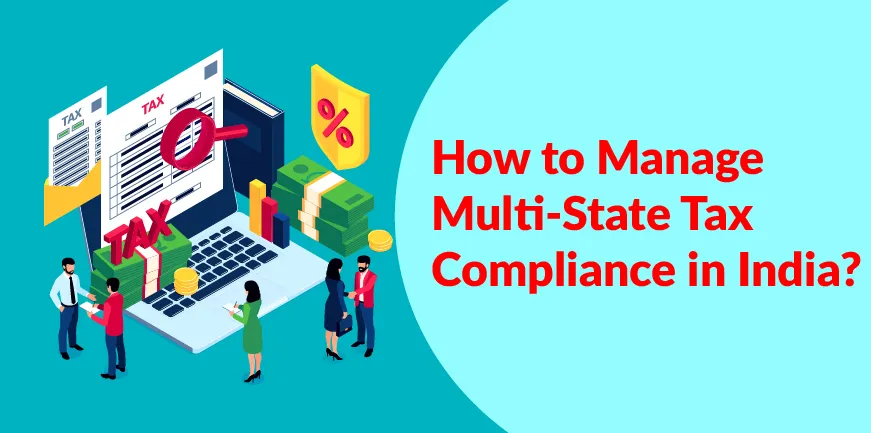
Managing multi-state tax compliance, especially in this volatile economy, where businesses are expanding in fast-growing cities like Mumbai and emerging cities like Bengaluru, Chennai, can be extremely challenging. Why? GST registrations, professional tax slabs, and e-way bill rules of every state are distinct. This makes carrying out routine operations chaotic, as they must meet deadlines and liabilities if not managed properly. Managing multi-location tax compliance can prevent organizations from hefty penalties, fines, and give them the confidence to grow without fear of being at fault compliance-wise.
What Is Multi-State Tax Compliance in India?
Multi-state tax compliance in India is a duty or commitment that businesses operating across different states have to comply with the local tax laws, regulations, and filing requirements of each specific state. While GST (Goods and Services Tax) has made taxation quite straightforward and similar across all states, each state still has the authority over various compliance aspects. This creates a complex regulatory landscape.
Why do Businesses Struggle with Multi-State Tax Compliance?
Businesses often struggle to maintain multi-state payroll tax compliance as they juggle different state-level rules, registrations, and procedures on top of complex national tax requirements.
1. Varied registrations, different rules
Every state in India has separate GSTINs, professional tax rules, labour laws, and shops and establishments registrations, each with different forms, portals, and timelines. Even if you just have one employee in a different state, you must comply with that state’s specific rules and have the necessary registrations and filings.
2. Complex compliance and frequent changes
Different states have operations that must follow GST returns, e-invoicing, e-way bills, TDS, and state-wise audits, which require hundreds of hours annually, for MSMEs with smaller finance teams. Frequent amendments, state-wise changes make it hard to stay updated, causing confusion and disputes despite the one tax rule.
3. Manual processes and weak infrastructure
Companies that are still using the old manual spreadsheets, paper records, and state-wise manual tracking are bound to make mistakes in calculating, miss due dates, and may produce inconsistent data across locations.
4. Less expertise and poor coordination
Smaller or fast-growing businesses usually don’t have in-house compliance specialists for each state; instead, they rely on a CA. But the problem with this is a blurry compliance view. The compliance responsibilities are given to different department leaders or local offices, which fails to give a whole overview of the compliance state.
What Taxes Are Involved in Multi-State Compliance?
Taxes in multi-state compliance include GST taxes that are state-specific, Professional Tax(PT), Labour Welfare Fund(LWF), and national payroll taxes such as TDS, EPF, and ESI.
| Tax Type | Description | Multi-State taxes |
| GST (CGST/SGST/IGST) | Unified indirect tax on goods/services; separate GSTIN per state mandatory for operations exceeding thresholds or interstate supplies . | Intra-state: CGST+SGST; Inter-state/branch transfers: IGST; E-invoicing uniform above ₹5 Cr turnover; E-way bills for goods >₹50K . |
| Professional Tax (PT) | State-level tax on income/employment; slabs vary (e.g., ₹200-₹2,500/month in Maharashtra/Karnataka) . | Mandatory in 15+ states (e.g., Tamil Nadu, Gujarat); absent in Delhi/Haryana; separate registrations/filings per state . |
| Labour Welfare Fund (LWF) | Employee welfare contributions: rates differ (e.g., ₹20/month employee + employer in Maharashtra) . | Applicable in 8-10 states (Karnataka, Gujarat, Andhra Pradesh); varying due dates/forms; no requirement in Delhi/Rajasthan . |
| TDS (Income Tax) | Withholding on salaries/professional fees; centrally governed but state-impacted by allowances . | State-wise salary variations (HRA, etc.) affect slabs; monthly/quarterly filings via state payroll . |
| EPF & ESI | Provident Fund (12% each employer/employee >20 staff); ESI health insurance (<₹21K salary) . | Centralized portals but state-specific documentation/inspections; LWF integration adds layers . |
What Registrations Do You Need for Multi-State Compliance?
Some of the primary registrations needed for multi-state compliance-
1. Goods and Services Tax (GST) Registration:
Businesses must obtain a separate 15-digit GST identification number (GSTIN) in every state where they have their establishment, even below the 40lakhs/20 lakhs threshold.
As of April 1, 2025, separate ISD registration to distribute input tax credit to their branches has become compulsory for businesses that must adhere to multi-state tax compliance efficiently.
2. Shops and Establishment Registration
Every office, warehouse establishment must be registered under the Shops and Establishments Act. They must renew their licenses every 1-5 years. These cover working hours, leaves, etc. This is a requirement of the state and has different timelines and rules.
3. Professional Tax (PT) Registration
Professional tax is a state-level tax that is mandatory for employers (having more than 20 employees) in states like Maharashtra, Karnataka, Telangana, West Bengal, Assam, and Gujarat. The slab rates, registration norms are different in every state.
4. Labour Welfare Fund (LWF) Registration
Just like PT, contributions must be made to LWF in some states, like Maharashtra, Karnataka, Gujarat, and Haryana, each of which has different payment cycles and contribution rates.
5. Contract Labour (Regulation and Abolition) Act (CLRA) Registration
If you employ workers in a new location, both the primary employer and the contractor may have to have separate licenses/registrations.
6. Local municipal registrations
Depending on the city, you may need local permits or trade licenses for office boards or signage.
7. Provident Fund (PF) and Employees’ State Insurance (ESI) Registrations
Single national EPFO registration, but location mapping mandatory for multi-state; monthly ECR filings; Single ESIC registration with branch-wise coverage; state inspections possible
What Documents Are Required for Multi-State Tax Compliance?
A set of KYC, business, and premises documents is a must for businesses operating in multiple states.
1. Core business and KYC documents
- PAN of the businesses, whether it’s a company/LLP/proprietor, and key promoters or directors.
- Incorporation certificate/partnership deed/LLP agreement or other business registration proof
- Identity proof and registered address proof like Aadhar, passport, voter ID, driving license, with contact details and photographs.
2. GST Registration (Per State)
- Business PAN, documents of incorporation, and authorised KYC signature
- Proof of primary and additional places of business establishment in that state: electricity bill, property tax receipt, rent/lease agreement, NOC from owner, etc.
- Bank account proof like a bank statement or a cancelled cheque, and digital signature certificate, and a board resolution/authorisation letter.
3. Professional Tax (PT) and LWF
- Incorporation certificate, PAN/TAN of the organization, address proof of where the office is in the state, and a list of employees with their salary details for PTRC (employer) registration.
- For LWF states, details of the office establishment, number of employees, and how they are categorized, salary information, and sometimes existing labour registrations
4. Shops and Establishments, and Labour Registrations
- Incorporation certificate, PAN/TAN of the organization, details of the office establishment in the state, and a list of employees with their salary details for PTRC (employer) registration.
5. Payroll, EPF, ESI, and TDS support
- Employee master data: IDs, PANs, Aadhar, salary structure, date of joining, and mapping location-wise for each state
- Bank details to pay salaries, PF, ESI challan, and TDS, like a bank statement or a cancelled cheque, TAN registration for remittance and returns.
How to Manage GST Compliance Across Multiple States?
The Goods and Services Tax (GST) regime mandates businesses to obtain separate GST registrations for each state where they have a place of business.
1. Mandatory separate registration
Each state operates as a separate jurisdiction under GST. If your business operates in five states, you must apply for five distinct GSTINs (one per state), regardless of the size of operations in each region.
2. Threshold limits
While the general threshold for GST registration is ₹40 lakhs for goods and ₹20 lakhs for services (₹10 lakhs for special category states), any interstate supply automatically requires registration, even if the turnover is below the threshold.
3. Compliance per GSTIN
Every state-wise registration has independent compliance. This includes maintaining separate books, filing state-specific GST returns (GSTR-1, GSTR-3B), and reconciling input tax credits. Mistakes in one GSTIN do not affect others but must be managed separately.
4. Branch transfers
Transfer of goods between branches in different states is treated as taxable supplies under GST, requiring proper invoicing and tax payment.
5. Technology & tracking
To manage multiple GSTINs the right way, it’s essential to use a reliable accounting software and ensure compliance tracking can be done from one place to avoid errors and penalties.
How to Manage Professional Tax (PT) Across States?
- An employer (corporates, partnership firms, sole proprietorship, etc.), also being a person carrying on trade/profession, is also required to pay professional tax on their trade/profession again subject to the monetary threshold, if any, provided by the respective state’s legislation.
In such a case, the employer needs to register and obtain both a professional tax registration certificate to be able to pay professional tax on his trade/profession and a professional tax enrolment certificate to be able to deduct the tax from his employees ‘ pay. Further, separate registration may be required for each office, depending on the respective state’s legislation. - Persons who are carrying on a freelancing business without any employees are also required to register themselves, subject to the monetary threshold, if any, provided by the respective State’s legislation.
However, a professional tax levy is subject to the exemption provided by the respective State to certain categories. For example, parents or guardians of any person who is suffering from mental retardation or blind persons are exempted, among others, from the levy of Karnataka Professional tax.
How to Handle Payroll for Multi-State Tax Compliance?
1. Know your employees’ location
Know the exact addresses of where your employees work and make sure they are classified under one of the categories, like permanent/temporary, to apply the right rules. Bear in mind that specific rules apply to remote workers as well, depending on the state they are working in.
2. State-specific deduction
You must make sure to configure a proper payroll software for different PT slabs. For example, a Rs. 2500 per month cap in Maharashtra and allowances affecting TDS.
3. Automated Calculations and Remittances
Calculate EPF (12% of both employee and employer’s side, up to Rs 15000), ESI (<21K salary), TDS per slabs, PT/LWF; generate challans and automate filing via EPFO, ESIC, TRACEs portals.
4. Payroll processing and reporting
Salaries are to be processed centrally with state-wise splits, issue payslips, and file GSTR-1/3B per GSTIN, monthly PT/LWF, quarterly TDS (24Q).
5. Audit and Reconciliation
Digital registers are to be maintained, reconciliation of ITC across all states, quarterly review must be conducted to update key aspects of wage ceilings or new LWF states.
6. Use cloud platforms
Platforms like Zoho Payroll with API integrations to EPFO/ESIC/Shram Suvidha for error-free ECR filings and Form 16. You can store and manage data from one place as per local rules, you may outsource your payroll and compliance needs to an expert if you are operating GCCs or from multiple locations. This can cut reconciliation time significantly. Retain 3-year records for audits to avoid penalties up to 50 lakhs.
What Are the Penalties for Non-Compliance in Different States?
Some of the common penalties for non-compliance fall into categories like
- Monetary fines that can range from several lakhs to crores of rupees, depending on the errors made
- Interests are charged if there are financial dues
- Fraud, tax evasion, environmental harm, or labour law breaches can lead to criminal prosecution
- Licenses can be suspended, bank accounts can be frozen, and operations can be halted due to non-compliance.
Specific-state implementation of laws:
1. Labour laws
- Wage violations can cost up to 50000 rupees and more, or imprisonment
- Not depositing EPF/ESI contributions can lead to paying interest and damages ranging from 5-25%
- Non-maintenance of records can lead to fines up to rupees 50000
2. Environmental laws
- Violations of Air or Water Pollution Acts can lead to 6 years in jail and fines up to 10,000 and 1lakh fines respectively.
- The NGT can impose taxes ranging from a lakh to several crores to cover environmental damage.
- Operating without an FSSAI licence can lead to 6 months of jail time and a fine of up to 5 lakhs rupees.
3. Tax Laws
- GST non-compliance can lead to hefty interest and fines. For example, if you don’t generate an e-invoice, it can lead to a 100% penalty of the tax value involved or rupees 10000, whichever is higher.
- Not filing ITR on time can result in fines of up to rupees 5000 to 10000, depending on timing and income level.
How to Create a Multi-State Tax Compliance Checklist?
Both central and state-specific regulations must be accounted for to create a multi-state tax compliance-
1. Identify business operations in each state
- Consider every state you have an establishment or are doing business in
- For every state, you must have a separate GST registration.
2. List of Applicable laws
- GST laws have state-specific requirements for registration and compliance
- Direct tax laws like the Income Tax Act, 1961, apply nationally
- Professional Tax, Shops and Establishments Act, and other local labour laws that vary by state
3. Compliance categorization by frequency and type
- Monthly/quarterly- GSTR-1, GSTR-3B, TDS payments and returns, and advance tax instalments
- Annual- GSTR-9, GSTR-9C, ITR filing and statutory audits
- E-way bills are generated for goods movement, e-invoices are generated where its applicable, and changes are updated.
4. Note deadlines
- A compliance calendar with specific deadlines for filing and payments
- All required forms that are required for each task must be listed.
5. Assign responsibilities
- Specific individuals or teams are assigned to carry out every task and each state’s compliance to ensure accountability.
6. Implement a tracking system and automate it
- Use a compliance software or calendar reminder to track deadlines and multiple GSTINs effectively.
- Automates tasks like tax calculations and return filing to minimize manual errors.
7. Conduct regular reviews and audits
- Monthly compliance meetings must be conducted, and internal audits must be conducted on a quarterly basis to find any issues
- Reconciliation of all purchase invoices with GSTR-2A/2B data to ensure correct input tax credit claims.
When Should Companies Outsource Multi-State Tax Compliance?
Here are some considerations before outsourcing-
- If a company is operating in more than two states and is employing remote workers, which results in PT/LWF obligations
- facing frequent audits/penalties due to manual processes
- Want experts to handle GSTIN filings, state reconciliations, and updates.
- GCCs and multilocation firms can benefit from outsourcing and can reduce compliance costs while ensuring accuracy and easy scaling
- If a company is looking to scale rapidly, is facing changes in regulations, or has payroll complexities across jurisdictions.
How Alp Consulting Helps Manage Multi-State Tax Compliance
Alp Consulting specializes in GCCs and delivers end-to-end risk mitigation, audit readiness, and real-time dashboards, transforming compliance from a liability into a strategic advantage. Outsourcing multi-state tax compliance to us empowers businesses to navigate India’s fragmented rules confidently, avoid disruptions, and prioritize innovation over endless filings.
FAQs- Frequently Asked Questions
1. What is multi-state tax compliance?
Multi-state tax compliance in India is a duty or commitment that businesses operating across different states have to comply with the local tax laws, regulations, and filing requirements of each specific state.
2. Do I need separate GST registration for each state?
Yes every state needs a separate 15-digit GSTIN for operations exceeding thresholds or interstate supplies.
3. How is professional tax different in each state?
Professional tax is a state levied tax on all earned wages. Slab rates and payment rules vary from one state to another.
4. How do companies manage payroll tax across multiple states?
Companies manage multi-state payroll taxes by using specialized software for automation, registering in each state where they are present, centralizing policies while allowing for local rules, and staying updated on varying state laws for income/local taxes, disability, and leave.
5. What is the simplest way to stay compliant in multiple states?
Use nexus tracking tools, centralize your tax calendar, automate sales tax calculations, consult a tax advisor and maintain good records.
6. Can tax compliance be fully outsourced in India?
Yes, tax compliance can be fully outsourced in India. Companies like Alp Consulting provide end-to-end outsourced accounting and compliance solutions, ensuring your financial records are accurate, compliant, and efficiently managed.
7. What are the common penalties for multi-state non-compliance?
Monetary fines that can range from several lakhs to crores of rupees, depending on the errors made. Interests are charged if there are financial dues. Fraud, tax evasion, environmental harm, or labour law breaches can lead to criminal prosecution, Licenses can be suspended, bank accounts can be frozen, and operations can be halted due to non-compliance.
Contact Us For Business Enquiry

Hariharan Iyer
Hariharan Iyer is the Vice President – Operations at ALP Consulting, bringing over 40+ years of experience in HR outsourcing and labour law compliance. He leads end-to-end HRO operations, ensuring process efficiency, statutory compliance, and seamless service delivery for clients across industries. With a strong background in labour law governance and workforce management, Hariharan plays a key role in driving operational excellence and compliance-led HR solutions at ALP Consulting.