
The Future of Global Capability Centers (GCCs) in India: 8 Key Trends to Watch in 2026
07/11/2025
6 Latest Executive Search Strategies in 2026 – Latest Trends
14/11/2025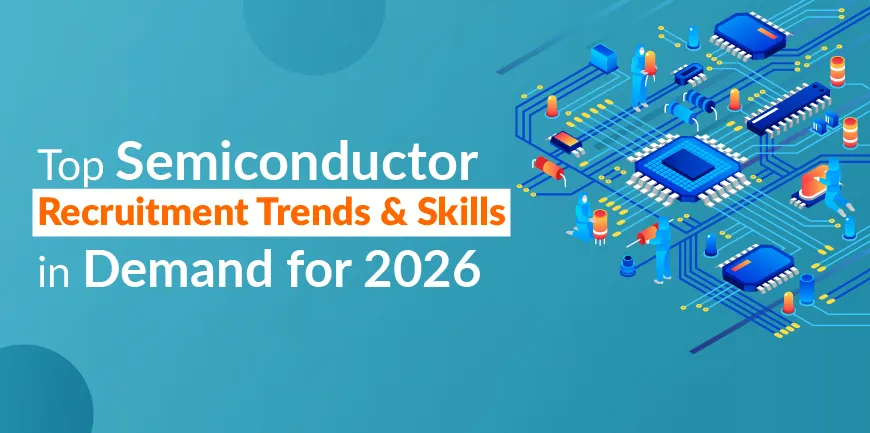
The semiconductor industry is undergoing a massive transformation with an influx of investments mainly in chip manufacturing, design innovation, and AI-driven hardware. There has been an explosion of skilled talent in this sector, and the talent war in this industry is now a reality. Organisations are rethinking and recrafting their strategies to attract professionals with tech skills that are ruling the industry.
According to reports, the global semiconductor market is projected to reach about US$1.2 trillion by 2034, representing a CAGR of ~7.5% from 2025 to 2034.
Reports suggest that in India, the sector is growing at a compound annual growth rate of approximately 13% to 20%
Are you planning to optimise your semiconductor business? Let us take you through some of the top recruitment Trends in the semiconductor industry and help you explore the various emerging demands that influence the sector today.
Why is Semiconductor Hiring Booming Globally?
Many factors have fuelled the current spike in semiconductor and hardware design recruitment. Let us have a look at them:
- AI and Edge Computing: With the advent of AI in the semiconductor industry, there is a sudden demand for more agile and efficient chips to power up AI-driven systems.
- Global Dynamic Realignment: There is a trend of nations across the globe investing in Nations are investing in domestic chip manufacturing for supply chain security
- Industry Expansion: Several design houses and startups are being set up, propelled by venture funding and AI hardware innovation.
- Technological Integration: This is when software and hardware designs are combined using advanced computing architectures, reshaping skill requirements.
Why Is Semiconductor Hiring Becoming More Competitive in 2026?
1. Design to Manufacturing Shift
There has been a radical shift from design-focused hiring practices in the sector to fab-prepared talent requirements. According to reports, the sector is expected to employ over 220,000 professionals by FY 2026, and reach 1 million jobs by 2026–27. New fabrication plants are being built, and there is a shift from construction to operation that is being witnessed.
2. High Demand Vs Limited Supply
India has a large supply of skilled and qualified engineers; however, there is a dearth of specialised engineers who are trained for niche domains in the semiconductor sector, increasing competition for businesses and forcing them to hire professionals from overseas.
3. Global Competition
Indian companies have to compete heavily with organisations across the globe in a scenario where semiconductor talent demand is extremely high everywhere, and every fab around the world is aligning its talent acquisition process to find talent from the same talent bank.
4. AI & Hardware Integration
There is a high demand for engineers who are well-trained in specialised fields, such as having expertise in AI chips and creating vast opportunities for engineers proficient in chip designing and integrating them into systems and software.
5. Need for Speed
With fabs ramping up their operations in 2026, there is no time for lengthy recruitment processes. These factories are searching and trying to find skilled professionals quickly, without wasting any time, as they immediately want individuals to manage high-end systems and work on niche equipment.
What are the Top Semiconductor Tech Skills in Demand
The latest skills that companies are looking for are not restricted to traditional designing but also new, innovative designing skills. Let us find out what they are.
1. Chip Design & Verification
- RTL design using Verilog, SystemVerilog, or VHDL
- UVM-based verification and testbench automation
- Emulation/FPGA prototyping and post-silicon validation
2. Physical Design & DFT
- Synthesis, place and route (PnR), and timing closure
- Tools like Synopsys, Cadence, and Mentor Graphics (Siemens EDA)
- Design for Test (DFT) and yield optimisation
3. Analogue & Mixed-Signal (AMS)
- Circuit simulation, layout design, and signal integrity analysis
- Knowledge of SPICE, Spectre, and Virtuoso environments
4. Hardware-Software Integration
- Embedded systems and firmware development (C/C++/Python)
- SoC bring-up, bootloader, and device driver experience
- Hardware security and low-level OS knowledge
5. AI Hardware & System Architecture
- Architecture design for AI accelerators, GPUs, and NPUs
- Familiarity with RISC-V, ARM, and custom instruction sets
- High-Level Synthesis (HLS) and AI workload optimisation
6. EDA & Automation Skills
- Scripting in Tcl, Python, and Perl for flow automation
- EDA toolchain integration and design flow optimisation
What are the Soft Skills Driving the New Semiconductor Workforce?
The semiconductor landscape is experiencing a revolution in terms of skill and talent requirements. Today, mastering technical skills is not enough anymore. Professionals are expected to have special skills, like cross-functional collaboration, enabling them to communicate across departments with transparent communication styles for faster and smoother integration of processes.
What Are the Top 10 Recruitment Trends in the Semiconductor Industry in 2026?
Just like technologies, the recruitment landscape in semiconductors is also evolving rapidly and here are a few ways in which companies are looking at recruiting talent:
1. Rise in Global Talent Hubs and Hybrid Models
Organisations today are scaling up their design hubs and venturing into locations beyond conventional centres. The hubs like. India, Vietnam, and Eastern Europe are gaining momentum and witnessing groundbreaking hiring in chip design. For certain roles like design verification and software-integrated positions, the hybrid work model has proven beneficial, so organisations are increasingly adopting it.
2. Campus-to-Industry Pathways
Semiconductor companies are focusing on talent development that is long-term, and to do that, they are investing heavily in university collaborations, systematic internship structures, and training modules. The aim is to build a sturdy talent pipeline that is long-lasting and beneficial for current and future purposes. Students from their early academic journey are trained and groomed for the purpose of aligning with the demand of the semiconductor sector.
3. Employee Development and Mobility
Talent scarcity is a persistent factor that is influencing the semiconductor sector, and to address this issue, companies are focusing on upskilling and reskilling their existing internal teams. This initiative enables organisations to capitalise on institutional knowledge as they try to bridge skill gaps in crucial facets.
4. AI integration in Hiring Processes
As we are aware, AI is transforming industries. The semiconductor industry is also being heavily influenced by AI-driven technologies, and they are driving companies to rethink how evaluation and selection of talent are conducted. AI can now analyse profiles and CVs for specialised design skills. The platforms can also accurately evaluate digital design portfolios, analysing candidates’ past knowledge and projects to determine their technical skills and in-depth expertise.
5. Employer Branding is a Priority
Next-gen engineers and top-notch talent today desire to work in organisations that have a positive brand image in the industry, along with ample growth opportunities. Candidates look for companies prioritising innovation, focusing on mentorship programs, and having a reputation for initiating high-end technical projects. Employer branding is one of the major factors that attract top talent today.
6. Internships & Apprenticeships are Vital
One of the most significant semiconductor hiring trends today is designing several internship programs that offer practical experiences in design and fabrication. This helps HR teams and employers to assess skills and onboard talent for future purposes, eliminating the chances of skill gaps.
7. Talent Hub Globalisation
Semiconductor firms today are increasingly focusing on tapping into skilled talent in various regions across the world rather than concentrating on centralised epicentres. This is enabling them to identify diverse talent from across the globe.
8. DEI is a Priority
With competition on the rise in the labour market, enterprises have started focusing on integrating inclusive hiring practices and implementing DEI measures, ensuring that professionals with top-notch skills are hired even from unrepresented groups, and there is no room for bias or unfair practices.
9. Data-Powered Tools
With AI ruling the sector, several AI-driven tools and platforms are helping companies to search and identify candidates from expanded talent pools, catering to meet specialised requirements and matching candidates to meet specific and niche needs. There is a rise in the utilisation of data analytics to predict future talent needs.
Alp Consulting Ltd, with its 30 years of experience in recruitment and staffing, partnered with the semiconductor industry and hired individuals for semiconductor positions for top clients, leveraging AI tools and data analytics.
10. Focus on Manufacturing Expertise
There is a high focus today on hiring for engineering roles that are not just associated with design engineering but are also related to the supply chain industry, process engineering, and a high requirement to be met in fab expansions and to support localisation strategies.
What are the Challenges Organisations Will Face?
1. Extreme Talent Crunch
The semiconductor industry is expanding like no tomorrow, and companies globally are finding it difficult to find skilled and talented professionals, especially for niche domains.
2. Competition Surge Across Firms and Geographies
There is high competition between countries globally, who are trying to attract top talent from across countries. Similarly, large tech firms and startups are trying to tap into talent pools and draw and retain the best of talent.
3. Complicated Hiring Cycles
The recruitment process in the semiconductor sector is usually complex, especially when it comes to hiring for chip design or verification roles, which require layers of assessment phases, portfolio reviews, etc, resulting in a lengthy hiring procedure and in losing out on candidates to competitors.
The Road Ahead
With the semiconductor ecosystem evolving, the hardware and software systems are merging, the future talent must realise that there is a plethora of opportunities beyond transistors, and the smart move is to integrate AI, data science and system design.
The boom opens up a great pathway for professionals to develop their careers in semiconductors and progress with substantial technical and soft skill capabilities to compete in global arenas. Companies, meanwhile, are getting an opportunity to rework and reimagine their recruitment methods by investing in creating a smart framework to stay ahead of the curve and top the global semiconductor race.
Key Takeaways
- Talent War is Intensifying
- Focus on Niche skills
- Smarter, Faster, AI-Powered Hiring
- Building Future Talent Banks
- Globalisation, DEI, and Employer Branding are Core Strategies
Frequently Asked Questions
1. What skills are required for semiconductor jobs in 2026?
For semiconductor jobs in 2026, a combination of advanced technical expertise in AI-assisted design, 3nm or lower node development, and specialised manufacturing skills is required.
2. Why is semiconductor hiring so competitive?
Semiconductor hiring is highly competitive due to a sudden surging demand, a limited supply of specialised talent, and massive, simultaneous global expansion of fabs.
3. Which semiconductor roles are the highest paying?
The highest-paying roles in the semiconductor sector are typically senior technical and management positions, like Senior Member of Technical Staff (SMTS), Staff Engineer, and Principal Engineers in VLSI, ASIC, or Physical Design.
4. Is a career in semiconductors a good choice in India?
In India, a career in the semiconductor sector is a great choice and offers ample opportunities with rapid industry growth, government incentives, and a high demand for skilled professionals.
5. How long does semiconductor hiring take?
Semiconductor hiring generally is a lengthy process and takes longer than other tech sectors, with methods for niche, critical, or leadership roles often spanning 90 to 120 days or longer.
6. What industries are driving semiconductor recruitment growth?
Industries driving semiconductor recruitment growth are Artificial Intelligence (AI) and Data Centres, automotive, consumer electronics, 5G and connectivity, etc.
Contact Us For Business Enquiry

Amit Saproo
Amit Saproo is the Head of Operations at ALP Consulting with nearly 17 years of experience in Executive Search, RPO, Leadership, and IT & Engineering recruitment. He leads nationwide recruitment programs across Technology, BFSI, and R&D domains, driving strategic hiring solutions for diverse client needs. Amit excels in building and managing high-performance teams that deliver scalable, end-to-end recruitment and consulting services.