
Impact of Labour Codes on IT & GCC Companies in India (2026 Guide)
17/04/2026
EOR vs Payroll Solutions: Key Differences, Costs & When to Choose
20/04/2026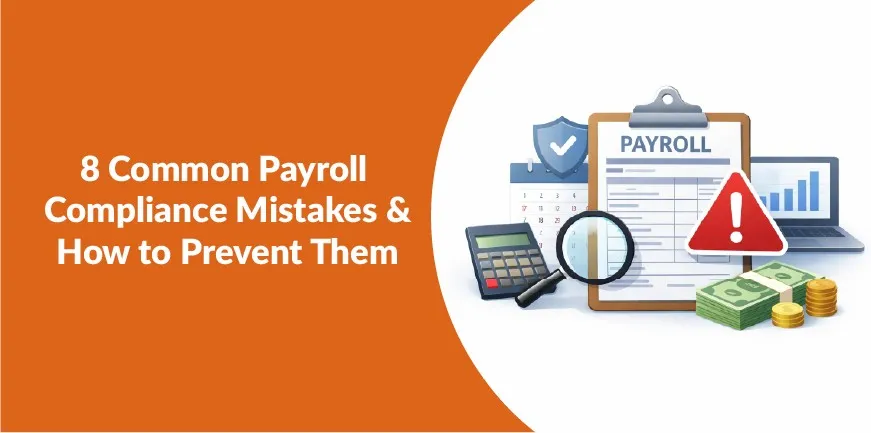
Every payroll mistake is a potential compliance risk; prevention always costs less than correction.”
Payroll has transcended from a salary processing process to a strong tool for boosting employee trust and brand reputation. However, mistakes are inevitable due to human involvement, and payroll is no exception. Is there an HR payroll mistakes list that is applicable universally for every business and industry? The short answer is yes. Also, is there a way to mitigate payroll errors before they escalate into serious consequences? The answer is yes for this also.
Without further ado, let’s discuss 8 common payroll compliance mistakes and how to prevent them effectively!
Click to Read: What is Payroll Compliance?
What are the 8 Most Common Payroll Compliance Mistakes?
Here are 8 common payroll compliance mistakes companies must avoid to prevent negative outcomes:
1. Incorrect Employee Classification
Misclassifying employees as independent contractors or vice versa makes it to the top of HR payroll mistakes list. Such issues can lead to non-compliance with labour laws, resulting in penalties, back payments, and legal disputes affecting business credibility.
Using a contractor for core business functions for more than 6–12 months (the “operational drift” rule) now triggers a high-risk flag in 33% of automated payroll audits.
2. Errors in Salary Calculations
Incorrect calculation of gross & net salary, OT (overtime), bonuses, or statutory deductions can trigger payroll inaccuracies. This leads to employee dissatisfaction, compliance violations, & financial discrepancies that may bring about external audits or corrective actions.
Globally, 82 million employees (54% of the workforce) encounter some form of payroll issue annually, with OT & bonus miscalculations topping the list.
3. Non-Compliance with Tax Regulations
Failing to correctly calculate, deduct, or deposit income tax & other statutory taxes on time as per the IT Act 2025 can result in penalties, interest charges, & increased scrutiny from regulatory authorities.
Under the new 2026 tax provisions, persistent failure to file returns can attract a penalty of Rs. 5,000 /day until the default continues.
4. Delayed Statutory Filings
Late submission of returns related to provident fund, ESI, or professional tax can attract penalties, disrupt compliance status, & create red flags during inspections or financial audits.
If an employee needs immediate medical while the employer is in default of missing ESI remittance, the ESIC can step in & legally recover the entire cost of the medical expenses from the employer with imposition of additional interest & penalties.
5. Ignoring Minimum Wage Laws
Not achieving parity with prescribed minimum wages across regions or industries can result in severe legal consequences, employee disputes, & reputational damage, especially during government inspections or compliance checks.
Previously, minimum wage laws only applied to specific “scheduled” jobs. In 2026, 100% of employees across all sectors are legally entitled to the minimum wage.
6. Poor Record Keeping
Inadequate maintenance of payroll records, employee data, & compliance documents can create bottlenecks during audits, hinder transparency, & elevate the risk of payroll compliance issues.
7. Failure to Update Regulatory Changes
Not keeping abreast with the latest amendments in labour laws, tax rules, or statutory requirements can lead to out-of-sync payroll practices, resulting in errors, penalties, & compliance gaps.
Due to a fully automated TRRN (Temporary Return Reference Number) in place, if any system doesn’t make an update to match the new 15th-of-the-month deposit logic, the “Defaulter” tag is attached to the company the very next day, resulting in immediate inspection from concerned authorities.
8. Inconsistent Payroll Processes
Lack of standardized payroll procedures can lead to discrepancies, delays, & errors in salary credit. This affects compliance accuracy & brings down overall operational efficiency within the organization.
On average, payroll errors & inconsistent procedures account for 2% to 5% of a company’s total annual payroll spend. The only way forward is to standardize the payroll processes without disrupting operations.
Why is Payroll Compliance Important?
Here are 5 reasons that highlight the importance of payroll compliance:
1. Avoids Legal Penalties
Achieving full payroll compliance ensures adherence to labour laws & tax regulations. Preventing payroll compliance mistakes helps organizations avoid fines, penalties, surprise audits, & potential legal complications or disputes.
2. Builds Employee Trust
Accurate & timely salary credits with correct deductions boost employee confidence, satisfaction, & retention while reducing payroll-related grievances or disputes.
Recent 2026 data shows that 49% of employees tend to look for a job change after experiencing just two incorrect payslips.
3. Ensures Financial Accuracy
Maintains precise payroll calculations, bringing down errors in wages, taxes, & contributions. This leads to better financial reporting & operational efficiency.
The global average payroll accuracy rate for companies using manual or legacy systems sits at 80.15%. This means nearly 1 in 5 payroll cycles contains an escalating error. This is why payroll compliance is non-negotiable to stay competitive & bring down costs for fixing payroll errors.
4. Supports Business Reputation
Strong payroll compliance practices boost organizational credibility, employer branding, trust among stakeholders, investors, & regulatory authorities in competitive markets.
In 2026, 88% of compliance leaders report that regulators are no longer tolerant of manual errors, shifting from “correction notices” to on-the-spot financial penalties.
5. Reduces Operational Risks
Systematic processes prevent payroll compliance issues, fraud risks, & mismanagement. This ensures smooth business operations & long-term organizational stability.
What Tax and Statutory Errors Occur in Payroll?
Here are 5 payroll processing errors examples in the areas of tax and statutory filings:
1. Incorrect Tax Deduction Calculations
Miscalculating income tax deductions due to outdated slabs or incorrect employee declarations during payroll processing cycles.
Example: An employee opts for the old tax regime and declares Rs. 1.5 lakh under Section 80C, but the payroll mistakenly applies the new tax regime without deductions. As a result, higher TDS is deducted every month, bringing down the employee’s take-home salary.
2. Delayed Tax Deposits
Failing to deposit deducted taxes within statutory deadlines leads to penalties, interest charges, & compliance risks.
Example: A company debits Rs. 2,00,000 TDS in April but deposits it 20 days late. This results in incurring of 1.5% monthly interest, i.e., Rs. 3,000 penalty, & compliance notices.
3. Errors in Statutory Filings
Incorrect or incomplete filing of returns like PF, ESI, or TDS creates discrepancies & audit issues.
Example: A company reports Rs. 5,00,000 wages in the PF return instead of Rs. 6,00,000 actual payroll. This mistake caused a contribution mismatch, audit flags, penalty notices, & mandatory correction filings later.
4. Non-Compliance with PF and ESI Contributions
Computational errors or non-remittance of PF & ESI contributions violate statutory norms & attracts penalties.
Example: A company underreports salaries, contributing to PF on Rs. 10,000 instead of Rs. 15,000. This leads to a shortfall, penalties, interest liabilities, & corrective payments after inspection by authorities.
5. Mismatch in Payroll & Tax Records
Inconsistencies between payroll data & filed tax returns trigger notices, audits, & additional compliance scrutiny.
Example: A Company reports Rs. 8,00,000 salary in payroll but files Rs. 7,20,000 in TDS return (Rs. 80,000 deficit). This triggered mismatch, tax notices, employee grievances, audits, & mandatory reconciliation with revised filings.
How Can Businesses Prevent Payroll Compliance Mistakes?
1. Implement Automated Payroll Systems
Use a reliable payroll management system with every available feature to make sure accuracy, compliance updates, & error-free calculations consistently.
2. Stay Updated with Regulations
Regularly trace labour law & tax updates to maintain compliance & avoid outdated practices.
3. Conduct Regular Payroll Audits
Perform periodic internal audits (best timeline-every 3months) to filter out & isolate errors, gaps, & ensure ongoing compliance accuracy.
4. Train Payroll and HR Teams
Provide continuous training to payroll, HR, employees, and the management team on compliance rules, tax laws, & payroll processing best practices.
5. Partner with Payroll Experts
Outsource payroll to experienced providers like Alp Consulting Ltd for compliance assurance, accuracy, & reduced administrative burden.
How Does Payroll Outsourcing Help Ensure Compliance?
1. Access to Compliance Expertise
Payroll providers ensure payroll compliance mistakes are mitigated by streamlining every task to match the evolving labour laws, tax regulations, & statutory requirements.
2. Accurate and Timely Filings
Experts manage timely tax deposits & statutory filings, bringing down the risk of penalties to zero.
3. Automated and Error-Free Processing
Cutting-edge payroll systems drive away manual errors in salary calculations, deductions, & compliance reporting.
4. Regular Compliance Monitoring
Continuous surveillance from payroll outsourcing experts isolates potential mistakes early in the process. This ensures corrective actions are done & dusted before audits or inspections are initiated by concerned entities.
5. Reduced Legal & Operational Risks
Outsourcing brings down compliance risks, prevents fines & disputes, thereby establishing smooth payroll operations.
Conclusion
Payroll compliance is no longer optional in 2026: it is a critical business function that directly impacts financial accuracy, legal standing, and employee trust. By eliminating common and unique payroll compliance mistakes and adopting structured processes, businesses can avoid penalties, audits, and operational disruptions & achieve better outcomes in terms of profitability & employee experience.
To derive 100% payroll compliance, collaborate with Alp Consulting today & get connected with the best solutions designed specifically to suit individual business needs & goals.
Contact Us For Business Enquiry

Hariharan Iyer
Hariharan Iyer is the Vice President – Operations at ALP Consulting, bringing over 40+ years of experience in HR outsourcing and labour law compliance. He leads end-to-end HRO operations, ensuring process efficiency, statutory compliance, and seamless service delivery for clients across industries. With a strong background in labour law governance and workforce management, Hariharan plays a key role in driving operational excellence and compliance-led HR solutions at ALP Consulting.