
8 Common Payroll Compliance Mistakes and How to Prevent Them
20/04/2026
What Is the Difference Between MSP and RPO?
20/04/2026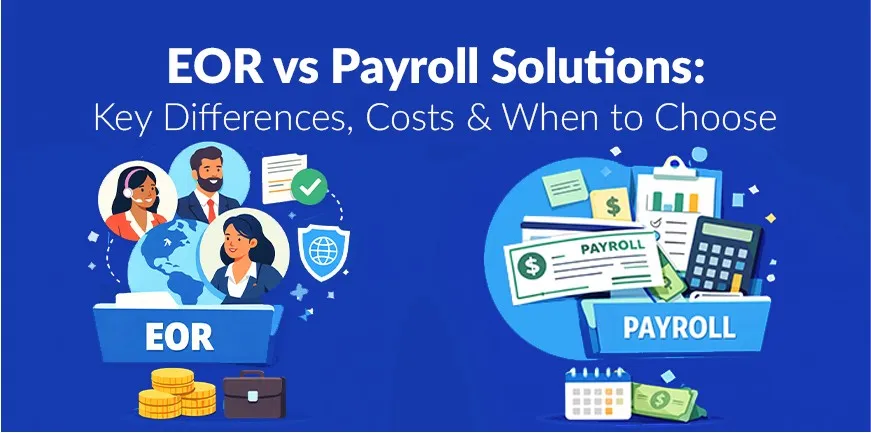
Both EOR and payroll solutions are vital for employee management, and choosing either of them requires strong due diligence. Understanding where each of them fits can offer great leverage for companies to maximise their business outcomes and brand value management.
Let’s commence a tug of war between EOR vs Payroll Providers and see how they weigh against each other in terms of applicability, pricing, scope, usability, and other related aspects.
What is EOR (Employer of Record)?
Before understanding the difference between EOR and payroll, we must know individual service in isolation. Let’s understand EOR or Employer of Record first.

EOR (Employer of Record) is a TPA that legally employs talent on behalf of a company. It manages compliance, payroll, & HR administration. The global EOR market is valued at $5.02 Billion in 2026, growing at a steady CAGR of over 6%. Also, SMEs contribute to 58% of overall demand, as they use EORs to compete with tech giants for global talent without the overhead of local subsidiaries.
EOR’s scope includes global hiring without entity setup, risk mitigation, and workforce scalability. Services under EOR vertical include employment contracts, payroll processing, tax filings, benefits administration, statutory compliance, onboarding, and offboarding, enabling companies to focus on core business operations.
What are Payroll Solutions?
Now that we have understood EOR services, it’s time to look at payroll solutions from an individual standpoint as we go further along with the EOR vs payroll comparison.
Payroll solutions are systems or a set of services that manage employee compensation, ensuring accurate and timely salary processing. Currently, the Indian payroll outsourcing market is profiting at $359.2 million in 2025-26 & is touted to skyrocket to nearly $600 million by 2034.
Payroll services cover salary calculations, tax deductions, statutory compliance, payslip generation, & reporting. These solutions can be software-based, like HRMS, or outsourced services involving seasoned experts like Alp Consulting Ltd.
Payroll solutions help organizations bring down errors, maintain compliance with latest 4 labour codes, & improve efficiency. Moreover, by automating complex payroll tasks, payroll solutions enable businesses to focus on strategic operations & employee satisfaction.

EOR vs Payroll Providers: What are the Key Differences?
Here are the 10 key differences between an employer of record vs payroll:
| Basis | Employer of Record (EOR) | Payroll Provider |
| Legal Employer | EOR becomes the legal employer of the workforce | Client company remains the legal employer |
| Scope of Services | Covers end-to-end employment lifecycle management | Focuses mainly on payroll processing & salary disbursement |
| Compliance Responsibility | Fully handles labour law compliance & statutory obligations | Supports compliance, but responsibility lies with the client |
| Employment Contracts | Drafts and manages legally compliant employment contracts | Does not manage or own employment contracts |
| Global Hiring | Enables hiring in new countries without entity setup | Cannot hire without the client’s local entity |
| Payroll Processing | Includes payroll along with broader HR & compliance services | Core service is payroll calculation & processing only |
| Tax Filings | Manages employee taxes, filings, & statutory contributions | Assists with tax calculations & filing support |
| Employee Benefits | Administers insurance, benefits, & leave policies | Limited or no involvement in benefits management |
| Risk Management | Assumes employment-related risks & liabilities | Minimal risk involvement; client bears liabilities |
| Offboarding Process | Handles terminations, final settlements, & compliance | Processes final payroll but not full exit compliance |
When to Choose EOR Services?

Here are 5 scenarios that enunciate when to use EOR vs payroll:
1. Expanding into New International Markets
When entering new countries without a legal entity, EOR enables quick, compliant workforce hiring and operations. Here, EOR vs payroll for global hiring tussle is clearly won by EOR, as running payroll for firms without a license in a particular country is challenging.
2. Ensuring Full Compliance with Local Laws
When navigating complex labour laws, EOR assumes compliance responsibility, reducing risks & legal liabilities significantly.
3. Hiring Remote or Distributed Global Teams
When building remote global teams, EOR simplifies cross-border hiring, payroll, and employee management efficiently.
4. Reducing Administrative and HR Burden
When internal HR bandwidth is limited, EOR manages end-to-end employment tasks, saving time and resources. This results in the cost of EOR vs payroll going in favour of EOR.
5. Managing Short-Term or Project-Based Workforce
When hiring for short-term projects, EOR provides flexibility without long-term entity setup commitments, unlike payroll, who cost reduces only in the long run.

When to Choose Payroll Solutions?
Here are 5 scenarios that put payroll outsourcing ahead in the battle of EOR vs payroll providers:
1. Operating Within an Established Legal Entity
When a company has a local entity, payroll solutions efficiently manage salaries, taxes, & statutory compliance requirements.
2. Handling Large Employee Workforce Efficiently
When managing a large workforce, payroll solutions streamline salary processing, reduce errors, & improve operational efficiency significantly.
3. Maintaining Direct Control Over Employees
When businesses prefer direct employee control, payroll agencies support processing without handling employment responsibilities.
4. Cost-Effective HR and Payroll Management
When budget constraints exist, payroll outsourcing offers affordable solutions compared to full-service EOR employment models. This is true especially when we compare EOR vs payroll for startups.
5. Simplifying Routine Payroll and Compliance Tasks
When payroll needs are standard, solutions automate calculations, filings, and reporting without complex employment management requirements.
Cost Comparison: EOR vs Payroll Providers

Here is a cost of EOR vs payroll comparison through 5 different aspects:
| Aspect | EOR (Employer of Record) Cost | Payroll Provider Cost |
| Pricing Model | Higher, bundled fee covering employment, compliance, & HR responsibilities | Lower, service-based fee limited to payroll processing and statutory filings. |
| Compliance Costs | Included in service fee; EOR assumes full legal liability and compliance risk. | Separate or additional; the company bears compliance responsibility and potential penalties. |
| Employee Benefits & Insurance | Included or managed by EOR, adding to the overall cost but reducing admin burden | Typically excluded, the employer arranges benefits, increasing indirect costs. |
| Setup & Expansion Costs | Minimal upfront investment; no need to establish a local entity in new markets | Higher setup costs due to entity registration, legal setup, and infrastructure requirements |
| Scalability Costs | Scales easily but becomes expensive per employee at larger workforce sizes. | More cost-efficient at scale as per-employee processing cost decreases |
EOR vs Payroll Providers: Which is Better for Your Business?
Choosing between EOR vs payroll providers depends on your business goals, expansion plans, & compliance capabilities. An Employer of Record (EOR) is tailor-made for companies trying to make their presence felt in new market territories quickly without setting up a legal entity. On the other hand, payroll providers suit businesses with already established entities needing efficient salary processing & compliance support.
Moreover, EOR offers end-to-end workforce management, whereas payroll providers focus on transactional accuracy. Ultimately, the right choice between payroll outsourcing vs EOR depends on your operational complexity, growth strategy, and level of control required over employment functions.

Key Takeaways
- EOR enables global hiring without entity setup, ensuring full compliance.
- Payroll solutions focus on salary processing within existing legal entities efficiently.
- EOR handles end-to-end employment, and payroll providers manage transactional payroll tasks.
- Cost of EOR vs payroll: EOR is higher upfront, and payroll is more economical at scale.
- EOR vs Payroll Providers. Choice depends on expansion goals, compliance needs, and operational complexity.
Contact Us For Business Enquiry
Frequently Asked Questions
1. What is the difference between EOR and payroll solutions?
The key difference between EOR and payroll is that EOR acts as a legal employer managing compliance, contracts, and HR, while payroll solutions only handle salary processing, taxes, and statutory calculations.
2. When should a company choose EOR over payroll?
Companies should choose EOR when expanding globally, lacking a local entity, needing compliance support, or hiring remote employees across multiple countries.
3. Is EOR better than payroll services?
EOR is better for global hiring and compliance, while payroll services suit companies with entities needing only salary processing support.
4. What are the benefits of using an Employer of Record?
EOR enables global hiring, ensures compliance, reduces legal risks, manages HR tasks, and eliminates the need for establishing local entities.
5. How to choose between EOR and payroll solutions?
Choose EOR for global expansion and compliance management, & payroll solutions for cost-effective salary processing within established local business entities.

Yugandhara V. M
Yugandhara V. M serves as the Assistant Vice President – HRO at Alp Consulting Ltd., bringing over 14 years of rich experience in Human Resource Outsourcing, payroll management, and statutory compliance. He specializes in driving process excellence across HR operations, ensuring seamless service delivery and compliance with labor laws. Yugandhara’s expertise lies in managing large-scale client engagements, optimizing HR processes, and implementing efficient workforce management systems that enhance organizational performance. He also leads comprehensive payroll services, ensuring accuracy, timeliness, and compliance for diverse client portfolios.