EOR vs Payroll Solutions: Key Differences, Costs & When to Choose
20/04/2026
GCC Setup in Delhi NCR: Cost, Process & Benefits
20/04/2026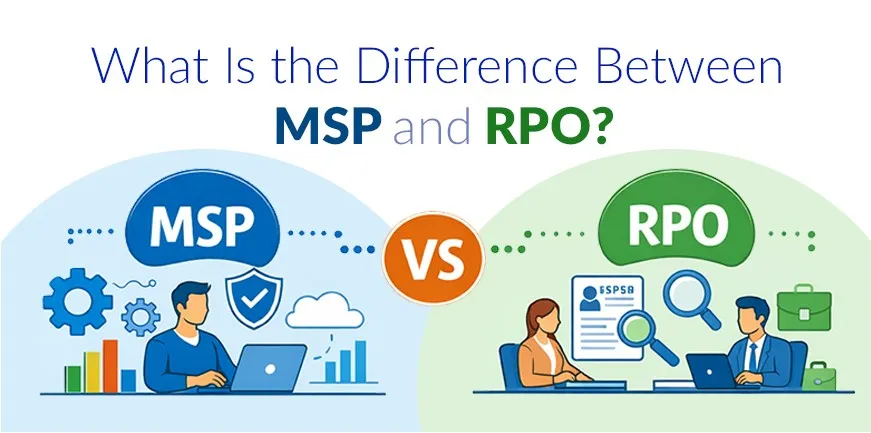
Are you planning to choose an effective hiring model that will help grow your workforce? In this new era of an ever-evolving talent ecosystem, you must design a team to enhance your business structure. The MSP vs RPO model is a continuous debate, and both approaches are impactful in their own way. It is for you to gauge which model caters to your business and its objectives.
What is a Managed Service Provider (MSP)?
A Managed Service Provider (MSP) is an external agency that is outsourced to take responsibility for offering solutions, such as managing your daily functions, including IT support-related tasks, HR, marketing, and hiring contingent workers. They are essentially partners who will cater to your specific requirements and help you accelerate your business goals.
What is Recruitment Process Outsourcing (RPO)?
Recruitment Process Outsourcing, or RPO, is a hiring approach where a business or employer partners with an external provider to manage the entire or some portions of their hiring process. The RPO provider handled the end-to-end recruitment process from searching for candidates to assessing them, hiring them and then taking care of the onboarding procedures. The service provider becomes a part of the internal HR team, offering effective and adjustable solutions to find the best-in-class professionals.
What are the key differences between MSP and RPO?
MSP and RPO are both vital drivers for companies looking to optimise their manpower for the progress and long-term sustainability of their business. However, understanding the difference between MSP and RPO will enable you, as a business, to choose the right model appropriate for enhancing your teams.
| Aspect | MSP (Managed Service Provider) | RPO (Recruitment Process Outsourcing) |
| Focus | These providers handle the flexible workforce, including temporary staff, contract professionals, and independent workers. | This approach focuses on recruiting permanent hires. |
| Manpower Type | Talent is hired based on short-term tasks or projects. | Usually recruit employees for full-time job roles eligible for benefits. |
| Fundamental Purpose | The providers focus on cost-effective methods, a high level of efficiency, and diligently comply with vendor rules and policies. | The focus here is usually on the quality of candidates, hiring pace, and employer branding. |
| Ownership | The procurement and operations teams usually handle the hiring model and its activities. | The HR or talent Management teams handle RPO. |
| Supplier Management | Oversees multiple staffing vendors/agencies | Direct sourcing; limited reliance on external agencies |
| Usage of Tech | The platform utilised is Vendor Management Systems (VMS) | Applicant Tracking Systems (ATS) and modern recruitment tools |
| Work Scope | The provider is essentially responsible for tasks like coordinating with vendors, handling contracts, tracking compliance systems, etc. | This approach is about offering comprehensive recruitment solutions starting from sourcing, screening, recruitment, and onboarding. |
| Strategic Duty | MSPs are focused on operations and reducing expenses. | The focus is mainly on acquiring top talent and strategising. |
| Engagement Model | Centralised vendor management | Dedicated Hiring Collaboration |
When should companies choose MSP?
1. Requirement of Niche Knowledge
You must choose MSP when you identify that there is a need for specialised talent to cater to niche domains in your business operations. This helps in hiring professionals that your organisation lacks.
2. Overburdened IT Teams
Sometimes it becomes the IT department’s responsibility to manage an overload of tasks and functions, which can become difficult for them. MSP providers can help with the IT work while your team can focus on core decision-making.
3. 24/7 Monitoring
If your business requires constant monitoring and oversight of systems to ensure security and enable uptime, then MSP is your solution.
4. Budget Issues
You suddenly plan to redesign your budget and want to convert your large IT expenditures to a monthly subscription plan. MSPs can assist you with reorganising your expense mechanisms.
5. Adjustability in Workforce Acquisition
If you desire to transform your IT infrastructure and require assistance to scale your teams quickly, you can take the assistance of an MSP to drive your business growth.
When should companies choose RPO?
1. Large-Scale Expansion
If you are planning on expanding your operations or venturing into new business territories, handling your business mergers, you need to choose the RPO model because it will help you in hiring large numbers.
2. Steep Hiring Costs
When you feel that your hiring expenses need to be curtailed and certain budget concerns are growing, then RPO is your best solution, as they can support you with calculated hiring decisions.
3. Sudden Hiring Demands
If there is a sudden and unprecedented requirement for recruitment due to changing markets or demands, then you must partner with an RPO, as they will offer you access to top talent that matches your immediate needs.
4. Quality & Brand Image Enhancement
When your company requires specialised talent and high-quality professionals, RPOs can help with advanced hiring tools and tech. If you are also planning to enhance your branding, RPO partners can provide you with the needed support.
5. Limited Resource Deployment
There can be a problem of HR teams getting pressured due to too much workload, resulting in a slowdown of resource management and the time taken to hire. This is when RPOs can help in utilising their resources and finding top talent quickly.
What are the benefits of MSP and RPO?
Both the hiring models are in their own way focused on optimising teams only difference is that they work for different labour force types. Let us find out their benefits:
Benefits of MSP
1. Cost-Effective Solutions
MSPs utilised centralised systems like VMS that enable streamlining expenses and cut down on extra hiring costs, enhancing efficiency levels.
2. Law Adherence Capabilities
MSPS can help companies and businesses ensure that they adhere to the changing compliance laws and keep updating them with any changes or upgrades to prevent companies from facing legal challenges.
3. Managing External Providers
MSPs maintain a professional and cordial relationship with vendors and other service providers to consistently maintain good quality and to sustain long-term relationships.
4. Adjustable Solutions
MSPs can support companies in swiftly adjusting their teams, whether it is scaling them up or down to cater to task or project needs.
Benefits of RPO
1. Elevated Hire Quality
RPO partners provide high-quality talent search systems with a wide and pre-evaluated talent base full of niche professionals, enhancing the level of hiring.
2. Fast Hiring Processes
Utilising the latest tech for hiring and structured methods and expertise, RPOs expedite the hiring procedures significantly, saving time.
3. Elevated Employer Branding
An RPO partner capitalises on efficient and speedy recruitment processes, creating a pleasant experience for candidates, resulting in a positive employer image.
4. Utilised Modern Tech
RPO partners are at the top in using advanced AI-powered technology and platforms that accelerate the efficiency of hiring stages, improving the overall image of companies, enabling them to attract better talent.
What challenges are associated with MSP and RPO?
Both the hiring models have one goal, and that is to improve operational and hiring efficiency; however, most organisations have to face hurdles while partnering with both MSP and rPo service providers. The hazards can start from the initial set-up to management problems that can linger long-term. Let us check out the challenges for a better understanding.
Challenges with MSP
1. Issues with Integration
The primary problem that businesses face is the integration and implementation of new and innovative systems, as the integration of the new systems into existing platforms and networks might cause disruptions. In a business with multiple systems, it is difficult to integrate everything into a centralised system.
2. Training & Adoption Issues
MSPs utilise methods that need to be adopted quickly, as they influence various tasks and recruitment stages. There can be a need for hiring managers and teams to receive proper training on how to handle new HR tech and adapt to the latest guidelines and software. The staff might hesitate to adopt everything new due to various reasons.
3. Unacceptance of Changing Systems
A lot of departments and even vendors are apprehensive about accepting the MSP structure as they fear that their independence will be lost. The resistance to the changing system can be due to various factors, such as a lack of proper communication between business owners and stakeholders or departments, no updated information from the beginning, etc.
Challenges with RPO
1. Cultural & Value Disconnect
Partnering with RPOS can bring to the table a major risk of them not totally comprehending a company’s vision, mission, & culture. This may lead to a botched candidate fit process and a weak presentation of the employer image, failing to attract top talent.
2. Diminished Control
Company leaders and department heads might feel that partnering with RPOs might result in them losing control and power to monitor functions. This might have happened due to poor collaboration and communication. There is a dearth of regular update flow regarding hiring in these cases.
3. Time-Consuming Process
RPOS take time to get established properly and integrate into businesses. Sometimes internal Hr teams need to be redesigned to make room for the RPO partner. It can be a long-term effort that might hamper operations and affect business imperatives.
What is the cost difference between MSP and RPO?
| Feature | MSP (Managed Service Provider) | RPO (Recruitment Process Outsourcing) |
| Scope | Handles the expenses of external agencies, staffing agencies and temporary labour. | Manages all the costs of comprehensive recruitment processes. |
| Process | Capitalises on alleviating the expenses of the temporary and variable workforce. | Focuses on elevating cost-effectiveness by reducing the hiring time. |
| Cost Structure | Procurement-driven model focusing on cutting down expenses on temporary staff | HR-enabled model focusing on fast hiring and quality for full-time workers. |
Can MSP and RPO work together in a hybrid model?
Organisations today are adopting a hybrid model where both MSP and RPO can cater to their demands and requirements. While MSPs support companies with the scaling of their teams by hiring temporary workers, RPO helps them with the recruitment of long-term employees.
The models function simultaneously under a consolidated talent structure backed by integrated systems and tech platforms. This way, enterprises can build a manpower plan that would foster cost-effectiveness and superlative efficiency, driving businesses towards growth.
Key Takeaways
- MSP vs RPO offer different manpower requirements
- Focus is cost vs. quality
- Disparity in ownership& strategy
- Models have Significant challenges
- Hybrid Model is here to stay
Frequently Asked Questions
1. What is MSP vs RPO vs staffing agencies?
MSPs handle contingent, temporary workforces, RPOs handle permanent hiring, and traditional staffing agencies fill individual roles on demand.
2. What is MSP in recruitment?
MSP in recruitment refers to Managed Service Provider, which is an outsourced external partner that manages a company’s contingent workforce, like temporary staff, contractors, and freelancers.
3. What is RPO in recruitment?
Recruitment Process Outsourcing (RPO) is a partnership where a company transfers part or all of its hiring functions to an external specialist provider.
4. What is the difference between MSP and RPO?
One of the key differences between MSPs and RPOs is that MSPs focus on managing the entire process, while RPO providers may offer specific services.
5. Which is better: MSP or RPO?
Both are good depending on what type of hiring model a business requires. Whether you need to manage contingent, temporary staff, utilise MSP or hire permanent employees, utilise RPO.
Contact Us For Business Enquiry

Amit Saproo
Amit Saproo is the Head of Operations at ALP Consulting with nearly 17 years of experience in Executive Search, RPO, Leadership, and IT & Engineering recruitment. He leads nationwide recruitment programs across Technology, BFSI, and R&D domains, driving strategic hiring solutions for diverse client needs. Amit excels in building and managing high-performance teams that deliver scalable, end-to-end recruitment and consulting services.