
What Is Human Resource Management? Definition, Functions & Process
17/04/2026
Impact of Labour Codes on IT & GCC Companies in India (2026 Guide)
17/04/2026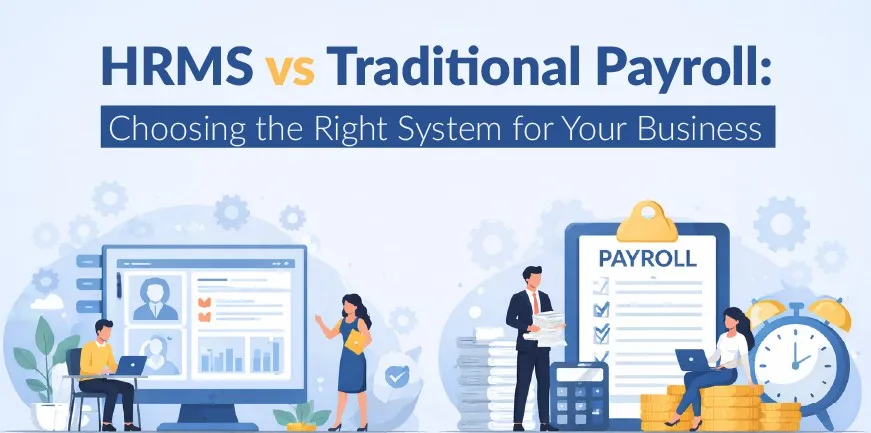
“The future of payroll lies in systems that think, not just systems that calculate.”
Fixing a single payroll mistake can cost an average of nearly Rs. 24000 for businesses. This shows that any complacency with payroll can cost big time for companies, along with employee dissatisfaction and reputation damage.
To combat this, choosing the right payroll system becomes paramount, & it should align with business goals and allocated budget. The common payroll systems available in the market include HRMS payroll, traditional payroll, & payroll outsourcing. In this discussion, let’s compare HRMS vs traditional payroll from different aspects & see which system comes out on top.

What is HRMS?
Before commencing the battle between HRMS vs Traditional Payroll, we need to isolate & understand both systems individually. Let’s understand HRMS first.
HRMS, a.k.a Human Resource Management System or Human Capital Management (HCM) system, is a cutting-edge management system leveraged by businesses to digitize, centralise, & automate core HR tasks like payroll, employee benefits administration, compliance, attendance & leave management, etc.
Additionally, an HRMS offers comprehensive talent management capabilities, including recruitment, onboarding, PM (performance management), goal setting, learning & development, compensation management, & succession planning. Moreover, automated HRMS platforms bring down manual payroll errors by up to a whopping 80%, a critical metric as global & domestic labour codes become more stringent.
Key users of HRMS in a company set up include:
- HR Professionals
- Recruiters
- Managers
- Employees
- Candidates
What is a Traditional Payroll System?
We understood HRMS; now it’s time to delve into the traditional payroll system. Understanding this will help us make an HRMS vs traditional payroll comparison more effective.
A traditional payroll system is an easy-to-follow manual or semi-automated approach to managing employee salaries, deductions, taxes, & statutory compliance. Traditional payroll is typically executed via spreadsheets (Google or Excel), paper records, or software with limited capabilities to run day-to-day operations.
Also, HR teams finalise gross & net salaries, taxes, & benefits using manual computational techniques, thereby elevating the chances of mistakes & delivery delays big time. Moreover, manual payroll systems suffer from an average error rate of nearly 20%, & the main culprit is data entry mistakes.
This system is often deprived of real-time updates, integration capabilities, & scalability. These bottlenecks make it arduous for growing organizations to maintain accuracy, compliance, & efficiency in payroll processing.
HRMS vs Traditional Payroll: What are the Key Differences?
Here are the 10 key differences between HRMS vs traditional payroll:
| Aspect | HRMS | Traditional Payroll System |
| Data Accessibility | Centralized, cloud-based access to employee data anytime & anywhere | Data is stored locally with limited accessibility & sharing capabilities |
| Integration Capabilities | Couples with HR, finance, & third-party systems like a duck to water | Minimal or no integration capabilities with other business systems |
| User Experience | Intuitive dashboards & ESS portals for all users | Complex interfaces with limited user-friendly features |
| Automation Level | Workflow elements like onboarding, approvals, & reporting are automated with simple coding integration. | Mostly manual processes necessitating human intervention at all times |
| Reporting & Analytics | Advanced analytics with real-time actionable insights & customizable reports | Basic reporting with limited insights & delayed data availability |
| Employee Self-Service | Employees can update data, apply leaves, & access documents through the website or app. | Employees are at the mercy of HR for most updates & requests. |
| Time & Attendance Tracking | Integrated tracking setup with biometric & remote work support | Often tackled separately via a third-party app or manually tracked |
| Mobile Accessibility | Mobile-friendly platforms enabling access on smartphones & tablets | Limited or completely devoid of mobile accessibility features whatsoever |
| Document Management | Digital storage & easy retrieval of employee documents | Paper-based or scattered document management systems |
| Decision-Making Support | Data-driven insights support strategic HR & workforce decisions | Limited data support for strategic decision-making |
HRMS vs Manual Payroll System: Cost Comparison
Here is a detailed cost comparison between HRMS vs manual payroll system:
| Cost Factor | HRMS (Human Resource Management System) | Manual Payroll System |
| Initial Investment | Requires upfront software subscription or implementation costs | Minimal initial cost due to the use of spreadsheets or basic tools |
| Operational Costs | Lower ongoing costs as automation takes over & there is minimal to zero manual intervention. | Higher recurring costs due to continuous manual processing efforts. |
| Manpower Expenses | Fewer HR resources are required due to automated workflows. | Necessitates larger HR teams for payroll processing & verification. |
| Error-Related Costs | Minimal errors bring down penalties & rework expenses significantly. | Higher chances of errors leading to financial losses & penalties. |
| Infrastructure Costs | Cloud-based systems reduce the need for physical infrastructure investments. | Requires physical storage, paperwork, & administrative infrastructure. |
HRMS vs Traditional Payroll: Accuracy and Efficiency Comparison
| Aspect | HRMS (Human Resource Management System) | Traditional Payroll System |
| Data Accuracy | Automated calculations bring down errors to almost 0 & ensure consistent payroll accuracy. | Manual payroll calculations increase the risk of errors & inconsistencies. |
| Processing Speed | Processes payroll in a jiffy with automated workflows & real-time updates | Processing is done at a slow pace due to manual calculations & approvals |
| Error Detection | Built-in validation checks filter out discrepancies before payroll finalization. | Errors are often detected when there is no time for rework & requiring time-consuming corrections. |
| Reconciliation Time | Faster reconciliation with integrated data and automated reports. | Lengthy reconciliation due to fragmented & manual data handling. |
| Workflow Efficiency | Streamlined workflows reduce dependency on multiple approvals & manual intervention. | Inefficient workflows with heavy reliance on manual coordination & approvals. |
HRMS vs Traditional Payroll Comparison Based on Scalability
| Aspect | HRMS (Human Resource Management System) | Traditional Payroll System |
| Workforce Expansion | Easily accommodates a growing employee base without process rejigging at a large scale. | Struggles to manage an increasing workforce efficiently |
| Multi-Location Support | Executes multistate & multicity payroll management from a single unified platform | Necessitates separate handling for each location or branch |
| Process Adaptability | Adapts quickly to organizational changes & varying business needs | Rigid processes make adaptation slow & complex |
| System Flexibility | Configurable modules allow businesses to scale features as needed | Limited flexibility with fixed, manual processes |
| Growth Sustainability | Ensures long-term scalability with minimal operational disruption | Growth leads to inefficiencies, delays, & increased workload |
HRMS vs Manual Payroll System: Compliance Management Comparison

| Aspect | HRMS (Human Resource Management System) | Manual Payroll System |
| Regulatory Updates | Automatically updates with the amended labour laws & statutory changes | Necessitates manual tracking of regulatory updates |
| Compliance Accuracy | Ensures accurate statutory calculations & filings via automation | Higher error risks in compliance calculations & filings |
| Audit Readiness | Maintains digital records for quick audits & easy compliance verification | Paper-based records make audits time-consuming & complex. |
| Filing Timeliness | Automated reminders ensure timely statutory filings & submissions | Missed deadlines due to manual tracking & follow-ups |
| Penalty Risk | Negates penalties via proactive compliance management & alerts | Increased risk of penalties due to human mistakes & delivery delays |
What are the Pros & Cons of HRMS?
Pros
1. Elevated Automation
Automates HR processes, bringing down manual work & improving overall efficiency significantly.
2. Centralized Data Management
Stores all employee data securely in one centralized & easily accessible platform.
3. Enhanced Decision Making
Provides actionable insights in real-time & analytics for revitalised workforce planning decisions.
4. Employee Self-Service
Enables employees to manage personal data, requests, & HR interactions independently.
5. Scalability and Flexibility
Adapts to business growth with flexible features & scalable HR solutions.
Cons
1. High Initial Investment
Requires high upfront costs for implementation, customization, & system deployment initially.
2. Learning Curve
Employees & HR teams may necessitate hand-holding & training sessions to get better at using HRMS without hassles.
3. Data Security Concerns
Sensitive employee data may bring security risks if protocols are thin & insufficient.
4. System Dependence
Over-reliance on the HRMS may halt operations during technical failures or downtime.
5. Customization Limitations
Some HRMS may not fully align with unique organizational requirements.

What are the Pros and Cons of Traditional Payroll?
Pros
1. Low Initial Setup Cost
Requires minimal investment as only spreadsheets or basic tools are adequate for payroll processing.
2. Simple to Understand
Easy to understand processes without needing advanced technical knowledge or training.
3. Greater Manual Control
Provides complete control over payroll calculations & approval workflows internally.
4. No Dependency on Software
Does not rely on complex software systems or continuous internet connectivity.
5. Flexible Custom Handling
Allows customized payroll handling based on unique organizational policies & structures.
Cons
1. High Error Risk
Manual payroll calculations increase the error percentage in payroll processing & compliance.
2. Time-Consuming Processes
Necessitates high man-hours for calculations, approvals, & payroll data management tasks.
3. Limited Scalability
Difficult to manage payroll efficiently as and when organization size & complexity increase.
4. Compliance Challenges
Tracking regulatory changes manually leads to compliance risks & potential penalties.
5. Inefficient Record Management
Paper-based records cause difficulties in storage, retrieval, & audit processes.

What is the Future of Payroll Systems?
1. AI-Driven Payroll Automation
Artificial intelligence will automate payroll processing to a large extent, bring down errors, enhance compliance accuracy to an elite level, & boost decision-making insights.
2. Real-Time Payroll Processing
Payroll management systems will bring about instant salary calculations (net pay excluding deductions), on-demand payments, & real-time compliance tracking for organizations.
3. Cloud-Based Global Payroll Integration
Cloud technology will unify multi-country payroll (merge city, state, and country under one centralised payroll system), ensuring seamless compliance, scalability, & centralized workforce management globally.
4. Elite Level Compliance & Regulatory Automation
Advanced payroll systems will auto-update labour laws, ensuring continuous compliance & minimizing penalties via proactive alerts.
5. Employee-Centric Payroll Experience
Future payroll platforms will bring forth a host of offers, including self-service portals, flexible pay options, & personalized financial wellness insights.
Verdict: HRMS vs Traditional Payroll: Which is the Right Choice?
Making the right choice between HRMS vs traditional payroll depends on business size, complexity, & growth plans. Traditional payroll may suffice for small businesses with a simple framework & limited budget, offering control & a low initial investment. However, as organizations look to upgrade & expand, managing compliance, accuracy, & efficiency becomes increasingly arduous when we go down the route of the manual payroll method.
Moreover, an HRMS brings forth automation, real-time insights, & streamlined processes to the forefront, making it convenient for modern businesses as per HRMS vs traditional payroll comparison. While both have merits, HRMS stands out as the smarter, future-ready choice for sustainable growth.
Going one step ahead, businesses may consider the middle route of outsourcing payroll to a top TPA like Alp Consulting Ltd, where they can enjoy the perks of an HRMS and reduce administrative load for HR teams simultaneously.

Key Takeaways
- HRMS automates payroll processes, bringing down errors & boosting overall efficiency significantly.
- Traditional payroll systems are cost-effective initially but fall short in terms of scalability & automation capabilities.
- HRMS ensures better compliance management via automated updates & timely statutory filings.
- Manual payroll increases error risks, delays, & operational inefficiencies in growing organizations.
- HRMS offers centralized data, real-time insights, & supports strategic business decision-making.
Contact Us For Business Enquiry
Frequently Asked Questions
1. What is HRMS in payroll?
HRMS is a centralized software suite automating payroll, employee data, compliance, & HR processes efficiently.
2. What is a traditional payroll system?
A traditional payroll system manages salaries manually using spreadsheets, paper records, & limited automation tools.
3. What is the difference between HRMS and payroll software?
The key HRMS vs payroll system difference is that HRMS covers end-to-end HR functions, whereas payroll software focuses only on salary processing tasks.
4. Which is better: HRMS or traditional payroll?
When it comes to HRMS vs manual payroll system, HRMS is better that manual payroll for growing businesses due to automation, accuracy, scalability, and compliance management advantages.
5. Is HRMS cost-effective?
Yes, HRMS is cost-effective in the long term by reducing errors, manpower, compliance penalties, and improving operational efficiency.
6. How does HRMS improve payroll accuracy?
HRMS automates calculations, validates data, reduces manual errors, & ensures consistent payroll processing accuracy.

Yugandhara V. M
Yugandhara V. M serves as the Assistant Vice President – HRO at Alp Consulting Ltd., bringing over 14 years of rich experience in Human Resource Outsourcing, payroll management, and statutory compliance. He specializes in driving process excellence across HR operations, ensuring seamless service delivery and compliance with labor laws. Yugandhara’s expertise lies in managing large-scale client engagements, optimizing HR processes, and implementing efficient workforce management systems that enhance organizational performance. He also leads comprehensive payroll services, ensuring accuracy, timeliness, and compliance for diverse client portfolios.