HR Software, Automation & Outsourcing: 2026 Guide
01/12/2025
How to Build a Leadership Pipeline in Your GCC: Strategies, Skills & Tools
01/12/2025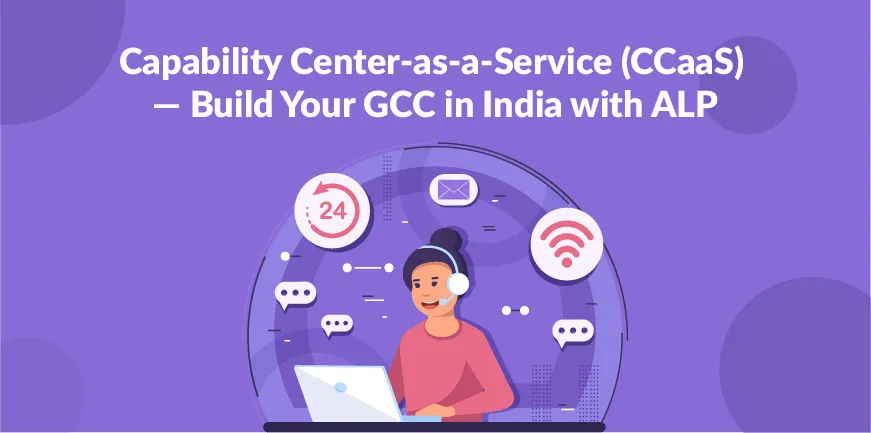
“What began as a cost play has become a capability play… GCCs are adding a powerful new layer of growth and long-term strength to India’s technology ecosystem.”- Christoph Schweizer (CEO, Boston Consulting Group)
Are you looking to build high highly-performing GCC in India? Do you want to engage with a CCaaS delivery model offered by Alp Consulting?
Capability Center-as-a-Service (CCaaS) is redefining how global enterprises build & scale their operations in India. Instead of navigating complex setup processes, companies can launch high-performing GCCs quickly through a plug-and-play, fully managed model. As of 2025, India hosts about 1,760–1,900 GCCs collectively employing nearly 1.9–2.0 million professionals across industries.
ALP Consulting, a leading CCaaS provider in India, enables this transformation by providing end-to-end support across compliance, talent, infrastructure, and operations. We help organizations build future-ready capability centers that accelerate innovation, reduce costs, & drive enterprise-wide digital growth with speed and confidence.
Capability Center-as-a-Service (CCaaS) is a flexible, plug-&-play model that enables companies to build and operate Global Capability Centers without managing infrastructure, compliance, hiring, or daily operations on their own. In this setup, a specialist partner sets up and runs the center end-to-end, while the company focuses on core business functions.
As of 2025, the Indian Business & Exporters Federation (IBEF) reports that GCCs now account for nearly 40% of India’s total office-space demand, with CCaaS being the central factor in reducing setup and deployment costs.
Example: A U.S. retail giant used a CCaaS provider to rapidly establish a 300-member analytics & engineering GCC in India, cutting setup time by nearly 60% and achieving faster digital transformation.
Why India Is the Ideal Destination for Global Capability Centers?
Here are 5 reasons that make India a prime destination for GCCS:
1. Access to Deep, Diverse Talent Pools
India offers one of the world’s largest STEM (Science, Technology, Engineering, and Mathematics) workforces, with strong expertise in engineering, digital technologies, analytics, and operations. Such a diverse talent pipeline enables GCCs to scale rapidly with high-quality, multi-disciplinary talent ready to be productive from Day 1.
India is projected to produce 18 million STEM graduates by 2027, making India a premier destination for established and emerging GCCS ready to offer CCaaS.
2. Competitive Costs and High Productivity
India delivers a powerful cost-to-skill advantage, allowing companies to reduce operational expenses drastically. This will help GCCs maintain strong productivity, faster turnaround, & high-quality output across technology, finance, & business services.
| Role | Typical Abroad Cost (e.g., US/Western markets) | Typical Equivalent Cost in India / Savings | Why This Matters |
| Software / Application Developer | Approx. US $110,000–$126,000 per year | Approx. US $15,000–$18,000 per year in many Indian centres | Almost 85–90% savings. It allows large dev teams while controlling budget and increasing output. |
3. Mature GCC Ecosystem and Infrastructure
With over 1,800+ GCCs already operating, India provides a mature ecosystem, advanced IT infrastructure, robust vendor networks, & a strong innovation environment that accelerates GCC growth and transformation. These centers collectively employ over 1.9 million professionals, forming the largest captive talent pool globally. The GCC number is projected to cross 2,100 by 2028, with the market size estimated to cross $90 billion with ease.
4. Strong Government Support and Policy Stability
Favourable policies, SEZ incentives, digital governance, & regulatory ease make India a supportive & stable environment for global enterprises setting up long-term capability centres. Example: GCC Policy 2025–30 includes capital subsidies up to Rs. 50 crores & incentives for Tier-2 city GCC expansion.
5. Rapid Digital Adoption and Innovation Mindset
India’s fast-growing digital economy, thriving startup ecosystem, & tech-forward workforce help GCCs innovate faster, build future-ready capabilities, & drive enterprise-wide digital transformation at scale. Around 83% of GCCs across India are scaling or investing in Generative AI applications.
How Alp Enables End-to-End Capability Center Setup in India?
Here are 7 steps followed by Alp to help GCCs build an end-to-end setup via the CCaaS delivery model:
1. Strategic GCC Planning & Market Assessment
Alp evaluates business goals, talent needs, cost benchmarks, & Indian location suitability to churn out a tailored GCC roadmap aligned with global operating expectations & long-term enterprise strategy.
2. Regulatory, Compliance & Entity Setup Support
We manage all regulatory obligations, labour laws, registrations, SEZ/STPI, & data security norms. This ensures your capability center is fully compliant, audit-ready, & built on a strong governance foundation from Day 1.
3. Talent Acquisition & Rapid Workforce Scaling
ALP recruits high-quality tech, digital, & business talent through targeted sourcing, assessments, and onboarding frameworks. This helps GCCs build skilled teams quickly while maintaining global excellence standards.
4. Infrastructure, IT & Workspace Setup
We establish office infrastructure, IT systems, security frameworks, & workspace design via a plug-and-play model. This ensures your GCC becomes operational in a jiffy with minimal complexity.
5. Operational Management & Day-to-Day Governance
Alp oversees HR operations, payroll, policies, vendor management, & workforce engagement. This ensures seamless daily operations, allowing global teams to focus solely on capability building and innovation.
6. Performance Management & Continuous Optimization
We track KPIs, productivity, talent performance, and process health to continuously refine operations, improve output quality, and maximize GCC efficiency across functions.
7. Transition-to-Ownership (If Required)
When enterprises are ready, Alp helps transition the GCC into a fully owned model with mature governance, stable teams, and optimized operating processes, ensuring zero disruption.
CCaaS Delivery Model: What Enterprises Gain from Alp’s Approach?
Here are 5 key perks GCCs can enjoy from Alp’s CCaaS delivery model:
1. Faster Time-to-Launch & Reduced Setup Complexity
Alp’s plug-&-play framework accelerates GCC setup by managing compliance, infrastructure, hiring, & governance. This empowers enterprises to go operational in a fraction of their usual timeline.
2. High-Quality Talent at Scale
With 3 decades of deep hiring expertise & industry-focused sourcing, Alp helps GCCs quickly build high-performing teams across tech, digital, analytics, & business functions without compromising skill quality.
3. Lower Operational Costs & Optimized Efficiency
CCaaS reduces investments in infrastructure, overheads, & internal HR/ops teams. Alp’s managed operations ensure cost efficiency while sustaining productivity & process excellence.
4. Flexible, Scalable Operating Model
Enterprises can start small & scale rapidly according to the business’s growth. Alp’s delivery model adapts to shifting talent, capability, & location requirements with minimal or zero operational disruption.
5. Governance, Compliance & Zero-Risk Operations
Alp handles regulatory obligations, workforce compliance, security frameworks, & risk governance. This ensures the GCC operates seamlessly, remains audit-ready, & meets global enterprise standards from day one.
What are the Key Capabilities Alp Brings In?
Here are 5 key capabilities Alp brings in as part of its CCaaS Delivery Model
1. Deep Talent Acquisition & Rapid Scaling Expertise
Alp builds high-performing GCC teams in a short duration via targeted sourcing, skill assessments, & industry-focused hiring strategies. This ensures enterprises get top-tier tech, digital, & business talent with minimal launch time.
2. Strong Compliance, Regulatory & Governance Frameworks
Alp manages end-to-end compliance, including labour laws, SEZ/STPI norms, payroll governance, & data security. This ensures the GCC operates risk-free, audit-ready, & aligned with global corporate standards from the first day of business.
3. Plug-and-Play Infrastructure & Technology Setup
From office space to IT systems, cybersecurity, and digital workflows, Alp provides ready-built infrastructure that fastens operational readiness while maintaining enterprise-grade reliability, uptime, & scalability.
4. Robust Operational Management & HR Service Delivery
Alp oversees daily operations, HR processes, payroll, engagement, & vendor management, ensuring smooth functioning. This lets global teams focus on innovation while Alp handles end-to-end workforce management.
5. Continuous Optimisation & Performance Intelligence
Alp monitors KPIs, workforce productivity, process efficiency, & operational health. Insights-driven governance helps optimise performance, enhance capability maturity, & maximise GCC output across all functions.
The Business Impact: Why CCaaS Accelerates Growth and Transformation?
1. Rapid Capability Building Without Setup Delays
CCaaS delivery model eliminates infrastructure, compliance, & hiring bottlenecks. This creates a supercharge & enables companies to launch operations quickly & build critical digital, engineering, & business capabilities far faster than traditional GCC models.
2. Access to High-Quality Talent at Scale
With ready talent networks and specialized sourcing, CCaaS helps companies ramp up skilled teams rapidly, accelerating innovation, digital delivery, & transformation across global functions.
3. Significant Cost Savings with Higher Productivity
CCaaS minimises operational overheads, infrastructure investments, and HR management costs. Enterprises benefit from India’s cost-to-skill advantage while maintaining strong productivity, quality, & speed.
4. Flexible, Scalable Operating Model for Evolving Needs
CCaaS lets companies scale teams, capabilities, and locations on demand. This agility supports fast-changing transformation priorities, product roadmaps, & global business cycles.
5. Strong Governance & Lower Operational Risk
With compliance, security, workforce operations, and governance managed by experts, enterprises avoid setup risks and focus entirely on driving digital transformation, innovation, and strategic enterprise growth.
What are the Latest Trends in Capability Center-as-a-Service?
1. AI & Automation-Led Evolution of GCCs
More GCCs are embedding AI, GenAI, automation, & intelligent workflows, transforming centers into innovation hubs rather than just cost or support centers. According to EY, 58% of GCCs are currently investing in “agentic AI” solutions, and another 29% plan to do so within a year. This shows strong momentum behind AI & intelligent automation adoption.
2. Shift from Cost-Arbitrage to Strategic Value & Innovation Hubs
GCCs are no longer only about savings. They now contribute to product development, analytics, R&D, & strategic enterprise initiatives. According to the 2025 EY GCC Pulse Report, 92% of leaders say their GCCs now contribute “far beyond cost-arbitrage”, signalling a clear transition towards innovation arbitrage & enterprise value creation.
3. Industry Diversification: GCCs Beyond Tech/IT
New GCCs are emerging across non-traditional sectors such as automotive, semiconductors, energy, healthcare/life sciences, industrial manufacturing, etc. These sectors are increasingly leveraging GCC models to offer better services.
According to a 2025 industry report, the number of engineering, R&D, and non-IT-oriented GCCs in India has grown 1.3 times faster than overall GCC growth. This trend shows rising demand for GCCs outside traditional IT services.
4. Cross-Functional & Multi-Service Capability Centers
Instead of isolated IT or finance centers, GCCs now host multi-functional capabilities through CCaaS. They are combining analytics, cloud, product engineering, cybersecurity, operations, & business services under one roof.
As per a 2025 industry paper, numerous Indian GCCs now handle high-value digital projects related to analytics, cloud, cybersecurity, and RPA in sectors like BFSI. This indicates a clear shift beyond legacy back-office services.
5. Stronger Focus on Governance, Compliance & Resilience
As GCCs handle critical enterprise functions, there’s a rising emphasis on robust governance, compliance, data security, & operational resilience, making GCCs trusted partners for global firms.
Key Takeaways
- CCaaS enables faster, cost-efficient GCC setup with seamless compliance, infrastructure, & talent readiness.
- India’s deep talent pool and mature GCC ecosystem make it the world’s preferred capability center destination.
- ALP delivers end-to-end GCC setup with strong governance, rapid scaling, & operational excellence.
- CCaaS accelerates digital transformation through agility, automation, high-quality talent, and scalable operating models.
- Emerging trends show GCCs shifting toward innovation, multi-service functions, and AI-driven value creation.
FAQs
1. How long does it typically take to establish a capability center using the CCaaS model?
A CCaaS-based capability center can typically become fully operational within 8–12 weeks, thanks to ready infrastructure, compliance support, and rapid workforce scaling.
2. What types of companies benefit most from the CCaaS approach?
Fast-scaling enterprises, digital-first companies, product firms, & global organizations necessitating rapid talent access, lower setup risk, & flexible capability expansion benefit most.
3. How secure is the CCaaS model for handling sensitive operations and data?
CCaaS partners like Alp Consulting deploy enterprise-grade security, compliance frameworks, controlled access, audits, & data-governance protocols to ensure safe, compliant, & risk-free operations.
4. Can CCaaS support hybrid or remote operating models for global teams?
Yes. CCaaS enables hybrid, remote, or distributed workforce models through digital infrastructure, cloud-based operations, policy alignment, and scalable collaboration systems.
5. What metrics should companies track to evaluate CCaaS performance and ROI?
Track productivity, talent quality, cost savings, time-to-launch, capability maturity, employee engagement, process efficiency, & overall contribution to enterprise transformation.
Contact Us For Business Enquiry

Kishore V N
Kishore V N is the Managing Director at ALP Consulting, bringing over 29 years of extensive experience in global recruitment, talent strategy, and workforce solutions. He has been instrumental in building scalable RPO, MSP, and modular talent sourcing models that empower organizations with a competitive edge in talent acquisition. Kishore’s leadership focuses on expanding ALP’s global presence, driving innovation in recruitment technology, and enhancing operational excellence. He also serves as Director at Datacore Technologies, steering digital HR transformation through advanced HRMS and virtual staffing solutions.