
Labour Law Compliance Checklist for 2026
23/01/2026
What Is Talent Acquisition? A Complete Guide
28/01/2026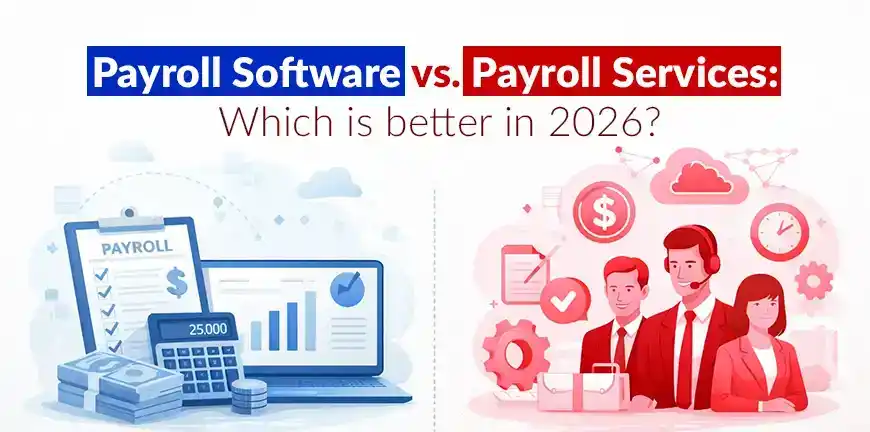
Running payroll manually is no longer feasible as brand reputation and employee satisfaction are directly linked to payroll accuracy. However, most employers are divided in their opinion on whether to use a standalone payroll software or partner with a reputable payroll service provider.
Although it’s a tricky decision, businesses can make an informed decision by weighing the differences between payroll software and payroll outsourcing against business goals and market standards. Let’s begin the tussle between payroll software vs payroll services and see which one will come out victorious.
What Are Payroll Services?
On paper, payroll services is a structured outsourced process that ensures employees are paid correctly & on time while maintaining compliance with labour and tax regulations. However, in the current business landscape, payroll services are a guardian angel that boosts employer brand value and employee experience.
Moreover, without expert payroll services, litigation and penalties are almost impossible to prevent. In yesteryears, payroll was mostly managed in-house by the HR team, but with increased regulatory complexities and multi-state operations, outsourcing payroll is the only way forward.

Key Tasks Involved in Payroll Services
1. Salary Processing
The payroll consultants will calculate salaries, deductions, reimbursements, bonuses, arrears, & perform validations, ensuring timely employee net salary disbursement execution nationwide.
2. Statutory Compliance Management
The payroll team will perform end-to-end management of PF, ESI, PT, TDS filings, labour law updates, audits, and documentation with 100% accuracy & meet deadlines.
3. Tax Computation & Filings
Here, the payroll experts will calculate employee income tax based on slab rates & opted regime, declarations verification, investment proofs validation, Form 16 generation, returns submission, & reconciliation.
4. Attendance & HRMS Integration
Attendance and leaves will be managed accurately and in real-time through the HRMS platforms, biometrics, and other tools. Later, reports will be extracted and used as payroll input.
5. Multi-Location Payroll Management
The payroll outsourcing team will seamlessly handle state-wise statutory variations, professional tax rules, local compliance updates, & reporting consistency.
6. Payroll Reporting & Analytics
The payroll services platforms offer provisions for the generation of customised MIS reports, payroll dashboards, cost analysis insights, compliance tracking, & management decision support.
7. Audit & Compliance Support
The payroll outsourcing crew will prepare statutory registers, initiate audit trails, ensure inspection readiness, perform documentation management, and provide regulatory clarification assistance.
8. Employee Payroll Support
The payroll consultants will carry out employee payroll query resolutions, pay slip explanations, tax clarifications, reimbursement tracking, & service desk support.

Who Benefits Most from Payroll Services?
Before jumping into the tussle between payroll software vs payroll services, let’s understand who benefits the most from payroll services in the current business landscape. Here are 5 major players that need payroll outsourcing services to effectively manage payroll operations while maintaining 100% compliance.
1. Expanding SMEs
SMEs are usually short on resources and hence look for payroll outsourcing most of the time. As they are always looking to expand to grab new market territories, the employee count and operating locations will also increase. To free the HR team for administration tasks and ensure 100% payroll accuracy, most SMEs will partner with top payroll agencies like Alp Consulting Ltd for end-to-end payroll management.
Outsourced payroll models allow SMEs to accommodate 30–50% business growth in headcount without needing to hire additional internal HR staff or invest in new software infrastructure.
2. Multi-Location Companies
Most Businesses look to expand state-wise to increase their reach and create a pan-India presence. However, payroll & compliance mandates vary drastically across states, creating complications for companies to churn out a unified payroll management system.
Therefore, Organisations operating across multiple states leverage payroll services to handle region-specific statutory rules, professional tax variations, filings coordination, centralised reporting, & seamless regulatory alignment.
Businesses operating in multiple locations are 40% more likely to be flagged for an audit by the EPFO or Income Tax Department due to inconsistencies in state-specific filings.
3. Compliance-Heavy Industries
Manufacturing, BFSI, healthcare, logistics, & regulated sectors are usually bombarded with complex regulations and frequent amendments. Hence, these sectors depend heavily on payroll services for continuous statutory monitoring, audit readiness, documentation accuracy, penalty prevention, & governance-driven payroll execution.
By 2026, 65% of companies in India have adopted cloud-integrated, outsourced payroll. For compliance-heavy industries, the move is no longer optional; it is a mandatory governance requirement to prevent penalties that average Rs. 15 lakhs to Rs. 20 lakhs per major violation.
4. Fast Hiring Environments
High-growth businesses typically experience frequent onboarding, payroll changes, variable compensation, contractor management, & seasonal workforce fluctuations. To manage such sudden requirements, they partner with payroll outsourcing services for operational stability & processing reliability.
5. Audit-Sensitive Businesses
Enterprises in sectors like BFSI, pharmaceutical, manufacturing, etc., are subjected to frequent internal audits, statutory inspections, investor reviews, & compliance certifications. Therefore, to prevent complications & achieve 100% compliance, they adopt payroll services to maintain documented controls, traceability, reconciliation accuracy, & defensible payroll records.

What Is Payroll Software?
Payroll software is an on-premise or cloud-based solution that helps with automating salary calculations, deductions, tax computations, payslip generation, and payroll reporting with minimal to zero human intervention. It integrates with attendance and HR systems to streamline payroll execution. However, compliance interpretation, statutory accuracy, filings, audits, and error accountability remain the employer’s operational responsibility.
Companies switching from manual or legacy systems to cloud-based payroll have slashed their processing time by 50%, reducing week-long tasks to just a few days.
Key Payroll Software Features
1. Automated Payroll Processing
Automatically calculates salaries, statutory benefit deductions, & taxes, ensuring accurate & timely payroll.
2. Statutory Compliance Management
Ensures PF, ESI, PT, & TDS filings are done on time & also comply with regulations.
3. Data Security and Privacy
Protects employee personal & professional data by utilising multiple security protocols, such as encryption, multi-factor authentication, role-based access, & secure cloud storage.
4. Attendance and Leave Integration
Syncs biometric attendance & leave records, eliminating the need for manual payroll data entry.
5. Employee Self-Service Portal
Employees access payslips, tax documents, & submit reimbursement requests digitally.
6. Multi-Location Payroll Management
Handles multiple branches, states, and tax structures seamlessly without operational complexity.
7. Payroll Analytics and Reporting
Generates real-time reports supporting payroll audits, compliance, & strategic decisions.
8. Seamless System Integrations
Integrates HRMS, accounting, & banking platforms for streamlined payroll processing efficiency.

Who Benefits Most from Using Payroll Software?
When we are comparing payroll software vs payroll services, we must also look at where each model fits best. Here are 5 businesses/departments that benefit from using a reliable payroll software:
1. Startups and Digital-First Businesses
Cloud payroll software like Zoho payroll management managed by Alp Consulting Ltd enables startups to automate salary processing, generate payslips instantly, manage taxes digitally, & scale payroll operations efficiently without increasing administrative overhead.
2. In-House HR and Finance Teams
Payroll software empowers internal teams to reduce manual calculations, minimise spreadsheet dependency, streamline approvals, maintain payroll accuracy, & enhance processing turnaround time with standardised workflows.
On average, internal teams save approximately 156 hours per year by automating salary calculations & approvals.
3. Remote and Hybrid Work Organizations
Distributed teams working remotely or via a hybrid model benefit from centralised payroll access, automated attendance synchronisation, online payslip delivery, location-based tax configuration, & real-time visibility across multiple work models.
4. Budget-Conscious Small Businesses
Small companies adopt payroll software to control recurring payroll costs, eliminate outsourcing dependency, simplify monthly processing, ensure statutory filings accuracy, & maintain predictable operational budgeting.
5. Technology-Driven Growing Enterprises
Scaling companies leverage payroll software to integrate HRMS, finance systems, automate compliance updates, generate analytics dashboards, & support data-driven workforce planning, negating operational bottlenecks.
Payroll Software vs Payroll Services: Business Impact Comparison
Here is a detailed business comparison of payroll software vs managed payroll services
| Business Impact Area | Payroll Software | Payroll Outsourcing Services |
| Initial Setup & Implementation | Requires software configuration, data migration, training, & internal process alignment. | Quick onboarding with expert-led transition, minimal internal disruption, & faster go-live. |
| Operational Ownership | Internal HR manages calculations, validations, updates, & issue resolution. | Dedicated payroll experts handle end-to-end processing & accountability. |
| Compliance Responsibility | Software provides tools, but compliance execution remains an internal responsibility. | Continuous compliance monitoring, filings, audits, & regulatory risk ownership included. |
| Error Risk & Accuracy | Accuracy depends on internal data quality & payroll expertise. | Multi-layer validation reduces payroll errors & rework significantly. |
| Scalability & Workforce Growth | Additional users, licenses, & integrations increase operational complexity over time. | Easily scales with employee growth, locations, & policy changes seamlessly. |
| Technology Maintenance | Updates, integrations, and cybersecurity oversight remain internally managed. | Technology upgrades, security management, & backups are handled by the provider. |
| Cost Predictability | Lower upfront cost, but hidden operational and manpower costs accumulate. | Transparent pricing with predictable monthly operational expenses. |
| Audit Readiness | Requires internal documentation discipline and reconciliation effort. | Audit-ready reports, traceability, and compliance documentation are readily available. |
| Business Continuity | Payroll continuity depends on internal team availability and expertise. | Built-in redundancy and expert backup teams ensure uninterrupted payroll cycles. |
| Strategic Focus | HR spends time on transactional payroll administration. | HR focuses on talent, growth initiatives, and strategic workforce planning. |

Pros and Cons of Payroll Services
Understanding pros and cons is critical when we are making an informed decision between payroll automation vs payroll outsourcing:
Pros
1. Compliance Accuracy and Risk Reduction
Payroll services ensure payroll processing is error-free from end-to end, 100% statutory compliance, expert oversight, reduced errors, improved efficiency, & operational reliability.
2. Time Savings and Productivity Gains
Outsourced payroll frees internal HR teams from administrative workload, enabling a strong focus on strategic workforce management initiatives.
3. Scalable Growth Enablement
Payroll external support helps in scaling seamlessly with employee growth, multi-location expansion, regulatory changes, & evolving business payroll complexity.
4. Dedicated Expertise and Support
Outsourcing payroll offers dedicated support teams, proactive compliance monitoring, audit-ready documentation, & continuous regulatory updates management.
5. Security and Business Continuity
Payroll solutions enhance data security, system reliability, disaster recovery readiness, & business continuity via professionally managed payroll infrastructure.
Cons
1. Coordination and Planning Alignment
It necessitates coordination with external provider timelines, encouraging better planning & internal payroll discipline improvements.
2. Customization Flexibility Considerations
Standardized workflows may limit customization flexibility, though structured processes boost accuracy & long-term consistency.
3. Onboarding and Transition Effort
The initial onboarding process requires data alignment efforts, resulting in smoother long-term payroll operations and stability.
4. Communication Dependency Management
Dependency on service partners requires clear communication, service-level agreements, & transparent operational governance frameworks.
5. Perceived Cost Sensitivity
Pricing may appear higher initially, but it offsets hidden internal costs, compliance risks, & technology investments.
Pros and Cons of Payroll Software
Pros
1. Automation and Processing Speed
Payroll software automates calculations, payslip generation, & statutory deductions, reducing manual workload & improving payroll processing speed significantly.
2. Cost Efficiency for Small Teams
Lower recurring costs offered by payroll software suit smaller organizations with stable payroll volumes & minimal compliance complexity.
3. Accessibility and Digital Convenience
Cloud access offered through payroll software enables anytime payroll visibility, document downloads, approvals, & remote operational flexibility across locations.
4. System Integration Capabilities
Payroll automating software integrates with HRMS, attendance systems, & accounting platforms, enabling smoother data flow & reduced duplication errors.
5. Reporting and Data Visibility
Payroll management software provides dashboards, customizable reports, historical data access, supporting payroll analysis, & operational decision-making accuracy.
Cons
1. Internal Expertise Dependency
Managing payroll compliance risks with software necessitates internal regulatory knowledge, accurate configurations, continuous updates, & disciplined validation processes.
2. Setup and Configuration Effort
Initial setup of payroll software involves data migration, policy configuration, integrations, & testing, requiring dedicated internal time investment.
3. Limited Human Oversight
Payroll software handles rules but cannot replace expert judgment for complex scenarios, audits, or regulatory clarifications.
4. Security and Compliance Responsibility
Data protection, access controls, backups, & compliance accountability remain largely internal organizational responsibilities even with the deployment of sophisticated payroll software.
5. Scalability and Complexity Growth
As the workforce grows, managing exceptions, multiple states, and regulatory changes increases operational complexity internally, making uniform payroll software deployment extremely challenging.
Hidden Costs & Operational Blind Spots in Payroll Software vs Payroll Services
Here is a detailed comparison of payroll software vs payroll services in terms of hidden costs and operational blind spots:
| Cost / Blind Spot Area | Payroll Software | Payroll Services |
| Implementation & Configuration | Data migration, policy setup, integrations, and testing consume significant internal time and consulting expenses. | Provider-led onboarding minimizes internal workload and accelerates stable payroll operations. |
| Compliance Monitoring Effort | Regulatory updates require continuous internal tracking, configuration updates, validation, and increasing payroll compliance risks with software. | Dedicated compliance teams track amendments, update systems, and validate filings, reducing regulatory exposure. |
| Internal Manpower Dependency | Payroll specialists required for exception handling, audits, reconciliations, and operational continuity. | Expert teams included, eliminating dependency on a single internal payroll resource. |
| Error Correction & Rework Costs | Payroll mistakes require internal investigation, reprocessing, employee escalations, and reputational recovery efforts. | Multi-level validations significantly reduce rework, escalations, and downstream correction costs. |
| Technology Maintenance & Security | Software upgrades, cybersecurity controls, access governance, and backups remain organizational responsibility and cost. | Provider manages infrastructure, security protocols, disaster recovery, and platform upgrades. |
| Scalability & Expansion Complexity | Multi-state rules, benefit variations, and integrations increase configuration complexity and operational overhead. | Seamlessly scales across locations, employee growth, and regulatory diversity. |
| Audit Readiness & Documentation | Documentation preparation, reconciliations, and audit responses demand heavy internal coordination and manual effort. | Audit-ready reports, standardized documentation, and expert audit support included. |
| Business Continuity Risk | Payroll continuity depends on internal staff availability and knowledge retention. | Redundancy teams ensure uninterrupted payroll execution during attrition or absences. |
| Hidden Opportunity Costs | HR spends excessive time on transactional processing instead of strategic initiatives. | HR regains bandwidth to focus on talent strategy and business growth. |
| Long-Term Cost Predictability | Variable consulting, staffing, and compliance remediation costs accumulate unpredictably. | Predictable monthly pricing with controlled operational expenditure visibility. |
How to Choose between Payroll Software Vs Payroll Services?
Here are 6 different scenarios where we can weigh payroll software vs payroll services and make an informed choice on the best-fit:
| Business Scenario | Payroll Software Fits Better When | Payroll Services Fit Better When |
| Small Team with Simple Payroll | Employee count is low, single location, minimal statutory complexity, stable payroll structure, and in-house administrative bandwidth exists. | Growth is planned soon, compliance risk sensitivity is high, or internal payroll expertise is limited. |
| Rapid Workforce Expansion | Headcount growth is predictable, HR systems are already integrated, and payroll rules remain relatively standardized. | Frequent hiring, compensation changes, multi-location onboarding, and payroll volumes fluctuate significantly. |
| Multi-State Operations | Limited states, similar payroll policies, and strong internal compliance management capabilities exist. | Multiple states with varying statutory rules, professional tax differences, and audit exposure exist. |
| Compliance-Critical Industry | Internal compliance experts continuously monitor regulatory updates & maintain strong internal audit governance. | Ongoing regulatory changes, frequent inspections, strict audit requirements, & penalty exposure demand specialized payroll governance. |
| Cost-Control Focused Businesses | Short-term cost optimization is a priority, payroll complexity is minimal, & internal manpower is available. | Long-term cost predictability, risk mitigation, & reduced internal workload deliver better business value. |
| Leadership Focus on Core Business | HR bandwidth exists to manage payroll operations, audits, reconciliations, & vendor coordination. | Leadership prefers outsourcing operational complexity to focus on growth, customers, and strategic initiatives. |
Factors to Consider When Choosing Between Payroll Software and Payroll Services
Here are 5 factors to consider while making a choice between payroll software vs payroll services
1. Compliance Complexity & Risk Exposure
Evaluate regulatory complexity, audit frequency, multi-state requirements, internal compliance expertise, tolerance for penalties, & whether payroll governance responsibility should remain internal or transferred to specialized external professionals.
2. Total Cost of Ownership and Scalability
Make a thorough assessment of software licensing, implementation, staffing, training, upgrades, security, rework costs, scalability expenses, & long-term predictability compared against bundled service pricing & operational stability benefits.
3. Internal Bandwidth & Expertise Availability
Consider whether HR and finance teams possess adequate payroll knowledge, time availability, backup coverage, & capacity to manage exceptions, audits, statutory updates, & continuous operational improvements.
4. Data Security, Continuity, & Reliability
Analyze cybersecurity controls, access governance, disaster recovery, system uptime, business continuity planning, vendor certifications, & accountability ownership across both software platforms & managed payroll service providers.
5. Business Growth, Geographic Expansion, & Future Readiness
Anticipate workforce growth, geographic expansion, regulatory volatility, technology integration needs, reporting sophistication, & leadership focus to determine which payroll model aligns with long-term organizational strategy.
Conclusion
Choosing between payroll software vs payroll services depends on business complexity, compliance exposure, scalability goals, and internal bandwidth availability. While payroll software delivers automation and cost efficiency for smaller, stable teams, it demands continuous internal compliance management and operational ownership.
Payroll services, however, provide expert-led execution, audit readiness, regulatory assurance, and scalable workforce support across multi-location environments. For growing, compliance-sensitive organizations seeking long-term stability, reduced risk, and strategic focus, payroll outsourcing services offer superior operational resilience & measurable business value.
Alp Consulting Ltd offers world-class payroll outsourcing services delivering compliant, scalable, accurate payroll management, empowering businesses to reduce risk, improve efficiency, and accelerate growth.
Key Takeaways
- Payroll services deliver stronger compliance governance, reduced risk exposure, operational scalability, and consistent audit readiness across the nation.
- Payroll software improves automation efficiency but requires internal expertise for regulatory interpretation, controls, exception handling, and accountability.
- Multi-location businesses benefit significantly from managed payroll services, which handle complex statutory variations and centralized reporting requirements.
- Hidden operational costs, compliance monitoring efforts, and manpower dependency often increase long-term software ownership expenses.
- Choosing payroll services allows leadership to prioritize strategic growth while minimizing operational disruptions and regulatory uncertainties.
Contact Us For Business Enquiry
FAQs
1. What are the 4 types of payroll systems?
Manual payroll, in-house payroll software, cloud payroll platforms, and outsourced payroll services support different organizational complexity, scalability, compliance, & operational control requirements.
2. What is the difference between payroll software and a payroll service provider?
Payroll software provides tools for internal processing, while payroll service providers like Alp Consulting manage execution, compliance, reporting, audits, accountability, & end-to-end operational responsibility.
3. Which is better for small businesses: payroll software or payroll services?
Small businesses benefit from payroll software initially, but payroll services deliver stronger compliance, scalability, support, & reduced administrative burden as business complexity increases.
4. Do payroll services reduce compliance risk compared to payroll software?
Yes, payroll services actively monitor regulations, manage filings, audits, and documentation, reducing payroll compliance risks with software-driven internal processing significantly.
5. Which option is more suitable for companies with multi-location or global payroll?
Payroll services handle multi-state regulations, currency variations, statutory filings, centralized reporting, governance frameworks, & operational scalability more effectively than standalone payroll software.

Yugandhara V. M
Yugandhara V. M serves as the Assistant Vice President – HRO at Alp Consulting Ltd., bringing over 14 years of rich experience in Human Resource Outsourcing, payroll management, and statutory compliance. He specializes in driving process excellence across HR operations, ensuring seamless service delivery and compliance with labor laws. Yugandhara’s expertise lies in managing large-scale client engagements, optimizing HR processes, and implementing efficient workforce management systems that enhance organizational performance. He also leads comprehensive payroll services, ensuring accuracy, timeliness, and compliance for diverse client portfolios.