
Importance of Training and Development in Organizations
10/04/2026
Human Resources Salary in India: Average HR Pay, Roles & Growth
15/04/2026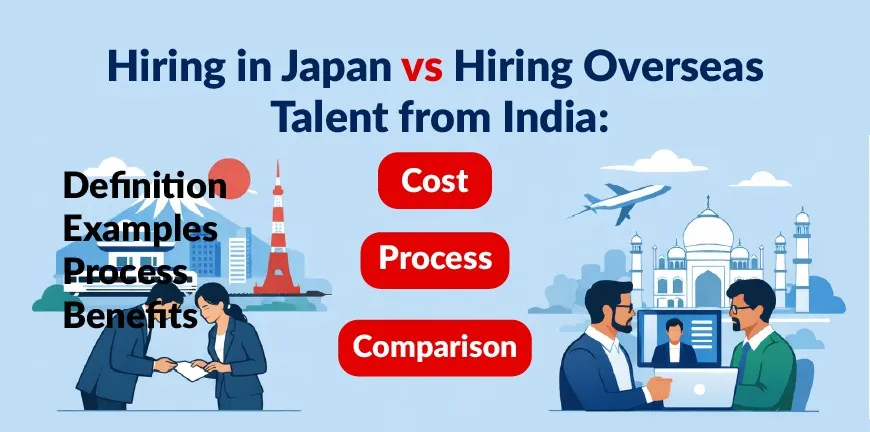
Japan is one of the strongest recruitment markets in the world, projected to grow 10.26 T. The Japan recruitment market comprises dispatching, outsourcing, recruitment advertising, & employment services. Hiring in Japan vs hiring overseas talent from India has become increasingly challenging due to high recruitment costs and talent shortages due to an ageing population. To sustain growth, companies in Japan are now exploring offshore hiring solutions with India as the most coveted destination.
What Does Hiring in Japan Mean for Companies?
Among the various reasons, Japan is home to advanced companies & technology. But unfortunately, it lacks talent management strategies to help organisations remain competitive in an evolving global market. Here are some top challenges why Japanese businesses are not able to inch forward.
1. Traditional Hiring Strategy
Companies in Japan hire fresh graduates from universities based on communication, ambition, & character. Unfortunately, the candidates are not hired based on domain-specific skills or technical knowledge. This reduces a company’s flexibility to adapt to new business environments. Also, positions are filled internally due to a lack of domestic talent.
2. Rigid Business Practices
As Japan is a vertical society, seniority is considered sacrosanct. This can be highly challenging for creative young talent who can perform better with skills alone. Personal ambitions have no place in Japanese companies, as conformity, teamwork, & loyalty are the core attributes of employees. Moreover, these companies follow a multi-task policy; they make candidates generalists rather than specialists.
3. Shrinking Workforce
Japan’s ageing population and declining birth rates make it difficult for Japanese companies to recruit skilled professionals. With fewer skilled talent, salaries, benefits, & other overhead costs surge to unexpected levels. Lengthy hiring rounds, intensive background checks, & delayed negotiations demotivate candidates.
4. Cultural Impact
Language barriers & cultural misalignment distort the recruitment process. This may be due to the lack of customised recruitment strategies & training models to align personal ambitions & cultural standards with the company.
What Does Hiring Overseas Talent from India Involve?
By outsourcing recruitment services from India, companies in Japan gain numerous advantages. Here are some reasons why India has become a coveted talent destination for Japanese companies.
1. Global Talent Acquisition Expertise
India has specialised global talent recruitment agencies or RPOs that source domain-specific and hidden talent from extensive networking sites, industry leaders, & social media platforms. Interacting with different industries, they source candidates with the right skills and cultural standards of Japanese companies.
2. Cost-effective Outsourcing
As India is a global hub for both technical and non-technical talent, the cost of hiring domain-specific & role-based talent in India is comparatively lower than in Japan. Recent reports suggest that Japanese companies can reduce costs up to 30% by outsourcing recruitment solutions from India.
3. 24/7 Service Support
The time zone difference between Japan and India allows Indian global recruitment agencies to offer 24/7 hiring support. Supporting Japanese companies outside their business hours helps reduce time-to-hire & operational disruptions. This can be vitally important during seasonal hiring or hard-to-fill positions.
4. Time Advantage
The 4-hour difference between Japan and India gives Indian global recruitment firms an additional advantage of sourcing, screening, vetting & building a talent pipeline for Japanese companies.
5. Advanced Recruitment Technology
The HR industry in India is advanced & shaped by automation & AI technologies. As Japanese companies emphasize culture, diversity, domain-specific skills, & EVP, global recruiters use AI-driven tools & strategies to screen capabilities, conduct psychometric analysis, & understand candidates’ brand perception before they are onboarded into Japanese companies.
6. Language & Cultural Development Specialists
As Japanese firms are built on both traditional & modern workforce culture, they pay more attention to linguistic capabilities to ensure candidates understand the workflow process faster & build positive peer relationships.
What are the key differences between hiring in Japan and hiring from India?
Companies in Japan understand the appeal of outsourcing hiring solutions in India, but they are hesitant due to certain risk factors. To understand the differences in hiring in Japan vs hiring overseas talent from India, here are some pointers.
| Factor of Difference | Hiring in Japan | Hiring Overseas Talent from India |
| Talent Acquisition | Companies recruit fresh graduates with zero technical expertise or specialized skills, but hire based on character, communication & ambition. | In India, global recruiters use AI-driven and automated tools and platforms to assess technical and psychological skills to support companies with skill-culture alignment. |
| Business Practices | Businesses in Japan give importance to seniority, loyalty & social alienation. | Recruitment in India focuses more on diversity & inclusion by hiring multi-generational, multi-regional talent. |
| Skills | Economic development is hampered by a low young workforce, poor technical knowledge, communication, & creative abilities. | Overseas recruitment in India focuses more on IT & AI-led talent with strong communication & leadership skills. |
| Culture | Since the Japanese workforce is not exposed to social media or professional job portals, they receive a low response rate due to poor branding strategies. | The global recruitment strategy in India involves a stronger EVP strategy proposed through social media & professional websites to tap high-quality talent. |
| Costs & Time | As the skilled force is limited, there is a huge demand for salary, benefits, & privileges by the existing talent. | As India is a global talent hub, the availability and accessibility of both technical and non-technical talent pools are large, costs spent on marketing or branding reduces. |
When should companies choose Japan hiring vs offshore hiring from India?
Japanese companies must consider outsourcing hiring solutions from India only when the internal team falls short of achieving the following targets.
1. Building a Strong Talent Base
Since the Japanese economy is undergoing a significant transformation led by new-age technologies & global business competition, companies are in demand of a globally skilled and culturally adaptable talent. As company HR faces labour shortage triggered by an ageing population, a technically backward workforce with poor linguistic abilities, they can outsource hiring solutions from India with a potentially strong technical & non-technical workforce with multi-lingual abilities.
2. Cost Savings
Japanese companies are resistant to using social media & professional websites to advertise job openings. They rely more on internal talent mobility due to skill shortage and a low-qualified workforce. In this case, partnering with a global recruitment agency in India can help them save costs on high salaries, remuneration, benefits, bonuses, & privileges to the internal talent and focus on recruiting an inclusive and culturally aligned workforce to drive business growth and operational success.
3. Focus on Core Business Functions
In a globally competitive environment, Japanese companies cannot rely on internal hiring systems or teams to spend time finding specialized talent in a low-skilled Japanese market. This can overburden HR teams and reduce their productivity. By outsourcing recruitment management to Indian agencies, Japanese companies can free up internal HR teams to focus more on strategic initiatives, such as employee engagement, learning & development programs, & building new business strategies.
4. Scalability & Flexibility
Hiring needs fluctuate with market demands and trends. To support these flexible talent needs, Japanese companies may not scale their team up or down. But to meet the seasonal or permanent talent demands and avoid operational disruption, Japanese companies can outsource talent recruitment to Indian hiring agencies.
Conclusion
Choosing local hiring vs global hiring solutions from India does not fit every Japanese company; rather, it depends on the business goals, team size, cultural outlook, talent needs, & the industry type. But if you are a leading Japanese company with a low-capability internal hiring HR team, and planning to scale, then it is essential to select a top recruitment agency in India. Since India is the top destination for qualified technical & non-technical talent with multi-lingual capacity, Japanese companies can look for a reputed, service-first, & industry-focused outsourcing hiring solutions provider. By outsourcing, Japanese companies can improve operational efficiency, scale growth, & build a resilient workforce of tomorrow.
Frequently Asked Questions (FAQs)
1. Why do Japanese companies hire from India?
Japanese companies hire from India for cost efficiency, strong STEM talent, English proficiency, scalability, and adaptability in global, tech-driven business environments.
2. What is the cost difference between hiring in Japan and India?
Hiring in India can cost 40–60% less than Japan, offering high-quality talent at significantly lower salaries, infrastructure, and operational expenses.
3. What are the challenges of hiring in Japan?
Hiring in Japan is challenging due to talent shortages, an ageing workforce, high costs, strict labour laws, and cultural-language barriers slowing recruitment.
4. Is Indian talent suitable for Japanese companies?
Indian talent suits Japanese companies well, bringing technical expertise, global mindset, flexibility, and strong problem-solving skills aligned with evolving business needs.
5. Can companies hire remote employees from India?
Yes, companies can hire remote employees from India, gaining access to skilled talent, reduced costs, and seamless collaboration through digital tools.
Contact Us For Business Enquiry

Kishore V N
Kishore V N is the Managing Director at ALP Consulting, bringing over 29 years of extensive experience in global recruitment, talent strategy, and workforce solutions. He has been instrumental in building scalable RPO, MSP, and modular talent sourcing models that empower organizations with a competitive edge in talent acquisition. Kishore’s leadership focuses on expanding ALP’s global presence, driving innovation in recruitment technology, and enhancing operational excellence. He also serves as Director at Datacore Technologies, steering digital HR transformation through advanced HRMS and virtual staffing solutions.