
What Is a Recruitment Agency? Basics and What They Do
20/02/2026
India AI Impact Summit 2026- Impact on Human Resources
24/02/2026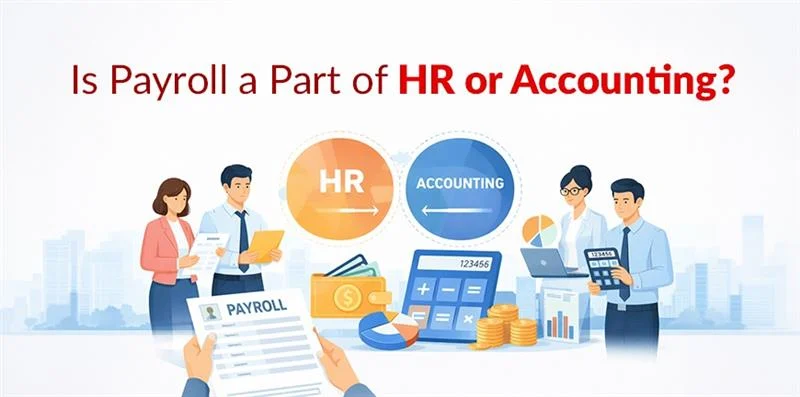
Payroll has become an essential part of employee experience and is no longer just a process of salary disbursement. However, there is a million-dollar question that every company is looking to find a sure-shot answer: Is payroll part of HR or finance?
Let’s try to find a rational answer through a detailed analysis by looking at payroll from both HR and finance/accounting aspects. At the end of this discussion, we will find out whether payroll management responsibility belongs to HR or Finance/Accounting!
What Is Payroll?
Before diving deep into the debate of “Is payroll part of HR or finance?” Let’s understand what payroll means in the context of business through an example.
Let’s take a mid-sized manufacturing company in Bangalore with around 250 employees spread across different departments. Every month from Jan to Dec, the payroll team collects attendance data from biometric systems or computer activity tracking. Once collected, the team will calculate overtime, incentives, statutory deductions like PF and ESI, and adjust leave balances.
Additionally, they also take care of the process of reimbursements, bonuses, and tax deductions before transferring the net salaries to employee bank accounts. Once salaries are credited accurately, payroll reports are shared with finance for accounting & compliance filing. At the same time, the HR team will use the data for employee records and performance-linked compensation planning decisions.

Can you retrace the steps of payroll processing from the above example?
Still confused, no problem. Let’s list the typical steps involved that will help us understand payroll in an organizational structure:
| Step | Payroll Processing Activity | Responsible Department |
| 1 | Collect attendance data from biometric systems & trackers (if installed in employee laptops) | HR |
| 2 | Validate employee working hours, OT (overtime), & leave balances | HR |
| 3 | Calculate gross salaries, including incentives & overtime payments | Payroll / HR |
| 4 | Compute statutory deductions like PF, ESI, & taxes | Payroll |
| 5 | Process reimbursements, bonuses, & other variable pay components | HR / Payroll |
| 6 | Prepare payroll summary reports for HR record validation | Payroll |
| 7 | Review payroll costs for accounting accuracy and classification | Accounting |
| 8 | Share salary statements with finance for fund allocation | Payroll / Finance |
| 9 | Transfer net salaries to employee bank accounts | Finance |
| 10 | File compliance reports and update organizational payroll records | Payroll / HR / Accounting |
Here is the finalized definition of payroll from a 360-degree perspective:
“Payroll is the systematic process of calculating employee earnings, deducting statutory contributions and taxes, processing reimbursements and bonuses, disbursing salaries, & generating compliance and financial reports within an organization”.

Is Payroll Part of HR?
As we continue to ponder whether payroll is part of HR or finance, let’s isolate payroll & understand its role in the HR department first!
Payroll is commonly positioned under HR because it directly supports employee compensation and workforce administration. The payroll function in HR typically sets in motion with gathering attendance, leave data, salary revisions, & employment changes, all of which are managed within the employee lifecycle.
However, when we examine the payroll meaning in HR from an organisational standpoint, it reflects more than just being a process initiated just for the sake of salary calculation. Moreover, the payroll control framework in HR represents the structured execution of compensation policies, benefits administration, statutory contributions, & employee communication.
Since HR takes care of hiring, promotions, appraisals, & exits, making payroll an integral part within the same department can bring a lot of advantages. The exclusive involvement of the payroll function in HR ensures consistency between compensation decisions & actual salary disbursement. Also, employees approach HR for payslip clarifications, tax declarations, & reimbursement queries, reinforcing HR’s operational involvement in payroll ownership structure.
At the same time, payroll management responsibility extends into compliance, reporting accuracy, and financial coordination. While payroll fits naturally within HR’s people-focused framework, its broader financial implications indicate that it may not belong exclusively to HR alone.
This is turning out to be an interesting seesawing battle, making it challenging for us to get a clear winner and an answer to the million-dollar question: Is payroll part of HR or finance?
Is Payroll Part of Finance or Accounting?
As we continue this tussle to get an answer for the tricky question Is payroll part of HR or finance? Let’s now shift the lens and examine payroll from a finance standpoint.
Payroll is aligned with finance in most cases because it directly throws its weight on the company’s cash flow, budgeting, cost control, & statutory compliance. The payroll function in finance typically focuses on:
- Fund allocation
- Salary Disbursement
- Tax remittances
- Ledger entries
- Financial reporting
From this perspective, payroll is not just about paying employees on time. Moreover, it is about managing one of the largest recurring expenses in an organization with precision & accountability.
Finance & accounting teams ensure salary payouts are backed by adequate working capital, accurately recorded in books of accounts, & reflected correctly in profit and loss statements (Income statements). They also oversee statutory filings, audit readiness, & reconciliation processes. In many organizations, payroll management responsibilities extend to finance/accounting due to the risk exposure & regulatory implications.
Under a structured payroll governance model, finance often establishes internal controls, approval hierarchies, & compliance checkpoints. Anyways, despite this strong financial oversight, payroll still relies heavily on HR-generated inputs, making it difficult to assign sole ownership to finance alone.

How Does Payroll Differ in Small vs Large Organizations in Terms of Payroll Management Responsibility?
Is payroll part of HR or finance? The answer to this question also depends on the size of the organisation. Payroll management responsibilities vary drastically between small and large organisations, like chalk and cheese. Here is a detailed comparison of payroll management responsibilities between small and large companies:
| Aspect | Small Organizations | Large Organizations |
| Payroll Ownership Structure | Payroll handled jointly by HR & Finance/Accounting | Dedicated payroll team with defined departmental boundaries |
| Degree of HR Responsibility | High: HR team handles A-Z payroll tasks | Moderate: HR offers inputs & policy approvals whenever deemed necessary |
| Degree of Finance/Accounting Responsibility | Moderate: Reviews payouts & manages accounting entries | High: Controls compliance, audits, reporting, & fund governance |
| Attendance & Data Collection | Managed entirely by HR with minimal automation | Automated systems: HR validates structured data inputs |
| Salary Calculation & Deductions | HR calculates & Finance cross-checks totals through Tally | Payroll specialists calculate & Finance oversees accuracy |
| Compliance & Statutory Filings | Shared responsibility and often externally supported | Finance/Accounting-led with strict internal controls |
| Salary Disbursement | Finance executes transfers once HR approval is obtained | Finance manages centralized & multi-location disbursement |
| Internal Controls & Governance | Limited formal controls, & fewer approval layers | Structured approval matrix with a strong payroll control framework |
| Audit & Reporting Complexity | Basic payroll reporting structure & limited audit exposure | Detailed reporting, multi-level audits, & regulatory scrutiny |
What Are the Pros and Cons of Keeping Payroll Under HR Alone?
Pros
1. Better Alignment with Employee Lifecycle:
Ensures payroll governance model syncs closely with hiring, promotions, & exits.
2. Improved Employee Query Resolution
Employees receive faster salary clarifications via centralized HR communication channels.
3. Stronger Data Confidentiality Control
Sensitive compensation & personal information remains securely managed within reliable HR teams via a robust payroll control framework.
4. Seamless Policy Implementation
Compensation revisions & benefit updates integrate smoothly with HR policies like clockwork.
5. Enhanced Employee Experience
Timely salary processing reinforces trust, improves engagement, & elevates employee satisfaction, resulting in reduced attrition rates.
Cons
1. Limited Financial Oversight
May fall short when it comes to rigorous financial controls & detailed accounting reconciliation processes.
2. Higher Compliance Risk Exposure
Complex statutory requirements may exceed the typical HR skill matrix.
3. Budgeting and Cost Visibility Gaps
HR may have limited visibility into the overall organizational cash flow.
4. Increased Operational Burden
Managing payroll alongside recruitment & performance significantly increases HR workload.
5. Weak Audit and Governance Structure
The absence of finance-led controls may diminish the effectiveness of payroll governance.

What Are the Pros and Cons of Keeping Payroll Under Finance/Accounting Alone?
Pros
1. Stronger Financial Control & Accuracy
Ensures payroll spending is accurately recorded, reconciled, & financially controlled.
2. Improved Compliance & Statutory Governance
Enhances regulatory compliance via structured accounting reviews & documentation.
3. Better Budgeting & Cash Flow Planning
Aligns salary credit with organizational budgeting & cash flow forecasts.
4. Robust Internal Audit Framework
Establishes layered approval systems & stronger payroll audit mechanisms.
5. Reduced Financial Risk Exposure
Minimizes payroll errors that could affect taxation & reporting accuracy.
Cons
1. Limited Employee-Centric Perspective
Finance teams may lack sensitivity toward employee compensation concerns.
2. Slower Query Resolution Process
Employees may experience delays in resolving pay slips & reimbursement clarifications.
3. Disconnect from HR Policy Changes
Compensation updates may not reflect changes in HR policies immediately.
4. Increased Communication Gaps
Requires additional coordination between HR inputs & finance processing.
5. Reduced Employee Experience Focus
Payroll is handled purely as numbers, not as an employee engagement driver.

What Challenges Arise When Payroll Is Misaligned Between HR and Finance?
Here are 5 key challenges faced by companies when payroll is not aligned correctly between HR and Finance/Accounting:
1. Delayed Salary Processing
Unclear payroll ownership structure & approval bottlenecks between HR and finance cause coordination gaps. This results in late salary disbursement & employee dissatisfaction.
2. Increased Payroll Errors
Inconsistent data validation & miscommunication on compensation changes create discrepancies in salary calculations & statutory deductions.
3. Compliance and Regulatory Risks
Ambiguity in maneuvering tax remittances & statutory filings increases vulnerabilities that can lead to penalties & audit complications.
4. Employee Query Escalation Issues
Payroll concerns get thrown around repeatedly between departments, reducing accountability & weakening employee trust in processes.
5. Financial Reporting Discrepancies
Misalignment in expense classification & reconciliation leads to inaccurate financial statements and budgeting challenges.
Why Payroll Should Be Considered Both an HR and Accounting Function?
Now that we have looked at payroll as part of HR and Finance/Accounting separately, it is clear that payroll must be considered to be an integral part of both HR and Finance/Accounting. Here are 5 reasons that establish a payroll control framework to be managed by both HR and the Finance/ Accounting function.
1. Integrates People Data with Financial Records
Payroll in organizational structure connects employee lifecycle information from HR with accounting entries. This ensures compensation decisions are in perfect coordination with accurate financial documentation.
2. Balances Employee Experience and Compliance
Shared payroll management responsibility between HR & finance safeguards timely salary credits while maintaining statutory deductions, tax filings, & audit-ready financial reporting standards.
3. Requires Dual Oversight for Accuracy
HR validates employee data & policy changes, while finance/accounting ensures calculations, reconciliations, & ledger postings remain accurate.
4. Impacts Organizational Budgeting and Workforce Planning
Payroll function in HR and finance influences manpower costs, budgeting forecasts, & compensation strategies. This requires coordination between workforce management & financial planning teams.
5. Strengthens Governance and Risk Control
Shared payroll governance model between HR and finance/accounting reduces errors, improves compliance transparency, & builds a structured payroll governance framework across departments.
What are the 5 Best Practices for an Integrated Payroll Model?
1. Establish Clear Ownership and Accountability
Define structured roles for HR & finance with documented approval workflows to prevent confusion & operational delays.
2. Implement Strong Payroll Governance Framework
Create standardized policies, compliance checkpoints, & audit trails to ensure transparency & regulatory adherence.
3. Use Centralized and Automated Payroll Systems
Adopt an integrated HRMS & accounting management system to reduce manual errors & improve real-time data synchronization.
4. Conduct Regular Reconciliation and Compliance Reviews
Perform monthly payroll audits, statutory verification, & ledger reconciliation by equal distribution of payroll management responsibility between HR & finance to maintain financial & regulatory accuracy.
5. Maintain Transparent Interdepartmental Communication
Schedule periodic coordination meetings between HR & finance to discuss updates, discrepancies, & policy-driven compensation changes.
How Alp Consulting Can Help Companies Manage an Effective Payroll Ownership Structure?
Alp Consulting Ltd, a leading payroll expert with 30 years of solid experiences helps companies design and implement an effective payroll ownership structure by clearly defining roles between HR & Finance/Accounting.
With structured workflows, compliance monitoring, and automated payroll systems, Alp ensures seamless coordination across departments. Our experts establish governance frameworks, approval hierarchies, & reconciliation controls to minimize errors and statutory risks.
By aligning employee data, financial reporting, and regulatory filings, Alp Consulting enables organizations to achieve accurate, compliant, and strategically integrated payroll management.
Is Payroll Part of HR or Finance? – Final Verdict
The verdict for the million-dollar question: Is payroll part of HR or Finance? ends in a tie. Payroll is not exclusively owned by HR or Finance/Accounting; it is a strategic function that sits at the intersection of both. HR drives employee data, compensation policies, & workforce inputs, while Finance ensures compliance, financial accuracy, and fund control.
A well-structured payroll governance model integrates both departments, making payroll a shared responsibility critical to organizational stability & employee trust.
Connect with Alp Consulting Ltd if you are looking for a reliable outsourcing partner to manage end-to-end payroll management.
Key Takeaways
- Payroll connects employee compensation processes with financial reporting and statutory compliance requirements seamlessly.
- HR manages employee data inputs, while finance ensures accuracy, compliance, and fund governance.
- A clear payroll ownership structure prevents errors, delays, and interdepartmental conflicts significantly.
- Integrated payroll governance model strengthens transparency, audit readiness, and organizational stability.
- Effective collaboration between HR and finance enhances employee trust & compliance reliability.
Contact Us For Business Enquiry
FAQs
1. Is Payroll Part of HR or Finance?
Payroll sits between HR & Finance, requiring shared responsibility for employee data management, compliance accuracy, and financial control.
2. Who Is Responsible for Payroll Processing in an Organization?
Payroll management responsibility depends on structure, typically shared between HR for inputs and Finance for validation, disbursement, and compliance.
3. Does Accounting Handle Payroll Taxes and Statutory Deductions?
Yes, accounting typically manages payroll taxes, statutory deductions, reconciliations, and ensures accurate regulatory filings and audit documentation.
4. Can Payroll Be Managed Without an HR Department?
Payroll can operate without HR, but employee data accuracy & policy alignment may become challenging.
5. Should Payroll Report to HR or the CFO?
Payroll reporting structure depends on governance model, organizational size, risk exposure, & desired financial oversight level.
6. Why Is Payroll Important for Compliance and Risk Management?
Payroll ensures statutory adherence, accurate tax remittance, audit readiness, & minimizes financial penalties and reputational risks.

Yugandhara V. M
Yugandhara V. M serves as the Assistant Vice President – HRO at Alp Consulting Ltd., bringing over 14 years of rich experience in Human Resource Outsourcing, payroll management, and statutory compliance. He specializes in driving process excellence across HR operations, ensuring seamless service delivery and compliance with labor laws. Yugandhara’s expertise lies in managing large-scale client engagements, optimizing HR processes, and implementing efficient workforce management systems that enhance organizational performance. He also leads comprehensive payroll services, ensuring accuracy, timeliness, and compliance for diverse client portfolios.