
Top 13 HR Trends in the Manufacturing Industry
14/01/2026
What is Human Resource Management (HRM)? An Expert Guide 2026
15/01/2026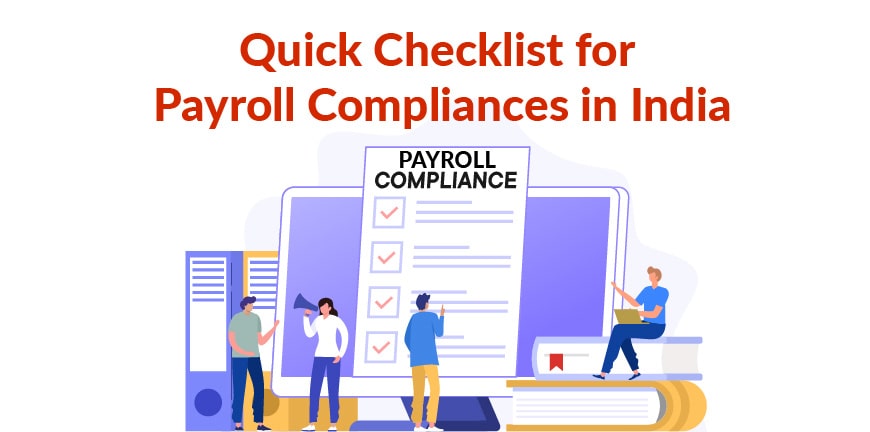
Is your business fully aligned with the latest labour codes and state-wise payroll rules for 2026?
One of the most important tasks that every business, whether big or small, must perform is processing the payroll. It is the most critical function that contributes to employee satisfaction and retention. Payroll processing is a daunting task, especially for the bigger organizations with a greater volume of employees. The average payroll fraud case lasts 18 months before being detected, with a median loss of approximately ₹42 lakh ($50,000) per case. Here is an important question: What’s the primary objective of payroll?
The accurate, timely payment of salaries, adhering to the compliance requirements. Every company, to run a successful business, must ensure compliance. Ensuring compliance is not just a necessity but is essential for the legal and ethical functioning of an organization.
Let’s work together and build an ultimate payroll compliance checklist ideal for all types of businesses and services managing single and multilocation business operations across India. Go!

What Is Payroll Compliance and Why Does It Matter for Payroll Accuracy?
Payroll compliance is the adherence to all the rules and regulations pertaining to payroll in the respective jurisdictions. If you have a business set up in multiple countries, the complexities of payroll compliance increase, too, since regulations and laws of different countries must be considered and adhered to. Failure to adhere to laws and regulations can lead to non-compliance and cause unnecessary hassle, heavy fines, and brand damage.
What Should Be Verified in the Payroll Compliance Checklist Before Running Payroll?
There are a whole lot of considerations to factor in before processing payroll. There is a checklist of requirements that need to be met to maintain compliance. They are-
1. Setting Up the Payroll
To process payroll, you first need to set up a proper compliance process. Businesses with multi-country payroll operations can either establish their own legal entities in each geography and set up a proper local payroll, register as a Foreign Employer and run a non-residential payroll, use an Employer of Record (EOR), or set up a shadow payroll for short-term employee assignments.
2 .Registration with Local Authorities
If your organization is expanding to new locations with new payroll setups, you must register with the local authorities to get all the necessary identification numbers and be able to run your company compliantly. The authorities you need to register with include tax authorities, social security bodies, and other government agencies.
3. Payment Infrastructure
If you are a company operating in multiple countries, then make sure you have a proper payment infrastructure. Paying international employees can get tricky as there are many rules and regulations to abide by, and different countries have different rules regarding whether businesses need an in-country bank account to pay local employees, which currency to use for paying wages and salaries.
If you are paying employee salaries in currencies other than the local one, you need to keep an eye on foreign exchange control.
4. Pay Schedule
Now that you have created a compliant payment infrastructure, you need to make sure the pay schedule meets the legal requirements. This refers both to the pay period, which can be monthly, semi-monthly, bi-weekly, or weekly, and the specific pay day. Many countries have rules about how often employees need to be paid and by what day of the month funds need to be made available to employees.
5. Compensation Laws
Before you start processing payroll in a new location, set the wages and salaries for your workers. Other than considerations regarding the competitiveness of the salary packages, the offered compensation needs to be in line with local laws. This includes minimum wage regulations, special regulations for certain industries and professions, and equal pay legislation.
6. Employee Classification
Classifying employees correctly is a crucial part of payroll compliance. Misclassification can lead to incorrect payments to the employees, as the taxes to be deducted vary from one type to the other. Workers can be classified as full-time employees, independent contractors. But since the guidelines as to what sets the two statuses apart differ from one country to the next, it is essential to have a country-specific checklist at hand and carefully examine each worker’s classification status.
7. Statutory Benefits
Employee benefits are an important part of the overall compensation package. Statutory benefits represent an important payroll compliance aspect. Not offering employees all the benefits they are legally entitled to will result in hefty fines.
8. Data Protection
Payroll data contains a lot of personal information, which is to be kept confidential and is therefore classified as highly sensitive. To prevent data breaches, organizations must set up a secure payroll system that uses encryption to protect data during transfers and storage.

What Compliance Checks Must Be Done During Payroll Processing?
1. Adherence to Labour Regulations
There are certain regulations as to how many hours an employee should work. Regarding this, you must make sure that the workload is within legal limits. Most countries regulate how many hours employees are allowed to work within one week, how many hours of rest they need to have, and how much overtime work is permitted.
2. Payroll Tax Calculating, Withholding, and Filing
Calculating, withholding, and submitting the right amount of taxes is an essential part of payroll compliance. To maintain a compliant payroll, businesses must calculate payroll taxes based on the updated tax rates and remit the withheld amounts to the respective authorities on time.
3. Payslip distribution
Providing payslips to employees is mandatory. Some of the particularly important aspects to be considered while distributing payslips are:
- To contain all the legally required information
- The payslips must be in digital or paper form, depending on the country-specific rules.
- They need to be distributed in a way that ensures the information remains confidential.
4. Accurate and timely payment
After the actual payroll processing, organizations need to make sure that the payment goes through correctly. Make sure that the payment is issued with enough lead time to guarantee the money hits the employee’s bank account on payday.
What Are the Mandatory Post-Payroll Compliance Checks Employers Must Follow?
Once you pay the employees, you may think you are done with the payroll process, but it does not end there. There are certain procedures you must follow post the payroll processing. They are-
1. Payroll Reporting
As part of payroll reporting, income tax and other payments must be made in an accurate and timely manner. Businesses must file quarterly or annual reports and fulfil additional statutory reporting requirements. Meeting the deadlines when submitting these reports is crucial to avoid fines and non-compliance.
2. Payroll Recordkeeping
Organizations are required to keep detailed records of all their payroll activities. Two of the most important aspects to keep in mind when it comes to payroll records are:
- The payroll documentation needs to be complete and contain all the required documents.
- Records must be kept at least for the minimum duration required by law.
Of course, it may sound quite straightforward, but it can quickly become quite a challenge when different authorities have different rules regarding how long certain payroll records must be kept. Storing payroll records digitally is extremely crucial.
3. Tax and Legal Changes
Labor laws and taxation rules are constantly changing. If you want to make sure your global payroll remains compliant, you need to keep track of the changes in the respective countries and implement the changes in the payroll system.
4. Employee Classification Review
Organizations need to conduct regular reviews to reevaluate the classification of their workers. This can be easily done if you have an employee classification checklist. The information then needs to be updated in the payroll system.
5. Preparation for Potential Audits
Compliance audits in payroll happen more often than you might think. Businesses must always be prepared to face audits. This means verifying that all the documents and paperwork are in order after each payroll run.
How to Prepare a Payroll Compliance Checklist for 2026?
Here is a step-by-step guide on how to prepare a robust payroll compliance checklist in 2026:
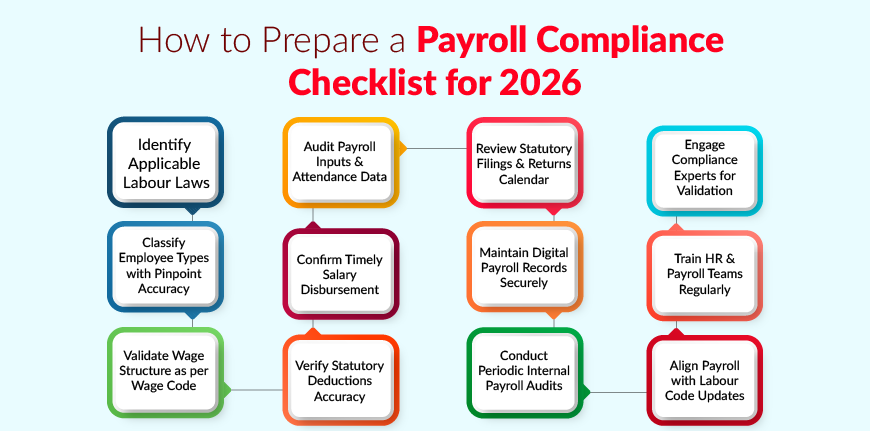
Step 1: Identify Applicable Labour Laws
Prepare a consolidated list of all the applicable central & state labour laws, wage codes, social security measures, & industry-specific regulations applicable to your jurisdiction, workforce categories, & employment contracts. Here are the 10 major laws employers must keep in mind while preparing the new year payroll compliance checklist in 2026:
- Code on Wages, 2019
- Code on Social Security, 2020
- Employees’ Provident Funds & Miscellaneous Provisions Act, 1952
- Employees’ State Insurance Act, 1948
- Payment of Bonus Act, 1965
- Payment of Gratuity Act, 1972
- Maternity Benefit Act, 1961
- Contract Labour (Regulation and Abolition) Act, 1970
- Shops and Establishments Act (State-specific)
- Professional Tax Act (State-specific)

Step 2: Classify Employee Types with Pinpoint Accuracy
The payroll rules, benefits, tax treatments, & statutory deductions vary across worker classifications. Therefore, employers must segregate permanent, contract, gig, apprentice, & expatriate employees according to the applicable income categories & tax slabs.
Example: A Bengaluru-based chocolate factory employs permanent staff with PF, contract workers via contractors, gig IT consultants with TDS only, apprentices on stipends, & expatriates under special tax and social security rules.
Step 3: Validate Wage Structure as per Wage Code
The HR and payroll team must ensure that the basic salary offered to workers meets the minimum percentage requirements. Additionally, the allowances must be correctly structured, & overtime calculations should align with the revised wage definitions under the Code on Wages, 2019.
Important rule change applicable to Code on Wages, 2019: If allowances (HRA, travel, and more) exceed 50% of the CTC, the excess amount is now automatically added back to the “Wages” for social security calculations.
Step 4: Verify Statutory Deductions Accuracy
The HR team must check PF, ESIC, professional tax, labour welfare fund, & income tax deductions for correct rates, ceilings, eligibility, & timely monthly remittance.
Did you know: Failing to deposit TDS by the 7th of the month triggers an interest penalty of 1.5% per month. In 2025–26, tax authorities have increased automated “Short-Deduction” notices by 35% for companies with unreconciled Form 24Q filings.
Step 5: Confirm Timely Salary Disbursement
The payroll team must validate salary payment timelines, bank transfer confirmations, payslip issuance, & compliance with wage period requirements under the latest labour law reforms and employment contracts.
Latest rules on wage disbursement: For any establishment (regardless of size), wages for a monthly wage period must be paid by the 7th day of the succeeding month. A delay of even 24 hours can trigger a “Show-Cause” notice if an employee reports it via the centralised Shram Suvidha Portal.
Step 6: Audit Payroll Inputs & Attendance Data
Reconcile attendance, leave, OT (overtime), shift allowances, & incentive data with payroll processing systems to negate wage disputes & statutory calculation errors.
Interesting move: To prevent “buddy punching” & wage theft, 80% of large Indian enterprises have moved to AI-driven biometric or geo-fenced attendance in 2026, which reduces OT disputes by nearly 45%.
Step 7: Review Statutory Filings & Returns Calendar
Prepare a compliance calendar covering monthly, quarterly, & annual payroll filings across PF, ESIC, TDS, labour departments, & digital compliance portals.
In the 2024-25 FY, Indian businesses paid an estimated ₹627 crore (~$75 million) in fines due to late tax and statutory filings. To prevent such unwarranted penalties that eat into profits, employers must include this step in their current payroll compliance checklist.
Step 8: Maintain Digital Payroll Records Securely
The HR team, in collaboration with the finance crew, must store payslips, registers, challans, employee declarations, & audit trails in encrypted, retrievable formats meeting data retention & inspection-readiness requirements.
Malicious Insider Risk: Insider-driven breaches (unauthorised employee access) remain the most expensive initial attack vector, costing an average of $4.92 million/ incident.
Step 9: Conduct Periodic Internal Payroll Audits
Schedule quarterly or semi-annual payroll audits to pinpoint non-compliance risks, process gaps, misclassifications, & documentation weaknesses before inspections occur.
Interesting stat: Organisations that conduct quarterly audits are 65% less likely to face employee-led litigation or labour union disputes regarding wage transparency.
Step 10: Align Payroll with Labour Code Updates
Track notifications, state labour law changes, threshold revisions, & digital reporting mandates under new labour codes to keep payroll policies continuously updated.
As of early 2026, while the Central Government has notified the codes, only a few states, like Gujarat & Arunachal Pradesh, have finalised all rules. Most other states are in various phases of issuing draft rules, which organisations must monitor state-by-state.
Step 11: Train HR & Payroll Teams Regularly
The HR team must provide ongoing training on statutory changes, portal updates, documentation standards, & compliance consequences to minimise dependency on individual payroll operators.
Impact of regular training: Organisations with trained HR teams report a 60% reduction in audit preparation time, as the team knows exactly how to maintain “inspection-ready” digital logs.
Step 12: Engage Compliance Experts for Validation
Get third-party payroll compliance reviews from top agencies like Alp Consulting Ltd, especially for multi-state operations, contractor payrolls, & audits triggered by inspections or employee grievances.
A fresh perspective: External audits typically identify 15% to 25% more compliance gaps than internal reviews, especially in areas like misclassified worker categories or complex OT calculations.

What Does a Payroll Compliance Audit Checklist for Employers Include?
Here’s the consolidated payroll compliance audit checklist for employers that offers the best chance for achieving 100% payroll compliance:
| Checklist Area | What to Verify During Audit | Applicable Law / Code |
| Employee Master Data | Appointment letters, job roles, wage category, UAN, ESIC number, KYC, and bank details updated & accurate | Shops & Establishments Act / OSH Code |
| Wage Structure Compliance | Basic pay structure, allowances, overtime, minimum wages, & correct wage definition alignment | Code on Wages, 2019 |
| Attendance & Leave Records | Attendance, weekly offs, OT, earned leave, sick leave, & national holidays are properly recorded. | State Shops Act / OSH Code |
| Provident Fund (PF) | Correct PF wage, contribution rate, ECR filing, challan payment, and UAN linking | EPF Act, 1952 / Social Security Code |
| Employees’ State Insurance (ESI) | Eligibility verification, contribution calculation, monthly remittance, and employee enrolment | ESI Act, 1948 / Social Security Code |
| Professional Tax (PT) | State-wise PT slabs, deductions, payment schedules, and returns filed correctly | State Professional Tax Acts |
| Labour Welfare Fund (LWF) | Employee and employer contributions are deposited as per state frequency and rates. | State LWF Acts |
| Income Tax (TDS on Salary) | Accurate tax computation, exemptions proof, monthly deposits, quarterly returns, Form 16 issuance | Income Tax Act |
| Bonus Payments | Eligibility check, minimum and maximum bonus limits, and timely annual disbursement | Payment of Bonus Act, 1965 |
| Gratuity Compliance | Eligibility tracking, correct calculation, timely settlement, and proper documentation | Payment of Gratuity Act, 1972 |
| Contractor Payroll Compliance | Contractor PF/ESI challans, wage registers, license validity, principal employer monitoring | CLRA Act, 1970 |
| Apprentice Stipend Records | Approved apprentice contracts, stipend payments, and training records | Apprentices Act, 1961 |
| Expat Payroll & Tax | Residential status, DTAA benefits, split payroll structure, tax equalization if applicable | Income Tax Act / Social Security Code |
| Payslips & Statutory Registers | Payslip format, wage registers, deduction registers, digital or physical preservation | Code on Wages / State Rules |
| Statutory Filings Calendar | Monthly, quarterly, and annual returns filed within deadlines | All applicable labour laws |
| Digital Record Retention | Secure storage of payroll data, challans, audit trails, and inspection readiness | Labour Codes & IT Rules |
| Internal Payroll Audits | Frequency of audits, gap closure reports, and corrective action documentation | Compliance Best Practices |
| Labour Code Transition Compliance | Alignment with notified state rules, thresholds, and digital reporting mandates | All 4 Labour Codes |
What Statutory Deductions Must Be Covered in a Payroll Compliance Checklist?
Here are 10 key statutory deductions covered under the payroll compliance checklist
1. Provident Fund (PF)
Mandatory retirement savings are deducted from eligible employees & matched by the employer, deposited monthly into EPF accounts via the government portal.
2. Employees’ State Insurance (ESI)
Health insurance contribution is deducted for employees earning within the wage threshold, providing medical care, sickness, maternity, & disability benefits.
3. Professional Tax (PT)
State-levied employment tax is deducted from salary based on income slabs & remitted monthly or quarterly to state authorities.
4. Income Tax (TDS on Salary)
Monthly tax deduction based on annual income, exemptions, & slab rates, deposited and reported quarterly to the income tax department.
5. Labour Welfare Fund (LWF)
Employee and employer contributions are collected periodically to fund worker welfare schemes. However, rates and frequency vary by state and are levied as per state government mandates.
6. Employee State Insurance Contribution Arrears
Past-period ESI short deductions recovered from employee salaries and remitted with interest, if applicable, after payroll compliance audits.
7. Provident Fund Arrears and Damages
Recovery of missed PF contributions, including statutory interest and penalties deducted or paid during compliance rectification processes.
8. Court-Ordered Salary Attachments
Mandatory deductions for maintenance, loan recovery, or legal orders are processed strictly as per judicial directions and timelines.
9. Employee Insurance Schemes under the Social Security Code
Contributions toward notified insurance or social protection schemes applicable to specific worker categories under evolving labour code rules.
10. Apprentice Welfare Contributions (if applicable)
Stipend-linked statutory contributions or welfare charges are levied under state apprentice welfare schemes, where notified by local authorities.
What Payroll Records and Documents Must Be Maintained for Compliance?
Here are the key payroll records and documents to be maintained by companies as part of the payroll compliance checklist in India.
| Record / Document | What It Contains | Retention / Purpose |
| Employee Master Register | Personal details, designation, DOJ, wage category, UAN, ESIC, bank details | Proof of employment and statutory coverage |
| Appointment Letters & Contracts | Terms of employment, wage structure, benefits, working hours, and clauses | Legal employment validation |
| Attendance & Muster Rolls | Daily attendance, shifts, overtime, and weekly offs | Wage and overtime verification |
| Wage Register | Gross wages, deductions, net pay, payment dates | Core payroll compliance document |
| Payslips | Salary breakup, deductions, net salary, and employer details | Mandatory proof of wage payment |
| PF Contribution Records | ECR files, challans, UAN lists, contribution breakup | EPF compliance and audit evidence |
| ESI Contribution Records | Contribution sheets, challans, IP details | Medical insurance compliance proof |
| Professional Tax Records | State PT returns, challans, employee-wise deductions | State tax compliance evidence |
| Income Tax (TDS) Records | Form 24Q, challans, Form 16, declarations | Salary tax compliance documentation |
| Bonus Register | Eligibility, calculation, payment dates, acknowledgment | Proof of statutory bonus compliance |
| Gratuity Records | Service records, nomination forms, and payment proofs | Exit compliance and dispute prevention |
| Leave Register | Earned leave, sick leave, maternity leave, encashments | Statutory leave compliance |
| Contractor Compliance Files | Contractor licenses, PF/ESI challans, wage sheets | Principal employer liability protection |
| Apprentice Records | Contracts, stipend payments, training logs | Apprentices Act compliance |
| Expat Payroll Files | Tax residency, DTAA forms, split payroll details | Cross-border tax compliance |
| Labour Welfare Fund Records | Contribution registers, challans, state filings | State welfare compliance proof |
| Statutory Returns & Filings | Acknowledgments of online submissions | Evidence of timely compliance |
| Inspection & Audit Reports | Notices, replies, closure reports | Regulatory readiness and defence |
| Payroll Change Logs | Salary revisions, deductions changes, approvals | Internal audit trail |
| Digital Payroll Backups | Secure archived payroll databases and documents | Data protection and retrieval need |

What Are the Payroll Compliance Requirements in India Under Current Acts & Laws?
Here are the key payroll compliance requirements under the labour regulations and laws:
1. Employee Registration & KYC
Collect Aadhaar, PAN, bank details, UAN, ESIC number, & maintain verified employee identity & statutory enrollment records.
2. Wage Structure as per the Wage Code
Ensure basic pay meets wage code definition, allowances are structured correctly, & minimum wages are complied with across job categories & states.
3. Timely Salary Payment
Pay wages within statutory timelines, via bank transfer, & issue payslips showing detailed earnings & deductions.
4. Attendance and Working Hours Records
Maintain daily attendance (preferably through biometrics or accurate software), OT, weekly off, and shift records to support wage & overtime compliance verification.
5. Provident Fund Contributions (PF)
Deduct & deposit employee and employer PF contributions monthly, file ECR, & maintain UAN-linked contribution records.
6. Employees’ State Insurance Contributions (ESI)
Enrol eligible employees, deduct contributions, remit monthly, & maintain insurance & benefit eligibility documentation.
7. Professional Tax Compliance (PT)
Deduct state-specific professional tax, deposit within due dates, & file periodic state returns accurately.
8. Income Tax Deduction at Source (TDS)
Calculate annual taxable income, deduct TDS every month within the due date, deposit timely, & file quarterly returns via Form 16 issuance.
9. Labour Welfare Fund Contributions (LWF)
Deduct & deposit employee welfare contributions (EWC) as per state schedules & maintain supporting payment records.
10. Bonus Payment Compliance
Identify eligible employees, calculate statutory bonus limits, & disburse within prescribed timelines annually.
11. Gratuity Eligibility and Payment
Track continuous service, calculate gratuity accurately, & settle within statutory time after employee exit.
12. Contract Labour Compliance Monitoring
Verify contractor PF, ESI, wage payments, licenses, & maintain principal employer compliance responsibility records.
13. Apprentice Stipend Payments
Pay government-notified stipend, maintain apprenticeship contracts, & upload training records on apprenticeship portals.
14. Expatriate Payroll and Tax Compliance
Apply residential status rules, DTAA benefits, split payroll structures, & mandatory social security exemptions where applicable.
15. Statutory Registers and Records
Maintain digital or physical wage, attendance, deductions, & employment registers as prescribed by state rules.
16. Statutory Returns and Filings
Submit monthly, quarterly, & annual labour and tax returns via applicable government compliance portals.
17. Digital Record Retention
Store payroll data securely for prescribed retention periods & ensure inspection-ready document availability.
18. Labour Code Transition Compliance
Track state notifications, revised thresholds, formats, & reporting requirements under 4 consolidated labour codes.
19. Internal Payroll Audits
Execute payroll compliance audit checklist to detect gaps, rectify errors, & prepare documentation for government inspections.
20. Compliance Training and SOP Updates
Train HR & payroll teams regularly & update payroll SOPs after regulatory or system changes.
What Are the Penalties for Payroll Non-Compliance in India?
Here are 5 major penalties levied on companies that fail to follow the payroll compliance checklist and end up violating the state & central government mandates:
1. Provident Fund Default Penalties
Delayed or missed PF payments attract interest, damages, recovery proceedings, attachment of bank accounts, & possible prosecution of directors under EPF Act provisions.
2. ESI Contribution Non-Payment
Failure to remit ESI contributions leads to interest, penalty damages, disallowance of benefits to employees, inspections, and recovery through attachment proceedings.
3. Income Tax TDS Non-Compliance
Late TDS deposit or incorrect deductions attract interest, monetary penalties, prosecution, disallowance of expenses, and blocking of lower deduction certificates.
4. Minimum Wage and Salary Delay Violations
Paying below minimum wages or delayed salaries leads to compensation orders, penalties, back wage recovery, prosecution, & labour inspector enforcement actions.
5. Statutory Bonus and Gratuity Defaults
Non-payment or delayed payment of bonus or gratuity will result in interest, penalties, employee claims, legal proceedings, & mandatory settlement orders from authorities.

Who Should Use a Payroll Compliance Checklist and When Is It Required?
Here is a list of teams or personnel who must use the payroll compliance checklist diligently to achieve the best outcomes in terms of optimizing the payroll process and eliminating the chances of violations.
| Who Should Use It | When It Is Required | Why It Is Critical |
| HR Managers | During monthly payroll processing and statutory filings | Ensures deductions, wages, and payments meet all legal requirements before salary disbursement |
| Payroll Teams | Before salary finalization and compliance uploads | Prevents calculation errors, missed deductions, and portal filing delays |
| Compliance Officers | During internal audits and regulatory inspections | Helps verify statutory adherence and prepare documentation for inspectors |
| Finance Managers | Before fund releases and statutory remittances | Confirms accurate provisioning for PF, ESI, tax, & benefit liabilities |
| Business Owners / Directors | During quarterly compliance reviews and risk assessments | Reduces personal liability &protects the company from penalties and prosecutions |
| Startups & New Employers | During employee onboarding and first payroll cycles | Establishes compliant payroll structures from the beginning of operations |
| Multi-State Employers | Before each state-wise statutory filing cycle | Manages variations in minimum wages, PT, LWF, and state labour rules |
| Principal Employers (Contract Labour) | Before contractor payments and license renewals | Ensures contractor payroll compliance to avoid joint liability penalties |
| Internal Auditors | During scheduled compliance and financial audits | Identifies payroll gaps and recommends corrective compliance actions |
| External Auditors & Consultants | During due diligence, mergers, and regulatory reviews | Validates payroll systems and statutory risk exposure for transactions |
Why Should Businesses Choose Alp Consulting for Payroll Compliance Support?
Businesses choose Alp Consulting Ltd for payroll compliance support because we combine deep labour law expertise with technology-driven processes & multi-state compliance capabilities. Our payroll compliance experts manage PF, ESI, PT, LWF, TDS, & labour code alignments while ensuring accurate payroll, timely filings, and inspection readiness.
We develop robust payroll compliance checklists, conduct proactive audits, close compliance gaps, & provide real-time advisory on regulatory changes. With dedicated compliance managers & strong government liaison, Alp Consulting helps businesses stay penalty-free, audit-ready, and fully compliant across India.
Conclusion
Payroll compliance in 2026 is more than just employee paying salaries: it’s about managing complex labour codes, multi-state rules, digital filings, & audit readiness. A structured & easy-to-navigate payroll compliance checklist empowers businesses to negate penalties, enhance employer reputation, & build employee trust.
Partner with Alp Consulting to simplify payroll compliance, ensure zero-error processing, & stay inspection-ready. Connect with our payroll & compliance experts today & secure 100% compliant payroll operations.
Key Takeaways
- Payroll compliance now necessitates strict alignment with labour codes, state rules, & digital inspection systems.
- A structured payroll compliance checklist ensures every statutory step is verified before salary processing.
- Timely statutory filings and salary payments are critical to avoid automated notices & financial damages.
- Secure digital recordkeeping and periodic audits ensure inspection readiness & long-term compliance stability.
- Expert payroll compliance partners like Alp Consulting help businesses stay penalty-free across multi-state operations.
FAQs
1. What is payroll compliance?
Payroll compliance means following all labour, tax, wage, & social security laws while processing employee salaries accurately & a timely manner. Using the latest payroll compliance checklist can drastically reduce errors and ensure processes are perfectly aligned with the latest labour reforms.
2. How do you ensure payroll compliance?
Companies can ensure payroll compliance through updated labour law knowledge, deployment of payroll compliance checklists, installation of automated payroll systems, conducting regular audits, maintaining accurate employee data, and ensuring on-time statutory filings.
3. How is AI changing payroll compliance in 2026?
AI enables real-time compliance checks, auto-updates labour rules, flags anomalies, helps in the development of an updated payroll compliance checklist, & reduces manual errors across complex payroll operations.
4. How often should a payroll compliance checklist be reviewed?
A payroll compliance checklist in India should be reviewed monthly and whenever labour law amendments, wage revisions, or policy changes occur.
5. How long should payroll records be maintained for compliance?
Payroll records should be retained for 3-8 years, depending on applicable labour laws and statutory audit requirements.
6. Can payroll compliance be outsourced to a third-party provider?
Yes, payroll compliance can be outsourced to expert providers like Alp Consulting, ensuring statutory filings, audits, updates, & inspection readiness.
Contact Us For Business Enquiry

Yugandhara V. M
Yugandhara V. M serves as the Assistant Vice President – HRO at Alp Consulting Ltd., bringing over 14 years of rich experience in Human Resource Outsourcing, payroll management, and statutory compliance. He specializes in driving process excellence across HR operations, ensuring seamless service delivery and compliance with labor laws. Yugandhara’s expertise lies in managing large-scale client engagements, optimizing HR processes, and implementing efficient workforce management systems that enhance organizational performance. He also leads comprehensive payroll services, ensuring accuracy, timeliness, and compliance for diverse client portfolios.