
Work-Life Balance: What It Is and How to Achieve It
10/12/2025
Top Hiring Trends in the IT Industry 2026
10/12/2025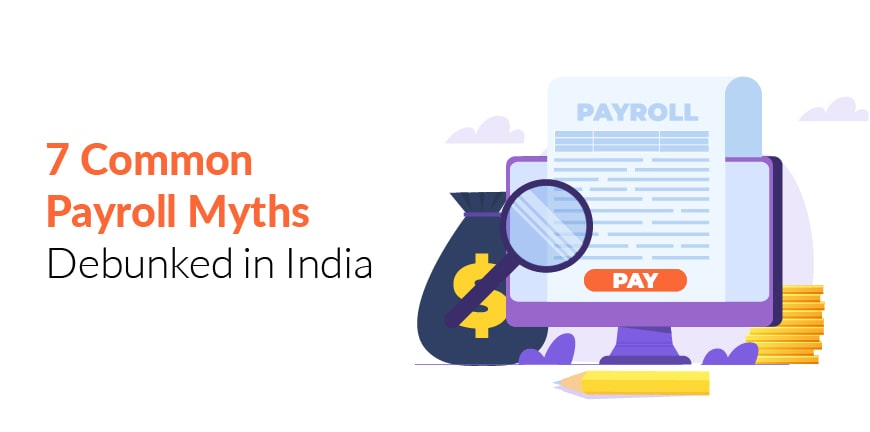
Enterprises, both big and small, do all they can to stay current in the evolving business landscape. Before jumping onto the bandwagon of adopting innovative trends, it is important that you do your fair share of research to distinguish between the actual facts and myths. One such administrative area riddled with myths is the Payroll Management System. If you thought that salary calculation is all that payroll accounting entails, then this is perhaps the biggest myth that needs debunking.
A Payroll Management System can assist with a whole gamut of HR functions from recording employee information, managing payments, tracking hours, managing leaves, incentives, and deductions, to other payroll administration responsibilities.
Be it the common statutory requirements that apply to Indian businesses, like the provision for minimum wages, payment of overtime wages to workers, TDS deduction, contributing to social security schemes such as PF, ESI, etc., adhering to regulations or labour laws, or even for addressing employee grievances; a payroll system can easily take care of all these nuances.
With the massive volume of data involved in the payroll and accounting process, it is critical to ensure that the organization’s payroll is entrusted to responsible hands or to a credible company. Even a minor data breach can be a huge liability for you and your company. That aside, before you decide to go with a complete payroll system overhaul, here are some possible myths that could stand in the way of your company’s growth trajectory.
Myth 1 – Payroll Management System is Complicated
In fact, managing payroll administration with the help of manual methods like spreadsheets is more tedious and prone to mishaps, often owing to human errors. What could seem like potential cost savings may actually be increasing the possibility of costly mistakes and keeping you away from driving business growth.
Manually trying to keep track of employee hours, calculating wages, withholding taxes, and deductions while performing other important business functions can be quite a gargantuan task. Making the whole process even more complicated are the stacks of paperwork involved and the storage of all these files.
Making the transition to a web-based Payroll Management System may seem difficult at first, but the benefits for both your employees and your company are plenty. There are a number of payroll processing systems in the market that can be customized to the specific needs of your business, making the automation transition smooth and streamlined.
Myth 2 – Payroll Management System is an Unnecessary Expense
More than half of Indian businesses still rely on paper or spreadsheet-based payroll management, and this is probably because they believe moving away from archaic methods could be expensive. But look at it this way, think of the many hours and huge effort spent by your staff just for payroll processing every month.
Payroll calculations do require a certain skill, so hiring an entire in-house team of full-time accounting professionals will prove to be costlier for small and medium-sized businesses. A good payroll system comes with the same expertise and better technology at a comparatively affordable cost. Outsourcing payroll also brings on board experts who could help save you hidden costs that may come in the form of government penalties, costly payroll mistakes, or legal obligations in the event of non-compliance.
Using a Payroll Management System gives you the freedom to focus your time and energy on other key business functions. A major benefit of using an online payroll system is that payroll processing can be done from anywhere, and you don’t need to be in your office poring through the many personnel files.
Myth 3 – Payroll Management System means a Lack of Control Over the Business
As a business owner, it is only natural to worry that outsourcing payroll could lead you to lose control over your business. Investing in a Payroll Management System that is custom-made to suit the needs of your business allows you to streamline payroll functions and gives you better control over the process. You can decide how much you want your employees to see once they log into the payroll system. You are still in charge here, and all the system will do is make the process simpler for you.
With a Payroll Management System, you can still choose to have complete transparency and control over crucial payroll functions.
Myth 4 – Spreadsheet-Based Payroll is Simpler and Error-Free
At least 40% of owners of small to medium-sized enterprises agree that payroll processing is perhaps the most time-consuming part of owning a business. Most businesses have, in fact, done away with spreadsheets or physical timesheets because of three major reasons: being extremely prone to mistakes, being vulnerable to fraud, and being quite hard to map.
Spreadsheets also require a skilled professional who is adept at handling the many specialized functionalities of the tool to ensure that all the redundant work done with it is worth the massive time and effort invested. Since spreadsheets don’t involve any upfront costs, business owners are led to believe that this is the best way forward.
According to research, 60% of companies say that it takes them close to 7 or more days for payroll processing, and a mighty 88% of these spreadsheets were found to have the simplest of data errors, which have to do with copy-paste, formulae, or formatting. Errors that could very well cost the company millions at times.
Myth 5 – Payroll Does Nothing to Enhance Employee Experience
Though not direct, a Payroll Management System that is efficient in every respect can have a major effect on the morale of your people. Creating a culture of transparency across your company is the first step to ensuring employee retention, and the payroll and accounting functions have a big role to play in this.
When payments made to your people are accurate, or pay slip issuance is timely, access to data is guaranteed, and when all their questions get answered through a self-service employee portal, the goodwill of the people and the confidence in your organization are reinforced. It is not always just about the money; there are also non-monetary factors that can enhance employee satisfaction and productivity. A seamless payroll system is one such factor.
Myth 6 – Only Large Organizations Need Payroll Management Systems
A handful of salt was once paid as salary to Ancient Roman warriors. So, take every myth that you hear about payroll processing with a pinch of salt. As a business owner, when it comes to opting for a Payroll Management System, it should not be the size of your company that you should take into account. If it makes perfect business sense, then even small companies with as low as 5 employees can benefit from implementing payroll systems or outsourcing payroll functions.
A good number of cloud-based payroll systems have excellent reporting capabilities and functionalities that can be tailor-made to suit the needs of small businesses. Outsourcing payroll processing can mean having dedicated professionals who can assist with tax payments, filings, and direct deposits, and help steer clear of penalties or fines incurred from non-compliance.
Myth 7 – Outsourcing Payroll is Risky and Not Secure
Whether it is a large business or a small one, the procedures, rules, and regulations that you need to follow with regard to payroll are similar. Outsourcing the entire payroll processing to experts will actually prove to be much less of a headache than you can imagine. In this way, the possibilities of errors and non-compliance can be easily removed from the whole equation.
It is quite natural to be extra cautious about sharing sensitive financial information with an outside agency and risking a data breach. But actually, the firm that you outsource payroll & accounting functions to will become solely responsible for thorough quality checks on the safety of the data. They are also accountable for the accuracy of the data and bound by contract to promptly eliminate any fraud risks.
Outsourcing payroll management is, in fact, more secure than it may seem. Also, think of the revenue-generating activities that you can do to grow your company instead of performing repetitive back-office tasks.
Once you have come to terms with the most commonly heard myths surrounding payroll management, it’s best to leave it to experts to have them all busted effortlessly. Outsourcing payroll management services can give you access to effective online payroll systems and dedicated professionals who can offer guidance to manage the risks better, improve payroll efficiency, stay in compliance with the many government intricacies, and always have complete control of the payroll processes.
Staying updated with the latest technologies and trends in payroll operations can be a big factor when it comes to reducing operating costs, boosting employee morale, or running a business smoothly and seamlessly.
Technology is changing the way we do business, and when you begin to look beyond the initial complexities of adopting something new, you will begin to see the benefits for your business and your people in the long run.
Myth 8 – Payroll Management Systems Cannot Handle Complex Salary Structures
Most businesses assume payroll management software cannot manage varied salary components such as performance bonuses, shift allowances, arrears, variable pay, or industry-specific compensation policies. However, in reality, modern payroll systems offered by top agencies like Alp Consulting Ltd are built with adaptable rule engines that calculate even the most complex structures automatically. They support multi-location salary policies, grade-based pay, flexible benefits plans, & industry compliance variations. Whether you have uniform salaries or highly dynamic compensation models, a robust payroll system can handle it all without errors.
Myth 9 – Payroll Systems Are Difficult to Integrate with Existing Tools
A common misconception observed among businesses is that deploying the latest payroll management system means overhauling existing attendance, HR, or finance tools. However, modern payroll platforms are equipped with plug-&-play integrations that include biometrics, HRMS, ERPs, accounting tools, & leave-tracking systems. Additionally, APIs & cloud connectors make sure smooth data flow across platforms, reducing manual work & eliminating duplicate entries. Moreover, instead of disrupting existing systems, payroll software strengthens them by centralising employee data, boosting accuracy, & creating one unified stop for all payroll-related information.
Myth 10 – Payroll Automation Reduces the Need for HR Teams
Some companies may develop a fear that payroll automation will make HR roles redundant. On the contrary, it frees HR teams from repetitive administrative tasks. This enables them to direct maximum efforts towards strategic initiatives like engagement, performance, talent development, & culture building. Moreover, payroll software simply manages calculations, compliance updates, & data processing, while HR still plays a critical role in policy-setting, approvals, employee communication, & grievance resolution. Additionally, instead of reducing HR influence, payroll automation amplifies it by enabling better decision-making & operational efficiency.
Key Takeaways
- Payroll systems simplify payroll processes, reducing manual errors & saving significant time for HR teams.
- Modern payroll software is affordable, scalable, & far more cost-effective than manual or in-house processing.
- Using payroll systems increases transparency & control, rather than reducing business oversight or decision-making power.
- Spreadsheet-based payroll is error-prone, time-consuming, and risky compared to automated, cloud-based solutions.
- Payroll automation enhances HR effectiveness, employee satisfaction, compliance accuracy, & overall organisational productivity.
FAQs
1. Can payroll management systems support remote or distributed workforces?
Yes. Modern payroll systems manage remote employees by syncing cloud attendance, flexible shifts, location-based compliance, & automated salary calculations seamlessly.
2. Does payroll software help with employee reimbursement and expense management?
Most payroll systems include reimbursement modules that track claims, approvals, and bills, & automate monthly settlements directly within the payroll cycle.
3. Can payroll systems handle multi-state compliance differences in India?
Yes. Advanced payroll platforms automatically apply state-specific PT, LWF, holidays, & compliance rules for companies operating across multiple states.
4. How does payroll software help during audits or inspections?
Payroll software generates accurate digital records, statutory reports, challans, and audit trails, simplifying government inspections and ensuring complete compliance visibility.
5. Do payroll systems support contractor, intern, and gig worker payments?
Yes. Modern payroll systems handle diverse workforce categories by customizing pay rules, deductions, payouts, and statutory applicability for each worker type.
Contact Us For Business Enquiry

Yugandhara V. M
Yugandhara V. M serves as the Assistant Vice President – HRO at Alp Consulting Ltd., bringing over 14 years of rich experience in Human Resource Outsourcing, payroll management, and statutory compliance. He specializes in driving process excellence across HR operations, ensuring seamless service delivery and compliance with labor laws. Yugandhara’s expertise lies in managing large-scale client engagements, optimizing HR processes, and implementing efficient workforce management systems that enhance organizational performance. He also leads comprehensive payroll services, ensuring accuracy, timeliness, and compliance for diverse client portfolios.