
Tax Compliance: Meaning, Types, Procedures & Best Practices
21/07/2026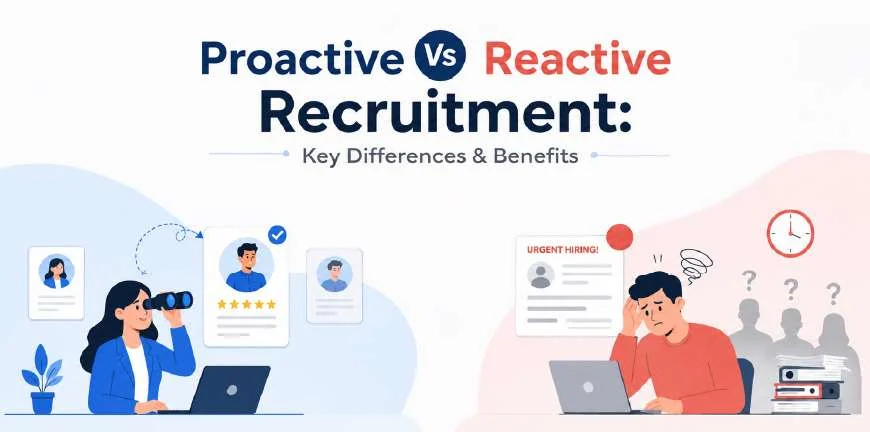
In a fiercely competitive talent landscape, the question for HR managers is not how costly a recruitment strategy is, but how big outcomes it delivers. From hiring speed and talent quality to business value, industries grapple with managing speed over delays as candidates move quickly.
To deeply understand how HR leaders use the right recruitment model, we need to explore the prospects and challenges of proactive vs reactive recruitment approaches.
What is Proactive Recruitment?
Proactive recruitment is a recruitment strategy HR follow to source candidates before vacancies arise or before a candidate starts searching for a role. When a role opens, recruiters activate their relationships with the candidates to fill positions at a sustainable speed.
How does the Process Look in Proactive Recruitment?
- Identify the key roles that could support your business in the future.
- Search for suitable talent based on the future business needs.
- Deploy an EVP strategy to introduce the prospective candidate to your organisation.
- Introduce talent engagement programs to keep the talent in your orbit.
- Reconnect with the talent and help them apply for vacant positions.
What is Reactive Recruitment?
Reactive recruitment refers to a recruitment model where an HR team searches for talent only after a position is approved. Instead of focusing on the future, this recruitment approach is demand-based and immediate. HR teams might feel time pressure to fill the position on an urgent basis.
How does the Process Look in Reactive Recruitment?
- Quickly identify active talent to support your immediate business need.
- Search for suitable talent using the broad and specialised talent portals.
- Once the job is posted, job seekers apply for the position.
- HR managers shortlist candidates after carefully screening and vetting candidates’ credentials.
- HR teams initiate the interview and other evaluation processes.
- After confirming the candidate, you roll out the job offer.
What are the key differences between Proactive and Reactive Recruitment?
Both recruitment strategies aim at bringing the best talent for your organisation, but there are key differences that an HR leader must know to leverage them effectively.
| Dynamics | Proactive Hiring | Reactive Hiring |
| Timing | The recruitment process is conducted all the time at a slow pace, as there is no urgent need. | In this model, recruitment happens on an immediate and need basis to fill a role. |
| Approach | You wait for the candidates to approach you through a job post. | You hunt for candidates to apply for a particular position to close the role gaps. |
| Relationship | They spend on marketing to keep the candidates engaged with the system | They do not nurture candidates to apply for the role; rather help them apply instantly. |
| Candidate | This approach can help you understand the quality of hire more deeply | In this model, you may skip certain verification or vetting processes to ensure quality |
| Employee Satisfaction | When you nurture candidates, they are likely to stay longer in the organisation | When quickly integrated into the system, candidates might feel disengaged and can result in high attrition rates. |
Is Reactive or Proactive Recruitment the best Talent Pipeline Strategy?
When an employee leaves the team, it’s not just operational disruption but an opportunity for the candidate sourcing teams to reorganise the structure, roles, and benchmark salaries.
However, let’s explore the reasons why forward-thinking leaders choose either a reactive or proactive recruitment model to drive workforce productivity.
Advantages of Choosing Reactive Recruitment
1. Business Cost Savings
HR managers save overhead costs by hiring candidates only when there is a demand-based or project-based need.
2. Waiting limits Talent Options
In a highly competitive talent market, speed matters for effective succession planning. To save a potential talent from joining your competitor, reactive recruitment specialists use an impressive & simplified recruitment & onboarding process.
3. Simplified Recruitment Process
Candidates under reactive recruitment are not made to wait long, as the decision-making process is swift, and the assessment process involves key levels, rather than intensive evaluation.
Disadvantages of Choosing Reactive Recruitment
1. Speed over Quality
By putting speed over quality, reactive hiring may increase the risk of bad hires as limited time is allotted for screening and evaluation.
2. Hiring Stress for Internal HR Teams
Hiring a new candidate only begins when someone leaves or resigns. This creates a huge stress for HR teams as they need additional responsibilities to identify suitable talent to support operational continuity.
3. Low Employee Morale
Roles vacant for a longer time may create operational gaps. The existing workforce may be burdened with additional tasks and responsibilities, which can lead to postponing holidays, sacrificing leaves, and stretching work on weekends.
Advantages of Choosing Proactive Recruitment
1. Strong Hiring Forecasting
Proactive hiring significantly reduces time-to-hire and helps fill critical positions in companies. In this model, candidates are vetted and are ready to be deployed.
2. Quality Hire
Constantly engaging with prospective talent will help you evaluate the candidate better and make informed talent decisions.
3. Employer Branding
Proactive recruitment helps you build positive employee value proposition strategies, enabling the organisation to attract passive candidates and active job seekers more quickly.
4. Market Competition
Proactive recruitment will help business leaders stay ahead of the market competition by gaining early access to a qualified talent pool.
Disadvantages of Choosing Proactive Recruitment
1. Ongoing Costs
Tracking changes in the external talent market, talent availability, salary benchmarking and understanding the top-demand roles competitors are aggressively hiring involves high operational costs.
2. No Immediate ROI
If the HR teams focus on quarterly results, then proactive hiring may not yield immediate results, as it produces outcomes in the long term.
3. Candidate Drop-Offs
Keeping candidates on the bench for long, and if they find an opportunity with other competitors before you hire them, then your hiring decisions are at huge risk.
Why Do HR Teams Prefer a Proactive Recruitment Strategy?
Besides warding off deadline slips and workloads, internal hiring teams outsource a proactive recruitment strategy from the top talent acquisition company to drive the following outcomes.
1. Remove Budget Strain
Save costs on talent benchmarking as organisations may not have the resources to sustain talent in the database for a designated period.
2. Market Intelligence
Outsourcing HR consultancies invest in various analytical and technological tools and software to predict workforce planning: talent market trends, salary benchmarking, & skill demands. This helps the internal teams build a broad talent pipeline.
3. Business Aligned Talent
HR recruitment agencies do not rush assessments, as they use AI-led evaluation strategies like ATS, recruitment metrics, project-based, psychometric, and keyword matching tools to deliver complaint-led, culturally aligned, and qualified talent.
4. Employer Branding
To competitively position the organisational brand, recruitment outsourcing teams may communicate brand stories, culture, benefits, & leadership on various online channels to improve candidate experience.
Why is Alp Consulting a leading Proactive Recruitment Partner?
Alp Consulting Ltd, as India’s leading talent acquisition management in Bangalore, enables global companies to hire better and faster. Alp’s suite of automated talent solutions is designed to tap domain-specific & culturally aligned talent.
- Our proven industry-led recruitment assessments, wide network of 500+ client partnerships, & specialised IT recruitment specialists.
- We have over 750+ HR professionals placed over 100K+ candidates across startups, MSMEs, to Enterprises.
- From contract hires to remote/hybrid staffing and proactive hiring, we design recruitment planning to drive business growth.
Frequently Asked Questions (FAQs)
1. We’re always hiring at the last minute. How can you help us become more proactive?
We have a broad talent pool where we source both active job seekers and passive talent, and by partnering with us, you can access need-based talent immediately from our portal.
2. How can proactive recruitment reduce our time-to-hire?
Our proactive recruitment helps you reduce your hiring time by enabling you to access pre-assessed and ready-to-deploy candidates.
3. Can you build a talent pipeline before we have open positions?
Our market intelligence helps us build active talent pipelines to support organisations in filling open positions faster with zero risks.
4. How can proactive hiring help us reduce business disruption?
Our strategic hiring is geared to provide you with skill-first and culturally aligned talent that not only reduces operational disruption but also reputational risks.
5. What recruitment strategy works best for businesses with rapid growth plans?
If it is an immediate business expansion plan, we think your internal team can adopt a reactive recruitment method. But if it is a long-term project, then proactive recruitment can be the best choice.
6. How can you help us prepare for future hiring needs instead of reacting to vacancies?
We design EVP strategies for sustainable candidate engagement and help them apply for future positions without any delays.
7. Can proactive recruitment improve our hiring quality and offer acceptance rates?
Yes, our proactive recruitment is targeted to improve hiring quality and workforce strategy through multiple evaluation methods and modern communication models to ensure they are the right fit.
8. How do you identify future hiring needs and talent gaps?
We identify your future business needs through our data-driven market intelligence analytical tools. By benchmarking salary, skill trends and market demands, we help you bridge talent gaps efficiently.
9. Can your team support both proactive talent pipelining and urgent hiring requirements?
Yes, our team is specialised in both reactive and proactive recruitment models to support industries with suitable talent.
10. How can proactive recruitment give us a competitive advantage in hiring?
Proactive recruitment gives you a competitive advantage, from brand positioning to hiring specialised talent, understanding market trends and driving operational excellence.
Contact Us For Business Enquiry

Amit Saproo
Amit Saproo is the Head of Operations at ALP Consulting with nearly 17 years of experience in Executive Search, RPO, Leadership, and IT & Engineering recruitment. He leads nationwide recruitment programs across Technology, BFSI, and R&D domains, driving strategic hiring solutions for diverse client needs. Amit excels in building and managing high-performance teams that deliver scalable, end-to-end recruitment and consulting services.