
How to Hire Bilingual IT Engineers for Japanese Companies
13/02/2026
Statutory Compliance Checklist for Gujarat
17/02/2026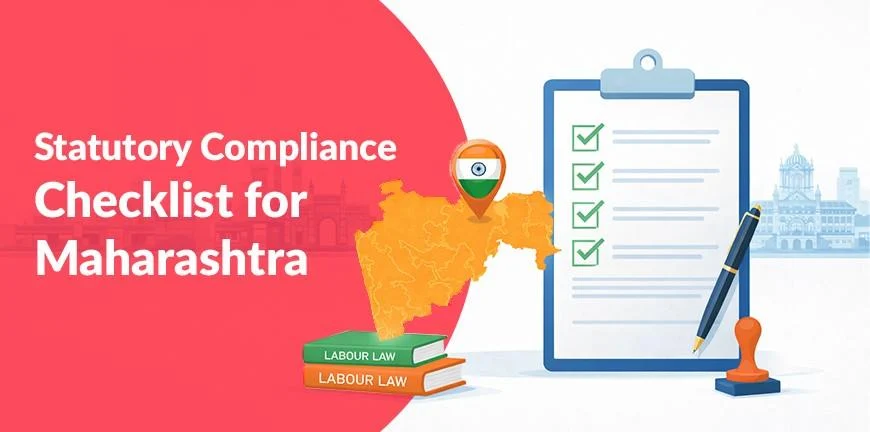
Want to build a risk-free statutory compliance system for your business?
Aligning the business operations with the laws and regulations of a particular state can be tricky, especially with new amendments and changes becoming so rampant. Companies operating in Maharashtra are devoid of any choice and must do whatever is necessary to ensure 100% statutory compliance to prevent penalties and reputational damage.
The best defensive mechanism that can surely help businesses align their processes effectively with the latest mandates and laws is the deployment of a robust statutory compliance checklist for Maharashtra.
Let’s dive deep and understand everything about the statutory compliance checklist for Maharashtra.
What Is Statutory Compliance in Maharashtra?
Statutory compliance in Maharashtra is a legal & ethical obligation that compels businesses to follow all applicable labour, taxation, & employment regulations governing workforce operations within the state.
Additionally, ticking every box of the statutory compliance checklist for Maharashtra with 100% accuracy & promptness ensures organizations (regardless of size, sector, employee count, & brand reputation) function ethically while upholding employee rights, workplace sanctity, & financial transparency.
Example: A manufacturing company in Pune (a major industrial hub in Maharashtra) operating for 10 years, producing automotive components for large companies like Hyundai, made a grave error of not remitting employee PF & professional tax contributions for several months in a row. During a surprise government audit, authorities quickly pointed out these violations, which were deemed unacceptable, & proceeded to lay out strict sanctions.
As a punishment, the government agency levied heavy fines, demanded back payments with compound interest, & temporarily suspended operations. The company was also bombarded with numerous employee complaints & reputational damage, leading to financial strain & loss of client trust.
The vital acts & regulations laid out by the government that every rookie, emerging & established employer must follow while running business endeavours in Maharashtra include:
- Maharashtra Shops & Establishments (Regulation of Employment & Conditions of Service) Act, 2017
- Factories Act, 1948
- Industrial Disputes Act, 1947
- Minimum Wages Act, 1948
- Payment of Wages Act, 1936
- Payment of Bonus Act, 1965
- Payment of Gratuity Act, 1972
- Employees’ Provident Funds and Miscellaneous Provisions Act, 1952
- Employees’ State Insurance (ESI) Act, 1948
- Maharashtra State Tax on Professions, Trades, Callings and Employments Act, 1975 (Professional Tax)
- Contract Labour (Regulation and Abolition) Act, 1970
- Equal Remuneration Act, 1976
- Maternity Benefit Act, 1961
- Labour Welfare Fund Act (Maharashtra Labour Welfare Fund Rules)
- Apprentices Act, 1961
- Industrial Employment (Standing Orders) Act, 1946
Statutory compliance is important in Maharashtra because it:
- Prevents legal penalties and operational disruptions.
- Safeguards employee benefits and fair treatment.
- Ensures smooth audits and regulatory inspections.
- Enhances employer credibility and brand reputation.
- Promotes sustainable, compliant business growth.
Statutory Compliance Checklist for Employers in Maharashtra
Here is a detailed statutory compliance checklist for Maharashtra employers:
1. Business Registration & Establishment Compliance
Companies (Primary employer) must register under the Shops & Establishments Act as part of Maharashtra’s statutory compliance requirements. In the next stage, employers must secure operational licenses, renew registrations periodically (to negate liabilities), display statutory notices, & comply with local authority mandates to make sure uninterrupted commencement of lawful business operations.
Note: There is a mandatory registration that is now required only for establishments employing 20 or more workers. However, small businesses in Maharashtra with fewer than 20 employees are now exempt from full registration but must submit a mandatory online “Intimation” (Form F). Failing to file this intimation can result in a penalty of up to Rs. 50,000.
2. Employee Onboarding and Documentation Compliance
As a part of the HR statutory compliance checklist for Maharashtra, the internal HR team must collect employee ID proofs, appointment letters, contracts, & statutory declarations. Additionally, they must maintain proper onboarding records aligned with Maharashtra labour regulations & documentation standards.
Company Compliance Checklist Maharashtra for Employee Onboarding and Documentation
| Document | Do’s | Don’ts |
| ID & Address Proof | Verify & store secure copies | Don’t accept invalid documents |
| Appointment Letter | Issue signed copies and file records | Don’t leave roles undocumented |
| Employment Contract | Clearly define terms and salary | Don’t use incomplete agreements |
| PF & ESI Forms | Submit registrations on time | Don’t delay statutory filings |
| Bank Details | Verify accuracy before payroll | Don’t process unverified payments |
3. Payroll Processing and Wage Compliance
To fulfil Maharashtra statutory compliance requirements, the payroll executives must ensure timely salary payments, adherence to minimum wage standards (as per the latest Code on Wages 2019 regulations), accurate overtime calculations, & lawful wage structuring that corroborates with Maharashtra employment regulations.
| Compliance Area | Key Requirement | Action for Employers |
| Salary Payments | Timely monthly wage disbursement | Process payroll within statutory deadlines |
| Minimum Wages | Follow the Code on Wages 2019 standards | Update salary structures as per the latest rates |
| Overtime Pay | Accurate overtime calculation | Pay overtime as per legal provisions |
| Wage Structure | Lawful salary components | Ensure compliant basic, allowances, & deductions |
| Payroll Records | Proper wage documentation | Maintain payslips and payroll registers |
4. Professional Tax Compliance
The company must register under the Maharashtra Professional Tax Act, deduct employee professional tax (PT) correctly, & file periodic returns within accepted deadlines to maintain regulatory compliance.
Maharashtra’s Monthly Professional Tax Slab Contribution Rates
| Monthly Gross Salary | Professional Tax (PT) per Month |
| Up to Rs. 7,500 (Male) | Nil |
| Rs. 7,501 – Rs. 10,000 (Male) | Rs. 175 |
| Above Rs. 10,000 (Male) | Rs. 200 (Rs. 300 from February) |
| Up to Rs. 25,000 (Female) | Nil |
| Above Rs. 25,000 (Female) | Rs. 200 (Rs. 300 in February) |
5. Bonus and Gratuity Compliance
As part of fulfilling the business compliance checklist in Maharashtra, the payroll team must calculate and disburse statutory bonuses & gratuity payments accurately. This must be accomplished while maintaining proper records as required under applicable labour laws.
Note: Statutory bonus is non-negotiable for employees whose monthly “wages” (as per the new 50% definition) are less than Rs. 21,000.
Latest Statutory and Gratuity Rates in Maharashtra
| Aspect | Statutory Bonus | Statutory Gratuity |
| Governing Law | Payment of Bonus Act, 1965 / Code on Wages | Payment of Gratuity Act, 1972 |
| Eligibility | Employees earning up to Rs. 21,000 per month | Employees completing 5 years of continuous service |
| Rate / Formula | 8.33% to 20% of the annual salary package | (15 × Last salary × Years of service) ÷ 26 |
| Salary Considered | Basic + Dearness Allowance | Basic + DA (Dearness Allowance) |
| Maximum Limit | 20% of annual eligible wages | Rs. 20,00,000 lifetime caps |
| Payment Timeline | Within 8 months after the FY end | Within 30 days of employee exit |
6. Employee Welfare and Safety Compliance
The compliance team in Maharashtra-based companies must inculcate workplace safety measures, maternity benefits, anti-harassment (both sexual & verbal harassment) policies, & welfare provisions to protect employee well-being & attain legal compliance.
Note: A new mandate (18-A under Maharashtra Factories (Second Amendment) Rules) requires all factory workers aged 45 & above to undergo a mandatory annual medical examination. The results must be submitted to the government electronically via the DISH (Directorate of Industrial Safety & Health) portal within 15 days.
7. PF and ESI Contribution Compliance
The companies legally operating in Maharashtra jurisdictions must deduct & deposit provident fund and ESI contributions on time (better to always pay before the deadline to bypass government holidays & Sundays). Additionally, they must submit statutory returns & maintain contribution records to negate penalties & legal disputes.
PF and ESI Rules & Rates in Maharashtra
| Statutory Component | Employee Contribution | Employer Contribution | Notes |
| Provident Fund (PF) | 12% of basic salary + DA | 12% of basic salary + DA (8.33% to EPS, 3.67% to EPF) | Mandatory for establishments with 20+ employees; PF admin/EDLI charges extra. |
| Employees’ Pension Scheme (EPS) | N/A | 8.33% (part of employer PF share) | Pension fund for retirement benefits under EPFO |
| ESI (Employee State Insurance) | 0.75% of gross wages | 3.25% of gross wages | Applicable if gross monthly wage ≤ Rs. 21,000. |
8. Attendance and Leave Management Compliance
To satisfy the mandatory compliance checklist of Maharashtra, the HR team must maintain accurate attendance, leave records, & working hours documentation. Moreover, these recordings must be aligned with statutory labour requirements & inspection standards.
Penalties for Record Violations in Maharashtra (2026)
| Violation Category | Penalty / Fine | Description |
| Failure to Maintain Registers | Rs. 500 – Rs. 5,000 per violation | For missing or incomplete statutory registers (attendance, wages, & leave records). |
| Obstruction of Facilitator | Up to Rs. 25,000 | Refusing to share digital attendance or compliance logs during inspection. |
| Directors’ Liability for Wilful Falsification | Up to Rs. 1,50,000 | Penalty for directors if attendance/wage records are deliberately falsified. |
9. Record Keeping and Register Maintenance
As a part of the Maharashtra statutory compliance requirements, companies must preserve employee registers, payroll data, inspection logs, & statutory documentation systematically to support audits and regulatory reviews.
Note: Companies in Maharashtra must preserve financial records (PF/ESI/TDS) for 8 years as per the Companies Act and Income Tax mandates.
10. Audit and Regulatory Filing Compliance
Conduct regular internal compliance audits, submit mandatory government returns before the deadline, & promptly rectify discrepancies to make sure continuous legal adherence. This should be promptly carried out to ensure 100% utilisation of the statutory compliance checklist for Maharashtra.
Note: In 2026, payroll compliance audits strictly check if an employee’s “Basic Pay” is at least 50% of their total remuneration. Any Miscalculation here can result in massive back-dated PF/ESI recovery demands with 12% interest.
What Are the 5 Benefits of Using a Statutory Compliance Checklist in Maharashtra?
Here are the top 5 benefits of deploying a strong statutory compliance checklist for Maharashtra-based organisations:
1. Prevents Legal Tussles & Financial Losses
Churning out a path-defining HR statutory compliance checklist in Maharashtra can empower businesses in mitigating incidents of violations that can turn into fines, penalties, litigations, & disruptions. Consistently fulfilling Maharashtra statutory compliance requirements can shield companies against legal hassles & financial implications.
2. Ensures Timely Statutory Filings & Payments
Strictly deploying a business compliance checklist, Maharashtra puts a seal on PF, ESI, professional tax, & labour law filings being completed accurately & within deadlines, reducing last-minute errors.
3. Improves Audit Readiness & Transparency
A well-oiled compliance checklist for companies in Maharashtra toughens documentation practices. This makes government inspections, labour audits, & internal compliance reviews smoother & more transparent.
4. Enhances Employee Trust & Workplace Stability
A company compliance checklist in Maharashtra brings with it a professional alignment with wage laws, welfare regulations, & statutory benefits. This boosts employee confidence, reduces falling out, & create stable and positive work environment.
5. Supports Sustainable and Scalable Business Growth
By systematizing processes with the support of the business compliance checklist Maharashtra, companies can easily achieve operational scaling confidently, attract investors, & maintain credibility with regulators & stakeholders.
What are the 5 Major Statutory Compliance Challenges in Maharashtra?
Here are the 5 top challenges faced by companies in fulfilling Maharashtra statutory compliance requirements:
1. Frequent Regulatory Updates and Amendments
Constant rejigging in Maharashtra labour regulations & central labour codes can disorient HR teams as they may be unable to keep a strong tab on compliance tracking due to resource shortage. This compels businesses to continuously monitor updates and revise payroll, documentation, & compliance processes to be up to speed with the latest labour codes.
2. Complex Multi-Law Compliance Requirements
Employers must tussle and take home the victory of 100% compliance by juggling multiple overlapping laws, including PF, ESI, professional tax, labour welfare fund, & wage regulations. This fight against the tide increases administrative burden and compliance risks, making companies in Maharashtra vulnerable to additional expenses that can reduce profits significantly.
3. Documentation & Record Maintenance Burden
Maintaining accurate registers, attendance logs, salary records, & statutory filings demands structured compliance management systems. Any unforeseen errors or missing records can open the pandora’s box, triggering inspections & financial penalties, making life difficult for companies operating in Maharashtra.
4. Timely Statutory Payments & Filings
Meeting strict deadlines for contributions & returns can push companies behind the eight ball, especially for growing businesses, leading to interest liabilities, penalties, and reputational damage.
5. Limited In-House Compliance Expertise
Many organizations either lack or don’t appoint specialized compliance professionals due to cost constraints. This lack of in-house compliance expertise may result in misinterpretation of legal provisions, incorrect filings, & increased chances of penalties and legal hassles.
What are the 5 Best Practices to Ensure 100% Statutory Compliance in Maharashtra?
Here are 5 best practices to make sure 100% statutory compliance in Maharashtra:
1. Establish a Dedicated Compliance Monitoring System
Create an easy-to-follow, structured compliance calendar that effectively tracks all Maharashtra statutory deadlines, filings, renewals, & inspections without leaving any wiggle room. to ensure nothing is missed throughout the financial year.
2. Conduct Periodic Internal Compliance Audits
Perform quarterly internal audits like clockwork using the statutory compliance checklist for Maharashtra to review payroll records, statutory registers, contribution payments, & documentation accuracy. This approach will help to isolate & rectify compliance gaps proactively.
3. Leverage Automated Payroll and Compliance Systems
Adopt reliable payroll management systems that automate PF, ESI, professional tax calculations, generate statutory reports, & send deadline alerts to keep the compliance team on their toes and reduce manual errors.
4. Train HR and Payroll Teams Regularly
Provide continuous training on updated Maharashtra labour laws, wage codes, & statutory amendments to ensure HR teams interpret & implement regulations correctly, leaving no room for any complacency.
5. Maintain Accurate Documentation and Digital Records
Systematically maintain updated employee records, wage registers, inspection logs, & statutory filings in secure digital formats to support audits & regulatory scrutiny.
How Alp Consulting Helps Businesses Manage Statutory Compliance in Maharashtra?
Alp Consulting Ltd, a 30-year-old veteran in the field of compliance, supports businesses in Maharashtra by offering end-to-end statutory compliance management across payroll, labour laws, PF, ESI, professional tax, & regulatory filings. Our experts with elite-level acumen of Maharashtra’s labour laws will monitor evolving legal updates, maintain accurate documentation, & ensure timely submissions to prevent penalties.
Through structured audits, automated compliance systems, and proactive advisory support, we help clients build an airtight statutory compliance checklist for Maharashtra that reduces risks and improves operational efficiency big time. With our dedicated compliance specialists taking care of all statutory requirements, businesses can focus on growth while staying fully aligned with Maharashtra’s statutory regulations.
Key Takeaways
- Statutory compliance in Maharashtra safeguards businesses from penalties, disruptions, and reputational damage.
- Employers must follow multiple labour laws covering payroll, welfare, tax, and documentation.
- Timely PF, ESI, bonus, gratuity, and professional tax payments prevent costly recovery demands.
- Structured statutory compliance checklist for Maharashtra improves audit readiness, transparency, and long-term operational stability.
- Partnering with experts like Alp Consulting Ltd ensures proactive, accurate, and risk-free compliance management.
FAQS
1. What Is Statutory Compliance in Maharashtra?
Statutory compliance in Maharashtra means following all applicable labour, tax, payroll, & employment laws governing business operations.
2. What statutory compliances are mandatory for businesses in Maharashtra?
Mandatory compliance checklist Maharashtra includes Shops registration, PF, ESI, professional tax, bonus, gratuity, minimum wages, & labour welfare regulations.
3. What are the penalties for non-compliance with labour laws in Maharashtra?
Penalties for non-compliance with labour codes in Maharashtra include monetary fines, interest on dues, prosecution, operational suspension, & reputational damage, depending on violation severity.
4. Is Shops and Establishment registration compulsory in Maharashtra?
Yes, registration is mandatory for establishments with 20 or more employees. However, smaller businesses must file mandatory online notifications.
5. How often are statutory compliances audited in Maharashtra?
Statutory audits in Maharashtra occur periodically through government inspections, internal reviews, & surprise labour department compliance checks.
6. How does minimum wage compliance work in Maharashtra?
Employers in Maharashtra must pay government-notified minimum wages based on skill category, industry classification, & periodic revisions.
Contact Us For Business Enquiry

Hariharan Iyer
Hariharan Iyer is the Vice President – Operations at ALP Consulting, bringing over 40+ years of experience in HR outsourcing and labour law compliance. He leads end-to-end HRO operations, ensuring process efficiency, statutory compliance, and seamless service delivery for clients across industries. With a strong background in labour law governance and workforce management, Hariharan plays a key role in driving operational excellence and compliance-led HR solutions at ALP Consulting.