

AI and Healthcare: Match made in Heaven?
27/11/2024
How Will Semiconductors Power Next-Gen AI?
29/11/2024
Sundar Pichai, CEO, Google, said, “A diverse mix of voices leads to better discussions, decisions, and outcomes for everyone.”
Today, when businesses are not restricted to one location and borders are blurring, recruitment has become a game-changer in the global arena. Companies are looking beyond their own countries to build diverse and inclusive teams. If you want to expand your business horizons on a global scale, then international staffing is an important avenue to explore and embrace.
To do so effectively, it’s essential that you know and understand the new market and hire the right local employees to assist with the growth of your organisation. Partnering with a recruitment agency could be a good step to take.
However, before diving into one, you must understand the various international staffing approaches there are and choose the one that aligns with your strategies with your business goals.
What is International Staffing?
International staffing means the process of recruiting, hiring, and managing employees across multiple countries. It is a crucial aspect of global business operations, especially for companies that operate in various international markets. There are two different types of international staffing strategies that one must know about. One is where they use employees from the home country to live and work in the country. These individuals are called expatriates. The second is a host-country national strategy, which means to employ people who were born in the country in which the business is operating.
Why Is International Staffing Important for Global Businesses?
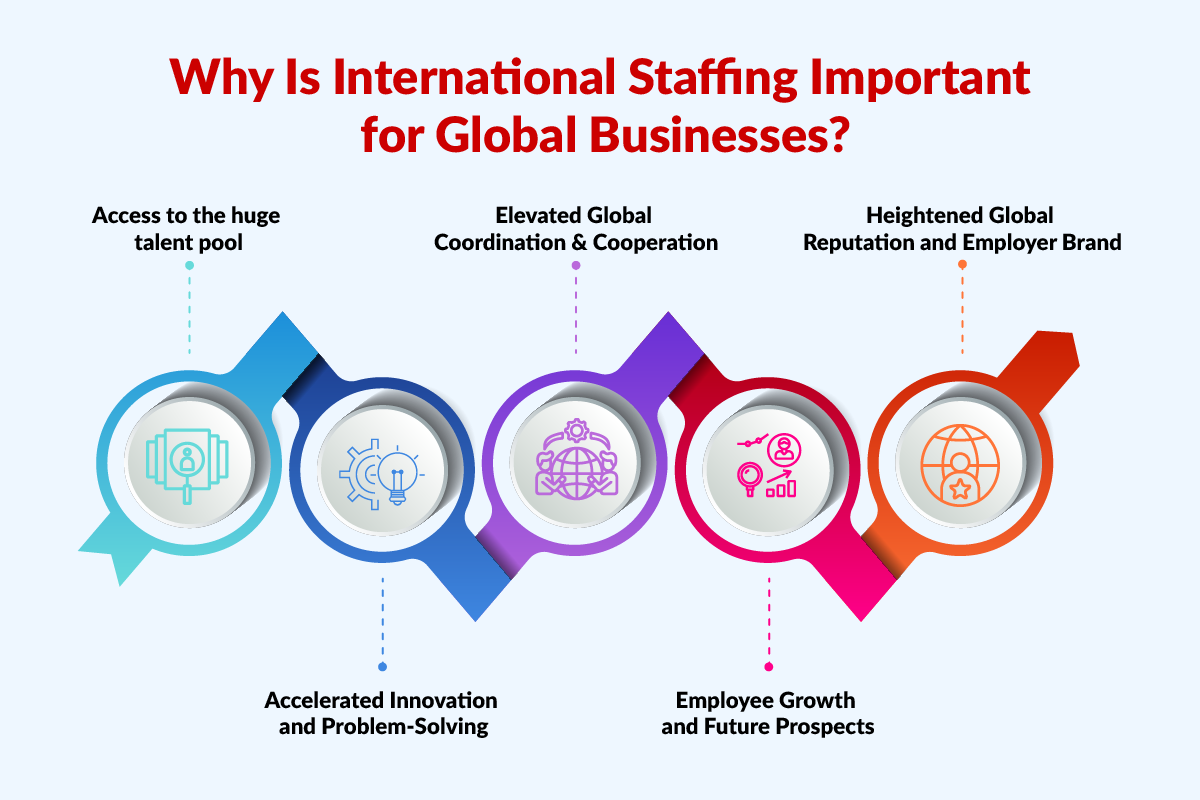
1. Access to the huge talent pool
With international staffing practices, organisations can get access to a wide pool of talent, maybe beyond the borders of the country. This bodes well for industries that require individuals with specialised skills that may not be available locally.
Also, with a diverse pool of talent comes creativity and innovation, and with the changing market conditions, access to a larger pool is important.
2. Accelerated Innovation and Problem-Solving
Diverse teams bring to the table different perspectives and ideas that drive innovation and provide solutions easily to solve complex global issues, conflicts, and misunderstandings.
3. Elevated GlobalCoordination & Cooperation
International staffing enables businesses to expand their global business network while building networks that entail international business personnel and managers. This enhances cross communication and collaborations, ensuring facilitation of seamless 24/7 operations.
Use Case- Global conglomerate Walmart has developed one of the largest global workforces, operating in more than 27 countries with staff from diverse backgrounds.
4. EmployeeGrowth and Future Prospects
Employees receiving international work and assignments get exposure to varied global work and culture, enhancing their professional and personal growth. This creates a robust career pathway for them.
5. HeightenedGlobal Reputation and Employer Brand
If you are an organisation adopting international staffing, you will be well known for your global hiring approaches, which in turn will attract skilled and top-notch candidates. This will also open doors for you internationally for global partnerships and collaborations.
What Is the International Staffing Process?
The international staffing process is significant, and it refers to a slew of steps organisations require to follow to select, recruit, and place appropriate candidates in global organisations across countries. The steps ensure the placement of the right talent in the right geographies, adhering to the local legal compliance and regulations. Here are a few vital stages in the international staffing process:
1. Manpower Planning and Role Recognition
The first step for you as an organization will be to identify the roles that are needed in international markets, the reasons why these roles are in demand and the specific skills required for the roles.
2. Staffing Approach Determination
The next important step for organizations is to select the staffing approach they want to apply, catering to the company’s global strategy.
3. Analyzing Jobs and Defining Requirements
The next stage is to craft clear job descriptions, performance criteria, and expectation formats, keeping in mind the legal and cultural considerations.
4. Sourcing and Hiring Talent
One of the most significant steps is talent acquisition(TA), where firms first have to source suitable talent and recruit them globally through various methods.
5. Evaluation and Selection
The hiring process involves systematic assessment systems and then filtering candidates, evaluating beyond technical skills and keeping in mind various global aspects.
6. Offer and Compensation
This stage is vital as compensation packages are designed considering factors like cost of living, tax rules, insurance & benefits, relocation allowance, etc.
7. Visa and Legal Formalities
As it is, international recruitment companies ensure that immigration, registration, and signing of other legal documents are accurate and on time.
What are the International Staffing Approaches?
There are four main approaches to international recruitment. They are-
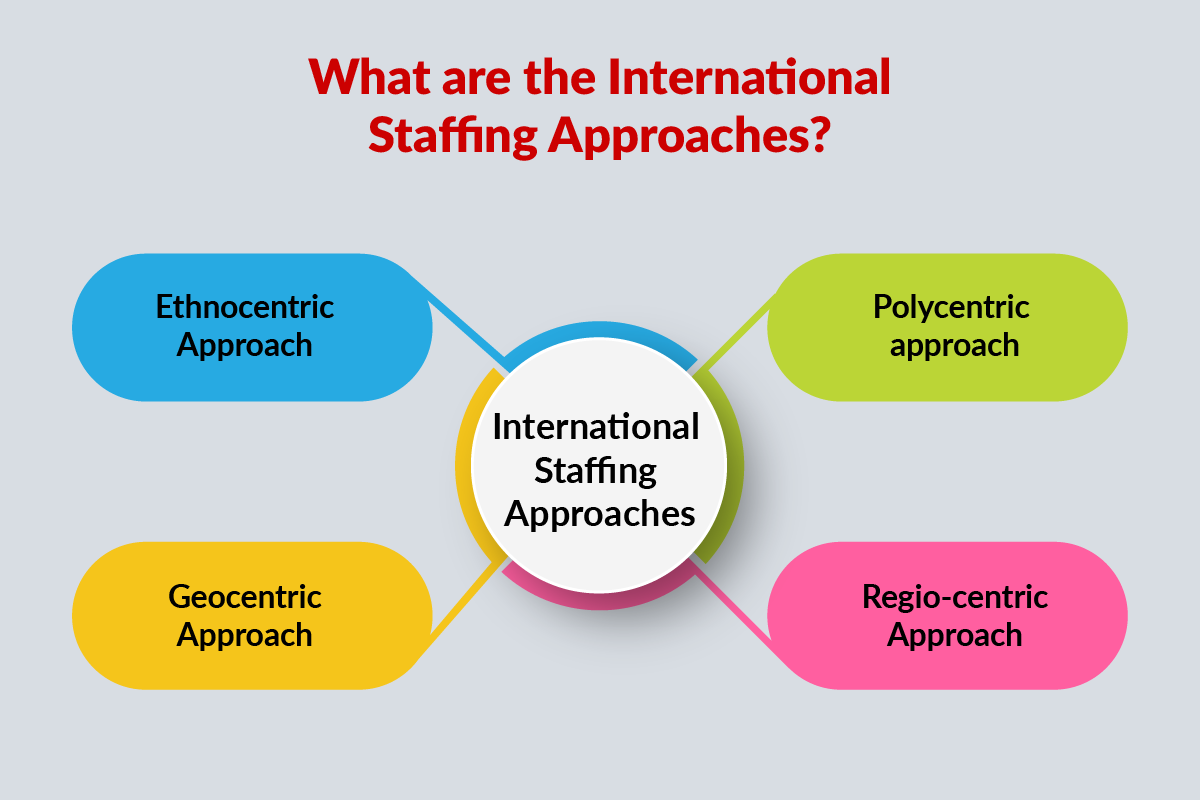
1. Ethnocentric Approach
In an ethnocentric approach, the recruitment firm will assist in sourcing candidates who fit your home country’s operational and management style and business practices. In this type of approach, the organisation relies on the parent country nationals (PCNs) to fill key positions.
Advantages
- Ensures consistency across all locations about the company’s culture and policies.
- A lot easier to coordinate employees or managers working in other locations, as they are PCNs and are familiar with the company’s culture and standards.
Challenges
- There may be a lack of cultural adaptation and sensitivity, which can lead to misunderstandings with local employees
- There may be a lack of understanding of local market conditions
2. Polycentric approach
The recruitment firm consultants with a deep knowledge of local markets provide insight and access to top local talent. They make sure that they select the best host country nationals who fit well with your company’s culture and can align with your company’s goals. In this approach, HCNs manage operations in their own country as they have a better understanding of their local market conditions.
Advantages
- With local talent on the front, there is a better understanding of culture, market, and regulations
- It’s also cost-effective as it eliminates relocation and expatriate management costs
Challenges
- Integration of the subsidiary with the parent country’s company culture and practices could get challenging.
- HCNs may see limited career opportunities within the wider organisation, potentially affecting their motivation and commitment.
3. Regio-centricApproach
Your recruitment partner helps identify and attract regional talent who can manage operations in multiple countries within the region effectively. If required, they also assist you in creating training programs that can harmonise practices and standards across the region. Here, the focus is on hiring and managing talent within the geographic region.
Advantages
- Has enough regional knowledge and network to manage operations effectively
- Offers a balance between global integration and local responsiveness
Challenges
- Management across multiple regions gets complex for obvious reasons
- This leads to regional biases, and there may be an overlooking of global perspectives
4. Geocentric Approach
Recruitment firms like Alp Consulting Ltd, with a global reach, can offer access to a vast network of potential candidates globally. This approach takes a global perspective, focusing on hiring the right talent regardless of nationality.
Advantages
- Access to individuals with a wide range of experiences and skills from around the world
- Helps build a unified corporate culture that stretches across national boundaries
Challenges
- Management of a global workforce involves challenges regarding logistics, immigration, visas, and relocation
- Can be a costly affair due to international relocations
What Are the Key Sources of International Staffing?
Multinational companies hire and place professionals across various countries through international staffing. Sources of international staffing are based on which region the talent is coming from and which country they are placed in. Here are the 4 major sources:
Parent Country Nationals (PCNs)
They are also called expatriates and home country employees, belonging to the country where the company headquarters is located. They are sent to work abroad in a subsidiary of the parent company.
Host Country Nationals (HCNs)
These employees are recruited locally in countries where the subsidiaries are located and operate. Companies use HCNs because the cost of hiring and relocation is lower. These employees understand and support local laws and culture.
Third Country Nationals (TCNs)
These employees are hired from various countries and regions and belong to neither the headquarters country nor the host country. This approach enables companies to gain global expertise.
Inpatriates (Inpats)
The employees are hired from subsidiaries of other countries to work at the headquarters, enhancing global coordination and developing a robust leadership pipeline.
What are the Benefits of International Staffing?
The importance of international staffing has grown drastically during the last few years, considering factors like globalisation of the economy, shortage of skilled workers, and development of new technologies. International staffing could be a great way to improve remote working. Some of the various benefits of international staffing are-
1. Cost-effective
One of the biggest advantages of international staffing is cost savings. Your company can acquire the best international candidates within the industry while paying lower salaries if they hire from countries where the cost of living and pay are lower. This is extremely beneficial for small businesses and startups. Also, hiring international candidates can save infrastructure expenses like space, rent, utilities, technology, etc.
2. New market opportunities
When you hire from outside, you’ll have access to fresh perspectives, new local markets, regulations, and best practices. Having local employees in other countries can also help companies establish local suppliers, distributors, and other stakeholders. They also tend to have a better understanding of the culture of the place, leading to better customer satisfaction.
3. Risk management
Operating from multiple regions is beneficial as there are more chances of saving the business during natural disasters. Additionally, having employees in different regions allows companies to operate at any time, leading to operations running smoothly around the clock. This can help with better responses to customers.
4. Enhanced brand reputation
Hiring internationally can go a long way in improving your brand reputation and also in enhancing your overall brand image. It can also be an exciting opportunity for employees to work in different countries and cultures. Companies with strong employer brands tend to have higher employee satisfaction and lower turnover rates. This is an important factor in developing a more engaged and productive workforce. Those who are more committed to diversity are more likely to have a positive brand image.
However, there are some challenges of international staffing, like
What are the Challenges of International Staffing?
Multinational enterprises manage crucial international operations by hiring staff from across the globe. However, it sometimes becomes difficult to handle the various factors that might adversely influence these kinds of staffing techniques. Let us check out some of the challenges that you, as an organisation, should watch out for:
Language barriers
Having an effective communication system can help address this
Cultural difference
Companies must be aware that people with different cultures and backgrounds come together, and they must be respectful of them.
Compliance issues
Companies that hire employees from other countries must ensure that they comply with local labour laws and regulations.
Expensive International Assignments
Placing employees internationally can come with high costs, especially when it comes to expatriate roles where costs like home allowance, relocation & travel, international schooling, etc, might be expensive.
Performance Handling Issues
Employee performance management becomes tricky when it’s handled internationally due to different authority expectations, time zone and distance barriers, etc.
What Are the Recent Trends in International Staffing?
International staffing today has undergone a massive transformative phase, and it has shifted from a vulnerable pandemic era to a more stable and tech-enabled landscape. Here are some of the emerging trends in this staffing approach:
AI and Automation are Transforming Staffing
The revolutionary era of AI tools and platforms is automating and speeding up staffing processes globally. From sourcing, screening, to matching candidates, the advanced technology is accelerating manpower operations across borders.
According to reports, approximately 75% of recruiters now allocate up to 70% of their hiring budgets toward AI-driven tools.
Borderless Hiring is the New Norm
The latest trend of cross-border hiring is gaining momentum, where international recruiting is going past niche roles and welcoming diverse professionals across the world to fill vacancies.
Hybrid and Remote Models Will Stay
International staffing strategies are increasingly integrating remote and hybrid work models as they are intrinsic to their business goals. Companies are hiring skilled professionals from various locations and running distributed operations successfully.
Evolving Mobility Programs and Metrics
Staffing is coming out of conventional expatriate approaches to growing mobility programmes supporting flexible work modes and relocation on a global scale. However, there is a focus on improving the measurement framework, which still requires work.
Skill-Based Hiring over Degrees
Organisations are focusing on skills rather than the backgrounds and earlier qualifications of professionals. Emphasis is on individuals who have expertise in practical knowledge and who can master niche skills.
Reports suggest, 45% of hiring managers plan to drop degree requirements for key roles in 2026, focusing instead on certifications and proven skills.
How Do International Staffing Strategies Align with Business Goals?
International staffing is an intelligent instrument enabling multinational corporations to foster innovation, stability, efficiency, and growth to gain a competitive advantage in the business landscape. If you are an organisation looking to adopt international staffing approaches, you must know how to align your staffing plans with business objectives. Let us look at how you can achieve this target:
Supporting Worldwide Business Expansion
You, as a business, must enter new business arenas and markets to grow internationally. PNCs are sent to new subsidiaries to ensure strategic alignment, transfer company culture, etc.
Enhancing Understanding of Local Customer Behaviour
The business objective is to adapt to the local culture, customer requirements, and regulations. The staffing approach should be hiring HCNs as they bring to the table local insights, fluency in language, market intelligence and local law awareness.
Efficient Resource Management with Cost Optimisation
Here, the objective of a business is to reduce costs while maintaining the quality of talent. You, as a company, might use local talent as labour cost will be lower, employ remote staff, and employ expats only for critical job roles.
Improving Learning Exchange and Capability Growth
The goal here is to build a global leadership pipeline and standardise processes. Global employment that rotates enables building leadership. Expatriates facilitate the transfer of headquarters knowledge while inpats bring knowledge from foreign countries to the headquarters.
How to Choose the Right International Staffing Approach for Your Business?
Deciding on which international staffing approach is right for your business depends on your company’s nature, strategy, and business goals. Some of the factors to consider are-
1. Company Size and Resources
Larger organisations with substantial resources are more likely to adopt a geocentric approach, while smaller firms may find a polycentric strategy more practical and cost-effective.
2. Nature of Business Operations
Companies that rely heavily on local market insights often benefit from a polycentric approach, while those aiming for seamless global integration may favour a geocentric strategy.
3. Cultural Sensitivity
Effectively understanding and respecting cultural differences is essential, particularly when implementing ethnocentric or polycentric approaches.
4. Long-Term Vision
For businesses with aspirations of establishing a strong global footprint, regiocentric or geocentric strategies are often better aligned with their long-term objectives.
International staffing is, of course, about filling various complex positions, but it is also about creating a dynamic, resilient, and forward-thinking workforce that can thrive in a global environment. By integrating international staffing into their strategy, companies can unlock opportunities for growth, innovation, and sustainable success.
How does Alp Consulting Ltd. Support International Staffing Needs?
Alp Consulting Ltd is a reputable recruitment and staffing firm with its presence in India and international markets. Our expert team will assist you with your international staffing requirements by helping businesses to fulfil their full-time and flexible hiring needs across regions and locations. We help organisations with specialised and executive hiring.
Our expertise in the Recruitment Process outsourcing RPO approach is well known, where we manage a part of the full recruitment cycle on behalf of clients. Supporting international staffing needs involves handling an array of regulations and laws that are specific to countries and regions, and our team manages the comprehensive compliance and payroll framework impeccably. We leverage the latest hr technology and tools to make hiring processes efficient and effective across borders.
Key Takeaways
- International staffing reaches out for global talent
- Businesses can choose from four key staffing approaches
- International staffing benefits businesses in great ways
- Global staffing also comes with challenges
- Alp Consulting Ltd. offers comprehensive global hiring support
Frequently asked questions
1. What is international staffing in HRM?
International Staffing in HRM is a strategically planned procedure of recruiting, selecting, and managing employees across different countries to support a company’s global operations.
2. What are the main international staffing models?
The main international staffing models are Ethnocentric, Polycentric, Regiocentric, and Geocentric, enabling multinational corporations to fill key vacant positions in foreign subsidiaries.
3. What is the difference between international staffing and global recruitment?
International staffing is the broad process of handling employees across borders, entailing strategy, hiring, and long-term management, while global recruitment is a vital part of that, focusing specifically on the sourcing and hiring of talent from different countries to fill roles.
4. Which international staffing approach is best for multinational companies?
The best international staffing approach for multinational companies (MNCs) is often the geocentric approach, as it enables the recruitment of best-in-class professionals regardless of nationality, nurturing a truly global talent pool and unified culture.
5. What are the advantages and disadvantages of international staffing?
The advantages of international staffing involve access to wider talent pools, cost savings (lower local wages), 365-day operations, fresh perspectives, knowledge transfer, etc but it often faces challenges like high costs, complex management, language and cultural hurdles, integration issues, etc.
Contact Us For Business Enquiry

Kasthuri R
Kasthuri R is the Co-Founder & Executive Director at ALP Consulting, bringing over 23 years of experience in search, staffing, and HR consulting. She has been instrumental in driving ALP’s recruitment, employee leasing, and executive search practices across diverse industry verticals. With deep expertise in talent acquisition, HR strategy, and operational management, Kasthuri has built scalable, client-focused solutions that enhance workforce efficiency. Her strategic leadership continues to steer ALP Consulting toward innovation and excellence in people management.