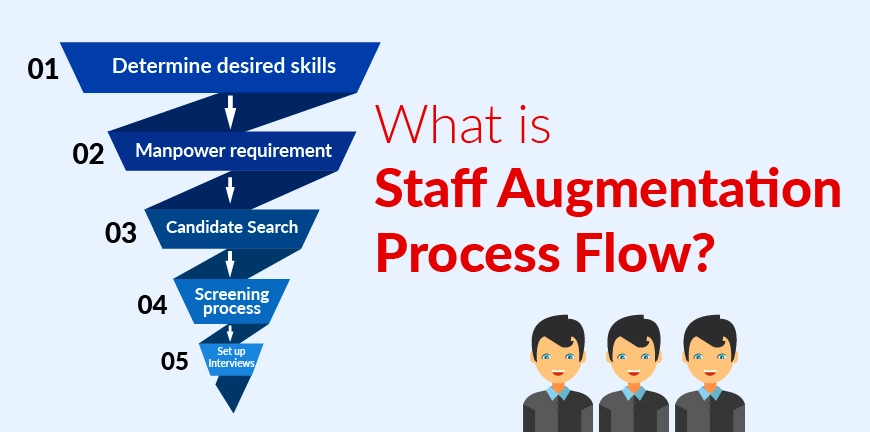
What is Staff Augmentation Process Flow?
28/11/2025
Managed Service Provider (MSP): Definition, Models, Benefits & Risks
28/11/2025
Do you need to hire talent on an immediate basis without offering long-term commitments? Then contract staffing is the way to go.
Every company looks to reduce costs while earning higher annual turnover. If a company only hires permanently, then it’s going to increase expenses, and can backfire in case the workload suddenly reduces, resulting in underutilisation. Therefore, every company must have a workforce that consists of all types of employees, including full-time, part-time, freelancers, etc., to cover all bases.
Let’s discuss contract staffing in detail, from definition to best practices, so that companies can plan accordingly and choose the right contract staffing partners that offer the best outcomes.
What is Contract Staffing?
Contract staffing can be defined as the provision of hires for an organization by a third party based on a contractual requirement for a limited period, with the terms of the contract being decided by the hiring party and the organization.
Example: A software firm receives a 6-project requiring cybersecurity experts. Instead of hiring full-time employees, it partners with a staffing agency like Alp Consulting to bring in contract specialists. The agency will be handling sourcing, onboarding, payroll, & compliance. After the project ends, the contract professionals are relieved without long-term obligations for the company.
Why Is Contract Staffing Important in 2026?
Here are 5 reasons that highlight the importance of contract staffing:
1. Access to Specialized Talent
Contract staffing powers companies to quickly onboard niche-skilled professionals for emerging technologies, short-term needs, or project surges without long hiring cycles, ensuring faster execution and competitive advantage.
2. Workforce Flexibility
Organizations can scale teams on will or project demand. This flexibility reduces overheads, ensures optimal resource allocation, & supports unpredictability in fast-changing market and technology environments.
3. Cost Efficiency
Companies can avoid paying long-term salaries, offer employee benefits, and invest heavily in training. Contract IT staffing helps manage budgets effectively, allowing businesses to pay only for required expertise during specific project durations. Moreover, partnering with a staffing company can help companies achieve an average of up to 30% reduction in cost per hire compared to traditional recruitment methodologies.
4. Faster Hiring Cycles
Top contract staffing agencies like Alp Consulting maintain talent pools, enabling rapid hiring. This reduces project downtime, helps meet urgent deadlines, & supports faster time-to-market for growing enterprises across industries. Example: When we compare permanent and contract staffing, for project-based roles, contract workers are often ready to start immediately, resulting in zero to negligible project downtime compared to the average 52 days it takes to fill a permanent tech position.
5. Reduced Compliance Burden
As we understand from the contract staffing meaning, agencies offering such services manage payroll, statutory compliance, contracts, onboarding, and documentation. This minimizes employer risk, administrative load, and legal exposure, enabling companies to focus fully on core business operations.
What is the Process of Contract Staffing?
In contract staffing services, such as those provided by HR consulting companies like Alp Consulting, the organization contacts the HR consulting firm with a need in mind. Most often, this is project-driven, and they need several people and entire teams to get the work done. They will mostly be experts from various fields and serving in positions such as Developer, SME, Network Administrator, and Manual or Automated Tester.
Here are the key steps involved in the contract staffing process:
1. Requirement Gathering
The employer shares project needs, skills required, duration, budget, and compliance expectations, and then requests agencies to provide a contract staffing proposal. Also, clear JDs help the contract staffing agency identify suitable resources quickly and accurately.
2. Talent Sourcing and Screening
The top agency, like Alp, taps into its talent pipeline, job boards, & networks to source candidates. Moreover, screening includes skill assessment, interviews, background verification, & matching candidates to client requirements.
3. Client Shortlisting and Selection
Shortlisted profiles are shared with the employer. Interviews or tests are conducted, and final selections are made. The agency ensures alignment between candidate skills, project needs, and organizational culture.
4. Contracting and Onboarding
Contract staffing service providers handle employment contracts, offer letters, compliance documents, NDAs, payroll setup, & smooth onboarding. They ensure all legal, statutory, & company-specific requirements are met before deployment.
5. Deployment and Performance Management
Selected contract staff begin working on the project. Also, agencies track performance, attendance, engagement, and support needs, ensuring the client receives quality output throughout the assignment.
6. Payroll, Compliance, and Offboarding
The agency manages salaries, taxes, statutory filings, extensions, and exit formalities. Offboarding is handled professionally with documentation, feedback collection, and smooth project handovers.
What are the Benefits of Contract Staffing?
Here are the key benefits of contract staffing:
1. A Large Talent Pool
The benefit of getting a contract staffing services company to shortlist candidates is that a larger talent pool is available, and that these leads will be of high quality. HR consulting firms use different techniques to tap into the talent pool at their disposal, be it with the skilled workforce of several HR executives or by using an applicant tracking system or other tools. This way, they are constantly in touch with both passive and active candidates.
2. Short-Term Business Needs Met
Because the time-to-hire is very low, and highly skilled experts and probably an entire team that has worked on a similar issue in the past are coming on board in contract staffing, short-term business needs are satisfied much faster.
3. Helps Find a Great Cultural Match
Though this is generally listed as a con when using a contract staffing services company to hire candidates for you, remember that if it is a great HR company like Alp Consulting, they would have significant experience with similar companies and the same industry that you work in. They would be able to conduct behavioural testing that would ensure that the cultural fit is great.
4. A Welcome Difference of Opinion
People hired in contract staffing typically have years of experience and probably would have worked in a different industry, and would come up with a very different opinion and set of views about your company, its goals, and how it can achieve its vision. This could prove indispensable in a crisis.
5. Greater flexibility
In contract staffing, there is much greater flexibility as opposed to permanent staffing or recruitment because the person need not be offered any of the benefits or compensations that you would offer a regular employee. The company can wait until the completion of the project to decide if they still need to continue with the contract staff.
What are the Challenges in Contract Staffing?
Here are the 5 key challenges of contract staffing:
1. Talent Shortages in Niche Skills
High demand for specialized skills makes sourcing suitable contract staff difficult. Moreover, staffing providers struggle with limited availability, increasing competition, & rising costs for emerging technology and domain expertise.
2. Compliance and Legal Complexity
Different states & industries have varying regulations. Incorrect documentation, payroll errors, or misclassification of workers can create legal risks & penalties for employers and staffing partners.
3. Cultural and Team Integration Issues
Contract workers may feel disconnected from full-time teams. Lack of engagement, unclear roles, or improper onboarding can reduce productivity and collaboration, impacting overall project success.
4. High Attrition and Contract Dropouts
Contract workers may leave mid-assignment for higher-paying opportunities. This disrupts project timelines, boosts replacement costs, and necessitates strong retention & engagement strategies.
5. Quality and Productivity Variability
Not all contract employees deliver consistent performance. Differences in motivation, experience, or commitment can affect output quality, requiring continuous monitoring and performance management.
Difference between Temp Staffing and Contract Staffing Services
Temp staffing is driven by periodic short-term needs, whereas contract staffing is a deadline-focused, project-dependent requirement for people, mostly experts. Contract staffing allows for a few benefits, such as holidays and sick leave, whereas temp staffing does not allow any such benefits. Another difference is that contract staffing services might include independent contractors and freelancers, while temp staffing doesn’t.
Here is a table highlighting the difference between contract and temporary staffing.
| Aspect | Contract Staffing | Temporary Staffing |
| Duration | Typically project-based, lasting several months to years, depending on scope and skill requirements. | Short-term assignments, usually a few days to months, are based on immediate workforce gaps. |
| Skill Level | Often involves specialized, niche, or technical skills required for specific projects or deliverables. | Usually involves general, entry-level, or support roles requiring quick onboarding. |
| Employment Terms | Structured contracts outlining responsibilities, timelines, deliverables, and performance expectations. | Flexible, basic arrangements focused on filling urgent or seasonal staffing needs. |
| Cost Structure | Higher compensation for skilled talent; cost linked to expertise and project complexity. | Lower cost due to simpler roles and shorter assignment periods. |
| Agency Involvement | Agencies handle hiring, onboarding, compliance, payroll, and performance management throughout the project. | Agencies mainly provide quick replacements, attendance tracking, and basic HR support. |
Difference between Contract Staffing and Permanent Staffing
In permanent staffing, though the people hired are not regular permanent employees, they are still hired for the long term and do not fill any temporary gaps in the structure or serve on a single project. They may have benefits and compensation on par with regular employees, too.
Here is a table highlighting the difference between permanent and contract staffing.
| Aspect | Permanent Staffing | Contract Staffing |
| Employment Duration | Long-term employment with no fixed end date; employees become part of the core workforce. | Short-term or project-based employment with a defined start and end date. |
| Cost Structure | Higher long-term costs due to salaries, benefits, insurance, and HR overheads. | Cost-effective as companies pay only for the project duration with fewer benefit-related expenses. |
| Skill Requirement | Suitable for core roles requiring continuity, loyalty, and deep organizational knowledge. | Ideal for niche, specialized, or urgent skills needed for specific tasks or projects. |
| Hiring & Onboarding Speed | Slower due to extensive interviews, cultural fit checks, and long HR processes. | Faster deployment because agencies supply pre-screened, ready-to-join candidates. |
| Compliance & HR Responsibility | Employer manages payroll, benefits, legal obligations, and compliance directly. | Staffing agency handles payroll, compliance, documentation, and legal responsibilities. |
How to Choose the Best Contract Staffing Agency?
A contract staffing agency can make or break your hiring. Make sure you choose an HR consulting firm like Alp Consulting that provides the best contract staffing services.
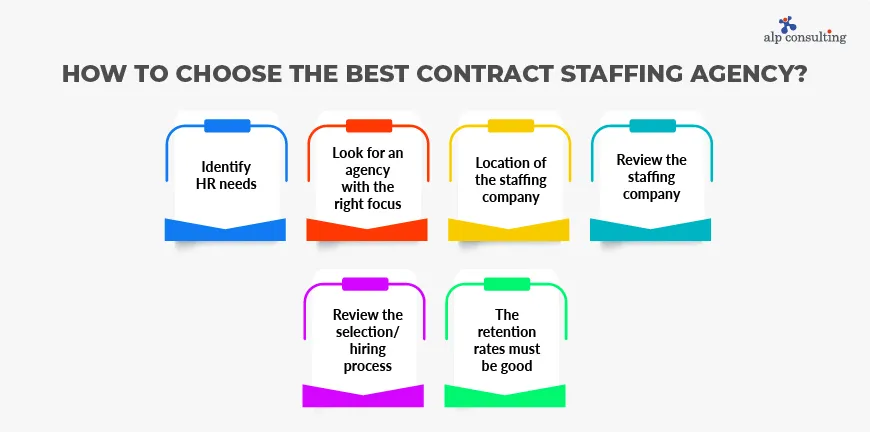
1. Identify HR needs
Ask the right questions about how many hires you need, how they will work, and how long they will be working for you.
2. Look for an Agency with the Right Focus
Does the staffing company you are looking at provide hiring services in your industry? How experienced is it in that industry?
3. Location of the Staffing Company
Where is the staffing company located? How will that impact the hiring process, and will they have an advantage in delivering what you need?
4. Review the Staffing Company
Ask people you know and others about the staffing company, and make sure you have a clear understanding of it and that it can serve your needs based on past records.
5. Review the Selection/Hiring Process
Understand how the selection process works and how good it will be to meet your requirements. Do you think that the process tests all the necessary skills?
6. The Retention Rates must be Good
Consider previous records and make sure the retention rates in the contract staffing company are good. This will help build trust within your company with all the decision makers as well.
What are the Best Practices of Contract Staffing?
Here are the 5 best practices that can bring better outcomes in contract staffing:
1. Clearly Defined Job Roles
Precise JDS, skill expectations, KPIs, timelines, & responsibilities ensure the right talent is chosen, reducing mismatches & setting clear performance expectations from the start.
2. Strong Screening and Vetting Processes
Using skill assessments, behavioural trait checks, reference verifications, & technical interviews helps staffing agencies deliver high-quality candidates who can contribute effectively right from Day 1.
3. Consistent Communication and Engagement
Regular updates, feedback sessions, & relationship-building with contractors improve retention, productivity, & project alignment. Moreover, engagement initiatives help foster a sense of belonging even in temporary roles.
4. Compliance-First Approach
Ensuring accurate payroll processing, statutory filings, documentation, & proper worker classification protects clients from legal risks & maintains trust between employers, agencies, and contract workers.
5. Data-Driven Talent Management
Using HR and People analytics to forecast demand, track performance, measure turnover, & optimize hiring decisions improves staffing outcomes and supports scalable, future-ready contract workforce planning.
Are you looking for Contract Staffing Services?
Companies today choose Alp Consulting because we deliver speed, precision, and compliance-driven workforce solutions. With rapid access to pre-vetted talent across IT, engineering, BFSI, healthcare, & emerging tech roles, we ensure organizations never face project delays or skill shortages. Our end-to-end support, including sourcing, onboarding, payroll, & statutory compliance, reduces operational burden and hiring risks.
We focus on providing flexible, scalable staffing models that align with evolving business needs. Whether you’re expanding teams, executing short-term projects, or managing workload peaks, Alp Consulting becomes your trusted partner for efficient, cost-effective contract staffing.
Key Takeaways
- Contract staffing offers faster hiring, specialized talent, and greater workforce flexibility for project-driven business demands.
- Partnering with agencies reduces compliance, payroll, and administrative burdens, enabling companies to focus on core operations.
- Contract staffing provides cost efficiency, minimizing long-term benefits, training expenses, and permanent employee overheads.
- Agencies ensure quality hiring through strong screening, large talent pools, and industry-focused selection processes.
- Alp Consulting delivers scalable, compliant, end-to-end staffing solutions that prevent project delays and skill shortages.
Frequently Asked Questions (FAQs)
1. What is contract staffing?
Contract staffing allows companies to hire employees for a specific duration or projects, offering flexibility, reduced costs, & access to specialized skills.
2. How is contract staffing different from permanent staffing?
Contract staffing involves fixed-term project roles, whereas permanent staffing offers long-term employment with full benefits, deeper organizational integration, & ongoing responsibilities.
3. Who pays contract staff?
Contract staff are usually paid by the staffing service provider, which manages payroll, compliance, documentation, and statutory obligations on behalf of the employer.
4. Is contract staffing legal in India?
Yes, contract staffing is fully legal in India, governed by labour laws & regulatory frameworks ensuring compliance, employee rights, fair practices, and transparent workforce management.
5. Why choose Alp Consulting for contract staffing?
Alp Consulting offers fast hiring, vetted talent, end-to-end compliance, payroll management, & flexible workforce solutions tailored to dynamic project and business requirements.
Contact Us For Business Enquiry

Kasthuri R
Kasthuri R is the Co-Founder & Executive Director at ALP Consulting, bringing over 23 years of experience in search, staffing, and HR consulting. She has been instrumental in driving ALP’s recruitment, employee leasing, and executive search practices across diverse industry verticals. With deep expertise in talent acquisition, HR strategy, and operational management, Kasthuri has built scalable, client-focused solutions that enhance workforce efficiency. Her strategic leadership continues to steer ALP Consulting toward innovation and excellence in people management.