
What Is POSH? Full Form, Meaning, and Everything You Need to Know
03/02/2026
Workplace Safety Compliance Audit & Inspection Checklist
04/02/2026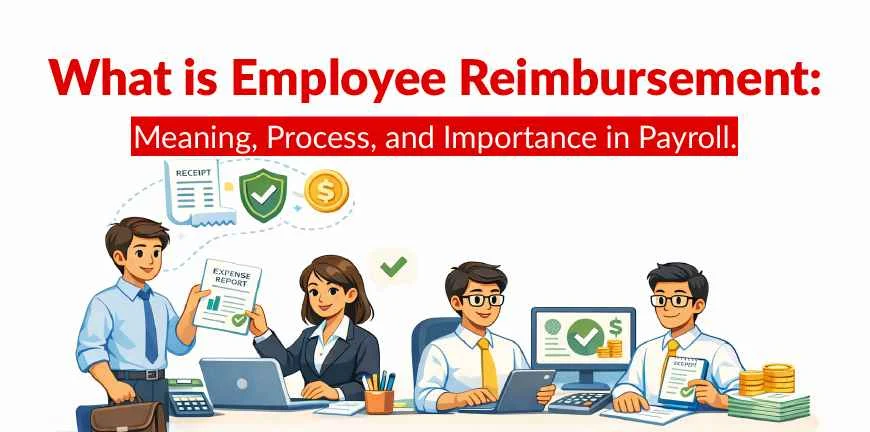
Are delayed reimbursements impacting employee satisfaction and trust?
Reimbursement inefficiencies can quietly disrupt payroll operations like termites hollowing out the furniture. The obstacles, such as manual claim handling, approval delays, unclear policies,& tax misinterpretations, can strain both HR teams and employees, leading to mistrust & dissatisfaction. Nearly 30–35% of expense claims carry errors, resulting in revenue leakage, rework, & compliance exposure.
When reimbursement meaning isn’t clearly defined or communicated, disputes & allegations are inevitable. In a sticky environment of tighter audits & rising employee expectations, getting reimbursement right is no longer optional; it’s paramount for payroll accuracy, cost control, & workforce trust.
Let’s take a deep dive & understand reimbursement meaning, importance, types, process, and checklist.

What is Employee Reimbursement? Meaning & Definition
Reimbursement meaning keeps evolving over time based on the field of application. In payroll, “Employee reimbursement is the process of compensating employees for approved business-related expenses they incur while performing official duties, ensuring accurate payroll treatment, compliance, and transparent expense recovery.
Beyond compensating employees for expenses incurred, employee reimbursement serves as a real-time cash control lever and a trust mechanism between the HR and finance teams. From meals to client meetings, travel tickets, WFH expenses, and business conferences, employee reimbursements directly impact payroll accuracy, cash flow visibility, employee morale, and compliance.
As policy-driven trust, financial predictability, seamless data-driven reconciliations, and time-stamped digital records form the bedrock of operational success, most finance leaders are switching to an automated HRMS reimbursement process. This adoption has helped HR and finance teams to efficiently maintain employee trust, operational productivity, financial discipline, and risk-free compliance across business processes.
What is the Importance of Employee Reimbursement in Payroll?
From an administrative activity of paying legitimate business, travel, and remote working expenses, employee reimbursements have become a strategic lever for HR and finance teams. Effectively handling reimbursements in payroll helps finance teams to lead a compliant, controlled, and employee-friendly reimbursement process.
The core importance of integrating employee reimbursement in payroll results in transparent & timely payouts, strong financial control, and compliance-ready payroll with minimal risk and effort. Here are 3 reasons why integrating employee reimbursements with payroll becomes a non-negotiable factor.
Integrating payroll with a structured reimbursement process boosts confidence among finance teams and high employee morale, while reducing manual errors, reconciliation gaps, tax misclassification, and delayed payouts.
When employee reimbursements flow through the payroll system, finance teams gain strong cost visibility as expenses are treated with defined rules and policies that can avoid breaches and budget misuse. Effective employee reimbursement management gives finance managers tight control over expenses and smart forecasting ability.
To protect both the organization and employees, modern finance teams adopt a well-defined reimbursement policy that entails role-based spend limits, proofs, submission timelines, role-based checks and approvals, and breach alerts that are aligned with payroll to avoid last-minute tax corrections (taxable or non-taxable reimbursements) and compliance risks. Hence, integrating reimbursement into payroll brings a statutory alignment, strengthens financial reporting, and helps in building a defensible audit trail.

What are the Different Types of Employee Reimbursements in India?
For finance leaders, employee reimbursement in payroll goes beyond paying back the expenses. They guard profit margins, strengthen employee trust & payroll governance. Below is the list of key reimbursements processed in India.
1. Travel and Conveyance
This reimbursement payable in such cases include tickets, fuel, hotel bookings, and meals. When routed through payroll, it eliminates cash handling while allowing finance teams to release accurate payouts, faster closures, and tight expense control.
2. Business & Client Reimbursement
This type of expense includes meals, accommodation, and entertainment of business clients. When channeled through payroll, it captures policy-mapped expenses and disburses eligible payouts from taxable pay. This reduces manual intervention and generates risk-free audit records.
3. Telephone and Internet Reimbursement
This expense involves broadband, mobile, and online tool charges, particularly when an employee is working in remote or hybrid mode. Structured payroll reimbursement in this case helps employees to avoid tax risks.
4. Medical Reimbursement
This expense covers consultation, diagnostic fees, treatment bills, and medicine charges. When integrated with payroll ensures timely payouts as per policy and tax treatment and precise audit trails for finance teams.
5. Mileage Reimbursement
This expense is applicable for employees’ travel out for business purposes. Integrating this expense with payroll is governed by policy and helps the finance teams control spend trends and reduce any non-compliant, inflated bills.

How does the Reimbursement Claim Process Work?
For most CFOs and finance managers, the reimbursement process goes beyond reimbursing the already incurred business expense. It is an act of controlling the financial workflow that impacts accurate cash flow, audit-readiness, and tax exposure.
A compliant employee reimbursement process in India generally includes the 4 following four steps.
Step 1
All expense submissions by the employee must be done through digital proofs.
Step 2
All these expense proofs will be validated by the finance manager against the reimbursement policy in terms of category, eligibility, limits, tax, and business relevance.
Step 3
After validation, the expenses undergo the role-based finance manager’s approval to prevent fraud, duplication, or policy breaches that can lead to audit & compliance risks.
Step 4
Finally, payroll integration is a stage where all the approved employee reimbursements are paid with accurate tax calculation and statutory compliance. At this stage, the reimbursement management system also classifies and treats reimbursement as taxable and non-taxable based on company policies and Indian income tax rules. It maintains 100% clarity from submissions to approvals and salary payouts with zero manual intervention.
Finally, the reimbursement process ensures visibility in reimbursements, accurate tax computation, faster closures, and seamless audit trails for statutory scrutiny.
What are the Key Differences between Employee Reimbursement and Allowance?
In the modern business age, most CFOs and finance managers confuse the terms employee reimbursements and allowance, which can silently increase payroll costs, lead to tax leakages, and land the business into compliance risks. Although both appear as compensation, they serve very different financial and regulatory purposes. Here are some stark differences between reimbursement vs allowance tax:
1. Business purpose
Employee reimbursements exist to repay the already incurred business expenses by an employee (meals, tickets, entertainment, travel, or fuel), while allowances are predefined payments regardless of whether the expense occurs or not. In this case, reimbursement protects business cost than an allowance.
2. Control & Evidence
Payroll-integrated employee reimbursement in salary is driven by a process of submitting claims, bills, approvals, and audit trails, whereas allowances are free from procedures or proofs and automatically flow with the salary. In this case, reimbursement in payroll brings in spend accountability and visibility in the business.
3. Tax Treatment
Most employee reimbursements are non-taxable as they are supported by proof and policies. On the other hand, allowances are mostly taxable, except in rare cases. In this situation, if the reimbursement management system is not structured, then non-taxable reimbursements can become taxable and can lead to low employee morale.
4. Payroll Integration
Employee reimbursements are processed post-expenses are incurred, unlike allowances, which are synced into the monthly gross salary, which can actually inflate compensation cost and reduce cost accuracy.
5. Compliance Risk
Employee reimbursements workflows have a maker-checker process that is audit-friendly, unlike allowances, which are less audit-risky but, in the long term, are prone to tax exposure.

What are the Common Misconceptions About Reimbursement in Payroll?
Most finance leaders and CFOs assume that employee reimbursements are an unnecessary payroll add-on. But they forget that it is quietly leading to cost leaks, compliance risks, and low employee satisfaction. So, let’s bust 5 common misconceptions about employee reimbursements in payroll.
1. Just an Expense Payout
Most organisations treat employee reimbursements as a simple refund. But if the reimbursement management system is poorly structured, it can lead to high taxable income, uneven payroll costs, and erroneous reports, eventually triggering workplace conflicts.
2. All Reimbursements are Non-Taxable
Whether employee reimbursements in India are taxable and non-taxable depends purely on eligibility, limits, proof, and policy structure. But in the absence of a structured reimbursement policy, finance teams might face payroll non-compliance and tax retrospection.
3. Reimbursements Can Be Managed
Reimbursements done in isolation can fracture audit trails. Reimbursement in payroll ensures accurate tax calculation, pay transparency, and statutory compliance. Unlike fragmented reimbursements, which can lead to reconciliation gaps, delayed closures, and reporting blind spots.
4. Reimbursements are Risk-Free
Weak controls in reimbursements demand scrutiny. Missed bills, inconsistent classification, and ad hoc payments can violate compliance norms, leading to penalties and business risks.
5. Manual Reimbursements are Good
Manual reimbursements often result in delayed approvals, erroneous data, and low employee morale. But with an automated and advanced reimbursement process, you can integrate claims, approvals, validations, and payouts in minutes.

How is Reimbursement of Taxes Treated Under Indian Laws?
For HR professionals, reimbursement can be a benefit factor, but for finance leaders, it is a yardstick for tax, compliance, and cash flow decisions. Reimbursement under Indian law is determined by three cardinal factors: proof, purpose, and policy alignment.
At the core, employee reimbursements are categorised as taxable and non-taxable.
Expenses incurred exclusively for official and business purposes, such as food, tickets, accommodation, entertainment, client visits, and travel, are non-taxable. Since these reimbursements are treated through a structured process backed by proofs, policies, and a compliance framework, they stay outside taxable income.
On the other hand, reimbursements paid as fixed allowances for personal purposes are subject to income tax, TDS deductions, and become a part of the reimbursement in payroll.
Having a clear reimbursement process helps finance teams maintain high cash flow visibility & expense governance and reduce audit risk & tax exposure.
What can be Included in the Reimbursement Checklist?
Employee Reimbursement has become a control engine for finance teams to maintain cash visibility, boost employee morale, and ensure compliance across the organization. But for a seamless process, finance managers can look up to this comprehensive checklist.
1. Clear Reimbursement Policy
A well-defined reimbursement policy entailing the expense categories, spend limits, proofs, and a role-based approval mechanism can avoid salary misclassification when it comes to taxable and non-taxable reimbursements.
2. Standardised Reimbursement Process
A simplified reimbursement process allows faster submissions, multi-layer approvals, and payouts to be quick and seamless. This supports faster adoption and helps finance teams save valuable time for strategic purposes.
3. Smart Integration of Reimbursement in Payroll
Employee Reimbursements are paid through salary and separately. By integrating payroll into reimbursements automates salary classification as taxable and non-taxable components effortlessly with zero payroll errors.
4. Reimbursement Compliance Checks
Validate compliance checks through a multi-stage reimbursement process where expenses are adhering to internal policies & tax rules. Use audit trails and documentation to avert any compliance risks.
5. Reimbursement Management Governance
A robust employee reimbursement management system covering maker-checker approval mechanisms, expense caps, fraud detection alerts, and strategic reporting dashboards is key to improving financial transparency and boosting employee satisfaction.
What are the Key Reimbursement Challenges Faced by Businesses?
As businesses evolve, financial governance becomes complex. Relying on legacy reimbursement processes can lead to loss, poor financial performance, and legal risks. Some of the reimbursement challenges finance teams and HR leaders still face include:
1. Fragmented Reimbursements
To avoid administrative burden, most businesses choose to run reimbursements outside the payroll system. This disconnect brings payout delays, duplicate entries & errors, and a complex reconciliation process.
2. Manual Reimbursement Process
To save administrative costs, finance teams still use emails, spreadsheet trackers, and paper documentation for approving reimbursements, unlike relying on automation that reduces TAT time, enhances cash visibility, and maintains audit trails to save businesses from audit risks.
3. Compliance Risks
Poor understanding of taxable and non-taxable reimbursements within the organisation can result in misclassification, which can further trigger TDS errors, compliance risks, and delayed payouts.
4. Weak Policy Enforcement
Most reimbursement policies are paper-based and are less implemented. Policy leakage often weakens checks & approvals and inflates reimbursement costs.
5. Poor Reimbursement Management Experience
Payout is one of the greatest motivators of employee experience in an organisation. But due to legacy reimbursement processes, delayed reimbursements will have a high impact on employee morale and trust.
How Payroll Outsourcing Simplifies Reimbursement Management?
Employee Reimbursement stands at the confluence of finance, tax, and compliance. For most CFOs and finance leaders, employee reimbursement has become a balance sheet conversation as it influences cash visibility, tax discipline, and audit preparedness. However, most businesses, due to low budgets and low technological adoption, are still relying on legacy systems and face silent cost leaks, delayed payouts, and reconciliation hassles while accumulating compliance and reputational risks.
By integrating reimbursement best practices into payroll, businesses win a competitive advantage.
- Payroll outsourcing providers help finance teams standardise the reimbursement process, which includes policy enforcement, payouts, and expense
- Payroll outsourcing teams build well-structured reimbursement policies & framework to validate claims seamlessly. This reduces the overhead of appointing a dedicated internal payroll specialist, which kind of serves as reimbursement for employers.
- As reimbursements merge into salary processing, payroll outsourcing teams help classify reimbursements into taxable and non-taxable.
- Adopting a structured reimbursement management system reduces manual intervention, automates claim checks to flag duplication, and ensures rule-based workflows to meet statutory requirements to avoid policy
- Payroll outsourcing partners strengthen reimbursement compliance as every claim carries a digital audit trail, making statutory inspections and year-end closures seamless.
- Payroll outsourcing is not a prompt payback mechanism, but a strategic engine that transforms the reimbursement process from a cost centre into a controlled, compliant, and predictable financial process. To know more, dive into the key takeaways listed below.
How Can Alp Help with Reimbursement Management?
Alp Consulting Ltd helps employers streamline reimbursement management via structured policy design, automation, & compliance-driven processes. Additionally, we manage end-to-end reimbursement lifecycles that include claim validation, documentation checks, tax treatment, approvals, & timely payouts.
Our expert team ensures reimbursements are in perfect sync with income tax rules, minimizes payroll leakages, and enhances employee transparency. With integrated reporting and audit-ready controls, Alp Consulting Ltd reduces administrative effort, improves accuracy, & delivers a seamless reimbursement experience across locations and employee categories.
Key Takeaways
As cost, compliance, and employee experience are keys to financial success in an organisation, here are key takeaways for finance leaders to know how employee reimbursement in payroll is leading that change.
- Direct payroll integration in employee reimbursements ensures every claim is validated, approved, and audited with zero duplications, pay delays, or manual
- An automated employee reimbursement system enables instant submission of claims, approvals, policy checks, and faster payouts, improving employee
- Improve tax efficiency through a clear reimbursement policy that aligns claims with tax and non-taxable rules to enable tax
- Integrated controls help finance teams to stay aligned with tax rules, documentation, and statutory requirements to avoid legal
- Centralised reimbursement dashboards enable finance leaders to predict future financial trends, identify cost-saving opportunities, and gain financial intelligence through data and
Conclusion
In a compliance-driven and cost-sensitive business environment, the employee reimbursement process cannot operate in isolation from the payroll system. By adopting an automated, structured, and policy-driven reimbursement in payroll, finance teams can process faster payouts, reduce documentation errors, achieve tax accuracy, boost employee morale, and improve financial governance at scale.
A defined reimbursement process with strategic classification helps finance managers maintain reimbursement payroll compliance, avoiding reputational and audit risks.
Payroll integration through Alp Consulting Ltd gives next-generation finance leaders a competitive edge in redefining salary strategy by making employee reimbursements a predictable, auditable, and insight-driven component in modern organisations.
Contact Us For Business Enquiry
FAQs
1. What is Employee Reimbursement? Why does it matter in payroll?
Employee Reimbursement simply refers to compensating an employee for the cost already incurred on behalf of the organization. When these reimbursements are handled through payroll, it guarantees the financial teams with payout accuracy, tax clarity, and audit trails to gain financial governance and cost control.
2. How is Reimbursement different from the regular salary components?
Employee reimbursement is not a compensation-based but an expense-based component. A structured reimbursement management system helps to segregate taxable and non-taxable reimbursements, avoiding tax exposure of both the employee and the organization during year-end audits.
3. What is the typical reimbursement process for finance teams?
A robust reimbursement process includes policy-led validations, digital submissions, automated role-based approvals, and payroll integration. This results in error reduction, fast closures, and month-end financial predictability.
4. How do companies manage compliance and reimbursement policy?
A well-defined reimbursement policy entails expense limits, role-based eligibility, tax treatement and documentation rules. Payroll reimbursement compliance ensures alignment with taxation rules to avoid misclassification and audit risks.
5. How does employee reimbursement impact financial control?
An efficient employee reimbursement system delivers real-time expense visibility, zero cash flow leakages, increases forecasting accuracy, and enhances financial governance. In short, it transforms employee reimbursements from a back-end task to a strategic finance control lever.

Yugandhara V. M
Yugandhara V. M serves as the Assistant Vice President – HRO at Alp Consulting Ltd., bringing over 14 years of rich experience in Human Resource Outsourcing, payroll management, and statutory compliance. He specializes in driving process excellence across HR operations, ensuring seamless service delivery and compliance with labor laws. Yugandhara’s expertise lies in managing large-scale client engagements, optimizing HR processes, and implementing efficient workforce management systems that enhance organizational performance. He also leads comprehensive payroll services, ensuring accuracy, timeliness, and compliance for diverse client portfolios.