What Is Remote Hiring – 6 Steps to Success
29/10/2024
RPO Vs Contingent Recruitment: What’s the Difference?
01/11/2024
People allocation is as powerful as financial allocation.” — Greg Case, CEO, Aon.
Time and again, companies need extra hands to fill in the gaps in their organization, sometimes to carry out a major project, and always for a short term. Various models can be adopted to close these talent gaps; one of the most popular and sought-after is resource augmentation. The resource augmentation market is expected to grow to USD 429.90 billion by 2033, according to GlobeNewsWire.
Some important factors to consider in resource augmentation services are that the employer oversees the management of the project and the team, with full control over the developmental process as well. The staffing company will help guide you through the process, ending with onboarding of the selected candidates and continued support beyond this to ensure that they thrive in the new environment and continue to contribute in a meaningful manner, as promised.
Let’s discuss resource augmentation in detail and gather valuable insights so that companies can make informed decisions whether to go for it or look for other alternatives.
Resource Augmentation Meaning
Resource augmentation services, in the context of HR, are the outsourcing of manpower, based on a skill requirement, or for the completion of a project, for a limited period. Depending on the complexity of a project, you add employees to your existing team who have a specific skill set to help execute certain tasks effectively.
So, essentially, resource augmentation is when you hire professionals “as a service”, for a short period as an extension of your in-house team, with the assistance of a staffing agency.
When Do You Need Resource Augmentation?
You need resource augmentation services when there are talent gaps in the teams in your organization, the time to market that you have targeted is very short, or when you are asked to work on a niche project. The last case, especially, is a strong one for resource augmentation, as bringing in experts to your current team with relevant experience is necessary even before you can get a head start in a short time.
Here are a few scenarios where resource augmentation models are the best fit.
| Scenario | Description | Benefit of Resource Augmentation |
| Project-Based Demand Surge | When a company takes on new short-term projects needing specialized skills. | Quickly onboard experts without long-term hiring commitments. |
| Skill Gap in Existing Team | When internal employees lack niche technical or domain expertise. | Fill skill gaps instantly with trained professionals. |
| Scaling Operations Rapidly | During expansion phases, mergers, or product launches. | Scale workforce efficiently without overburdening HR processes. |
| Temporary Workforce Shortage | Due to resignations, maternity leave, or seasonal workloads. | Maintain productivity through flexible, on-demand staffing. |
| Digital Transformation Initiatives | When adopting new technologies like AI, cloud, or automation. | Access emerging tech talent to accelerate digital transformation goals. |
How is Resource Augmentation Different from Outsourcing?
Here are the key differences between resource augmentation and outsourcing:
| Aspect | Resource Augmentation | Outsourcing |
| Control | Client retains maximum control over project management and delivery. | Vendor takes complete ownership of project execution & results. |
| Team Integration | External professionals work as part of the internal team. | Work is handled independently by an external organization. |
| Duration | Typically used for short-term or skill-specific needs. | Generally best-suited for long-term, full-scale operations. |
| Cost Structure | Pay only for specific resources and the duration required. | Fixed or project-based pricing for end-to-end services. |
| Flexibility | High flexibility in scaling up or down the team size. | Limited flexibility once contracts & scopes are fixed. |
| Confidentiality | Greater data control since work happens within company systems. | Higher data leak risks as work occurs outside the organization. |
| Skill Focus | Brings specialized, on-demand skills to existing teams. | Focuses on delivering entire functions or projects externally. |
What are the Benefits of Resource Augmentation Services?
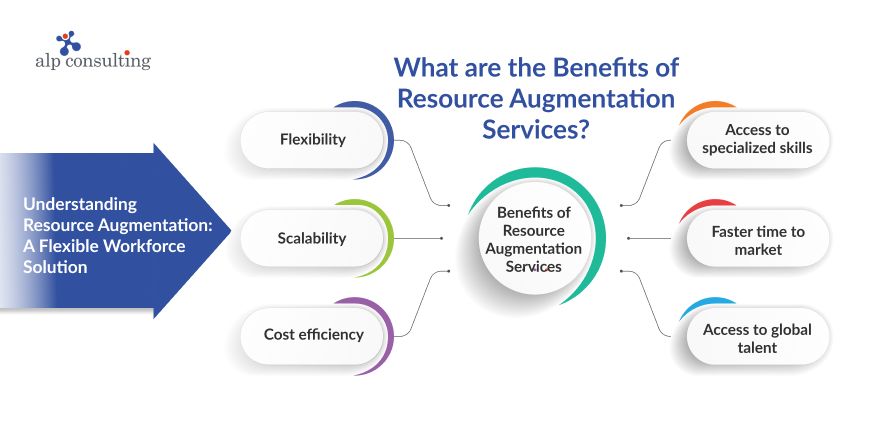
1. Flexibility
Companies can easily adjust to short-term needs without bringing about drastic changes in the way their people work or the way the organization itself functions or what it aspires for.
2. Scalability
Gives organizations the freedom to handle larger projects that require a lot more resources, without having to hire any by themselves, beginning with the recruiters who will help with the job.
3. Cost efficiency
Helps avoid expenses associated with hiring permanent employees, such as privileged leaves, travel allowances, and other reimbursements.
4. Access to specialized skills
Get people with specialized skills on board, who can help you navigate the difficulties you face in each project by making use of technologies you never knew could work.
5. Faster time to market
Get projects done much faster, with the right talent, and spend the rest of the time reviewing the product or solution, for a better user experience.
6. Access to global talent
You can hire solution experts from anywhere in the world with resource augmentation. And this gives you access to incredible talent, because every part of the world is evolving in its own way, and that industry experience and skillset may prove very valuable for you.
How Does Resource Augmentation Work?
The basic resource augmentation process can be explained in 4 simple steps:
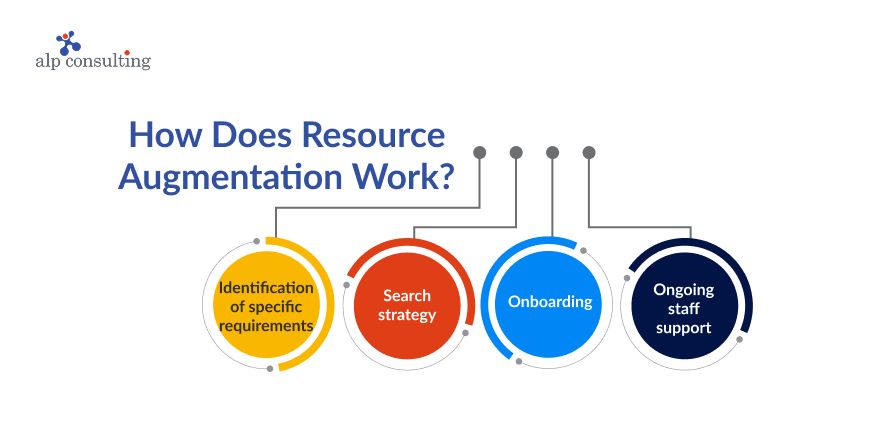
1. Identification of specific requirements
Before we start looking for resources to expand the team in-house, we would need some information from you, such as the abilities, experience or any qualifications of the individuals you wish to recruit. Also, you would need to share information such as how many individuals you are planning to add to your team in resource augmentation.
2. Search strategy
Once the candidate/team augmentation requirements are shared, a search strategy is formulated by the staffing company, which then begins the process of actively looking for additional resources for the team. The staffing company also decides what channels to use and who will be involved in the search and interview stages of the resource augmentation service.
3. Onboarding
Once the selection process is over, then begins the onboarding of each candidate begins. Each company’s vibe and culture are different from the next, and the new joiners will need support to settle in and, most importantly, to catch up on work. A staffing company will ensure that this stage of the resource augmentation process also happens without any problems.
4. Ongoing staff support
Once the new resources are onboarded and have settled in, they may have issues with the workplace or even lack clarity on the terms of the contract. We take feedback and suggestions from both the augmented resources as well as the employer, building a strong and healthy relationship between them for the remainder of the contract period.
Who Can Benefit from Resource Augmentation?
Any organization without any limits or expectations in terms of size or industry can benefit from resource augmentation. The businesses that will benefit the most are organizations looking to diversify their businesses, businesses that handle a large volume of jobs, and startups that are looking for talent.
Other medium-sized or large organizations that are trying to stay compliant as per government or the compliance requirements issued by industry regulatory bodies will also benefit from resource augmentation. The possibilities are endless. Talk to a staffing company to understand how they can improve your productivity and drastically reduce your time to market for a solution with resource augmentation.
Any organization without any limits or expectations in terms of size or industry can benefit from resource augmentation. The businesses that will benefit the most are organizations looking to diversify their businesses, businesses that handle a large volume of jobs, and startups that are looking for talent.
Other medium-sized or large organizations that are trying to stay compliant as per government or the compliance requirements issued by industry regulatory bodies will also benefit from resource augmentation. The possibilities are endless. Talk to a staffing company to understand how they can improve your productivity and drastically reduce your time to market for a solution with resource augmentation.
For instance, Infosys leveraged resource augmentation during a major cloud migration project for a global retail client. By integrating on-demand cloud engineers and DevOps specialists, Infosys accelerated delivery timelines by 30% while reducing project costs by 25%.
According to Grand View Research (2025), the global staff augmentation market is projected to reach USD 147.2 billion by 2030, growing at a compound annual growth rate (CAGR) of 9.5%, driven by digital transformation & remote work trends.
What are the Challenges in Resource Augmentation?
Here are 5 common challenges faced by companies while engaging with resource augmentation services:
1. Cultural Integration Issues
Integrating external talent hired through resource augmentation with existing teams can create communication gaps, conflicting workflows, & cultural misalignment, affecting productivity and collaboration.
2. Data Security Risks
Working with external professionals increases exposure to sensitive data, requiring robust cybersecurity measures & NDAs to ensure compliance and confidentiality, resulting in heavy documentation work.
3. Dependency Concerns
Over-reliance on resource augmentation services may hinder internal capability building & create risks when temporary contracts end or resources leave suddenly.
4. Quality Control Challenges
Maintaining consistent quality standards can be cumbersome when managing a mix of in-house & external professionals with varied work practices.
5. Legal & Compliance Barriers
Different jurisdictions may have complex labour laws, taxation, & contractual obligations that can complicate engagement models & compliance.
What are the Latest Trends in Resource Augmentation?
1. AI-Driven Talent Matching
Organizations are increasingly leveraging AI-powered platforms to match the right professionals with project requirements. These tools analyse skill sets, experience, & cultural fit, significantly reducing hiring time and improving workforce efficiency.
2. Remote Global Workforce Expansion
Companies now tap into global talent pools, hiring remote professionals from different regions through resource augmentation services to optimize costs and access specialized skills unavailable locally. This trend also supports round-the-clock productivity & diversity.
3. Hybrid Team Models
Businesses are adopting hybrid structures where permanent employees collaborate with on-demand specialists. This model ensures operational flexibility, faster scalability, & balanced workloads during peak project phases.
4. Focus on Niche Tech Skills
As digital transformation accelerates, there’s a sharp rise in demand for professionals skilled in AI, cloud computing, cybersecurity, blockchain, & data science to drive innovation and resilience.
5. Outcome-Based Engagements
Rather than paying for time or resources, companies are shifting to performance-based models like resource augmentation, where vendors are compensated based on results, efficiency, and measurable business outcomes.
Conclusion
Resource augmentation can mean different things, such as augmentation of infrastructure, hardware, etc., but in the realm of HR, it is another term for staff augmentation. Staff augmentation can help add the best individuals to your team in very little time, ensuring that the projects you are working on are completed on time and with complete correctness. Are you looking for a resource/staff augmentation partner? Alp Consulting, with consulting experience of more than a decade, is the people to talk to for your resource augmentation needs. When are you talking to us?
Key Takeaways
- Resource augmentation enables businesses to bridge talent gaps efficiently without long-term hiring commitments.
- Companies retain full control over projects while accessing specialized skills through flexible staffing solutions.
- AI-driven talent matching and global remote hiring are redefining modern resource augmentation strategies.
- Resource augmentation supports scalability, cost efficiency, and faster time-to-market for dynamic business environments.
- Partnering with expert agencies like Alp Consulting ensures compliance, quality, and smooth integration of augmented teams.
Contact Us For Business Enquiry
Frequently Asked Questions (FAQs)
1. What is Resource Augmentation?
According to Resource augmentation meaning, it is a business strategy where companies temporarily hire skilled professionals externally to meet project-specific needs & bridge workforce gaps efficiently.
2. What is the Difference Between Outsourcing and Augmentation?
Outsourcing transfers complete project ownership externally, while resource augmentation services supplement existing teams with external experts, maintaining internal control and collaboration.
3. Can Resource Augmentation Be Used for Long-Term Needs?
Yes, companies can retain augmented staff for long-term projects when continuous skill support, flexibility, & cost optimization are required over full-time hiring.
4. When Should a Company Consider Resource Augmentation?
Companies should consider resource augmentation services from top agencies like Alp Consulting during talent shortages, project surges, digital transformations, or when specialized expertise is temporarily required without permanent hiring.
5. What Skills Are Most in Demand for Resource Augmentation?
IT, cybersecurity, data analytics, cloud computing, software development, project management, & digital marketing are among the most sought-after skills globally.
6. What Are the Legal or HR Concerns in Resource Augmentation?
Compliance with labour laws, contract clarity, confidentiality, worker classification, & intellectual property protection are crucial HR and legal considerations in augmentation.

Rajkumar Shanmugam
Rajkumar Shanmugam is the Head of HR at ALP Consulting, bringing over 19 years of comprehensive HR leadership experience across India and international markets. His expertise spans talent acquisition, employee relations, performance management, compliance, and HR transformation. Rajkumar has a proven track record of driving people-centric initiatives, enhancing workplace culture, and aligning HR strategy with business goals. With extensive experience in US staffing operations and global mobility, he continues to lead organizational excellence through innovation and employee engagement.