Change Management: Benefits & Principles to Modern Businesses
29/06/2026
Work-Life Balance: Definition, Process, and Examples
30/06/2026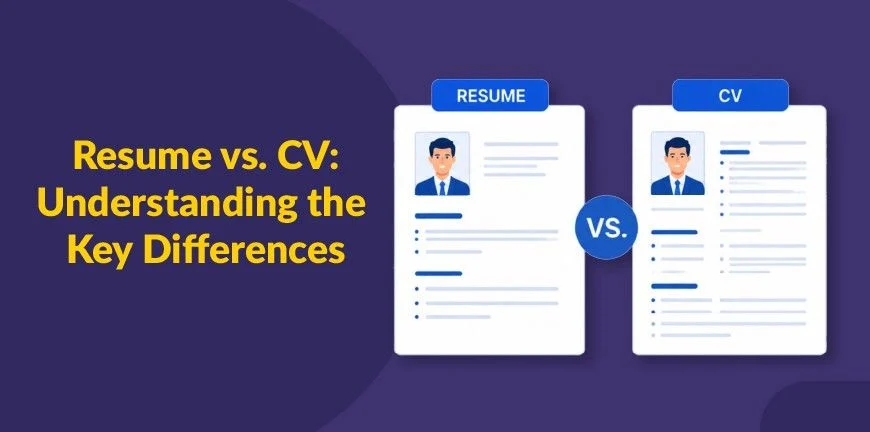
The line between CV vs resume is still not visible to most hiring managers and candidates. Though both serve as essential documents to recruiters, they are not the same in purpose, format, & usage.
So then why do some send a CV and others a Resume? Does one look better than the other? Or are they created based on the geography, experience, skills, or educational background of a candidate?
By breaking the myth between CV & resume, HR leaders can seamlessly scale up the hiring process, candidate evaluations, & drive tangible recruitment outcomes.
How Do CV Vs Resume Meaning Differ?
Terms like CV vs Resume in India are used interchangeably by both hiring managers and candidates. To better understand the difference, here are 3 key dynamics.
| Dynamics | CV | Resume |
| Purpose | Candidate profile designed for academic, research, & medical professions | This format is used for corporate, business, & other occupational roles |
| Layout | The document outlines academic qualifications, research details, certifications, achievements, publications, & professional history | This document outlines relevant work history, skills, project achievements, and domain expertise in an industry, & salary scale |
| Size | There is no specific word or page limit followed for a CV, as it contains more academic information | Typically for professional employers and includes only up to 2 pages maximum, highlighting key skills & experience |
Difference between CV vs Resume: Meaning & Format
In this section, a detailed discussion is made on the meaning and use case of a CV and a Resume.
What is a CV?
Curriculum Vitae in Latin, “Course of Life,” is a comprehensive document that contains detailed academic experience and career history. It is more suitable for applying for academic & research professions. As this document provides extensive information about the candidate, it is suitable for executive and key leadership roles.
What to Include in a CV?
Here are the key sections that can help you create an impressive CV format.
- Insert a passport-size photograph in your CV.
- Include your contact number, email address, & LinkedIn profile link.
- Present your employment history and experience in reverse order, starting with your current experience.
- Also list your academic degree in reverse order with dates, institution titles, and qualifications.
- Avoid including any foreign languages unless it is relevant to the section.
As part of the Technical Skills Section
Add your technical skills, communication abilities, research projects, & leadership networking skills.
As part of the Volunteer Experience
- Add your outreach projects, fieldwork studies, interviews with leaders, and social engagements.
- Add the prestigious bodies, boards, & forums that you worked with for key projects and outcomes.
- Share your references who have commended your projects and involvements.
What is a Resume?
A resume is a formal document that outlines a candidate’s qualifications, skills, and professional experience and is used to apply for a role in a specific industry.
Understanding CV vs Resume examples is vital for a candidate applying for a role in a different region. In some European countries, the term CV serves the same purpose as a resume. Unlike in the US, recruiters often treat resume and CV differently.
A typical resume format includes key skills, experience, & outcome-driven projects rather than a detailed academic journey. This helps employers quickly evaluate a candidate’s suitability for a particular role.
What to Include in a Resume?
Designing a resume is critical as it commands a candidate’s authority and relevance in the job market. So, as a best practice, you may include:
- The resume is a brief history of your professional experience, so do not exceed 2 pages.
- If you are a fresher, limit it to only one page, but if you’re a professional, include the experience, projects, skills, & outcomes achieved in a maximum of 2 pages for better application screening.
- Use professional language across the summary, skills, professional achievements, and projects sections.
- Avoid any graphs to explain your skill range, but connect them to projects and case studies.
- Avoid any personal details like parental details, DOB, marital status, age, religion, caste, & identification numbers.
- References must be given only if requested by the employer.
Best Resume vs CV Examples for Better Hiring Decisions
A good example of a CV contains clear details, which can potentially increase the Here are some examples.
- Candidates use professional fonts like Calibri, Cambria, Open Sans, Helvetica, Georgia, & Bookman Old Style.
- They avoid any decorative elements to ensure employer engagement.
- They include their full name, city, contact details and LinkedIn links.
- They include skillsets, career summary, and goals sections.
- They often display their leadership achievements with stats.
- They include Job position, company name and years they served in reverse chronological order.
A typical resume example includes skills and experience to enhance the recruitment process and job search, as most recruiters use ATS and other screening tools. Candidates follow these tips.
- They design a resume in PDF format or MS Word format.
- They match the professional summary to the Job Description.
- They list out skills and project-based outcomes with data.
- They place awards and recognitions for successfully achieving targets.
- They elaborate on the tools, technology, & software they used during projects.
- They display external exposure and engagements to project industry experience.
- They avoid personal details but highlight professional details briefly.
Conclusion
Understanding the difference between CV and resume helps candidates create stronger job applications, and employers enhance their assessment processes. A critical understanding of the CV and resume is vital for candidates to achieve career growth & for employers to drive informed career decisions.
Frequently Asked Questions (FAQs)
1. How does Alp evaluate CVs and resumes during candidate screening?
Alp Consulting evaluates CVs and resumes using ATS, screening and keyword-matching tools.
2. How can organisations identify the most qualified candidates from large applicant pools?
Employers can identify qualified candidates by understanding the structure of their resumes or CVs, skills, projects, industry experience and cultural orientations.
3. How is candidate suitability assessed beyond the information in a CV or resume?
Screening tests, project-based assignments and cultural evaluations help employers assess candidates beyond the information on resumes or CVs
4. Can Alp help reduce the time spent reviewing applications?
Alp Consulting has the experts and screening tools that can help reduce resume evaluation time by 30% per candidate and improve hiring decisions for the clients.
5. How can candidate shortlisting accuracy be improved?
Candidate shortlisting accuracy can be improved by using AI-led screening tools and psychometric analysis.
6. Can screening services support both entry-level and experienced professionals?
Yes, our screening services support both entry-level and experienced candidates across industries.
7. How are technical and non-technical candidate profiles evaluated?
Technical and non-technical candidates are evaluated using ATS, project-based assignments, and psychometric analysis.
8. Can organisations hire candidates with specialised skills and experience more efficiently?
If your CV or resume is designed in the right format with key details, then organisations can evaluate your skills and experience for particular roles.
9. How do recruitment partners ensure only relevant profiles are shared with hiring teams?
Recruitment partners conduct pre-assessment tests to ensure the CVs or resumes meet the desired expectations of the companies & reduce hiring risks.
10. Can Alp support high-volume recruitment without compromising candidate quality?
Alp Consulting is specialised in qualitative high-volume hiring as it screens the talent CVs or resumes with high-end AI-screening tools and project-based tests.
Contact Us For Business Enquiry

Amit Saproo
Amit Saproo is the Head of Operations at ALP Consulting with nearly 17 years of experience in Executive Search, RPO, Leadership, and IT & Engineering recruitment. He leads nationwide recruitment programs across Technology, BFSI, and R&D domains, driving strategic hiring solutions for diverse client needs. Amit excels in building and managing high-performance teams that deliver scalable, end-to-end recruitment and consulting services.