
Top 15 HR Policies and Procedures for 2026
23/07/2026Contingent Worker: Meaning, Types, Benefits & Examples
28/07/2026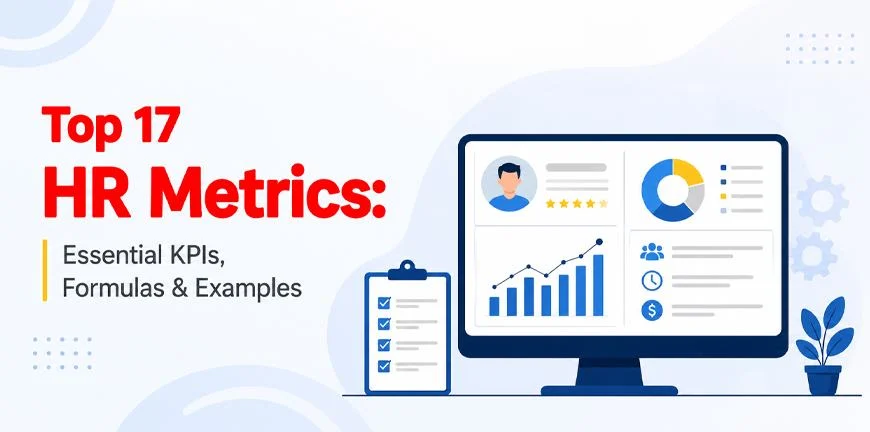
HR metrics are an integral aspect of recruitment, enabling organisations to enhance hiring, improve retention, and elevate productivity. Tracking these metrics accurately supports data-powered and informed decisions.
Businesses often find it difficult to handle their workforce without any assistance, resulting in weak hiring decisions, steep recruitment expenses, high employee turnover, and many more. It is the metrics that empower them to hire efficiently, driving business success.
One of the most significant metrics is measuring employee engagement. According to a Gallup report, India’s employee engagement has dropped to 20% from 23%.
Key Takeaways
- HR metrics enable data-driven decisions that improve hiring, retention, and employee engagement
- Tracking key optimise HR strategies and business outcomes
- Employee-focused metrics provide valuable insights into workforce health and productivity
- HR technology and analytics tools simplify the measurement and analysis of HR metrics
- Regularly monitoring HR metrics empowers organisations to build a future-ready organization
What are HR Metrics?
HR metrics are measurable data points utilised to assess an organisation’s effectiveness, efficiency and impact on its labour force and HR activities. They cover areas including hiring, retention, training, employee satisfaction, performance, engagement and productivity. They also offer deep and significant insights, powering business and HR leaders to make smart decisions.
What are the Top 17 HR Metrics?
Here are some of the most important HR metrics that will drive you to improve your business performance.
1. Time to Hire
This metric measures the number of days a candidate has applied for a job till the they accept the offer. This enables organisations to assess candidate experience and hiring efficiency. A short Time to Hire that is short enables businesses to hire qualified talent quicker, elevates the candidate experience, and diminishes the risk of losing candidates to competitors.
Formula: Time to Hire = Offer Acceptance Date − Application Date
2. Cost per Hire
Cost per Hire is the metric highlighting the cost a company spends on hiring new employees. This also helps in understanding the efficiency of the recruitment process. The measurement of this metric requires including internal and external costs. Internal costs entail:
- Sourcing cost
- Administrative expenses
- Hiring team cost
- Hiring manager cost
External costs include:
- Background verifications
- Marketing expenses
- Signing bonus
- Technological cost
Formula: Cost per Hire = (Internal Hiring Costs + External Hiring Costs) ÷ Total Number of Hires
3. Quality of Hire
This metric evaluates the benefit of hiring a professional and what value they add to the organisational growth. The assessment determines how efficient the hiring is and the long-term effects of the contribution of new employees to company performance. It also measures how easily they can align with the company culture and goals.
Formula: Quality of Hire (%) = (Performance Score Retention Score Hiring Manager Satisfaction Score divided by 3
4. Time to Fill
Time to Fill is a recruitment metric measuring the total number of days taken to fill a job vacancy, starting from the date the job was posted or approved till the day a candidate accepts. It is important as it improves hiring efficiency and enables organisations to identify and hire qualified talent faster.
Formula: Time to Fill=Offer Acceptance Date (or Joining Date) −Job Requisition Approval Date
5. Early Turnover
This measures the number of employees who are exiting the organisation in the first year. This metric indicates issues regarding misalignment between the employee and the job role assigned to them or between the employee and the company. Early turnover can be expensive as it takes time to get suitable replacements.
6. Employee Turnover
This measures the percentage of professionals leaving the organisation in a year. If performance and turnover metrics are combined, then they can track whether the workers who left performed well or badly. This also gives HR teams insights into which departments or functions make workers comfortable working in and the ones dissatisfying them.
Formula: Employee Turnover Rate (%) = (Average Number of Employees During the Period divided by Number of Employees Who Left During the Period)×100
According to Gallup reports, 23% of employees in India are actively engaged at work.
7. Employee Promotion Tenure
This metric evaluates the months or years taken for an internal promotion to happen for an employee. It also shows why top-tier professionals leave and join companies offering better opportunities.
8. Revenue per Employee
This highlights the overall organisational efficiency, indicating the actual quality of manpower. This metric is assessed by looking at the ratio of the company’s total revenue divided by the number of employees who are currently working.
9. Employee Performance
This metric measures how employees meet expectations and effectively attain goals by completing responsibilities and contributing to the objective of the organisation. Organisations evaluate performance by utilising appraisal scores, goal completion rates, key performance indicators (KPIs), manager assessments, 360-degree feedback, and productivity metrics.
10. Billable Employee Hours
This metric is essentially an HR and labour force productivity metric measuring the average number of hours an employee devotes to customer-centric billable work during a particular period. It enables firms to evaluate the utilisation of manpower, the way resources are allocated, and productivity generated by revenue.
11. Employee HR Cost
The metric measures the average amount of money a company spends on HR functions. The calculation of the cost is done by dividing the total cost of HR operations by the total number of employees in the organisation. The metric helps organisations to effectively track hR efficiency.
Formula: HR Cost per Employee=Average Number of Employees/Total HR Operating Costs
12. HR to Employee Ratio
This metric assesses the number of HR specialists available to support the total labour force of an organisation. It helps organisations gauge whether their HR team is well equipped and can efficiently handle functions from hiring to onboarding, manage payroll and compliance and other HR activities.
13. Diversity Hiring Rate
Diversity Hiring Rate measures the percentage of new employees from underrepresented or diverse sections during a specific period. It helps organisations evaluate how effectively their hiring practices support diversity, equity, and inclusion (DE&I) goals.
14. Employee engagement
The employee engagement metric is significant in determining the productivity levels of teams across departments. The metric measures how motivated, committed and connected employees are to the organisation and their jobs. It highlights the engagement levels of professionals who are focused and encouraged to align their work to organisational goals and success.
Formula; Employee Engagement Score (%) = (Total Survey Score Obtained ÷ Maximum Possible Survey Score) × 100
15. Leadership Impact
The metric evaluates how leaders lead teams and how they influence the performance of employees, retention and engagement levels. It is the measurement of the capability of leaders and managers to inspire and lead teams achieving organisational objectives.
16. Employee Satisfaction
This measures the satisfaction levels of employees. How they like their job profiles, work environment, culture, salary package, and career development opportunities. With the help of this metric, companies can comprehend what employees are thinking, and accordingly they can improve the areas that need attention.
17. Employee Training Cost
This measures the average amount spent on training and development initiatives for an employee over a period by a company. Tracking this metric enables organisations to determine the learning and development expenses and investments driving optimisation of training budgets and a fair assessment of training outcomes.
How Does Alp Help Businesses in Measuring HR Metrics?
One of the leading staffing and recruitment companies, Alp Consulting Ltd, has the expertise of supporting businesses with HR metrics assessments. The company helps businesses through various methods like:
1. Applicant Tracking Systems (ATS)
ATS platforms are one of the most popular platforms that measure hiring metrics like time to hire, time to fill, cost per hire, source of hire, offer acceptance rate, and quality of hire. The system tracks candidates throughout the recruitment process and delivers effective results.
2. HRIS (Human Resource Information System)
Utilising HRIS platforms to gather and evaluate employee data is an important method offering real-time HR dashboards and reports.
3. Performance Management Systems
Performance management software and tools are responsible for tracking employee goals, KPIs, appraisal scores, productivity, competency assessments, and manager feedback to measure individual and team performance.
4. Payroll and Attendance Systems
Payroll and attendance software like e-manage helps in monitoring absenteeism, overtime, payroll accuracy, labour expenses, billable hours, workforce utilisation, and compensation-related metrics.
5. Learning Management Systems (LMS)
LMS platforms measure learning and development metrics, including training completion rates, learning hours, certification rates, training effectiveness, and training ROI.
6. Employee Feedback and 360-Degree Reviews
Collecting feedback from managers, peers, direct reports, and employees provides valuable insights into leadership effectiveness, collaboration, communication, and overall performance.
7. HR Analytics Tools
Advanced analytics platforms combine data from multiple HR systems to create interactive dashboards, identify workforce trends, and support predictive analytics.
8. Exit Interviews and Stay Interviews
Exit interviews reveal the reasons employees leave, while stay interviews uncover factors that encourage employees to remain with the organisation. These methods help measure retention drivers and improve employee experience.
Conclusion
Measuring HR metrics accurately powers businesses to build smart, sustainable teams. With the work landscape evolving and inclining towards data-driven approaches in 2026, the metrics are vital to growth and business continuity. To evaluate your HR metrics effectively, contact Alp Consulting Ltd!
Frequently Asked Questions
1. What are HR metrics?
HR metrics are data-driven indicators that measure workforce performance, productivity, engagement, and effectiveness, helping organisations make smarter, strategic people decisions.
2. What are some HR metrics that matter?
Key HR metrics include employee turnover, time-to-hire, cost-per-hire, engagement scores, retention rates, and performance levels that reveal organisational health.
3. How frequently should HR metrics be measured?
HR metrics should be measured monthly, quarterly, or in real-time based on business needs, enabling proactive decisions, trend tracking, and improvement.
4. Can HR metrics help address staffing problems?
HR metrics can help address staffing problems by identifying hiring gaps, skill shortages, and inefficiencies, enabling data-backed staffing strategies, recruitment, and improved workforce planning outcomes.
5. What are HR analytics tools?
HR analytics tools are software platforms that collect, analyse, and visualise HR data, enabling actionable insights and smarter workforce decisions.
Contact Us For Business Enquiry

Hariharan Iyer
Hariharan Iyer is the Vice President – Operations at ALP Consulting, bringing over 40+ years of experience in HR outsourcing and labour law compliance. He leads end-to-end HRO operations, ensuring process efficiency, statutory compliance, and seamless service delivery for clients across industries. With a strong background in labour law governance and workforce management, Hariharan plays a key role in driving operational excellence and compliance-led HR solutions at ALP Consulting.