
Types of HR in 2026: Functions, Roles, and HR Models Explained
17/04/2026
What Is Human Resource Management? Definition, Functions & Process
17/04/2026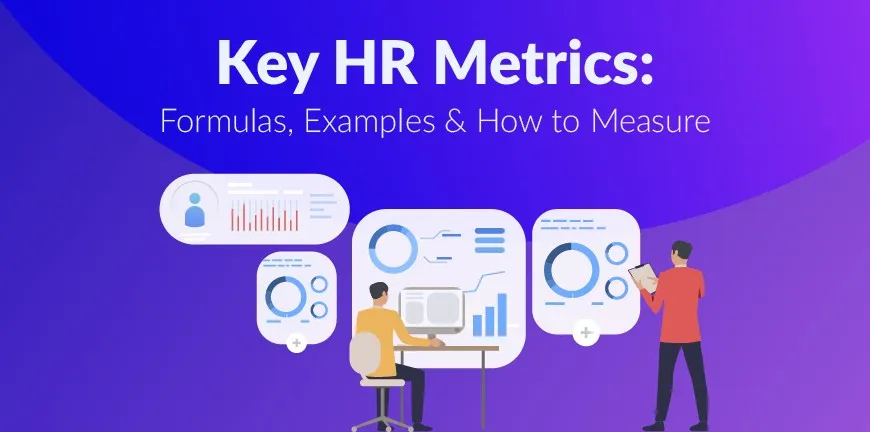
Operations are usually set & forgotten by HR teams. Much of the company’s success depends on the cost-effectiveness of the tools or processes. Using important HR metrics can help measure ROI, which can help HR teams understand the organisation’s financial health.
What are HR Metrics?
HR metrics are quantifiable data that show the effectiveness of HR initiatives in an organisation. By assessing different aspects of the workforce management, HR can identify weak areas and improve performance through data-driven strategies. By implementing these data-driven strategies, HR can make informed decisions in hiring, retention, compensation, & employee engagement. This eventually leads HR to drive operational excellence & culturally aligned workforce.
Why is the importance of HR metrics in business?
One of the smartest ways to make HR function data-driven and outcome-based is through embedding HR metrics. Some of the key benefits of HR metrics to businesses are:
1. Strategic Talent Management
HR metrics help in identifying talent needs and gaps. It helps HR teams make informed talent decisions, development & retention. By leveraging the data from these metrics, HR teams can build targeted talent management programs & strategies to enhance workforce capabilities.
2. Cost Effectiveness
By effectively tracking and analysing hiring, training, & turnover costs, HR teams can use metrics to allocate budgets strategically to reduce financial strain. By investing in smart technologies and development programs, HR managers can justify their investments with the costs to avoid any financial imbalance.
3. Strategic Workforce Planning
HR metrics help HR managers with new trends & predictions essential for smart workforce planning. They also ensure that the planning is aligned with the business objectives & the right talent is hired to sustain organisational growth.
4. Informed Decision Making
HR metrics empower HR teams to make data-driven workforce decisions by analysing absenteeism, performance, & employee satisfaction rates. They also provide insights into the effectiveness of the workforce strategies and maximise their impact.
What are the different types of HR metrics?
As HR metrics influence business decisions, ignoring them can lead to potential losses & risks. In this section, we explore how different HR metrics have become a strategic asset more than an option. Some of the basic HR metrics are:
1. Time to Hire
The time-to-hire metric indicates the number of days a candidate took to apply for a job and accept the offer letter. This metric provides insight into the hiring efficiency and the candidate experience. Delays in hiring can demotivate candidates and lead to high candidate dropout rates.
2. Cost Per Hire
The metric shows the cost spent on hiring new candidates. The costs can involve background checks, marketing, external recruitment team costs, administrative expenses, and technology costs. They can also measure the recruitment efficiency rate.
3. Quality of Hire
This metric shows the value every employee brings into the organisation. It measures recruitment efficiency & the long-term impact of the employees on the organisational performance.
4. Turnover
The metric measures the number of employees leaving the company in a year. The metric, combined with the performance metric, helps us understand turnover with low-performing employees. It also provides information on why employees leave the organisation, due to engagement, culture, or job satisfaction.
5. Performance
Among the many qualitative & quantitative metrics, HR performance metrics are used to measure a candidate’s performance, net promotion score, management objectives, number of errors, feedback, & forced ranking. This helps the HR teams to identify high performers, active team players, & exceptional leaders.
6. Absenteeism
This is a strong metric that predicts employee dissatisfaction, attrition, & reduce operational bottlenecks. It helps HR teams measure the unplanned absences of employees monthly or yearly and identify the reasons, such as health or stress, behind long absences.
7. Engagement
HR retention metrics help HR professionals evaluate employee satisfaction, which is directly related to productivity. Employees who are proud of their company work in challenging environments. This metric helps to drive high employer branding through motivated employees.
8. Leadership
This metric helps to unpack the effectiveness of the leadership initiatives, performance, & job security. This metric also discloses the skills, communication, morale, & decision-making abilities across different projects & timelines in the organisation.
9. Employee Satisfaction
HR engagement metrics help you assess your employees’ job satisfaction, work-life balance, & cultural alignment with the organisation. They use different questionnaires to understand the employee expectations.
How to calculate HR metrics?
Calculating important HR metrics is a critical component of HR management as it supports decision-making with accurate data regarding employees’ work, capabilities, morale, & career ambition within an organisation. Some key formulae HR teams used are shown in the HR metrics examples below.
1. Time to Hire
Average Time to Hire = Candidate time to hire in days + Nth candidate time to hire / total number of Jobs
2. Cost Per Hire
Cost per Hire = Internal Costs + External Costs / Total Number of Hires
3. Turnover
Turnover Rate = Number of new hires who quit the organisation/ number of new hires from that period X 100
4. Absenteeism
Absenteeism Rate = Number of Absent Days/ Total working days X 100
Are HR Metrics the same as KPIs?
HR KPIs and metrics are not the same. HR metrics mostly deal with everyday points, whereas KPIs focus on targeted goals. To understand the differences better, we have provided a table below.
| Point of Difference | HR Metrics | KPIs |
| Performance | Tracks across all areas | Monitors only specific goals or objectives |
| Goals & Data Points | Scattered data points | To track one goal, you need multiple data points or metrics |
| Time frame | HR metrics are not tied to a particular time frame & are informational in nature | KPIs are long-term goals achieved in a particular frame of time |
| Focus Level | HR metrics are usually broad in nature and deal with day-to-day business processes. | KPIs deal with specific goals focused on process & problems |
| Relevance | Relevant across all the HR departments | Relevant only in specific departments |
Common challenges in tracking HR metrics and how to overcome them?
HR metrics can break or make a business. When your revenue misaligns with business goals, you have common HR metrics. Let’s understand the most critical challenges in HR metrics.
- Business leaders care more about revenue. A slight miscalculation of turnover data of potential employees can greatly affect the financial health of the organisation.
- HR teams often assign employees with tactical metrics rather than strategic metrics. They calculate the cost to hire one employee instead of the value of workforce productivity.
- HR metrics are often broken down into silos. This fragmented setup does not support driving a single goal. Hence, HR measurement metrics can result in a waste of time and effort.
How can companies measure and improve HR metrics?
Some of the smart ways to change HR metrics from failure into a strategic asset for companies is HR teams can-
- Use cloud solutions to bring data together instead of relying on fragmented data. This is possible by training HR teams with data and analytical skills that help them use data strategically.
- Shift from reporting historical data to predictive analytics, which provides real-time information on the root cause analysis behind numbers.
- Benchmarking against the industry standards
- Building HR tech platforms & dashboards
- Drive action through storytelling
How are HR metrics evolving in 2026?
HR metrics are no longer measurement tools but have evolved into predictive, adaptive, & transformational assets to HR managers across different sectors. The use of data has helped HR managers to build a strong, resilient, & future-ready workforce.
What are the most important HR metrics to track in 2026?
Some of the interesting trends in the HR metrics is changing the HR landscape are:
- AI-driven Forecasting to forecast turnover and prepare succession planning.
- Personalised learning & development programs.
- Real-time dashboards to help managers & leaders make informed decisions.
- Ethical Data Framework to enhance transparency & responsible use of data.
- DEI analytics to support equitable work representation & opportunities.
Conclusion
Alp Consulting Ltd, India’s leading recruitment firm, gives you the ability to hire better and faster. Alp’s suite of automated recruitment solutions is designed to tap top talent. Our validated assessments help you achieve high-quality talent decisions and build a diverse workforce of tomorrow. Alp has processed over 10 million candidates, and analysing these data helps us deliver actionable insights to zero in on candidates who meet your business needs and growth.
Frequently Asked Questions (FAQs)
1. What is HR metrics?
HR metrics are data-driven indicators that measure workforce performance, productivity, engagement, and effectiveness, helping organisations make smarter, strategic people decisions.
2. What are some HR metrics that matter?
Key HR metrics include employee turnover, time-to-hire, cost-per-hire, engagement scores, retention rates, absenteeism, and performance levels that reveal organisational health.
3. How frequently should HR metrics be measured?
HR metrics should be measured monthly, quarterly, or in real-time based on business needs, enabling proactive decisions, trend tracking, and improvement.
4. Can HR metrics help address staffing problems?
Yes, HR metrics identify hiring gaps, skill shortages, and inefficiencies, enabling data-backed staffing strategies, recruitment, and improved workforce planning outcomes.
5. What are HR analytics tools?
HR analytics tools are software platforms that collect, analyse, and visualise HR data, enabling actionable insights and smarter workforce decisions.
Contact Us For Business Enquiry

Hariharan Iyer
Hariharan Iyer is the Vice President – Operations at ALP Consulting, bringing over 40+ years of experience in HR outsourcing and labour law compliance. He leads end-to-end HRO operations, ensuring process efficiency, statutory compliance, and seamless service delivery for clients across industries. With a strong background in labour law governance and workforce management, Hariharan plays a key role in driving operational excellence and compliance-led HR solutions at ALP Consulting.