15 Questions to Ask a Recruitment Agency Before Hiring
02/07/2026
Top 10 Soft Skills That Hiring Managers Look for in 2026
03/07/2026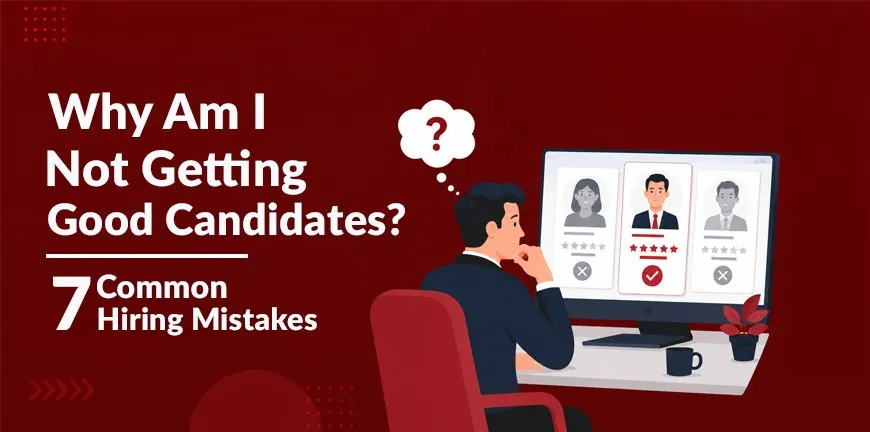
If your HR team is buried under applications but still can’t fill the role, the problem usually isn’t effort; it’s infrastructure. Outdated sourcing tools, stretched generalist recruiters standing in for specialists, and screening processes that haven’t kept pace with the market all quietly stand in the way of finding qualified candidates.
Here are the 7 hiring mistakes that quietly prevent HR teams from attracting and securing qualified candidates.
Key Takeaways
- Strong candidate sourcing attracts more qualified candidates from diverse talent pools.
- Clear job descriptions improve candidate quality & application relevance significantly.
- Faster approvals reduce candidate drop-offs & boost hiring success.
- Employer branding influences candidate quality & overall hiring outcomes.
- Recruitment metrics reveal hiring gaps and elevate long-term recruitment performance.
What Are the 7 Common Hiring Mistakes?
Here are the 7 most common hiring mistakes the HR team must always avoid:
1. Poor JD (Job Descriptions)
One of the biggest reasons employers grapple with finding qualified candidates is designing a strategic job description.
Incorrect skill requirements, unclear company culture, unstructured compensation, unrealistic benefits, and weak employer messaging often discourage qualified candidates from applying.
How to fix it
- Write clear, comprehensive job descriptions.
- Focus on role-based expectations.
- Highlight career growth & company benefits.
- Use a keyword-matching tool to assess the roles seamlessly.
2. Limited Candidate Sourcing
Most specialised professionals aren’t actively searching for jobs; they’re already employed. As a result, companies relying only on job boards end up competing for a small pool of active job seekers, creating the perception of a talent shortage.
The strongest candidates are usually passive talent, open to the right opportunity but unlikely to apply on their own. Reaching them requires proactive sourcing through employee referrals, LinkedIn outreach, industry communities, recruitment partners, & well-maintained talent pipelines.
Each sourcing channel uncovers a different segment of the talent market. Expanding beyond traditional job postings gives employers access to qualified candidates long before competitors find them.
Important Stat: While job boards and career sites take an average of 39 to 55 days to yield a hire, employee referrals drop that time-to-hire down to just 29 days. (Source: Forbes Survey)
How to fix it
- Professional networking channels.
- Employee referral programs.
- Invest in long-term recruitment marketing.
- Offer market-standard compensation packages.
3. Poor Tech Screening
Receiving hundreds of CVs means little if your candidate screening process fails to pick the right talent.
An ATS can efficiently manage large application volumes, but it shouldn’t be the sole decision-maker. When filters rely too heavily on keywords, qualified candidates may be rejected simply because their resumes don’t match predefined criteria. That doesn’t mean they lack the skills or experience needed for the role.
The most effective screening process combines ATS efficiency with human expertise. Structured interviews, technical assessments, and competency-based evaluations help recruiters validate skills & assess role fit. They also identify high-potential candidates beyond what’s written on a resume.
How to fix it
- Use structured screening criteria.
- Combine ATS filtering with manual review.
- Conduct skills-based assessments.
- Standardize interview evaluations.
4. Weak Employer Branding
Top candidates don’t just apply; they research first. If what they find is sparse, inconsistent, or unconvincing, many won’t apply. Employer branding shapes that first impression long before a recruiter makes contact.
It reflects your company culture, values, growth opportunities, and what it’s actually like to work there. A strong employer brand doesn’t just attract more applicants; it attracts better-qualified candidates and often reduces the overall cost per hire.
How to fix it
- Strengthen your careers page.
- Showcase employee success stories.
- Share workplace culture on social platforms.
- Respond professionally to employer reviews.
5. Delayed Hiring Approvals
Qualified candidates rarely remain available for long. Yet many offers are delayed because of lengthy internal approval cycles, unavailable hiring managers, or waiting for senior leadership or the CEO to approve and sign offer letters.
While the process stalls, competitors move faster, giving candidates better opportunities and increasing the chances of losing top talent.
How to fix it
- Define clear approval timelines for every hiring stage.
- Delegate offer approvals to authorized decision-makers.
- Use digital workflows for faster offer approvals.
- Track offer turnaround times and eliminate approval bottlenecks.
- Provide timely candidate feedback.
6. Ignoring Recruitment Metrics
Many employers measure hiring success by the number of applications received. However, application volume doesn’t necessarily translate into better candidate quality.
Instead, organizations must trace recruitment metrics such as quality of applications, interview-to-offer ratio, offer acceptance rate, source of hire, time-to-hire, & quality of hire. These insights help lock down precise reasons where candidates are dropping out & which sourcing channels consistently bring forth better talent.
Using recruitment data enables employers to continuously optimize their recruitment funnel & make informed hiring decisions.
Important stat: According to Forbes, unoptimized processes lead to an average of 20 interviews per successful hire (a 42% increase in structural drag over recent years), allowing competitive candidates to accept faster offers elsewhere. (Source: Forbes)
How to fix it
- Track quality of hire regularly.
- Measure sourcing channel performance.
- Monitor recruitment funnel conversions.
- Review hiring reports monthly.
7. Misaligned Hiring Expectations
Expecting candidates to possess every technical skill, certification, & industry experience significantly shrinks the available talent pool. In today’s competitive hiring market, organizations often need to hire for potential rather than perfection.
Focusing on trainability, learning ability, cultural alignment, & long-term growth often produces stronger hiring outcomes than waiting months obsessing over finding an ideal candidate.
How to fix it
- Prioritize essential skills.
- Hire for learning potential.
- Offer upskilling
- Reassess unrealistic requirements.
Conclusion
Finding qualified candidates starts with addressing the common hiring mistakes that hold employers back.
Alp Consulting helps employers overcome these challenges through specialist recruiters, strategic sourcing, structured screening, & streamlined hiring processes.
Ready to hire better talent faster? Partner with Alp Consulting today.
Frequently Asked Questions (FAQs)
1. We are receiving plenty of resumes, but very few suitable candidates. How can you help?
We improve candidate quality by refining job descriptions, expanding candidate sourcing channels, strengthening candidate screening, & targeting professionals who closely match your hiring requirements.
2. How do you screen candidates before sharing profiles with us?
We combine structured interviews, technical assessments, competency evaluations, resume reviews, and cultural fit assessments before recommending candidates.
3. Can you help us attract higher-quality candidates for difficult roles?
Yes, we use specialized candidate sourcing strategies, industry networks, passive candidate outreach, and recruitment marketing to attract highly qualified professionals.
4. How do you source passive candidates who aren’t actively applying for jobs?
We leverage professional networking platforms, talent communities, industry referrals, executive search techniques, & existing talent databases to engage passive candidates.
5. Can you improve our candidate quality without increasing hiring costs?
Yes, we optimize sourcing channels, improve candidate screening, and refine recruitment strategies, which often improve candidate quality without significantly increasing recruitment budgets.
6. How do you reduce the time our team spends reviewing irrelevant resumes?
We pre-screen applicants using structured evaluation criteria, ATS technology, technical assessments, and recruiter-led interviews before submitting shortlisted candidates.
7. Can you support niche and hard-to-fill hiring requirements?
Yes, we specialize in sourcing niche, leadership, technical, and difficult-to-fill positions using targeted recruitment strategies and industry-specific talent networks.
8. How do you ensure candidates match our technical and cultural expectations?
We evaluate technical competencies, communication skills, behavioural traits, and organizational fit through structured interviews and role-specific assessments.
9. What changes would you recommend if our current hiring strategy is not delivering the right talent?
We assess your recruitment process, job descriptions, sourcing channels, employer branding, recruitment metrics, and hiring workflow to identify improvement opportunities and develop a more effective talent acquisition strategy.
Contact Us For Business Enquiry

Amit Saproo
Amit Saproo is the Head of Operations at ALP Consulting with nearly 17 years of experience in Executive Search, RPO, Leadership, and IT & Engineering recruitment. He leads nationwide recruitment programs across Technology, BFSI, and R&D domains, driving strategic hiring solutions for diverse client needs. Amit excels in building and managing high-performance teams that deliver scalable, end-to-end recruitment and consulting services.