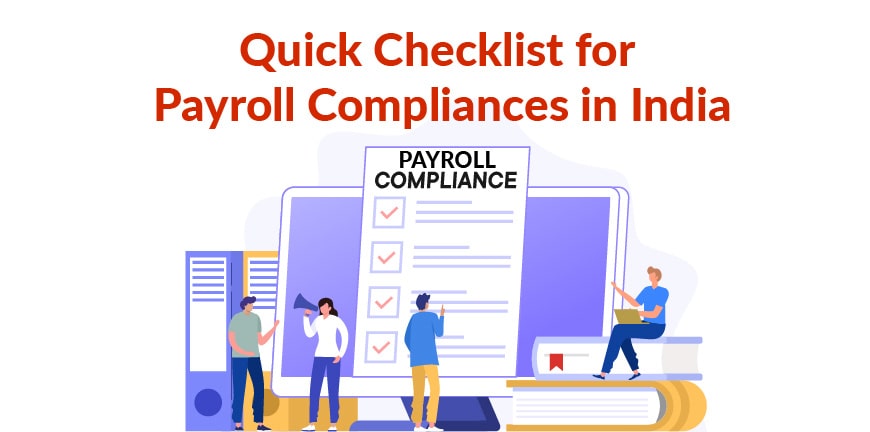
Payroll Compliance Checklist For 2026
02/07/2026
Why Am I Not Getting Good Candidates? 7 Common Hiring Mistakes
03/07/2026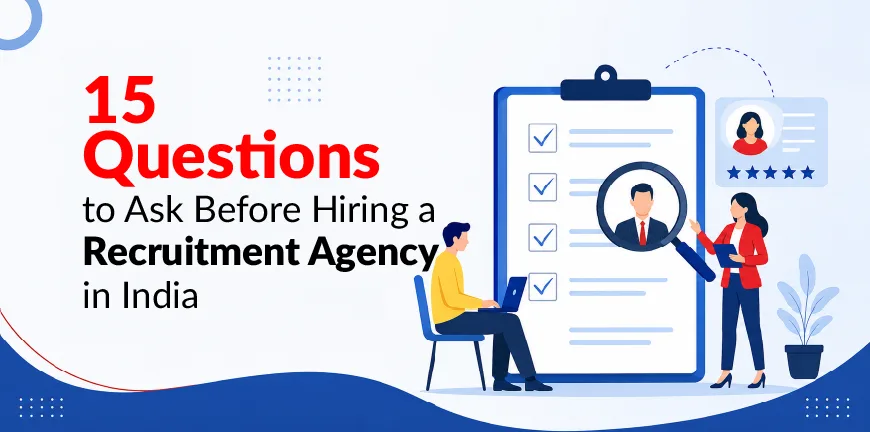
Most employers find out that a recruitment agency was the wrong fit after the damage is done. Delayed closures, weak shortlists, zero market insight: it adds up fast. The questions to ask a recruitment agency before you engage can save you all of it. Here’s what to ask, what to listen for, and how to evaluate your options.
Key Takeaways
- Ask strategic questions before selecting a recruitment agency for successful hiring outcomes.
- Evaluate industry expertise, sourcing methods, and recruitment metrics before making decisions.
- Review recruitment technology, SLAs, and pricing for transparent hiring partnerships always.
- Prioritize quality of hire over speed to build stronger long-term workforce success.
- Use a recruitment agency selection checklist to compare partners objectively and confidently.
What are the Top 15 Questions to Ask a Recruitment Agency Before Hiring?
Here are the top 15 questions to ask a recruitment agency before making the final choice:
1. What industries & job roles do you specialize in?
Industry knowledge isn’t optional: it’s the difference between a recruiter who screens CVs & one who actually understands what the role demands. Ask whether the agency has placed candidates in your sector, for comparable roles, at similar levels.
Agencies with real industry exposure already know the skill benchmarks, going salary rates, & what good candidates in your space look like, and that shows up in results.
Companies that lean on sector-specific expertise & structured screening report up to 22% faster hiring and a 14% lift in candidate quality scores. (Source: Business Research Insights)
2. How do you source qualified candidates?
A recruiter who only posts on job boards isn’t sourcing: they’re waiting. Ask how they actually find candidates: Are they tapping proprietary talent databases? Mining professional networks?
Engaging passive candidates who aren’t actively looking but are absolutely open to the right opportunity? The sourcing mix matters because the best hires rarely apply first.
Outbound-sourced candidates are 5 times more likely to get hired than someone who stumbled across a job listing, & that gap is hard to close with reactive hiring alone. (Source: Gem Recruiting Benchmarks)
3. What does your recruitment process look like?
A vague recruitment process is a warning sign: push for specifics. How do they move from brief to shortlist? What does their screening look like, and who handles interview coordination and offer management?
The best agencies run structured, repeatable workflows because consistency is what keeps good candidates from dropping off mid-process.
72% of professionals state that the overall smoothness and speed of an interview process directly influences their final decision to accept or reject an employer’s offer. (Source: JobScore Annual Data)
4. How do you screen candidates before sharing profiles?
Sending unscreened CVs is not recruitment: it’s filtering outsourced to the employer. Ask what their screening actually covers: technical skills, communication, cultural alignment, employment history, & role-specific competencies.
A shortlist should arrive pre-qualified, not pre-assembled. The more scrupulous the candidate screening upfront, the less time your hiring managers will spend on F2F or virtual interviews that were never going to go anywhere.
Rigorous upfront vetting drops median time-to-fill from 44 days to 39 days, preventing premium talent from losing interest. (Source: SHRM Benchmarking Report)
5. What recruitment metrics do you track?
Reliable agencies use recruitment metrics to measure performance. Ask about their average time-to-Hire, submission-to-interview ratio, offer acceptance rate, joining ratio,& quality of hire. These metrics provide objective evidence of their recruitment effectiveness.
The average market offer acceptance rate hovers around 75% to 81%, meaning roughly one in four offers are declined due to late-stage alignment failures like compensation mismatches or lack of transparency (Source: JobScore)
6. How large and relevant is your talent pool?
A recruitment agency should have access to a diverse talent pool of active & passive candidates. Ask how they maintain candidate databases, refresh talent pipelines, & engage professionals who may not be actively searching for jobs. A larger & well-managed talent pool helps fill vacancies faster.
Candidates who are proactively sourced and nurtured from an agency’s owned talent pool are more than 2x as likely to be high-quality hires compared to inbound applicants from public job listings. (Source: Aptitude Research / Employ Inc.)
7. What recruitment technology do you use?
Modern hiring can’t be managed without recruitment technology. Technology tells you a lot about how seriously an agency takes its process. Ask what tools they’re running: ATS platforms, AI-powered sourcing, resume parsing, recruitment CRMs, & interview scheduling. These aren’t extras; they’re infrastructure.
Agencies that invest in the right technology move faster, collaborate better, & deliver a candidate experience that doesn’t fall apart between stages. The ones still working off spreadsheets will show it in the results.
Implementing a robust Applicant Tracking System (ATS) enables talent acquisition teams to streamline their screening pipelines. Nearly 86% of recruiters stated that their ATS has brought a stark reduction in their overall time-to-hire. (Source: GetApp / Tracker-RMS)
8. How do you ensure quality of hire?
Filling a role fast means nothing if the hire doesn’t last. Ask how the agency defines & tracks quality: not just at the offer stage, but after placement. Do they use competency-based assessments? Structured interviews? Do they follow up with hiring managers once someone is on the ground?
The agencies worth working with treat the placement as the beginning of accountability, not the end of it.
Prioritizing evidence-based hiring choices yields massive long-term dividends, as organizations with high-quality hires achieve up to a 30% increase in baseline operational productivity. (Source: Intervue / Gallup Research)
9. Do you conduct background verification?
One bad hire who misrepresented their credentials can cost far more than the recruitment fee. Ask what their verification process actually covers: employment history, educational qualifications, identity checks, & professional references. Shortcuts here show up later, & they’re rarely cheap. A credible agency treats background verification as standard, not optional.
Recruiters note that 60% of companies report a noticeable reduction in employee turnover directly attributable to rigorous upfront verification. (Source: WifiTalents)
10. How quickly can you fill open positions?
Every week, a critical role sits vacant, and someone else is carrying the weight. Ask for realistic time-to-hire benchmarks across role types & seniority levels, not a best-case number designed to win the mandate.
The agencies worth trusting will give you honest timelines, flag potential delays, & tell you when a deadline simply isn’t achievable. That kind of candour early on is itself a green flag.
60% of organizations admit their hiring cycles expanded due to added approval layers, risking candidate drop-out. (Pin.com)
11. What is your pricing model?
Understanding the overall recruitment cost helps you compare agencies effectively. Ask whether they follow contingency, retained, or project-based pricing. Also, clarify replacement guarantees, hidden charges, and payment milestones to avoid future surprises.
For a mid-level professional with 2–5 years of experience earning an annual salary of Rs. 10 lakhs to Rs. 25 lakhs, recruitment agency fees typically range from 8.33% (one month’s salary) to 10% of the annual CTC, resulting in an estimated hiring cost of Rs. 83,300 to Rs. 2,50,000. (Source: Wisemonk)
12. What does your Service Level Agreement (SLA) include?
A handshake agreement is not a recruitment strategy. Before you proceed with engagement, ask what their SLA actually covers: hiring timelines, reporting cadence, communication standards, replacement terms, escalation paths. A well-structured SLA protects both sides & removes the ambiguity that causes friction later. If an agency hesitates to commit anything to paper, that hesitation is the answer.
30% of new hires leave an organization within their first 90 days, reinforcing why structural SLA protections, like a mandatory 90-day free replacement guarantee, are a vital safety net for corporate budgets. (Source: Forbes)
13. Can you support our future workforce planning?
Your hiring needs today won’t look the same in twelve months. Ask whether the agency can scale with you: bulk hiring, seasonal ramp-ups, new market expansion, & long-term workforce planning. A transactional agency fills today’s vacancy & moves on. A strategic partner is already thinking about your next ten hires before you’ve asked for them.
Industry surveys indicate that Gen Z professionals explicitly prefer short 18-to-24-month tenures before transitioning roles. This meant organizations must build constant internal mobility programs and external “warm pipelines” to offset regular, predictable attrition. (Source: Forbes India)
14. How do you support employer branding?
Every interaction with candidates shapes your organization’s reputation. Ask how the agency represents your company, communicates your EVP, & ensures a positive candidate experience. Strong Employer Branding attracts better talent & improves offer acceptance rates.
Indian workforce considers work-life balance (63%) as the primary driver when selecting a preferred employer, followed by attractive compensation & benefits (60%) and strong corporate reputation (60%). (Source: Statista Employer Brand Research)
15. Why should we choose you as our hiring partner?
Every agency will tell you they’re different: ask them to prove it. What do their retention numbers look like? How long have their clients stayed? Can they point to measurable outcomes rather than testimonials?
The answers will quickly separate agencies with a genuine track record from those with a well-rehearsed pitch. The right recruitment partner earns the mandate with evidence, not promises.
Moving from transactional ad-hoc hiring to an integrated, technology-enabled recruitment process outsourcing (RPO) engine can drive an immediate 120% surge in pipeline velocity. This shortened traditional multi-month hiring timelines down to an agile, just-in-time model. (Source: Forbes India)
What Mistakes Should Employers Avoid When Choosing a Recruitment Agency?
Even experienced employers sometimes make preventable mistakes while selecting a recruitment agency. Avoid these common pitfalls:
- Choosing an agency on price alone, without evaluating what that price actually delivers.
- Overlooking industry expertise & assuming any recruiter can hire for any role.
- Skipping recruitment metrics and taking capability claims at face value.
- Ignoring the agency’s technology stack and sourcing depth.
- Signing off on an SLA without reading what it actually commits both sides to.
- Engaging a partner without understanding how their recruitment process actually works.
- Optimising for speed and discovering too late that quality was the casualty.
- Picking an agency built for today’s vacancy with no capacity to support tomorrow’s workforce planning.
What Does a Recruitment Agency Selection Checklist Include?
Use this recruitment agency selection checklist before finalizing your hiring partner.
| Evaluation Criteria | ✓ |
| Relevant industry expertise | ☐ |
| Structured recruitment process | ☐ |
| Strong candidate sourcing capabilities | ☐ |
| Effective candidate screening process | ☐ |
| Access to a large and relevant talent pool | ☐ |
| Modern recruitment technology | ☐ |
| Proven recruitment metrics | ☐ |
| Competitive time-to-hire | ☐ |
| Consistent quality of hire | ☐ |
| Background verification services | ☐ |
| Transparent recruitment cost | ☐ |
| Defined Service Level Agreement (SLA) | ☐ |
| Employer branding support | ☐ |
| Workforce planning capabilities | ☐ |
| Dedicated recruitment partner/account manager | ☐ |
Conclusion
Choosing a recruitment agency is a business decision, not an admin task. These 15 questions to ask a recruitment agency cut through the pitch and get to what actually matters.
If you’re looking for a recruitment partner with proven industry expertise, structured hiring processes, and measurable recruitment outcomes, Alp Consulting can help you build high-performing teams.
Frequently Asked Questions (FAQs)
1. How does Alp ensure candidates match our technical and cultural requirements?
We conduct technical assessments, structured interviews, competency evaluations, and culture-fit discussions before recommending candidates. This improves the quality of hire and reduces hiring mismatches.
2. What sourcing strategies do you use to find qualified candidates?
We combine job portals, internal databases, employee referrals, social media, professional networks, and passive candidate outreach to build a diverse talent pool.
3. How quickly can you start supporting our hiring requirements?
We can begin immediately after understanding your hiring requirements, defining job descriptions, and finalizing the service agreement.
4. Can Alp scale recruitment as our hiring demand increases?
Yes, we can support bulk hiring, project-based recruitment, campus hiring, and expansion initiatives while maintaining hiring quality.
5. How do you handle niche, leadership, and hard-to-fill positions?
We use targeted market mapping, executive search methods, passive candidate engagement, and industry networks to identify highly qualified professionals.
6. What level of recruitment reporting and visibility can we expect?
We provide regular reports covering candidate pipeline status, recruitment metrics, interview progress, offer acceptance rates, and hiring timelines.
7. Can Alp work as an extension of our internal talent acquisition team?
Yes, we work closely with internal HR and talent acquisition teams, aligning with hiring goals, employer branding, and recruitment strategy.
8. How do you maintain candidate quality while meeting hiring timelines?
We balance speed and quality through structured candidate screening, recruitment technology, standardized interviews, and continuous performance monitoring.
9. What makes your recruitment approach different from other agencies in India?
We combine industry expertise, advanced recruitment technology, a strong talent pool, measurable recruitment metrics, transparent communication, and a consultative hiring approach to deliver consistent hiring success.
Contact Us For Business Enquiry

Amit Saproo
Amit Saproo is the Head of Operations at ALP Consulting with nearly 17 years of experience in Executive Search, RPO, Leadership, and IT & Engineering recruitment. He leads nationwide recruitment programs across Technology, BFSI, and R&D domains, driving strategic hiring solutions for diverse client needs. Amit excels in building and managing high-performance teams that deliver scalable, end-to-end recruitment and consulting services.