Maximizing ROI: The Hire-Train-Deploy Approach
16/09/2023
What is Compliance and its Necessities?
05/10/2023
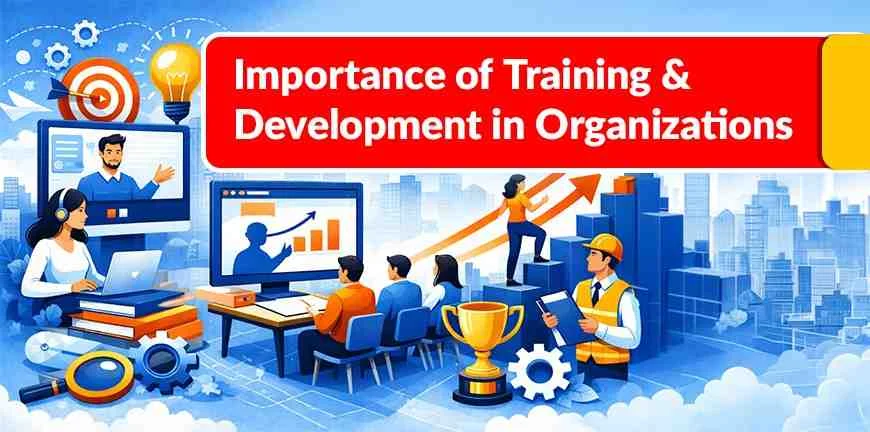
Employee training and development is also one of the facets of employee management in HR that is undergoing a sea-change, with many different training paradigms emerging and novel ways of looking at employee training and development. Moving from an offline, curriculum-based mode of teaching to a more online, real-world, skills-based approach, employee training and development is something that brings with it several benefits.
According to the latest reports, 58.5 % of organisations in India have increased their Learning & Development (L&D) budgets for FY 25.
Employee training and development is sometimes the most divisive aspect of HR when it comes to approving how much money should be spent on it and how much time should be focused on it. But it shouldn’t be! Employee training and development is an integral part of HR in any company, and there is no question that it deserves the time and other resources you wish to dedicate to it.
Employee training and development is a procedure in which organisations work towards accelerating the skills and knowledge of employees to enhance their performance, nurturing them for better long-term career prospects.
What Are the Top 10 Benefits of Employee Training and Development?
Here are some of the significant advantages of employee training and development:
1. Positive Impact on Employee Performance
An employee’s performance is proven to increase with training and development. When an employee is provided with on-the-job training and motivated to work harder, he/she develop more confidence on the job.
In an independent study conducted in 2018 on the performance of employees in banks, it was proven that employee performance in public sector banks showed a vast improvement as opposed to private sector banks, and this was largely due to the greater adoption of employee training and development programs in these banks.
2. Stronger Workforce
A confident and engaged employee who is also rewarded for his productivity is expected to stay longer than one who is not. Studies show that one of the reasons cited for moving from one company to another was the access to better employee training and development programs, which they felt led to better career growth.
3. Improves Alignment with Organizational Goals
The fact that the employer is engaging with the employees through a training and development program secures a buy-in from the employees. Their activities are also more aligned with the organisational goals as they have more clarity on them now after the training.
Building a knowledge base of all the content imparted during the training programs can further strengthen the mutual faith between employer and employees, as employees now believe that the employer is working towards their benefit and trying to retain them, and strengthen the alignment with the organisational goals.
4. Helps Fix Skill Gaps
Some employees need to be trained in specific skills, but there often is no way to find out what skills need to be added to. This requires a skills assessment, which needs to be very thorough and address all aspects.
Sometimes, a general training program that happens on a routine basis can help employees navigate their way to the right skills and thereby remove any skill gaps that exist, allowing them to complete the tasks at hand as efficiently as possible.
5. Boosts Employee Motivation and Engagement
Employee training and development not only boosts employee productivity but also improves employee engagement, inspiring employees to be more supportive of the company and put in longer hours at work, sharpening their skills, if not helping other employees too.
Increased employee engagement and motivation are known to impact productivity, too. Increased employee engagement also improves reputation by WOM and is reflected on online review websites such as glassdoor.com, where employees will try and leave positive feedback.
6. Increases Knowledge Sharing
Not only do employees get better at their jobs, but the same employees will also inspire and be able to help his/her peers also be better at their jobs. This is because learning is a continuous process, and it is easily transferable. Thus, training even one individual helps the entire team want to learn and upskill and directly impacts their performance when they do so.
7. Increases Innovation
There are three factors that improve innovation at the workplace. They are (a) great leadership, (b) engaged employees, and (c) the desire to learn. Of these, we know that without great leadership, a good employee training and development program wouldn’t be possible, and that higher engagement among employees is a result of training and development.
All that is required to drive innovation in the workplace is the desire to learn, for which employees must be coached, as well as in the benefits of such training, how it helps the company, and how it helps employees too.
8. Improves business processes
As a result of training and development, when employee performance improves, employees transform into strategists. They not only work on their individual performance, but they also help improve existing processes and process efficiencies.
They have more time on their hands to meet unconventional challenges at work more confidently. They can work with their teams to come up with solutions that speed up the delivery of products or services and invite positive feedback from customers.
9. Creates a stronger employee value proposition
Your employee value proposition is just what the name suggests – it is what you as an employer offer any new employee upfront. It is the sum of your reputation, the benefits you of,fer etc. But how does training and development help?
Training and development come in as a benefit that your company provides, and even helps to distinguish it from other companies. Adding such a benefit helps create a strong employee value proposition, which in turn helps to attract quality talent from anywhere in the world.
10. Training gives a competitive advantage over others
When your company implements a training and development program that helps tens or even hundreds of individuals in your company grow, and their productivity and performance improve, this eventually translates to much higher ROI at the end of the year.
This gives them an advantage over other companies in the same industry year after year. Training and development programs are also reviewed to align them better with organizational goals, and this continuous process of improvement makes them better over time.
How Does Employee Training Support Organisational Growth?
Robust and well-trained teams lead companies towards growth and prosperity. Companies equipped with such teams can craft and implement new structures and strategies, adjust to market demands, and draw top talent.
1. Accentuates Employee Performance and Productivity
Training and development programs and sessions conducted by enterprises impart technical and practical knowledge to employees, boosting their confidence and knowledge base. Highly skilled individuals will automatically contribute in a better manner towards the productivity of organisations.
2. Fosters Innovation and Adaptivity
Organisations initiating continuous learning programs and development strategies drive a culture of innovation, motivating employees to adapt to new and improved advanced technologies. For example, in sectors like manufacturing, semiconductor, etc, proper training enables employees to easily adjust to the evolving market shifts.
Use Case- Lex (Learning Experience Platform) and Infosys Wingspan were launched by Infosys. It’s an AI-powered digital learning platform delivering personalised learning paths based on employee roles, skills, and interests. The platform offered microlearning modules. The result was that over 70% of employees completed courses in emerging technologies such as AI, blockchain, and IoT.
3. Advances Succession Strategies
A well-crafted and structured training module or framework helps recognise and prepare future leadership by thoroughly developing and polishing managerial and strategy-related capabilities. This approach ensures continuity in leadership and smooth transitions during unprecedented times.
4. Strengthens Company Brand and Reputation
Organisations facilitating employee development programs will automatically appeal to job seekers and existing employees, as they will be investing in programs that enhance career growth, resulting in creating an attractive reputation and professionals’ desire to work in such companies.
What Are the Modern Employee Training Trends?
As the job landscape evolves, so will organisations and the training methods they implement for the betterment of their workforce. Let us look at some of the emerging trends:
AI-powered learning analytics- AI tools have become one of the major drivers in improving training processes by measuring engagement standards, performance, and skill enhancement, enabling L&D teams to add finesse to programs. Data analytics provide insights that determine how well learning investments are aligning with business results.
E-learning and digital platforms- Today, training programs are essentially being conducted online through various applications and systems like LMS, mobile apps. Learning has become flexible, and employees can get training lessons anytime and from any location.
Microlearning- This type of learning module is beneficial to professionals who are very busy and cannot invest too much time. These programs are designed for quick learning, improving retention, and engagement. They are becoming more impactful than the conventional training systems.
VR and AR Training Sessions- In certain sectors, immersive reality learning experiences have proven to be useful for professionals, as they can delve into real-world learning scenarios, enabling them to master complex skills.
How Can Companies Implement Effective Employee Training Programs?
To implement an impactful training program, organisations must formulate a robust structuring entailing proper planning, strategizing, and constant improvement.
The first step organisations require to focus on is to identify the training requirements, comprehend the skills that employees need to master to cater to business goals. Discuss with team leaders and managers to ensure that the training is relevant.
Then organisations need to establish clear objectives by outlining the areas that need special attention and can contribute towards a company’s success. Companies must craft relevant and engaging training content that blends theory and practical lessons. Another important aspect of designing training programs is how organisations can utilise advanced technology like digital platforms and integrate AI to track participation, assess results, etc. If you, as an organisation, want assistance with your training programs, contact Alp Consulting.
At Alp, we actively promote the NAPS scheme and provide facilitations for training the candidates who are up for an apprenticeship. We aim to serve our clients from different sectors by delivering them qualified apprentices to join their workforce and add value to the organisation. To know more. Connect with us. We are here to help!
Key Takeaways
- Employee Training Drives Performance and Productivity
- Training Strengthens Retention and Alignment
- Bridges Skill Gaps and Fosters Innovation
- Enhances Employer Brand and Competitive Advantage
- Modern Training Trends Are Tech-Driven
Frequently Asked Questions (FAQs)
1. What is employee training and development?
Employment training and development refers to a process that enables the enhancement of employee skills and long-term career growth through training and development programs.
2. Why is employment training and development important?
Employee training and development are important as they enhance the productivity and performance of employees, facilitating engagement and retention.
3. What are the benefits of employee development?
Employee training and development are advantageous to organisations and employees as they help accelerate job performance, improve retention rates, and nurture a positive work landscape.
4. How does training improve employee motivation?
Training motivates employees by building confidence, boosting morale, and making them feel valued while offering a range of opportunities for them.
5. What are modern trends in employee training?
The modern trends of training include AI integration, microlearning, use of Virtual Reality, and other immersive technologies etc.
6. How can HR measure training success?
HR can measure training success by analysing the satisfaction of the learner, change in behaviour patterns, ROI of businesses, etc.`
Contact Us For Business Enquiry

Suresh Ramkrishna
Suresh Ramkrishna is the Operations Manager at Alp Consulting Ltd., with over 30 years of extensive experience spanning recruitment operations, sourcing, supply chain management, and client relations. At Alp, he leads the Search & Staffing Practice, specializing in bilingual and niche skill hiring while overseeing Japanese language and TITP (Technical Intern Training Program) initiatives. He also manages NAPS (National Apprenticeship Promotion Scheme) training programs, fostering skill development and workforce readiness across industries. Previously, he spent over two decades in the apparel export industry, managing vendor development and international sourcing for top global brands. Suresh’s leadership blends strategic talent acquisition with operational excellence across diverse industries.