What is Employee Engagement and How to Boost It in 2026
27/04/2026
Compliance Calendar 2026 – Complete Annual Checklist
28/04/2026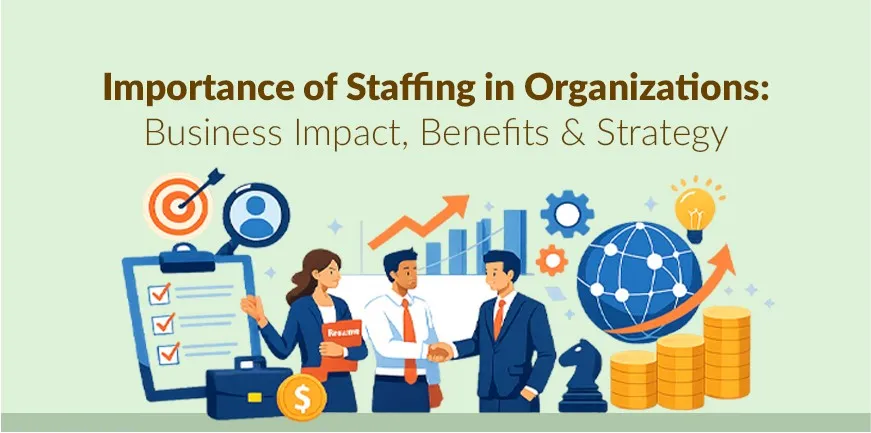
If you pick the right people and allow them to spread their wings. You almost don’t have to manage them.” — Jack Welch, former CEO, General Electric.
Workforce management is the decisive factor to make a company stand out from its competitors. Don’t you agree?
However, to create a dedicated and exceptional employee team, a well-crafted staffing process is a must. Staffing is a core HR function that can dictate a company’s future, as wrong talent acquisition can create chaos and affect profitability and brand reputation big time. The cost of a bad hire is estimated to be 30% of the employee’s first-year net earnings. For leadership roles, this can skyrocket to 200% of their annual CTC due to lost productivity & cultural damage.
In this discussion, let’s get a clear understanding of the importance of staffing, its business impact, benefits, and much more.
Why is Staffing Critical for Business Success?
Any business that is looking to expand or increase productivity must have an effective staffing process that brings fresh and experienced talent to accelerate business growth. Here are 5 reasons that illuminate the importance of staffing:
1. Access to Skilled Talent
By realizing the importance of staffing in management early, companies can direct their time & resources towards developing foolproof staffing strategies. This long-term commitment of embedding staffing in the business growth plan helps companies maximize their reach & hire the best available talent.
2. Increased Productivity
With top-skilled professionals donning the right roles via effective staffing, firms can achieve higher output, smoothly rendered workflows, minimise downtime to zero eventually, & improve service delivery by 5x. This arrangement provides a strong impetus, resulting in high-octane business growth & profitability.
3. Flexibility & Scalability
Effective staffing empowers companies to scale up & down their workforce volume in a jiffy in response to fluctuating market demands, seasonal peaks, or project needs. This ensures business agility without long-term resource constraints.
4. Reduced Hiring Risks
By understanding staffing and its importance in-depth, companies can develop effective staffing solutions. These solutions can minimize turnover, compliance issues, & mismatched hires. Additionally, it reduces overhead costs while building a stable, engaged, & loyal workforce that supports long-term growth.
5. Strategic Focus
A well-maintained staffing process frees up the management team. It allows them to focus more on innovation, customer experience, & expansion strategies. This accelerates organizational success & drives consistent market growth.
How does Staffing Impact Organizational Performance and Productivity?
The importance of staffing process will be observed in organizational performance and productivity.
Here are 5 ways effective staffing impacts organizational performance & productivity.
1. Efficient Workforce Planning
Staffing brings accurate workforce planning to the forefront, matching business persona and objectives with available talent. This arrangement significantly enhances overall organizational productivity.
2. Skill Utilization
By perfectly matching employee skills with JDs, staffing eliminates mismatches, boosting performance & productivity across all organizational functions.
3. Reduced Downtime
Efficient staffing will help management fill resource gaps in a short time, ensuring business continuity and uninterrupted workflow.
4. Enhanced Collaboration
Robust staffing process results in the formation of balanced teams equipped with complementary skills, fostering cooperation, innovation, & faster achievement of organizational goals. This leads to boosted productivity and better project delivery.
5. Continuous Improvement
Through time-to-time training, career development, and upskilling initiatives, staffing drives employee growth, improving organizational performance & productivity over time.
What is the Strategic Importance of Staffing in Workforce Planning?
Here are 5 reasons that highlight the strategic importance of staffing in workforce planning:
1. Alignment with Business Goals
Staffing on point ensures the right talent makes the final cut. This calibrates workforce capabilities with short & long-term organizational goals & business strategy.
Diverse & strategically sequenced teams are 35% more likely to outperform their competitors in terms of profit accumulation.
2. Improved Operational Efficiency
Staffing done right skyrockets operational efficiency by placing skilled employees in roles that maximize productivity & performance outcomes.
Inefficiency due to poor skill-matching can cost a business between 15% & 40% of its total operating costs through errors, rework, and customer dissatisfaction.
3. Greater Business Agility
Well-executed staffing efforts support business agility by enabling quick adaptation to market changes through proactive hiring & talent pipelines.
Companies that rejig capabilities around outcomes rather than job titles on a consistent basis are 3 times more likely to outsmart their counterparts financially.
4. Cost Optimization
Crafty staffing brings down costs by shrinking skill gaps, turnover risks, & inefficient hiring via structured workforce forecasting.
Employees hired based on predictive, skills-based matching attain productivity thresholds 40% quicker than those hired merely on intuition.
5. Stronger Employer Brand Positioning
Staffing done with finesse reinforces employer branding by attracting, engaging, & retaining high-quality talent synced perfectly with organizational culture. 86% of job seekers research company reviews & ratings before clicking the apply button. In tech & specialized sectors, this jumps to 92%.
How does Staffing Affect Cost Efficiency and Profitability?
Here are 5 ways the importance of staffing in an organisation is realised in terms of cost efficiency and profitability:
1. Sleek Workforce Allocation
Strategic staffing creates the right hiring conditions where only the right talent is getting onboarded. This brings down unnecessary hiring & skyrockets productivity across critical business functions.
2. Reduced Hiring and Training Costs
On point staffing shrinks employee turnover big time, thereby lowering recruitment expenses & reducing training investments for new employees over and over.
3. Improved Operational Efficiency
Whenever we explain the importance of staffing, skill vs job titles is always up for debate, & it’s usually skill that wins in current hiring expectations.
Skilled employees complete tasks quickly without botching accuracy, thereby reducing delays, rework costs, & boosting overall operational efficiency.
4. Better Demand Forecasting and Planning
Data-backed staffing lines up workforce levels with demand, thereby putting a lid on overstaffing or understaffing & optimizing labour cost efficiency.
5. Enhanced Employee Productivity & Output
The right talent in the right roles boosts performance, increasing output quality, driving revenue growth, and improving overall profitability.
How does Effective Staffing Benefit Employee Retention and Engagement?
Here are 5 ways the importance of staffing is illuminated from an employee retention & engagement standpoint:
1. Ideal Role Fit & Job Satisfaction
Effective staffing creates perfect unison between skills and job roles. This uplifts employee satisfaction, thereby reducing frustration & increasing long-term employee retention significantly.
2. Reduced Workload Imbalance
Proper staffing negates employee burnout since the workload will be evenly distributed among employees. This engages employees better, & their motivation also gets an adequate boost.
3. Clear Career Pathing Opportunities
Strategic staffing bolsters internal mobility, offering career pathing opportunities that spur employees to stay longer (at least 5 years) & deliver peak performance for a prolonged period.
4. Stronger Team Collaboration and Culture
Hiring culturally coherent employees via diligent staffing brings with it teamwork, strengthens relationships, & builds a more engaging workplace environment.
5. Increased Recognition and Performance Alignment
Staffing done right aligns goals with capabilities, enabling fair recognition, boosting motivation, & encouraging sustained employee engagement.
What are the 5 Risks of Poor Staffing Decisions?
Here are 5 risks employers might face for ignoring the needs and importance of staffing:
1. Increased Employee Turnover
Hiring misfit candidates triggers displeasure among themselves & other staff members. This results in frequent exits & higher replacement costs.
In India, hiring a “bad hire” without proper verification or fit assessment can cost a company an average of Rs. 5 Lakhs per instance in 2026.
2. Decline in Productivity Levels
Underqualified or misaligned employees severely dent efficiency, causing delays, mishaps, & missed business targets.
India Decoding Jobs Report 2026 research report let the cat out of the bag and revealed that underqualified hires devour 3 to 4 times more management time than top-quartile performers.
3. Higher Recruitment and Training Costs
Multiple rehiring & retraining cycles skyrocket operational expenses & strain HR resources significantly.
For a mid-level professional in India (CTC Rs. 15–25 Lakh), the baseline recruitment cost averages Rs. 3 Lakh to Rs. 5 Lakh per cycle. Multiple hiring cycles like this will snowball employee hiring & training costs.
4. Negative Impact on Team Morale
Poor hires dent team dynamics adversely, lower motivation, & create dissatisfaction among high-performing employees.
Research shows that high-performing employees are 34% more susceptible to burnout when miffed by underperforming colleagues/teammates.
5. Compliance & Legal Risks
If the important factors of effective staffing are not satisfied, then it will hinder labour law compliance efforts, leading to costly penalties, litigation, & reputational tarnish.
How Does Staffing Support Business Growth and Scalability?
Here are 5 ways business growth and scalability are fostered by realising the importance of staffing:
1. Enables Rapid Workforce Expansion
Flexible staffing models offer businesses an impetus to scale teams on demand based on project requisites.
2. Aligns Talent with Business Goals
Strategic hiring ensures the right skills are in play & support evolving business objectives & expansion plans.
3. Supports Market Expansion Efforts
Staffing enables hiring local & specialized talent for entering new markets efficiently.
4. Improves Operational Agility
The right workforce opens up options for businesses to adapt like a chameleon to dynamic market conditions & unforeseen opportunities.
5. Brings down Growth-Related Risks
Planned staffing negates resource gaps, ensuring smooth scaling without operational disruptions or inefficiencies.
What are Real-World Examples of Staffing Impact in Organizations?
Here are 3 real-world examples that exemplify the importance of staffing function in organisations:
1. Compliance Agility in a Pune Manufacturing Plant
A Pune manufacturer shifted contract workers to fixed-term employment under the new labour codes.
The Impact: Labor costs rose 8%, but compliance risks and disputes were eliminated.
The Result: Productivity increased 15% with improved morale and zero legal disruptions.
2. The “Bilingual Bridge” in Chennai’s IT Sector
A Chennai IT firm built a hire-train-deploy pipeline for bilingual engineers.
The Impact: Onboarded 50 culturally aligned engineers for a Japanese client.
The Result: Achieved 98% CSAT and secured a ₹120 Crore secondary contract.
3. Scalability via “Gig-Integration” in a Mumbai Fintech
A Mumbai fintech scaled support using 150 freelancers rather than hiring 200 permanent staff.
The Impact: Support capabilities jumped to 300% within 2 days.
The Result: Achieved 99.5% compliance, avoiding Rs. 10,000– Rs. 20,000 per worker misclassification penalties.
Why Do Companies Outsource Staffing Services?
1. Instant Access to Specialized Talent
Outsourcing brings forth faster access to skilled professionals across industries & niche roles.
2. Recruitment Time and Cost Reduction
Staffing partners like Alp Consulting Ltd streamline hiring processes, slashing a huge chunk of recruitment expenses & shrinking time-to-hire significantly.
3. Improved Compliance and Risk Management
Experts ensure processes stay abreast with labour laws, bring down legal risks & compliance-related penalties.
4. Scale Based on Business Needs
Companies can scale their staff volume up or down in no time based on project or market demands.
5. Focus on Core Business Functions
Outsourcing staffing gives maximum man-hours on a platter to internal teams to concentrate on strategic priorities and growth initiatives.
How can Companies Improve Staffing Effectiveness?
1. Implement Data-Driven Hiring Strategies
Put people analytics & workforce data to good use to gauge skill shortcomings & refine hiring accuracy significantly.
2. Focus on Skills-Based Recruitment Approaches
Hold skills & competencies in a higher pedestal than credentials to ensure better role alignment & performance outcomes.
3. Enhance Employer Branding and Candidate Experience
Build an employer brand that will stand the test of time & seamless hiring journeys to secure & retain top talent effectively.
4. Outsource Staffing to Specialized Service Providers
Partner with staffing firms that are top of their game & can offer access to a wide talent pool across all roles within a short timeline.
5. Strengthen Workforce Planning and Forecasting Capabilities
Ensure workforce planning & business goals go hand-in-hand using predictive insights to mitigate resource shortages or excess.
How is Staffing Becoming More Strategic in 2026?
1. Alignment with Business Objectives
Staffing strategies are designed in tandem to suit long-term business goals & growth priorities.
2. Increased Use of Workforce Analytics
Data-driven insights are now having the final say in hiring decisions rather than going with mere intuition, thereby improving workforce planning, productivity, & cost efficiency.
3. Emphasis on Skills-Based Hiring Models
Organizations are placing skill matrix at a higher slab than academic prowess to build agile, future-ready, and high-performing teams.
4. Integration with Technology & Automation
Advanced HRMS tools fine-tune the recruitment framework, facilitate better candidate-role matching, & boost overall hiring effectiveness.
5. Flexible Workforce Models
Companies are harnessing hybrid, gig, & contract staffing to remain versatile in dynamic market conditions.
Conclusion
The importance of staffing extends far beyond hiring. More than talent acquisition, it shapes productivity, profitability, compliance, & long-term business resilience. Organizations that invest diligently in strategic staffing gain the impetus to build agile, high-performing teams ready to take on any challenges head-on.
To unlock this advantage, partner with Alp Consulting Ltd today for scalable, data-driven, & reliable staffing solutions.
Key Takeaways
- Strategic staffing drives productivity, profitability, and long-term business growth.
- The importance of staffing lies in aligning talent with business goals.
- Effective staffing reduces hiring risks, costs, and compliance challenges.
- Data-driven and skills-based hiring improves workforce efficiency and performance.
- Outsourced staffing enables scalability, agility, and access to specialized talent.
Frequently Asked Questions (FAQs)
1. Why is staffing important for organizations?
The importance of staffing lies in ensuring the right talent drives productivity, growth, compliance, and competitive advantage.
2. What is the role of staffing in workforce planning?
Staffing aligns workforce capabilities with business goals, ensuring optimal resource allocation and future readiness.
3. How does effective staffing improve employee retention?
Effective staffing ensures better role fit, reducing dissatisfaction, improving engagement, and increasing long-term employee retention.
4. How is staffing evolving in modern organizations?
Staffing is becoming strategic, data-driven, and flexible by integrating technology, analytics, and skills-based hiring models.
5. How does staffing affect employee productivity and efficiency?
Right staffing improves productivity by aligning skills with roles, reducing errors, delays, and operational inefficiencies.
Contact Us For Business Enquiry

Kasthuri R
Kasthuri R is the Co-Founder & Executive Director at ALP Consulting, bringing over 23 years of experience in search, staffing, and HR consulting. She has been instrumental in driving ALP’s recruitment, employee leasing, and executive search practices across diverse industry verticals. With deep expertise in talent acquisition, HR strategy, and operational management, Kasthuri has built scalable, client-focused solutions that enhance workforce efficiency. Her strategic leadership continues to steer ALP Consulting toward innovation and excellence in people management.