
Top 10 Leadership Skills Business Leaders Must Know in 2026
22/06/2026
Is Temp-To-Perm Hiring Effective for Software Engineers Working for IT Companies?
22/06/2026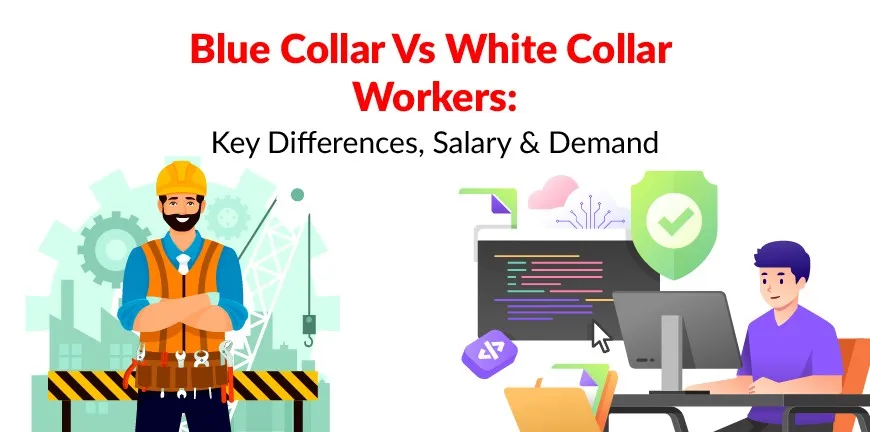
Whether it is blue-collar vs white-collar, each defines business success. Most often, due to a lack of specialised recruiters, low bandwidth, poor budgets, & inadequate talent pool, sourcing the right talent becomes a huge challenge for HR teams.
However, smart leaders choose the top manpower recruitment company in India to bridge talent gaps and drive operational efficiency. If you can’t find one?
How to Know White-Collar vs Blue-Collar Worker?
A white-collar job refers to a corporate workforce that requires formal education, expertise, & experience to work in a particular industry. Recruiting white-collar roles involves multiple rounds of assessments, testing, and interviews before they are recruited for a particular position in a labour-intensive sector or a professional industry.
A blue-collar job refers to a career in the manual workforce that requires minimum education and expertise in a particular trade or skill. The recruitment process for these roles involves trade testing and experience, mostly adaptable to factory settings.
To deeply understand the white-collar vs blue-collar meaning, dive into the interesting sections below.
What is Blue Collar Vs White Collar Salary Scale?
Our recruitment team negotiates white-collar vs blue-collar wages based on industry benchmarks. Below is the breakdown of the roles, industries, and salary scales of blue and white-collar workers.
| Blue-collar Roles | Industry | Salary Trends |
| Welder | Manufacturing, Oil & Gas, Construction, Automotive | 2.5 – 5 LPA |
| Technicians | Manufacturing, Telecom, Electronics, Facility Management, Aviation | 3-6 LPA |
| Electrician | Manufacturing, Infrastructure, Power, Facility Management | 3-6 LPA |
| Fitter | Engineering, Manufacturing, Oil & Automotive | 3-6.5 LPA |
| Service Staff | Hospitality, Healthcare, Aviation, Facility Management | 3.5-4.5 LPA |
| Drivers | Logistics, Ecommerce, Transportation, & Facility Management | 2.5 – 5 LPA |
| Packers | Warehousing, Manufacturing, Ecommerce, Logistics | 2-4 LPA |
| Nurses/healthcare workers | Healthcare, Medical Tourism, Hospitals, Daycare | 3-8 LPA |
| Warehouse managers | Warehousing, Manufacturing, Ecommerce, Logistics | 5-10 LPA |
| White-Collar Roles | Industry | Salary Benchmark |
| Software Engineers | IT/Saas, GCC, Fintech, Startups | 8-22 LPA |
| Developers | IT Saas, fintech, e-commerce, edtech, health tech | 7-20 LPA |
| Business Analysts | BFSI, IT services, Consulting, Retail, Healthcare | 8-18 LPA |
| Risk Managers | Banking, Insurance, fintech, Investment, consulting companies | 15-35 LPA |
| Cybersecurity specialists | IT, BFSI, Telecom, GCCs | 10-30 LPA |
| Marketing Managers | Consumer, Retail, Healthcare enterprises | 10-25 LPA |
| CFO/CXOs | IT, AI/ML, Fintech, Ecommerce, Healthcare firms | 50-100 LPA |
| Data Scientists | Manufacturing, Retail, IT, Healthcare, BFSI companies | 12-36 LPA |
| Accountants | FMCG, Tech, Manufacturing, Logistics, BFSI | 5-10 LPA |
| Sales Managers | IT, manufacturing, Logistics, BFSI | 8-20 LPA |
| HR Managers | IT, Manufacturing, Healthcare, Retail, Consulting | 8-22 LPA |
| Project Managers | IT, Construction, Telecom, Manufacturing | 12-25 LPA |
How does outsourcing Blue-Collar Vs White-Collar Recruitment Benefit Businesses?
Some of the key benefits of hiring skilled labour & professional workforce for industries.
1. Bridging Skill Gaps
Every minute is revenue for both CEOs & industrialists. Hiring skilled professionals into the factory or company drives workforce productivity.
2. Skill-First Talent Reduces Overheads
Prioritising skills over degrees helps businesses drive operational efficiency and also reduce operational overhead costs from employing specialists, licenses & software, & marketing ads.
3. Job-Ready Workforce
Outsourcing recruitment companies follow a structured assessment process. They identify candidates from:
- Reputed portals and internal platforms
- Screen candidates through specialised AI tools to ensure skill, cultural and compliance fit.
- Improve employee experience through innovative EVP and marketing ads.
- Enable end-to-end tracking and monitoring using ESS portals.
- Use upending communication & negotiation models to tap niche talent at the right salary benchmark
- Provide 24/7 support services from candidate sourcing, onboarding to payroll & compliance processes & market insight reports.
Meet Seasonal Spikes or On-demand Roles
Predicting niche or bulk hiring needs is not within the control of an internal hiring team, but is shaped by economic or natural trends. To support this gap, outsourcing recruitment agencies stand on the frontline with seasoned market intelligence & support specialists. They drive business success by placing domain-specific, budget-supporting, & compliant talent.
What are the Key Challenges in Recruiting Blue Collar Vs White Collar Worker?
Recruiters face critical challenges while hiring blue-collar and white-collar workers for the following reasons.
1. Lack of Specialised Workforce
Digitalisation is sweeping across industries, and automation is taking over operations. To match the speed of production & services, leaders are in demand for skill-first talent more than generalised blue and white-collar talent.
2. Retention & Growth
Retaining blue and white-collar talent in the industry is a huge challenge for recruitment companies. In search of better career growth, candidates drop out due to multiple job offers, seasonal demands, work-life imbalance, inflexible timings, & poor work culture.
3. Compliance Compatibility
Recruiters face documentation challenges during screening and verification processes. Negotiating compensation & other benefits often leads to high RENEG rates.
What are the Future Trends driving Workforce mobility?
Time and Revenue matter most for business leaders. The better way to save both is to look at the recruitment trends outsourcing companies follow in blue and white-collar recruitment.
- Reduce time-to-hire through automated recruitment processes.
- Access to specialised job portals allows them access to vast candidate profiles such as tradespeople, technicians, & engineers to improve hiring decisions.
- Avoid employee misclassification, cultural misalignment, & attrition as outsourcing recruiters provide you with pre-screened talent.
- Track candidates in real-time through ATS and ESS management tools if you have an overseas employment model.
- Gain access to hidden talent by building a network with industry leadership groups during critical workforce demand.
- Integrated compliance & payroll platforms help you avoid any financial losses and reputational damage without increasing your business overhead.
Alp Consulting: The Best International Recruitment Company
Alp Consulting Ltd, a top global recruitment company, enables leaders to recruit both industrial & corporate workforce faster & smarter. Alp’s suite of automated IT staffing solutions is designed to tap domain-specific & culturally aligned talent. From contract hires to remote/hybrid staffing and retained search professionals, we zero in on candidates who meet your business needs and growth.
- Our proven industry-led recruitment assessments.
- Wide network of 500+ client partnerships
- Specialised IT recruitment specialists across 750+ HR professionals have placed over 100K+ candidates across startups, MSMEs, & Enterprises.
- Internationally Accredited Agency RA ID: 6444494 to offer cross-border hiring solutions.
- Certified ISO 9001:2000 Process to ensure compliance, consistency & workforce reliability.
- Recognised as an International Recruitment Agency RA ID: 6444494.
- Recognised for Niche & Bulk Hiring projects.
Frequently Asked Questions (FAQs)
1. Why are companies increasing their demand for blue-collar workers?
Seasonal spikes, sudden attrition, & salary benchmarks are some of the top challenges that give rise to the demand for blue-collar workers in labour-intensive industries.
2. Which workforce category faces higher talent shortages?
In the blue-collar workforce category, labour-intensive industries like manufacturing, retail, automotive, & construction services face a talent crunch. In the white-collar workforce category, IT, BFSI, healthcare, & engineering services face wide talent gaps.
3. How do recruitment strategies differ for blue-collar and white-collar hiring?
Recruitment strategies for a blue-collar workforce are simple, as they involve trade testing, payroll, & compliance, with a modest check on qualifications. Whereas in the professional sector involves multiple layers of screening, testing, interviews, verification checks, leadership-level interactions, onboarding and salary negotiations.
4. What factors influence salaries in blue-collar and white-collar jobs?
Skill proficiency, scalability, communication, cultural adaptability & compliance standards determine the salary scale for a blue or white-collar worker in all sectors.
5. Which workforce segment has higher attrition rates?
Manufacturing, construction, automobile, & retail industries and IT & BFSI companies face high attrition during peak seasons or new salary benchmarks.
6. How can businesses balance blue-collar and white-collar workforce planning?
Businesses can balance blue and white-collar workforce by understanding the role needs, budgets and project demands.
7. Are blue-collar wages increasing in India?
Yes, according to the new labour codes, wages for blue-collar workers are increasing 5-6% every year.
8. What hiring trends are shaping blue-collar and white-collar recruitment?
Skill-first hiring, DEI policy, automation, & scalability are deciding the next in blue and white-collar recruitment.
9. How does technology impact demand for both workforce categories?
Digital transformation is revolutionising all sectors in India, and currently over 55-65% of industries across all sectors are adopting digital transformation to meet workforce productivity and drive operational success in India.
10. Which workforce category is expected to see stronger growth in the coming years?
As per industry sources, IT/SaaS, BFSI, Retail, Healthcare & telecom categories are expected to witness strong growth in the coming years.
Contact Us For Business Enquiry

Amit Saproo
Amit Saproo is the Head of Operations at ALP Consulting with nearly 17 years of experience in Executive Search, RPO, Leadership, and IT & Engineering recruitment. He leads nationwide recruitment programs across Technology, BFSI, and R&D domains, driving strategic hiring solutions for diverse client needs. Amit excels in building and managing high-performance teams that deliver scalable, end-to-end recruitment and consulting services.