Top 10 Highest Paying Jobs in India: Top Careers, Salaries, & Future Scope
16/03/2026
Best Candidate Experience Examples for Inspiration
16/03/2026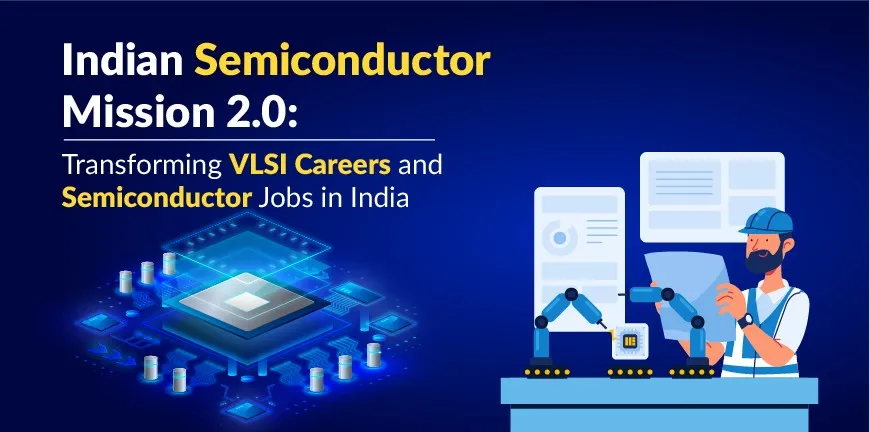
Technology has become a yardstick to measure a country’s success. India’s semiconductor market, valued at $38 B, is expected to grow to approximately $45B by 2030. As India walks toward global growth, the Indian Semiconductor Mission 2.0 is a game changer. The government semiconductor initiatives in India have shifted their focus from policy formulation to the implementation phase, supported by foreign investments.
This has led to the establishment of country-wide semiconductor industry units to support large-scale chip production. With large-scale semiconductor projects flowing into the country, India is poised to become a global leader in the semiconductor industry. Beyond valuable investments, it is the policy maturity and talent programs that have helped the industry to localise chip production, attract technological innovation, & diversify global supply chains.
Why India Semiconductor Mission Matters?
As oil powers transportation & industries, semiconductors power most of the electrical devices through chips. They have become the new fuel to power digital infrastructure. They have become a strategic priority to both industries & national security. The India semiconductor mission objectives go beyond manufacturing output to establishing technological sovereignty, making the country a competitive & credible partner in the global supply chain.
India Semiconductor Mission 2.0 Explained
The government of India launched the India Semiconductor Mission 1.0 in 2021 as part of the Atmanirbhar Bharat Strategy. It allocated over 1.6 lakh crore to incentivise silicon fabrication, compound semiconductor facilities, assembly & testing, & chip design units. But in 2026, the focus shifted completely to establishing domestic semiconductor equipment & materials under the Indian Semiconductor Mission 2.0 with a support of INR 1000 crore.
The main objective of ISM 2.0 is to strengthen homegrown semiconductors, own intellectual property, & support domestic & international value chains. In short, the ISM 2.0 projects India not as a semiconductor assembly base, but as a global supplier.
What are the Major initiatives for Semiconductor talent development?
The union budget has allocated the semiconductor industry $19 B to upskill employees for competitive semiconductor jobs in India. As research & development, tech skills, & leadership are complex in the semiconductor industry, the budget is laser-focused toward equipping people with semiconductor fabrication, design, & packaging skills.
1. The US-India Initiative on Critical & Emerging Technology (iCET)
Under this program, the US & India collaborated on research & development, workforce development, & supply chain diversification. The program also funded projects on advanced packaging & materials. The program also covered exchange of engineers & policy makers to share best industry practices, fabrication security, & export quality control.
2. Chip to Startup (C2S)
Chip to Startup is yet another learning & development program under ISM 2.0. It aims to create a systemic transformation of semiconductor design capabilities in over 300 firms, 250 academic institutions, & 65 startups. The main goal of this project is:
- Develop 85K quality engineers in embedded systems for VLSI career opportunities in India.
- Create 175 Application Specific Integrated Circuits.
- Build a chip design ecosystem in India.
3. SMART Semiconductor Training
Skilled Manpower Advanced Research & Training is a smart incubation facility under the C2S L&D program. The facility is designed to enable startups & semiconductor companies to test their chip designs domestically & reduce high operational costs. This program supports highly skilled semiconductor test engineers to produce reliable semiconductor & electronic chip designs.
4. Lam Research Industry Partnership
Lam Research signed a partnership with ISM & IIM to train 60,000 semiconductor engineers in fabrication technologies for 10 years. The training comprises semiconductor modelling, design, automation, & integration.
5. FutureSkills Prime Program
Futureskills Prime Program is a digital initiative by NASSCOM & MeitY aimed at equipping semiconductor-skilled professionals in:
- Advanced semiconductor topics
- Real-world semiconductor industry projects & tools
- Gain industry-backed certifications to boost employability.
What are the Challenges for the future of the Semiconductor Industry in India?
Semiconductors are no longer an industry component, but a strategic force, shaping national AI ecosystem, defence capabilities, energy systems, telecommunications, automotive, & data centres. However, there are 4 key challenges the ISM 2.0 is facing.
1. Demand-Supply Gap
The annual semiconductor demand stood at $50B. The domestic manufacturing value came to less than $3B. With the semiconductor imports rising to $1.7 lakh crore, the ISM 1.0 did not solve the challenge due to structural issues. This called for a redesign of the ISM 1.0 as the country heavily depended on speciality gases, ultrapure water systems, clean infrastructure, & capital equipment.
2. Poor Fab Centre Strategy
The cost of each fab costs around $5-10 B. This led to low investment, poor centre-state coordination, and delayed fund disbursements. Poor regulation checks have slowed the projects. Adding to this, the domestic value addition remains very low.
3. Lack of Talent for Design
Having design talent does not support the ISM 2.0. Identifying semiconductor manufacturing engineers, material scientists, & equipment specialists is daunting. In an era of geopolitical uncertainty, striking academic-industry partnerships with foreign countries is risky.
How Alp Consulting Helps Semiconductor Businesses Hire Top Talent?
Alp Consulting Ltd, India’s leading global recruitment firm, gives you the ability to hire better and faster. Alp’s suite of automated recruitment solutions is designed to tap top talent. Our validated assessments help you drive high-quality talent decisions and build a diverse workforce of tomorrow. Alp has processed over 10 million candidates, and analysing these data helps us deliver actionable insights to zero in on candidates who meet your business needs and growth.
Key Takeaways
Alp powers the Indian chipmakers with a semiconductor talent edge. As a leading staffing & recruitment provider, we understand the semiconductor industry 360 degrees. From rising semiconductor fab investments, to spiking demand for design & embedded talent, to rising imports of materials & infrastructure, we assess every challenge. To navigate this ISM 2.0 challenge, explore the key takeaways of partnering with a leading semiconductor RPO.
- Fast access to high-quality & niche semiconductor talent
- Shorter hiring cycle
- Stronger compliance reliability
- Workforce scalability & industry outcomes
- Low hiring cost & high operational efficiency
Frequently Asked Questions (FAQs)
1. What is the expected growth of India’s semiconductor market?
The Indian semiconductor industry is projected to exceed $1000 B by 2030. This trend is driven by electronics demand, AI growth, EV adoption, & domestic chip manufacturing.
2. What are the key focus areas of ISM 2.0?
India Semiconductor Mission 2.0 focuses on chip fabrication, semiconductor design, packaging, R&D, supply chains & domestic talent pipeline.
3. How will India Semiconductor Mission 2.0 impact VLSI and semiconductor job opportunities in India?
ISM 2.0 will create thousands of semiconductor jobs in VLSI design, chip fabrication, testing, packaging, & advanced electronics manufacturing.
4. What skills are most in demand for semiconductor and VLSI careers in India?
Top skills include VLSI design, RTL coding, Verilog/SystemVerilog, semiconductor physics, chip verification, embedded systems, EDA tools, and hardware debugging expertise.
5. What are the key challenges for ISM 2.0?
Key challenges for India Semiconductor Mission 2.0 include high capital investment, limited fabrication expertise, global supply chain dependence, talent shortages, technology transfer barriers, infrastructure readiness, and intense competition from established semiconductor hubs.
Contact Us For Business Enquiry

Amit Saproo
Amit Saproo is the Head of Operations at ALP Consulting with nearly 17 years of experience in Executive Search, RPO, Leadership, and IT & Engineering recruitment. He leads nationwide recruitment programs across Technology, BFSI, and R&D domains, driving strategic hiring solutions for diverse client needs. Amit excels in building and managing high-performance teams that deliver scalable, end-to-end recruitment and consulting services.