Manual Payroll vs. Automated Payroll System: Pros and Cons
09/12/2025
Key Compliance Checklist for Employers Using Contract Staff
09/12/2025
“The only thing worse than training your employees and having them leave is not training them and having them stay”- Henry Ford, Founder of Ford Motor Company.
The landscape of training and development has shifted from “learning for knowledge” to “learning for velocity” in 2026. Global employee engagement has dropped to 20%, its lowest level since 2020. This “quiet quitting” costs the global economy an estimated $10 trillion (which roughly amounts to 9% of global GDP) in productivity loss (Gallup). The importance of training and development lies in balancing business growth with employee career pathing.
Let’s take an in-depth look at training and development from an employer and HR leader standpoint, so that they can build programs that serve 2 main purposes:
Accelerate business performance via agile, skill-driven workforce development.
Enable clear career progression to boost engagement & retention.
Key Takeaways
- Training and development strengthen workforce agility, productivity, engagement, and long-term organizational competitiveness effectively.
- AI-driven disruption demands continuous upskilling, reskilling, & future-focused employee capability development initiatives.
- Effective T&D strategies combine structured learning, technology platforms, performance measurement, & business alignment successfully.
- Organisations investing consistently in employee development achieve stronger retention, profitability, innovation, and workforce resilience.
- Continuous learning cultures help businesses adapt faster to evolving industry trends, technologies, & workforce expectations.
What is Training and Development?
Training and development definition: It is a continuous learning approach that improves employee efficiency, prepares future leaders, & ensures organizations stay competitive in rapidly evolving business environments.
HR training and development is a structured set of activities designed to improve employees’ knowledge, skills, behaviours, & performance. This is applicable for both their current roles and for future career growth within the organisation.
When we see training and development as separate entities:
- Training gives impetus to teaching specific skills needed to perform a current job role effectively.
- On the other hand, development creates a strong basis for long-term growth, such as preparing employees for future responsibilities, leadership roles, & evolving business needs.
As a couple, they form the backbone of any effective HR strategy. Moreover, in HRM, training and development (T&D) is considered a core function that directly influences performance management, succession planning, & employee engagement.
The World Economic Forum (WEF) reports that 39.5% of core skills will be obsolete by 2030 (ForbesUpskilling). Hence, the training and development function will be instrumental in helping employees stay ahead of the curve & ready to embrace any challenge with the right mindset & skillset.
What is the Difference Between Training and Development?
The difference between training and development is primarily one of time frame and purpose.
| Dimension | Training | Development |
| Focus | Current job role | Future roles and growth |
| Time frame | Short-term | Long-term |
| Goal | Skill acquisition | Personal and professional growth |
| Initiated by | Employer/Manager | Employee or Organisation |
| Example | Software onboarding | Leadership coaching programme |
Key Takeaways from this comparison
- Training boosts current job skills, whereas development builds future leadership capabilities.
- Training is short-term, employer-driven, while development is long-term, growth-focused.
To learn more about the differences in training and development, visit: Difference Between Training and Development in HRM.
How is Training and Development Different from Learning and Development (L&D)?
| Dimension | Training & Development | Learning & Development (L&D) |
| Scope | Focused on specific skills & employee growth | Broader strategy contributing to a continuous learning culture |
| Approach | Structured, program-based activities | Ongoing, flexible, & self-driven learning ecosystem |
| Objective | Improve job performance & future readiness | Enable continuous skill evolution & innovation |
| Ownership | Driven mainly by HR or management | Shared between the organisation & employees |
| Time Orientation | Training (short-term), Development (long-term) | Continuous, lifelong learning process |
Why is Training and Development Important in 2026?
Training and development matters in 2026 more than ever before. Here is why:
1. The Skills Crisis is Real
According to the World Economic Forum data, it estimates that 44% of employees’ core skills will be disrupted between 2023 & 2027. Organisations that miss out on addressing this shortfall will face compounding talent shortages. (weforumfuturejobs)
2. AI is Reshaping Every Job
AI is expected to take away approximately 92 million jobs while simultaneously creating 170 million new roles (a net rise of 78 million jobs). This means almost every workforce needs substantial reskilling investment right away. (WEForum)
3. Employees Expect It
94% of employees say they would stay at a company longer if it invested in their learning and development. (LinkedINReport2026)
4. Cost of Inaction is High
Replacing an employee in the Indian market typically costs between 50% and 200% of their annual salary, depending on the specialized nature of the role. Proactive training and development programs cost significantly less in this situation.
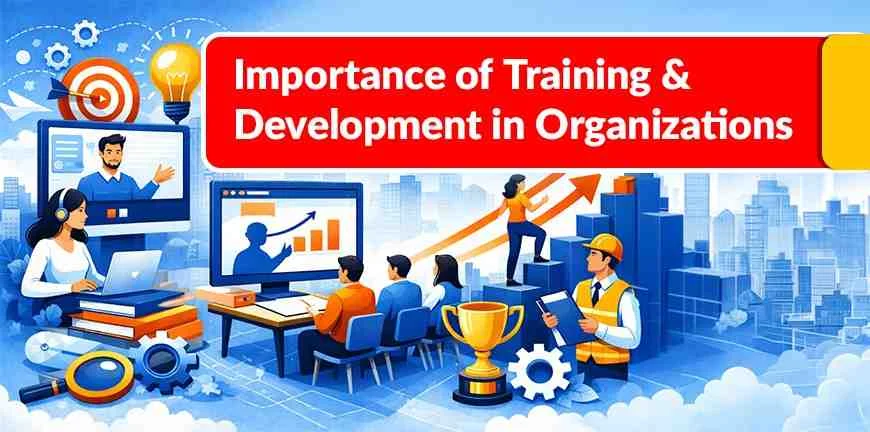
To learn more about the importance of training and development, visit: Importance of Training and Development in Organizations.
What are the Benefits of Training and Development?
The advantages of training and development go well beyond improving individual performance.
Here are 5 evidence-backed benefits of training and development:
1. Higher Revenue and Profitability
Companies with in-depth employee training programmes earn higher income per employee compared to those without formalised training.
2. Stronger Employee Retention
Employees stay for a longer tenure at a company if they receive the training they desire for career and position progression. In a labour market where attrition is expensive, this is a direct bottom-line benefit.
3. Improved Employee Engagement
Workplace training positively impacts employees’ job engagement, thereby increasing productivity as well as brand value.
4. Reduced Skill Gaps and Talent Dependency
Most organisations experience tangible benefits from upskilling & talent development initiatives, including improved productivity & career advancement. Organisations that build skills internally bring down reliance on costly external hiring.
5. Competitive Advantage
Companies that invest substantially in quality training generate higher profit margins than those that show reluctance in dedicating resources to training & development initiatives. In fast-moving industries, that edge is decisive.
To grasp more about the benefits of training and development, visit: Top 10 Benefits of Employee Training and Development
What is the Training and Development Process?
The training and development process typically follows the 5 stages:
Step 1: Needs Analysis
Identify gaps between current employee performance and the industry benchmarks. This can be done through performance reviews, manager feedback, employee surveys, & business goal mapping.
Step 2: Design
Define learning objectives, choose appropriate delivery methods, & finalise content curation roadmap. This stage determines whether training will be instructor-led, digital, blended, or on-the-job.
Step 3: Development
Build or curate training materials such as e-learning modules, workbooks, video content, assessments, & facilitator guides (whichever works best for your industry or domain).
Step 4: Delivery (Implementation)
Roll out the program through chosen channels. This includes scheduling sessions, communicating with learners, enabling managers, & ensuring technology is in place.
Step 5: Evaluation
Measure whether the training program is churning out the desired outcomes. The most widely used framework for this is Kirkpatrick’s Four Levels, which evaluates reaction, learning, behaviour, & results.
What are the Top Training and Development Models?
Several models guide how organisations design and evaluate T&D programmes:
1. ADDIE Model
It is the most widely used instructional design framework that banks on 5 crucial stages: Analysis, Design, Development, Implementation, & Evaluation.
2. Kirkpatrick’s 4 Levels
It is considered a gold standard for measuring training effectiveness from learner reaction to business results.
3. 70-20-10 Learning Model
This type of T& D model reveals that 70% of skills are learned while performing work assignments, 20% via tapping into the acumen of peers & colleagues, & 10% through well-orchestrated training sessions. This model compels organisations to invest substantially in social & experiential learning, not just classroom instruction.
4. Bloom’s Taxonomy
This is a framework for setting learning objectives across cognitive levels, from basic recall to higher-order thinking & application.
What are the Methods of Training and Development?
Training and development methods can be broadly categorised or classified into 2 approaches: on-the-job & off-the-job
1. On-the-Job Methods
- Switching between Job Roles: Juggling employees systematically across roles to inculcate cross-functional capabilities.
- Mentoring and coaching: Creating a buddy system, where employees team up with senior leaders or coaches for one-on-one mentoring or coaching to carry out their tasks with more clarity.
- Apprenticeships: These are structured learn-while-you-work programmes (usually offered through government support) that offer practical training laced with better employment opportunities in the future.
- Project-based learning: Enrolling in stretch projects to build new competencies.
2. Off-the-Job Methods
- Instructor-led training (ILT): Classroom or virtual sessions orchestrated by an expert trainer.
- E-learning & LMS-based courses: These are self-paced digital learning modules.
- Workshops and seminars: These are focused skill-building sessions.
- Simulations and gamification: These are gamified learning experiences that boost engagement & completion rates to 90%, compared to just 25% for non-gamified training.
How Do You Measure the ROI of Training and Development?
Measuring ROI is the most persistent challenge in HR training and development. L&D professionals use performance reviews to measure business impact, employee productivity indicators, & employee retention rates to track effectiveness.
A practical ROI framework includes:
- Pre/Post assessments: It measures acumen and skill gain.
- Performance KPIs: Track error rates, output quality, & productivity
- Retention metrics: Compare turnover rates before & after programme rollout.
- Manager feedback: Structured 90-day post-training evaluations.
- Business impact mapping: Connect learning outcomes to revenue, cost savings, or customer satisfaction scores.
What Tools and Software Power Modern Training and Development?
Technology is now central to how training and development operate at scale. Here are the top 5 tools that streamline all types of training and development programs:
1. Learning Management Systems (LMS)
These tools centralize employee training, track progress, automate certifications, & deliver scalable learning experiences across departments & remote teams efficiently.
Ex: Canvas LMS, Moodle, Docebo, etc.
2. Virtual Training Platforms
They enable live online workshops, webinars, & collaborative learning sessions with screen sharing, recordings, breakout rooms, and interactive participation features. Ex: 360Learning, iSpring, Zoom, Microsoft Teams, etc.
3. Employee Skill Assessment Tools
These tools measure employee competencies, identify skill gaps, personalize learning paths, & support data-driven workforce development & succession planning strategies. Ex: TestGorilla, HackerRank, Adaface, etc.
4. Content Authoring Software
This software-based tool will help in creating engaging e-learning modules, quizzes, simulations, & multimedia training content quickly without requiring advanced technical or coding expertise. Ex: Articulate 360, Codility, etc.
5. Learning Experience Platforms (LXP)
LXP delivers personalized learning recommendations using AI, encourages self-directed development, & boosts employee engagement through curated educational content. Ex: Degreed, Juno LXP, etc.
What are the Common Types of Training Programs?
The most common types of training and development programmes deployed in organisations today include:
1. Onboarding & Induction Training
It helps recruits get first-hand experience on company culture, policies, workflows, responsibilities, & workplace expectations.
2. Compliance & Regulatory Training
It ensures employees are aware & consistently follow industry regulations, legal etiquette, workplace safety protocols, & organizational ethical guidelines.
3. Leadership and Management Development
It builds decision-making, strategic thinking, communication, & people-management capabilities among current & future organizational leaders effectively.
4. Technical and Functional Skills Training
It enhances job-specific expertise, technical competencies, operational efficiency, & practical knowledge required for daily professional responsibilities.
5. Soft Skills Training
It improves communication, teamwork, adaptability, emotional intelligence, problem-solving, & interpersonal relationships within diverse workplace environments effectively.
6. Diversity, Equity, and Inclusion (DEI) Training
It promotes inclusive workplace behaviours, cultural awareness, equal opportunities, respectful collaboration, & unbiased decision-making across organizational teams.
7. AI & Digital Skills Upskilling
It equips employees with emerging technology acumen, AI literacy, digital tools expertise, & automation-driven workplace capabilities.
What are the Latest Trends in Training and Development in 2026?
1. Skills-Based Learning Architecture
Organisations are moving away from job title-based development & transitioning toward skills-based frameworks. Learning & development is now mapped to skills gaps, not just role profiles, enabling faster workforce agility.
2. Microlearning
Bite-sized, on-demand content modules (5–10 minutes) are gaining popularity because they align with how people consume information in their regular lives. Microlearning fits into the workflow without disrupting productivity.
3. Manager-as-Coach
70% of the variance in team engagement is attributable to the manager, which is pushing organisations to invest like never before in coaching skills for line managers, not just senior leaders.
4. Continuous Learning Culture
More than 70% L&D leaders now view continuous skills training as a cornerstone of business resilience. The annual training calendar is giving way to always-on, embedded learning cultures.
What are the Common Challenges in Training and Development and How to Overcome Them?
Even the best-designed T&D programmes run into predictable obstacles:
Challenge 1: Low Learner Engagement
Low learner engagement is one of the biggest hurdles organisations face while implementing various types of training and development programs.
The fix: Move from passive delivery (videos, slides) to active learning formats like case studies, simulations, & peer discussion.
Challenge 2: Lack of Resources
Most organisations cited a lack of resources and personnel as their top training challenge.
Solution: Prioritise high-impact programmes, leverage LMS automation, & consider curated third-party content over expensive custom builds.
Challenge 3: Proving ROI
Connecting training to business outcomes remains the most persistent challenge.
Solution: define business KPIs before training begins, not after, and build measurement into programme design from day one.
How Do You Build a Training and Development Strategy?
A training and development strategy aligns learning investment with business goals. Here’s a practical framework:
1. Anchor to Business Priorities
Identify the 3–5 strategic objectives that training and development policy must support (growth, digital transformation, compliance, leadership pipeline).
2. Conduct a Skills Gap Analysis
Assess current capabilities against future needs via assessments, performance data, & manager input.
3. Define Your Learning Architecture
Determine the mix of formal, informal, & social learning across roles and levels.
4. Set a T&D policy
Document accountability, learning hours expectations, budget allocation, & manager responsibilities.
5. Choose Your Technology Stack
Select an LMS or LXP that fits your scale, budget, & integration requirements.
6. Build a Measurement Framework
Define what success looks like at Kirkpatrick Levels 1–4 before launch.
7. Review Quarterly
Skills need to change fast. A strategy that isn’t reviewed at least quarterly risks becoming irrelevant.
Looking for a Training and Development Partner?
Building a high-performing training & development function necessitates the right infrastructure, expertise, and strategy. Whether you are designing your first learning programme or scaling a global capability development initiative, choosing the right HR and L&D partner makes a measurable difference.
Alp Consulting Ltd, a leading training and development service provider, helps you conduct skills gap analysis, design blended learning programmes, implement and manage an LMS, measure training ROI, & stay ahead of rapidly changing compliance and industry requirements.
If you are looking for tailored training and development solutions that improve employee KPIs, connect with Alp Consulting today!
Frequently Asked Questions (FAQs)
1. What is Employee Training and Development?
Employee training and development improve workforce skills, knowledge, productivity, performance, & long-term career growth opportunities.
2. What does T&D mean in HRM?
Training and development definition in HRM refers to training and development activities enhancing employee capabilities, efficiency, and organizational performance outcomes.
3. Is training and development the same as L&D?
Training and development focus specifically on skills, while L&D covers broader, continuous employee learning initiatives organization-wide.
4. Who is responsible for training and development in an organisation?
HR teams, managers, leaders, and employees collaboratively share responsibility for effective workplace training and professional development initiatives.
5. How Does Training and Development Apply Across Industries?
Training and development enhance productivity, compliance, innovation, employee performance, and adaptability across every industry sector globally.
Contact Us For Business Enquiry

Suresh Ramkrishna
Suresh Ramkrishna is the Operations Manager at Alp Consulting Ltd., with over 30 years of extensive experience spanning recruitment operations, sourcing, supply chain management, and client relations. At Alp, he leads the Search & Staffing Practice, specializing in bilingual and niche skill hiring while overseeing Japanese language and TITP (Technical Intern Training Program) initiatives. He also manages NAPS (National Apprenticeship Promotion Scheme) training programs, fostering skill development and workforce readiness across industries. Previously, he spent over two decades in the apparel export industry, managing vendor development and international sourcing for top global brands. Suresh’s leadership blends strategic talent acquisition with operational excellence across diverse industries.