Top Hiring Trends in Iot Industry in 2026
02/03/2026
GCC Global Talent Hiring Trends in 2026
02/03/2026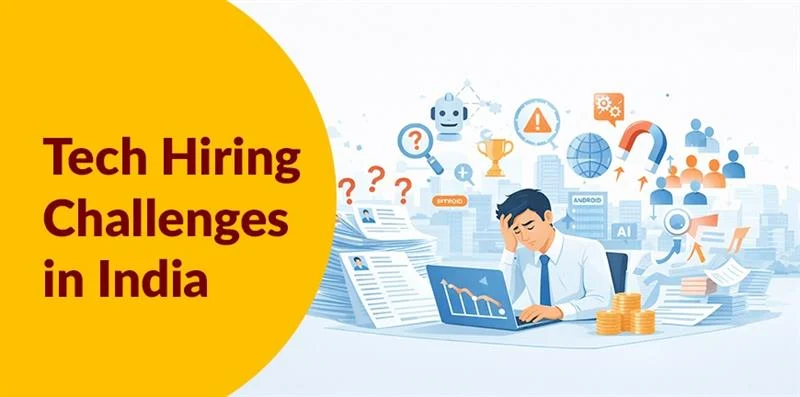
Are you a tech company facing challenges while recruiting niche tech talent?
The tech industry in India in 2026 is stepping into a new era where innovative concepts, modern technology and skilled talent demand are intrinsic to the sector. Employers are transforming their hiring framework to source and place best-in-class talent catering to their requirements.
Recent reports suggest that tech attrition has stabilised at 13% – 15% for major IT firms, down from the 20%+ peaks of 2022.
Why Is Tech Hiring Becoming More Difficult in India?
Tech hiring challenges in India have peaked in recent years. Here are some of the factors influencing the shift:
1. AI & Automation
The advent of modern AI technologies and software has automated complex tasks that were earlier handled by juniors, such as maintenance, testing, etc. This has resulted in less requirement for large-scale traditional-style recruitment.
2. High Niche Skills Demand
The tech sector today sees a reduction in demand for generic roles but a high demand for specialised roles in niche domains. They are finding it hard to find niche-qualified professionals.
3. Controlled Hiring Planning
It is becoming tough for experienced professionals to change jobs as organisations are making their hiring processes rigid. Today, campus hiring for freshers is also well thought out.
4. Alleviated Traditional Hiring
Large IT companies are experiencing slower growth compared to previous years. They have slowed down on their hiring and are recruiting a few professionals. Some forms are laying off people, and some are maintaining the same workforce size, resulting in diminished job opportunities.
5. Focus on Efficiency
Companies are aiming to enhance productivity rather than focusing on company growth, as there is an issue of US and European IT firms tightening the budget.
What are the Top 8 Tech Hiring Challenges?
With the digital revolution taking over, IT companies are facing complex challenges in hiring tech talent. Let us find out what the hurdles are:
1. Talent Scarcity in Niche Tech
There is a high demand for skilled professionals in emerging technology domains, and as the demand is high, the supply of such specialised talent is relatively low. There is a wide gap between the academic curriculum and industry-ready skills that is actiually expected.
As per reports, there is a 45% talent deficit specifically in AI, Cybersecurity, and Data Engineering roles
2. Highly Competitive Market
There is fierce competition as high-profile MNCs, GCCs, and many enterprises eye the same talent pool. The outcome is a state of confusion where there is salary inflation, a clash in offers, etc.
3. Lengthy Hiring Procedures
Qualified and skilled candidates lose interest if hiring cycles encompass complicated technical assessments, long and many interview rounds, and delayed outcomes, which often lead candidates to go to competitors.
4. Flexible Work Mode Hiring
The talent access has become diverse and expanded due to hybrid and remote work models, but it poses a challenge for IT firms in terms of finding the appropriate talent who is culturally fit, handling distributed onboarding, multi-location compliance, etc.
5. Elevated Attrition Issues
Skilled talent, especially in niche areas, is open to better opportunities and will be keen on working with companies offering competitive salaries, better career paths, and growth opportunities.
6. DEI Gaps
Today, IT companies are focused on diversity and inclusion aspects; some are still grappling to fill the gaps and build diverse teams, and attract professionals from tier 2 and tier 3 cities.
7. Employer Brand Image
Candidates today are specific about which company they are applying to and thoroughly research and assess it. Companies who do not communicate the job roles clearly and are unable to emphasise clear growth paths often fail to build a brand reputation, resulting in fewer applicants being attracted.
8. Frequently Evolving Skill Needs
The IT sector is transforming with technological advancements, and the skill requirements are also changing rapidly. There can be a new requirement as soon as a role is filled.
How Do Skill Gaps Impact Tech Hiring in India?
Tech talent shortage and widening skill gaps are increasingly affecting tech hiring. Let us find out how:
- Heightened Time & Costs- IT businesses are faced with the obstacle of elevated expenses along with lengthy periods of extensive hiring processes to identify and recruit suitable candidates with appropriate skills, increasing competition.
- Disconnect Between Perception & Reality- many IT engineers claim to be AI prepared; however, only a small percentage can actually contribute and be a part of AI system development, driving HR heads and businesses to bank on technical tests and real-world projects.
- Focus on Specialised Hiring- There is a shift from bulk and mass recruitment to hiring specific professionals catering to niche disciplines. There is a demand for individuals who can utilise AI tools, software and leverage modern technologies.
- Reduced Innovation & Productivity- A lack of talented professionals in companies results in delayed projects, unproductive outcomes, and a dearth of innovative ideas, leading to slow business progress.
How Do Startups vs Enterprises Face Different Tech Hiring Challenges?
| Hiring Factor | Startups | Enterprises |
| Budget & Compensation | Limited budgets; may rely on ESOPs and growth potential to attract talent | Higher salary bands, structured benefits, and stable compensation packages |
| Employer Brand Recognition | Often unknown; must work harder to build credibility | A Strong employer branding attracts candidates more easily |
| Hiring Speed | Usually, faster decision-making, but with a limited HR infrastructure | Slower due to multiple approval layers and structured processes |
| Role Expectations | Need multi-skilled, adaptable talent who can handle diverse responsibilities. | More specialised roles with clearly defined responsibilities |
| Risk Perception | Candidates may see a higher job security risk | Perceived as stable and secure employers |
| Talent Competition | Compete heavily with larger firms for top candidates | Compete with startups offering flexibility and an innovative culture |
| Growth Opportunities | Faster career growth and ownership opportunities | Structured career paths, but sometimes slower progression |
| Technology Stack | Often use modern, cutting-edge tech stacks | May deal with legacy systems along with modernisation efforts |
| Retention Challenges | Risk of talent leaving for higher-paying, stable roles | Risk of talent leaving for dynamic startup environments |
| Hiring Volume | Targeted, critical hires that directly impact business growth | Large-scale hiring across multiple departments and geographies |
| Decision Flexibility | Flexible offers, customised roles possible | Standardised compensation and HR policies |
Which Tech Roles Are Challenging to Hire in India?
- AI & Machine Learning Specialists: Demand for AI/ML experts, including AI orchestrators and agentic engineers, exceeds supply.
- Cloud Architects & Engineers: As cloud adoption is enhanced by firms, finding the right expertise in AWS, Azure, and GCP, alongside security and cost optimisation skills, is tough.
- Cybersecurity Experts: Cyber threat issues are increasing, and a massive talent scarcity is observed for job roles like security architects and engineers, specifically in the BFSI sector.
- Full-Stack & Backend Developers: There is fierce competition for experienced developers with expertise in modern frameworks, system design, and scalability.
- Data Scientists & Engineers: Specialised professionals who can handle, evaluate, and structure data are in high demand, resulting in significant hiring challenges.
- DevOps & Platform Engineers- As companies adopt automation, identifying skilled DevOps and platform engineers remains a major problem.
How Can Companies Overcome Tech Hiring Challenges?
1. Widen Talent Search
IT companies must expand their search in finding the right kind of tech professionals and put an effort into accessing the global talent pool rather than constricting themselves to locations.
2. Enhance Employer Branding
IT organisations must be well versed in utilising social media channels to showcase their brand, company culture and values through employee testimonials, clearly communicating about career growth opportunities and other features that will draw top talent.
3. Streamline Hiring Processes
The recruitment cycle structured by companies must be smooth and fast, preventing delays and leveraging HR tech tools to expedite and automate processes like screening CVs, scheduling interviews, etc. They must also conduct structured technical skill assessments to identify suitable talent.
4. Intensify Networking Methods
Companies must be a part of communities and talent networks, engaging with passive talent who are not immediately looking for job opportunities but are open to the right ones, building a robust talent pipeline.
Should Companies Outsource Tech Recruitment?
Partnering with a tech outsourcing company like Alp Consulting Ltd can be beneficial for IT firms. Our 30 years of legacy in recruitment and staffing, and expertise in tech hiring have helped an array of leading Tech players across the country.
Outsourcing tech hiring will enable you to access specialised talent, as outsourcing companies like us have a vast global network that makes it easy to find niche talent. Recruiters like us will assist you with hiring workers as per your project requirements, helping you to scale your operations according to changing demands.
An agency like us can also help you reduce your time to hire by offering swift and smart hiring solutions with modern technology. Outsourcing tech hiring will enable you to overcome the tech hiring challenges , driving business growth and development.
What are the Future Trends in Tech Hiring?
- AI-Enabled & Skill-Led Hiring– One of the most significant IT hiring trends includes the use of AI in hiring processes and systems to speed up processes and conduct assessments based on skills rather than degrees.
- Cross-functional Tech Workforce– Employers today focus on hiring professionals who can work across domains and departments, blending business strategy and technical insights.
- Global Hiring & Regional Focus– Significant centres like Bengaluru remain the dominant IT hub but there is a trend of focus shift towards finding talent in tier 2 cities as well. GCCs that are innovation hubs are being set up in India, increasing demand and opening doors for skilled tech talent.
- Evolving Work & Talent Strategy– There is an inclination towards flexible work models, and top talent is keen on working for remote and hybrid arrangements. Companies are also enhancing their use of contractors, freelancers, and Statement of Work (SOW) models.
Key Takeaways
- Shift from Volume to Specialisation
- Skill Gaps Are the Biggest Hurdle
- Hiring Is Structured & Efficiency-Driven
- Competition Is Fierce
- Strategies need to Evolve to Win
Frequently Asked Questions
1. Why is tech hiring difficult in India despite a large talent pool?
Tech hiring in India is challenging despite a large talent pool, due to a massive gap in employment where few graduates possess the practical skills needed for modern, high-skill roles.
2. What are the biggest tech skill shortages in India?
The biggest tech skill shortages in India include AI-ready talent, cloud native expertise, mid to senior cybersecurity roles, etc.
3. How long does it take to hire a senior tech professional in India?
Hiring a senior tech professional in India usually takes 90 to 180 days, approximately 3 to 6 months for the entire process.
4. Are salary expectations rising in Indian tech jobs?
Salary expectations for Indian tech jobs are rising, especially for niche roles.
5. How can startups compete with large IT companies for talent?
Startups can compete with large IT companies for talent by offering career growth opportunities, utilising modern tech, facilitating a purpose-focused culture, etc.
6. Is outsourcing tech recruitment a good strategy?
Outsourcing tech recruitment is an impactful strategy to reduce costs and enhance productivity.
Contact Us For Business Enquiry

Roshan Suresh
Roshan Suresh is the Vice President at ALP Consulting with over 17 years of experience in technology and leadership hiring. He specializes in full-time recruitment for IT products, e-commerce, services, and BFSI sectors, driving end-to-end hiring strategies for top enterprise clients. With a strong foundation in R&D and technical recruitment, Roshan has built high-performing teams that deliver exceptional talent solutions across India.