
5 Best Virtual Onboarding Practices for New Hires
04/06/2025
What is Span of Control: Types, Formula, Benefits & Best Practices
09/06/2025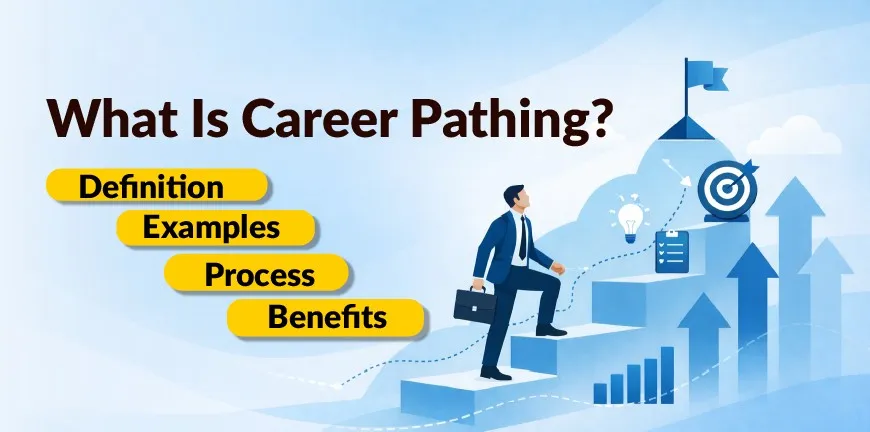
Want to create a labour force that is future prepared?
Career pathing is not just about building careers, but if you are a business investing in it, the exercise will help you in creating a loyal team, enhancing engagement, and uplifting retention. In today’s fast-moving work landscape, the expectation of new teams and talent is also rapidly evolving, and for them, careers are essentially journeys that need to be crafted by skills, aspirations, and myriad opportunities.
What Is Career Pathing?
It refers to a process in which an employer and employee work closely to design a path that lays out the future growth prospects in an organisation.
The practise involves highlighting the special skills, roles and the kind of training required to develop the advancement graph. Career pathing is vital for both employees and companies, as the success of both depends on the impact of the decisions and actions taken to make significant improvements.
Why is Career Pathing Important for Employees & the Organisation?
Career pathing plays a pivotal role in helping organisations and employees foster a growth environment that builds mutual trust and creates a success drive for both parties. Here are the reasons that make career pathing important for employees and employers in 2026:
For Employees
1. Clear Career Trajectory
Career pathing is a clear guide for employees who can confidently follow the path of advancement in an enterprise, eliminating any suppressed anxiety.
2. Uplifted Motivation & Satisfaction
Employees with clear career paths can focus better since they know what must be done to achieve the objectives, leading to improved motivation and job satisfaction.
3. Focus on Skill Amplification
A proper career path involves skill development programs that identify niche skills and focus on developing them for upcoming job positions, encouraging robust training and development.
4. Financial stability
Career pathing approach helps in getting promotions and better appraisals, leading to financial stability and a better standard of living.
5. Elevated Loyalty
Employees feel empowered when their career growth is taken into consideration by employers, and they help them with their ambitions and future. Their loyalty towards the employer and the company increases, and they stay longer.
For Employers
1. Accelerated Employee Retention
By offering career scopes that are long-term and effective, companies retain their employees as the employees are loyal and keen on staying on.
2. Improved Capability Building
Organisations that develop skills internally have a better chance of filling the skill scarcity that exists within an organisation and not resort to external agencies for help.
3. Uplifted Productivity
Employers ensure that skills are honed correctly, and employees are placed in suitable roles catering to the organisation’s goals, improving outcomes.
4. Improved Workforce Development
Career Pathing helps companies align their strategic objectives with workforce development plans, leading to highly skilled employees ready to take up any challenge.
5. Gain a competitive edge
A comprehensive and personalised career pathing program will help employers retain top talent and gain a competitive edge for higher business growth.
What are the key Components of an Effective Career Pathing Framework?
Effective career pathing ensures that employee career growth caters to the requirements of the organisation through creating robust structures that are transparent and trustworthy. Here are a few of the vital elements that build a strong framework:
1. Hierarchy & Grade Structure
This entails the systematic breakdown of all the levels and grades from senior to junior in an organisation and a detailed explanation of the organisational structure.
2. Proficiency Assessments & Skill Description
There must be skills that are clearly explained, a detailed role analysis and the know-how necessary for each role, enabling employees to keep track of work progress and recognise existing gaps.
3. Career Growth Designing
A visual map is formulated showcasing potential career courses that might lead to promotions or interdepartmental moves, facilitating personalised and flexible routes.
4. Employee Development Programs
Employers must design foolproof, customised development methods, including training programs, workshops, mentoring plans, etc, to enable skills acquisition.
5. Evaluation Measures & Guidelines
Well-defined and transparent benchmarks must be designed for each job position that will determine the success and progress levels. The metrics will help determine eligibility for promotion or a role change.
6. Integration of Systems
The career structure needs to be properly integrated into HR management systems, which might include salary planning frameworks, performance analysis, future labour force planning, etc.
What Are the Different Types of Career Paths?
In the course of a job, employers can provide opportunities to their employees to grow in the company and aim for higher level of job positions, and for that, a slew of skills and experiences can be offered that are not just beneficial to employees but profitable for employers as well. Let us find out the different types of career paths:
1. Vertical Career Path
This is the conventional method in which employees move up the career ladder through job promotions, going up to higher positions with more compensation, responsibilities, and power.
2. Lateral Career Path
This is a structure that allows employees to work in other departments within the organisation to acquire new skills and gain new experiences without getting promoted. This approach motivates employees to focus on upgrading their skills, preventing stagnation.
3. The Dual Path
This is a framework that enables employees to choose to advance in their career by not opting for managerial roles. This path is for professionals who want to enhance their expertise in other technical roles and focus on innovation and mentoring.
4. In-Place Career Advancement
This path is essentially for specialists who are not interested in promotions or role change; they want to develop the skills and expertise they already have and enrich them.
5. Collaborative Career Path
This structure allows employees to opt for both vertical and lateral career paths, letting them understand both paths and decide what kind of career advancement they are looking for.
How does Career Pathing work in an Organisation? (Step-by-step process)
Organisations must structure career pathways in a streamlined manner and execute them systematically for better outcomes. Here are the following steps they need to follow:
1. Clearly Define Job Positions and Skill Sets
The first step enterprises need to take is to create a clear and well-defined document that states the job definitions, skills, and competencies required to cater to every job role necessary for a proper career path development structure.
2. Outline Progression Routes
Managers and HR leaders then sit and chalk out a plan and design a framework of robust career growth routes that include the different types of career paths.
3. Goal & interest Evaluation
While designing a framework, employees are also involved in the organisation, which must ensure that they analyse their aspirations, interests, assess their strengths and then discuss them with their managers, helping them to find out the most suitable paths.
4. Execute Gaps Assessment
Employees and managers comprehensively evaluate the existing skills of the employee and compare them to the skills required for a specific role, identifying gaps.
5. Formulate a Developmental Structure
A customised plan is developed where the aspired career goals are connected to the learning pathways that can be implemented, such as training, mentoring, project work, etc.
6. Implement & Monitor Outcomes
Employees begin their training programs and embark on a career progression journey, while managers and team leaders assess the structure and adjust it according to the progress and update the structure as per requirement.
What is the difference between Career Pathing, Career Mapping, and Career Development?
| Feature | Career Pathing | Career Mapping | Career Development |
| Definition | A well-designed structure defining possible career growth pathways within an organisation | The method of recognising and visually presenting potential career paths for a professional | A host of developmental programs enabling employees to cultivate skills and grow in their careers |
| Focus | Company framework & predetermined roles | Planning the career of a specific individual and their growth trajectory | Continuous skill development & growth |
| Perspective | Organization-focused | Employee-driven | Both employee and company-driven |
| Goal | Convey a clear message on growth scopes | Support employees in exploring and selecting suitable career paths | Enhances skills and prepares for future roles |
| Nature | Static or Guided Framework | Personalised & agile process | Continuous and ever-changing process |
| Result | Clear career development framework | Personalised career structure | Elevated skills, competencies, future readiness, and growth |
| Ownership | HR / Organisation | Employee + Manager + HR | Shared (Employee, Manager, L&D/HR) |
What is the difference between a Career Path and a Job?
| Feature | Career Path | Job |
| Definition | A long-term plan involving roles and growth over time | A particular job position held by an individual at a specific time. |
| Scope | Long-term development | Short term |
| Focus | Holistic professional growth | Daily tasks and responsibilities |
| Timeline | Covers different roles and years | Restricted to the current employment period |
| Goal | Long-term progressions, development, and growth | Receiving income and performing assigned duties |
| Perspective | Future-focused | Present-centric |
| Ownership | Primarily employee-driven (with organisational support) | Assigned by the employer |
| Result | Career growth, skill development, and advancement | Salary, experience, and job performance |
What Are Examples of Career Paths?
According to career pathing, career trajectories may go vertically upwards or laterally sideways based on the type of roles and skills required. Additionally, the success of a career pathing depends on an individual’s commitment and appetite for success, along with a willingness to take on added responsibilities for making the business operations more efficient.
Here are the typical career path examples you can come across in most organisations:
| Department or Niche | Career Path |
| Administration | Data Entry Operator -> Receptionist -> Administrative Assistant->Executive Assistant->Secretary->Administrative Service Manager-> Office Manager->HOD |
| HR | HR Intern-> HR Assistant->HR Assistant->HR Specialist->HR Manager->Director of HR->HR VP->HR Chief |
| Sales | Sales Rep-> Account Executives->Account Manager->Sale Manager-> Regional Sales Manager->Sales Director->VP of Sales->CSO (Chief Sales Officer) |
| Software Programming | Intern or Apprentice-> Entry-level Software Programmer-> Level 2 Software Engineer->Senior Software Developer->Technical Lead-> Technical Senior Manager->CTO (Chief Technology Officer) |
What Are the Key Benefits of Career Pathing?
Deploying effective & efficient career pathing programs for employees in a company can bring numerous advantages for both employees and employers. Here are the key career pathing benefits:
1. Elevated Employee Retention
Employees who are provided with a clear structure in terms of their career development and know that they will have a bright future in the company will automatically be keen on continuing with the company for the long term.
2. Highly Engaged Employees
A well-planned and communicated career framework results in employees feeling empowered and motivated to work in an environment of growth, hence they not only contribute better but are keen on learning about the nitty-gritty of the business.
3. Cost-Effective
A clear career path structure leads to a lower number of professionals leaving an organisation due to a high level of employee engagement. This helps organisations to save expenses and prevent costs related to high turnover.
4. Secure Workplace
For employees, a well-designed career path is something that gives them job security, and they do not have to be anxious and urgently look for other opportunities, as they can trust the career growth plans the organisation has to offer.
5. Increased Innovation and Growth
A definitive career pathing program will help employees elevate their skills and knowledge exponentially, creating the foundation for increased innovation and growth.
What are the Challenges of Implementing Career Pathing Programs?
Implementing career development plans is advantageous and profitable; however, certain challenges can hinder the progress of career pathing programs, including:
1. Employee Interest & Skill Mismatch
Sometimes, organisations designing career roadmaps fail to consider the actual interests and aspirations of employees, and employees are bound to follow the career plan even though it does not cater to their desires, passions, or skills.
2. Eliminating Digital Obstacles
Companies today design career development structures by integrating modern digital career tools and platforms. But in certain regions where employees are not well versed in digital tools and modern career platforms, they might find it difficult to adapt the framework.
3. Managerial & Employee Pushback
Employees might be reluctant to adopt the career guidelines and could be uncomfortable in changing their current roles. While leaders or managers might not have the knowledge or training capabilities to guide employees through career growth paths for their development.
4. Unclear & Vague Structures
Some organisations fail to create a transparent career pathing structure and confuse employees. Such structures fail to show employees the real growth prospects in the career plan, leaving them disinterested and disillusioned.
5. Evolving Skill Sets
The job market witnesses regular and rapid changes in job roles and skills, and that’s why long-term career development plans might not work, as the skills and roles incorporated in them might evolve in the long run.
What are the Best Practices of Career Pathing?
The best practices for achieving success in career pathing programs include:
1. Make Career Pathing Inclusive
Companies must ensure that career pathing is not considered as one task but rather an integral part of the day-to-day operations, with a strong emphasis on active participation and periodic progress reviews.
2. Use Internal Expertise Effectively
The company must ensure management and leadership group members are fully involved in career pathing programs, providing guidance and mentorship to employees to improve their skills and expertise that can elevate them to the next level.
3. Empower Employees to Take Ownership
The company must empower employees to take ownership of their individual care programs. Create goals with specific deadlines to push employees out of their comfort zones and achieve better outcomes. Additionally, create a safe environment where employees feel comfortable and confident to take risks, make mistakes and learn from them, and approach management in case they are stuck and need support.
4. Period Review and Feedback
The company must put the necessary effort into reviewing the career progress of each employee and provide feedback for making improvements. Additionally, the companies must ensure employees are implementing the feedback diligently in their career path steps and measure the KPIs for further improvements.
If creating a career pathing program is difficult internally, always seek support from top HR and Employee training agencies like ALP Consulting Ltd for end-to-end career pathing solutions.
What are the Latest Trends of Career Pathing?
The importance of career pathing is being realised today, and companies are designing personalised career paths prioritising skills and adaptability. Let us find out the latest trends in career pathing:
AI-Powered Career Roadmaps– Organisations are utilising AI-enabled tools and platforms to create career structures and personalised career journeys, analysing new and traditional job roles.
Reports suggest that career paths in AI are currently commanding a 20–30% salary premium.
Focus on Skill Development– Career development today is more about honing skills than waiting for conventional promotions. and managers to make the promotion happen.
Employee Mobility Initiatives– New, improved programs are being created within organisations to mobilise employees and teach them new skills, explore new projects to make them well-equipped to grow internally.
Emphasis on Sustainability & Tech Skills– Focus is largely on adopting and developing skills like STEM, data science, and green tech, with the renewable sector gaining traction.
Key Takeaways
- Career pathing program aligns employee career prospects and aspirations with company goals
- Enhances job satisfaction, retention, and productivity through structured, transparent growth and development plans.
- Three core paths: skill-based, knowledge-based, and cross-functional, cater to diverse career aspirations effectively.
- Effective career pathing requires tools, training, leadership support, and regular feedback for measurable results.
- Challenges include employee reluctance, unclear structures, leadership gaps, and technological or resource limitations.
Frequently Asked Questions (FAQs)
1. What is career pathing?
Career Pathing is an ongoing process where the employer designs a career map for employees, aligning with the organisation’s vision and goals, enabling employees to maximise their potential, and creating a win-win condition for both.
2. Why is career pathing important?
A good career pathing program helps companies create a progressive working environment for employees to flourish, improving productivity, increasing brand value, maintaining a future leadership pipeline, and enhancing employee retention rates.
3. What are the benefits of career pathing?
The key benefits of a career pathing program include enhanced motivation and job satisfaction, higher productivity, increased employee retention and engagement, improved succession planning, etc.
4. What are the different types of career paths?
The career path types that most companies follow as the foundation for creating career pathing programs include vertical and lateral. Dual path, etc.
5. What are examples of career paths?
Career path examples practised in Indian companies include HR intern to HR chief, data entry operator to office manager, sales rep to CSO (Chief Sales Officer), etc.
Contact Us For Business Enquiry

Rajkumar Shanmugam
Rajkumar Shanmugam is the Head of HR at ALP Consulting, bringing over 19 years of comprehensive HR leadership experience across India and international markets. His expertise spans talent acquisition, employee relations, performance management, compliance, and HR transformation. Rajkumar has a proven track record of driving people-centric initiatives, enhancing workplace culture, and aligning HR strategy with business goals. With extensive experience in US staffing operations and global mobility, he continues to lead organizational excellence through innovation and employee engagement.