
Payroll Calendar for 2026
28/03/2026
Gross Pay vs. Net Pay: What is the Difference?
29/03/2026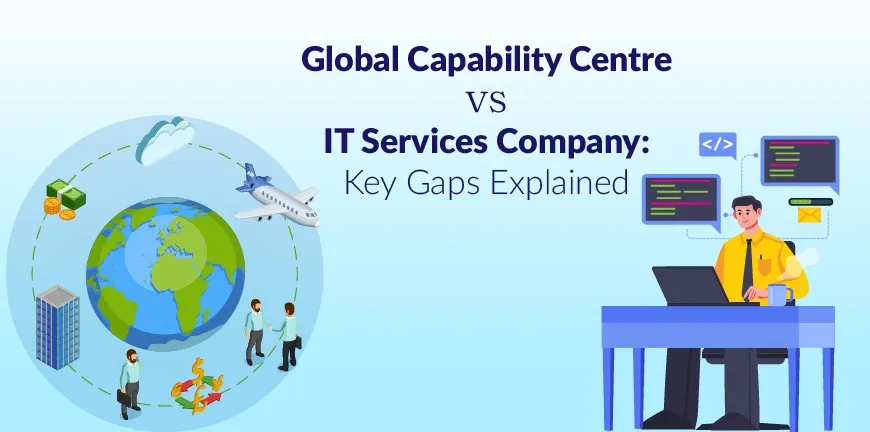
India has become a powerhouse for GCCs with 1600+ centres and 1.6 million people employed across the country. This remarkable growth has transformed India into a global transformation centre. Moreover, digital penetration in the Tier 2 and Tier 3 cities has signalled an 8% growth of GCCs by 2030. But understanding the difference between the Global Capability Centre vs IT Services Company can give you deeper insights into which model fits your business needs.
What is a Global Capability Centre (GCC)?
A global capability centre is a captive centre strategically established by global corporates to conduct business in an offshore location. By integrating customised experts & advanced technologies, GCCs have become a strategic enabler for companies to build a talented workforce, enhance operational efficiency, improve financial stability, manage risk, & scale business growth.
What is an IT Services Company?
IT services companies are independent firms that offer tech-led services to businesses. They primarily support digital transformation of their partner companies by offering tech-driven strategies, HR talent, & other implementation services. IT service companies strengthen their technical abilities & expertise to meet the evolving needs of their clients.
What are the Key Differences Between GCC and an IT Company?
As businesses scale, they adopt different hiring models in tandem with the business goals and IT requirements. Understanding the critical differences between a GCC vs IT company can strengthen your decision-making.
| Point of Difference | GCCs | IT Company Services |
| Ownership & Structure | Captive centre fully owned by the parent company | Third-party vendor offering IT solutions to business clients |
| Core Objective | Build long-term strategic capabilities for scaling and growth | Fill roles fast and focus on volume hiring |
| Hiring Nature | Hires for internal roles for the parent company exclusively | Hires for multiple roles across many industries |
| Employment Relationship | Candidates are on the company’s payroll | Candidates in this model are on a third-party payroll |
| Talent Strategy | Focused on strategic, long-term hiring & retention | Focused on cost & short-term hiring needs |
| Cost Model | High initial upfront cost | Paid per hire or markup on salaries |
| Control & Governance | Has complete control over hiring, culture, & decision-making. | Do not have complete control or governance over candidates |
| Brand Alignment | Deeply connected & aligned with one brand | Connected with multiple brands |
When Should a Company Choose GCC Over an IT Vendor?
Choosing between GCC vs IT hiring model entirely depends on the business size, talent requirements, cost, & growth scope of your company.
A. If you are opting for the IT vendor services, ensure you:
- Need project-based support
- Short-term business goals
- Have low budgets
- Exclusively cannot handle risk, compliance & recruitment operations
B. If you are opting for the GCC services, ensure you:
- Build long-term strategic capabilities
- Talent matches your core business functions & operations
- Need complete control and governance over your teams
- Expand to large-scale operations and growth
- Aspire to boost innovation & global integration
What are the Advantages of the GCC Model?
About 50% of the world’s GCCs are established in India. Here are the top 4 reasons why GCCs are a strategic asset to companies in India.
1. Skilled Workforce
India is an IT talent hub. The multi-layer talent ecosystem has made the country an attractive destination for GCCs. Moreover, the emerging skilled workforce, specialised in AI, ML, Cloud, IoT, cybersecurity & data analysis, makes the city an ideal option for companies to build global capabilities and support product innovation.
2. Cost & Infrastructure
The deep technological penetration across cities makes India a unique location for GCCs. The well-connected infrastructure, innovation tech parks, & ambience have attracted companies not only to set up GCCs in urban zones, but also in Tier 2 & Tier 3 cities. Moreover, the quick availability of vendor services in cloud, cybersecurity, ERP, AI, legal, HR & real estate services is driving operational efficiency & reducing the cost of the parent company.
3. Government Support
The government of India’s pro-innovation approach & incentive policies, business-friendly regulations, tax exemptions, and SEZ benefits have helped the GCCs in India to expand considerably. The political maturity & positive economic climate enable global companies to make long-term investments.
4. Sectoral Diversity
India has a rich industrial diversity. The multi-sectoral operational models & layered business needs push global companies to set up GCCs to reduce operational costs, enhance product innovation, & explore new market opportunities.
What Are the Limitations of GCC Setup?
Having listed out the benefits of the GCCs, there are critical challenges that global companies face while setting up a GCC or entering a new market.
1. High Rental Costs
Setting up GCC centres in prime locations can be expensive due to high commercial rentals and high real estate costs. This can deeply affect the cost arbitrage benefits.
2. Urban Strain
High traffic congestion, underdeveloped commuting networks, & unhealthy environment affect the work-life balance of employees working in the GCCs.
3. Intense Talent Competition
Top companies & startups compete fiercely for skill-first talent. Without a constant watch on market trends, salary benchmarks, & talent availability, the workflow pressure can increase on GCC’s hiring teams.
4. Complex Regulations
Inadequate knowledge of new labour laws, compliance standards, compensation policies, & BGV policies can land the GCCs in legal and financial risks. Hiring a specialist in these domains can lead to additional overhead.
5. Cultural Misalignment
Ensuring operational & cultural alignment with the parent company requires a versatile leadership capability. Finding a leader specialised in local laws, labour laws, & change management to lead the GCC can be challenging. The absence of such a role can lead to distorted operational and strategic direction.
How is Alp Consulting building a Robust GCC in India?
Alp Consulting Ltd, India’s leading global recruitment firm, gives you the ability to hire better and faster. Alp’s suite of global recruitment solutions is designed to tap into compliance-driven & culturally adaptable talent. Our validated project-based assessments, automated screening, psychometric analysis, & expert-led verification process help you drive high-quality talent decisions & build a diverse workforce of tomorrow. Alp has processed over 10 million candidates, and analysing these data helps us deliver actionable insights to zero in on candidates who meet your business expectations and scaling needs.
Frequently Asked Questions (FAQs)
1. What is required to set up a GCC in India?
Setting up a GCC in India requires entity registration, office infrastructure, regulatory approvals, technology setup, leadership hiring, and a clear operating model aligned with global business goals.
2. How long does GCC setup take?
GCC setup in India typically takes three to nine months, depending on approvals, infrastructure readiness, hiring timelines, and how quickly the organization scales initial operations.
3. What is the cost of setting up a GCC?
The cost of setting up a GCC varies widely, covering real estate, technology, talent acquisition, compliance, and operations, typically ranging from moderate to high investment depending on scale.
4. Which cities are best for GCC in India?
Top cities for GCCs in India include Bengaluru, Hyderabad, Pune, and Delhi NCR, offering strong talent pools, robust infrastructure, and thriving ecosystems for global business operations.
5. What talent is required for GCC?
GCCs require a mix of skilled professionals across technology, analytics, finance, HR, and operations, along with leadership talent capable of driving innovation and aligning with global strategies.
6. What compliance is needed for GCC?
GCCs in India must comply with company laws, tax regulations, labor laws, data protection norms, and industry-specific guidelines to ensure smooth, legally sound, and compliant business operations.
Contact Us For Business Enquiry

Kishore V N
Kishore V N is the Managing Director at ALP Consulting, bringing over 29 years of extensive experience in global recruitment, talent strategy, and workforce solutions. He has been instrumental in building scalable RPO, MSP, and modular talent sourcing models that empower organizations with a competitive edge in talent acquisition. Kishore’s leadership focuses on expanding ALP’s global presence, driving innovation in recruitment technology, and enhancing operational excellence. He also serves as Director at Datacore Technologies, steering digital HR transformation through advanced HRMS and virtual staffing solutions.