
Global Capability Centre vs IT Services Company: Key Gaps Explained
29/03/2026
How Does Unlimited PTO Work? Learn the Pros and Cons
29/03/2026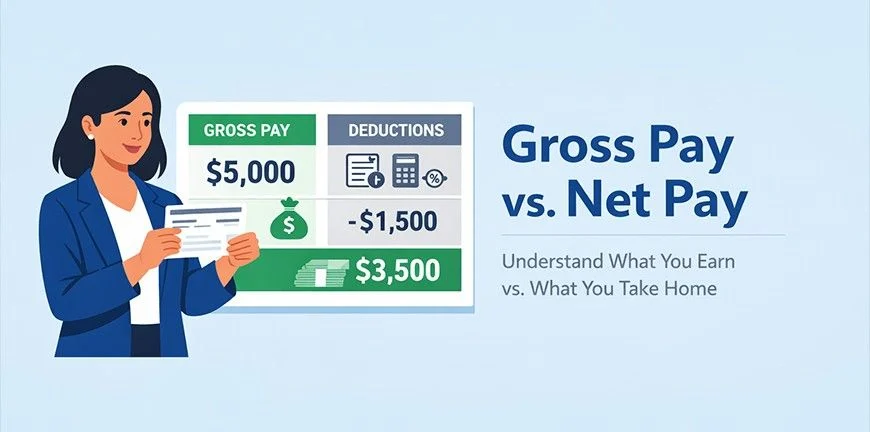
“Understand CTC today, avoid confusion tomorrow.”
Most employees use gross and net pay interchangeably, assuming that both are the same. However, this is far from true, and understanding the difference between gross pay and net pay can break this pattern for both employees and employers.

Whenever a CTC package is shown, you must be in a position to calculate gross pay and net pay without skipping a beat. Let’s decipher this and clear all your apprehensions about gross and net salary by making a detailed gross pay vs net pay comparative analysis. Go!
What Is CTC?
Before commencing the tussle between gross pay vs net pay, let’s get a gist about CTC.
CTC a.k.a Cost to Company, refers to the total expenses an employer bears to engage an individual to run business operations. A CTC involves various components other than the basic pay, such as HRA, PF, ESI, medical insurance, bonus, etc.
In simple terms, CTC is the amount of money spent by a company to hire and support an employee till his contract expires. Along with standard benefits, CTC may also cover additional perks such as meal vouchers (like Sodexo), office space rent, subsidised loans, transportation services, etc. Here is a breakdown of CTC typically used in Indian firms:

| Component | Formula / Calculation |
| Basic Salary | Fixed percentage of CTC (commonly 40%–50%) |
| HRA (House Rent Allowance) | Basic Salary Percentage (e.g., 40%–50%) |
| Special Allowance | CTC − (Basic + HRA + Other Allowances + Perks) |
| Gross Salary | Basic + HRA + Allowances |
| Employee Deductions | Employee PF + PT (Professional Tax) + Income Tax |
| Net Pay (Transferred to bank account) | Gross Salary − Employee Deductions |
| Employer PF Contribution | 12% calculated from Basic Salary |
| Gratuity | (Basic pay × 15 × Service Years) ÷ 26 (or estimated %) |
| Total Benefits Receivable | PF + Insurance + Gratuity + Other Perks |
| Total Cost to Company) | Gross Salary + Employer Contributions + Benefits |
Here is an example for a better understanding:
Assume annual CTC = Rs. 6,00,000
| Component | Calculation | Amount (Rs) |
| Basic Salary (40%) | 40% of 6 lakhs | 2,40,000 |
| HRA (50% of Basic) | 50% of 2.4 lakhs | 1,20,000 |
| Employer PF (12%) | 12% of 2.4 lakhs | 28,800 |
| Gratuity (4.81%) | 4.81% of Basic | 11,544 |
| Special Allowance | Remaining balance | 1,99,656 |
| Gross Pay | Basic + HRA + Special Allowance | 5,59,656 |
| Employee PF (12%) | 12% of Basic | 28,800 |
| Professional Tax (tentative) | Fixed estimate | 2,400 |
| Income Tax (estimate) | Based on the tax slab | 20,000 |
| Net Pay (Take-home) | Gross − Total Deductions | 5,08,456 |
| Total CTC | Sum of all components | 6,00,000 |
What is Gross Pay?
Before jumping to the comparison between gross earnings vs net pay, let’s analyse gross pay.
Gross pay is the total earnings an employee receives before deductions, including basic salary, allowances, bonuses, and incentives, forming the basis for calculating taxes, contributions, & net take-home salary.

Components of Gross Pay
1. Basic Salary
Fixed base pay forms the core component of the employee compensation structure.
2. House Rent Allowance (HRA)
Allowance provided to employees for meeting house rental accommodation expenses.
3. Dearness Allowance (DA)
Cost-of-living adjustment paid to offset the inflation impact on salaries.
4. Special Allowance
The residual component balances the salary structure after allocating other fixed elements.
5. Bonus
Performance-based incentive paid periodically to reward employee contributions and achievements.
6. Overtime Pay
Additional compensation for working beyond standard scheduled working hours.
7. Commission
Variable earnings based on sales performance or business target achievements.
8. Leave Travel Allowance or LTA
Allowance given for travel expenses incurred during employee leave periods.
What is Net Pay?
Now that we are thorough with gross pay, it’s time to learn about net pay so that when we gauge gross pay vs net pay calculator, it is clearer.
Net pay is the final amount credited to an employee’s bank account after deductions, statutory contributions, & other applicable deductions from gross pay, representing the actual take-home salary.
Components of Net Pay
1. Employee Provident Fund (PF)
Mandatory retirement contribution is deducted from salary as per statutory regulations.
2. Professional Tax
State-imposed tax is deducted monthly based on employee income slabs.
3. Income Tax (TDS)
Tax is deducted at source based on the income tax slab rate applicability.
4. Employee State Insurance (ESI)
Social security contribution is subtracted for eligible employees under the ESI program.
5. Loan or Advance Deductions
Amounts deducted towards employee loans, advances, or salary recoveries.
6. Other Deductions
Includes insurance premiums, voluntary contributions, or company-mandated deductions.
What is the Difference Between Gross Pay and Net Pay?

Here are the 10 key differences between gross pay vs net pay:
| Basis | Gross Pay | Net Pay |
| Definition | Total earnings before any deductions | Final take-home salary after all deductions |
| Calculation Stage | Calculated before taxes and contributions | Calculated after subtracting all deductions |
| Components Included | Basic, allowances, bonuses, incentives | The only remaining amount after deductions |
| Tax Impact | Taxable income is derived from gross pay | Taxes have already been deducted from this amount |
| Deductions | Does not include any deductions | Includes PF, tax, insurance, and other deductions |
| Purpose | Used for salary structuring and benefit calculation | Reflects actual salary credited to employee |
| Visibility | Shown as earnings in the payslip | Shown as the final payable amount |
| Employee Perspective | Represents total compensation before reductions | Represents actual usable income |
| Employer Perspective | Helps in budgeting employee compensation | Represents payout after statutory compliance |
| Financial Planning Use | Basis for tax planning and salary structuring | Used for personal expenses and savings planning |
How is Gross Pay Calculated?
Here is an example of gross pay calculation (monthly).
Assume Annual CTC = Rs. 9,00,000 (Rs. 75,000 per month)
| Category | Component | Monthly (Rs) |
| CTC | Total Cost to Company | 75,000 |
| Employer Costs | Employer PF Contribution | 3,600 |
| Gratuity (approx.) | 1,400 | |
| Gross Pay Components | Basic Salary | 32,000 |
| House Rent Allowance (HRA) | 12,800 | |
| Dearness Allowance (DA) | 3,200 | |
| Special Allowance | 10,000 | |
| Bonus | 5,000 | |
| Overtime Pay | 2,000 | |
| Commission | 3,000 | |
| Leave Travel Allowance (LTA) | 2,000 | |
| Gross Pay | Total Earnings | 70,000 |
How is Net Pay Calculated?
Here is an example of net pay calculation (monthly).
Assume Annual CTC = Rs. 9,00,000 (Rs. 75,000 per month)
| Category | Component | Monthly (Rs) |
| Gross Pay | Total Earnings | 70,000 |
| Deductions | Employee PF Contribution | 3,600 |
| Professional Tax | 200 | |
| Income Tax (TDS) | 5,000 | |
| Employee State Insurance | 500 | |
| Loan/Other Deductions | 700 | |
| Total Deductions | 10,000 | |
| Net Pay | Take-home Salary | 60,000 |
What Deductions Affect Net Salary?
Here are 10 deductions that affect net salary receivable:
1. Employee Provident Fund (PF)
Mandatory retirement savings contribution is subtracted every payroll cycle as per statutory mandates.
2. Employee State Insurance (ESI)
Social security deduction for healthcare benefits applicable to eligible employees.
3. Income Tax (TDS)
Tax is deducted at source based on the declarations and income slabs.
4. Professional Tax
State-level tax is deducted periodically based on employee salary brackets.
5. Labour Welfare Fund (LWF)
Statutory contribution is deducted for employee welfare schemes & benefits.
6. Gratuity Contribution (Employee Share if applicable)
An optional deduction if the employee contributes towards the gratuity benefit schemes.
7. Loan Repayments
Deductions for employee loans or salary advances are taken from the employer as part of repayments.
8. Insurance Premiums
Amount extracted towards health, life, or group insurance coverage plans.
9. Voluntary Provident Fund (VPF)
An ad hoc voluntary contribution made by the employee towards the provident fund savings.
10. Other Recoveries
Includes penalties (fines), asset recovery costs, or miscellaneous employer-mandated deductions.
Why Do Employees Get Confused Between Gross and Net Pay?
Here are 5 reasons that create confusion among employees in distinguishing between gross pay vs net pay:
1. Complex Salary Structures
Multiple salary components & allowances make it arduous to clearly understand the total earnings breakdown.
2. Lack of Payroll Knowledge
Limited acumen of payroll terms leads to confusion between earnings & actual take-home salary.
3. Hidden Deductions
Statutory & optional deductions are not always clearly explained in salary structures or payslips.
4. CTC Misinterpretation
Employees often assume CTC equals take-home salary without accounting for employer contributions & deductions.
5. Inconsistent Payslip Formats
Different payslip formats across companies create difficulty in comparing gross & net salary figures.
Example: Gross Pay vs Net Pay Calculation

Here is a simplified gross pay vs net pay example:
Let’s offer an annual CTC of Rs. 6,00,000 to a new employee, which comes around Rs. 50,000 every month till the next appraisal cycle is initiated. Out of this, a portion is allocated towards employer contributions such as provident fund and gratuity, reducing the actual gross pay to around Rs. 46,600 per month.
This gross pay includes all earnings, like basic salary, allowances, and bonuses, before any deductions. However, from this amount, deductions such as employee provident fund (Rs. 2,400), professional tax (Rs. 200), and income tax (Rs. 2,000) are applied.
After subtracting these deductions totalling Rs. 4,600, the employee receives a net pay of Rs. 42,000 per month. This gross pay vs take-home salary difference shows that while CTC represents the total cost to the employer, the net pay is the actual take-home payment after all deductions for the employee.
How Alp Consulting Helps Companies with Salary Management?
Alp Consulting Ltd, a pro payroll agency in India, supports businesses with A-Z salary management by driving elite-level payroll processing, statutory compliance, & timely salary disbursement.
By leveraging advanced payroll systems & expert-driven processes, Alp minimises errors, enhances data security, & streamlines operations. Its scalable solutions help organisations maneuver complex workforce structures efficiently while boosting transparency, control, & overall payroll governance.

Key Takeaways
- CTC includes all employer expenses, not the actual employee’s take-home salary.
- Gross pay represents total earnings before deductions like tax and PF.
- Net pay reflects the final salary credited after all applicable deductions.
- Multiple salary components and deductions create confusion among employees frequently.
- Effective payroll management ensures compliance, accuracy, and timely salary disbursement.
Contact Us For Business Enquiry
Frequently Asked Questions
1. What is gross pay in salary?
Gross pay is total earnings before deductions, including basic salary, allowances, bonuses, & benefits.
2. What does net pay mean?
Net pay is the actual take-home salary after all deductions like taxes, PF, & benefits.
3. What is the difference between gross and net pay?
The gross pay vs take home salary difference is that gross pay is total earnings; net pay is the remaining salary after deductions and taxes are applied.
4. How is net salary calculated from gross salary?
Net salary is calculated by subtracting taxes, provident fund, insurance, & other deductions from gross.
5. What deductions reduce net pay?
Deductions include income tax, provident fund, professional tax, insurance premiums, & other statutory contributions.
6. Why is the net salary lower than the gross salary?
When we weigh gross earnings vs net pay, net salary is lower due to mandatory deductions like taxes, benefits, & statutory contributions applied.

Yugandhara V. M
Yugandhara V. M serves as the Assistant Vice President – HRO at Alp Consulting Ltd., bringing over 14 years of rich experience in Human Resource Outsourcing, payroll management, and statutory compliance. He specializes in driving process excellence across HR operations, ensuring seamless service delivery and compliance with labor laws. Yugandhara’s expertise lies in managing large-scale client engagements, optimizing HR processes, and implementing efficient workforce management systems that enhance organizational performance. He also leads comprehensive payroll services, ensuring accuracy, timeliness, and compliance for diverse client portfolios.