HR Outsourcing Cost India: What You Pay vs What You Save?
03/07/2026Competency Mapping in 2026: Meaning, Process, Strategies & Future Trends
04/07/2026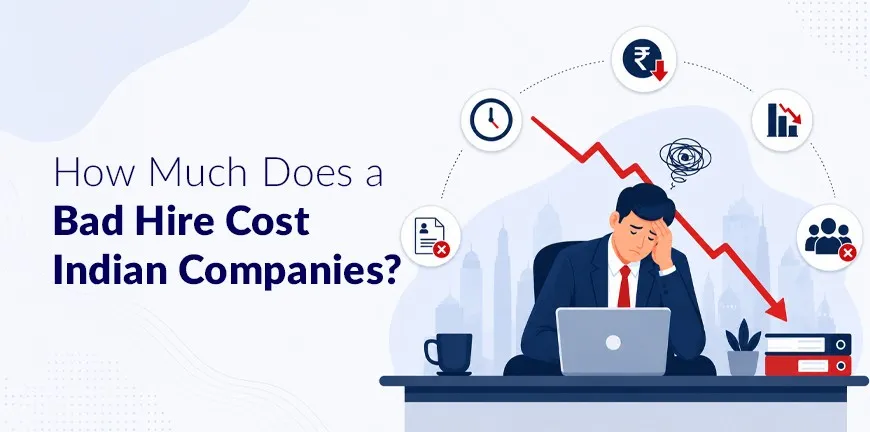
According to the Society for Human Resource Management, the cost of a bad hire spans 30% to 150% of an employee’s annual salary based on the job roles. Bad hires are usually products of challenges that businesses face, like skill gaps and high attrition.
Let us find out the true cost of bad hires, discover the hidden costs, and uncover how you, as a business, can avoid the unnecessary bad hire expenses
Key Takeaways
- Bad hires can cost 30%–150% of annual salary
- Productivity, team morale, and client relationships are directly impacted.
- Hidden costs like employer brand damage and attrition increase expenses.
- Structured, skills-based hiring significantly reduces hiring risks.
- Partnering with experts improves quality of hire, speed, and cost efficiency.
What is a Bad Hire?
A bad hire is essentially the consequence of a bad hiring decision, where an employee does not meet the expectations of the employer in terms of performance, disrupting the productivity of teams and might leave the organisation, resulting in financial and operational damages.
Detailed Cost Breakdown of a Bad Hire
1. Recruitment & Onboarding Costs
These are the costs associated with job adverts, agency fees, documentation, background checks, time taken by HR managers and recruiters for interviews, and expenses for training and onboarding.
2. Productivity & Performance Loss
The impact of a bad hire is directly on teams, as an underperforming employee will not only not meet company expectations but also hamper productivity, leading to managing the expenses of poor deliverables, incurring financial losses due to targets missed, and the cost of reworking client projects and tasks.
3. Employee Replacement Costs
Businesses can find it challenging when they incur costs as employees leave after completing a short period. The expenses of rehiring can be a lot, with restarting the recruitment cycle from scratch and a prolonged time to hire.
4. Compensation & Benefits Paid
Additional costs can be incurred when employees are underperforming, but their salaries and benefits are still being paid during the time period.
5. Business & Growth Opportunities
A lack of productivity, missed timelines, and missed project deadlines can result in a loss in revenue due to consistent inefficiencies caused in the operations.
What are the Hidden Costs of a Bad Hire Most Companies Ignore?
| Hidden Cost | Meaning | Business Impact | Estimated Result |
| Employer Image Damage | Poor hiring decisions can cause a poor and dissatisfactory employee experience. | Fails in attracting skilled professionals | Reduction in offer acceptance rates, higher hiring marketing expenses |
| Client Unhappiness | Underperforming hire missing deadlines and business objectives | Eroded client faith, revenue loss, and a jeopardised brand image. | Fewer chances of business offers repeating, contractual risks. |
| Compliance or Legal Risks | Hiring mistakes in roles that must adhere to compliance rules and regulations. | Legal consequences, audits, and image damage | Fines, legal costs, operational disruptions |
| High Attrition Effect | A bad hire can impact entire teams, diminish team spirit and cause others to quit. Impacts team morale, causing others to leave | Escalated turnover, repeated hiring cycles, and a decline in productivity | 2x–3x hiring expenses, reduced team efficiency |
How to Calculate Your True Cost-Per-Hire?
Understanding your actual cost-per-hire requires you to account for both direct and indirect expenses:
Direct Costs:
- External recruiter
- Job board posting fees
- Background checks
- Pre-employment evaluations
- Relocation costs
- Sign-on bonuses
Indirect Costs:
- Total time taken by internal HR
- Time taken by hiring managers
- Time taken for team interviews
- Onboarding and training time taken
- Productivity loss during transition
- Administrative processing time
How Can Companies Prevent Bad Hire Costs?
Before you begin your hiring process, you need to draw out all the cost elements, such as:
- Amount to be spent on recruitment
- Time to hire expenses
- Investment in training & onboarding
- Productivity loss risk
1. Use a Structured & Data-based Hiring Approach
Use a scientific and advanced method of hiring with standardised interview and assessment stages leading to elimination of bias and optimising hiring accuracy.
2. Focus on Hiring Quality
Sometimes a rushed recruitment cycle results in costly mistakes. You need to enhance the quality of hires, not by speeding up processes, but by establishing clear KPIs like review performance after 90 days, assessing retention rates, and gauging the satisfaction level of the hiring manager.
3. Prioritise Skills over Resumes
You must emphasise skills over past qualifications and focus on the practical skills of professionals you are hiring rather than depending solely on their CVs and profiles. This minimises the chances of spending money on training and upskilling.
4. Elevate Candidate Experience
Weak communication with candidates can lead to misconstrued messages and a mismatch in terms of expectations vs performance. This causes early attrition. You must work on sharing your vision and growth pathways and communicate the role goals clearly.
5. Coach Managers & Interview Panels
Interview panels with improper briefing and training increase the chances of bad hires. Training must include ways of reducing bias, improving interview frameworks, and the utilisation of smart decision-making methods.
Recruitment Agency vs In-House Hiring: Which Reduces Bad Hire Risk?
| Factor | Recruitment Agency | In-House Hiring | Impact on Bad Hire Risk |
| Candidate Screening Quality | Multiple screening stages with domain expertise and pre-assessed talent networks | Depends on the in-house recruiter’s potential and capacity | Hiring mistakes costs are usually reduced when agencies are involved due to their extensive screening procedures. |
| Talent Pool Access | The talent network is vast, including passive and diverse candidates across sectors. | Restricted access specifically to job portals, referrals, and employer brand reach | Quality of hire is enhanced by a broader outreach. |
| Time-to-Hire | Swifter, as pre-evaluated talent pipelines are readily available | Slow due to sourcing and approval stages | Internal hiring delays initially might result in rushed hiring decisions. |
| Evaluation Tools | Agencies utilise advanced assessment tools, methods, and benchmarking | Can be restricted or inconsistent across teams | Hiring mistakes can be reduced by strong structures |
| Industry Expertise | Expert recruiters with niche market insight | Mostly generalised HR teams | Expertise is beneficial to sync candidate and roles. |
| Cost Structure | Higher upfront fees are paid, but performance-enabled | Visible costs are lower, but higher hidden expenses | Inconsistent in-house hiring leads to higher long-term costs |
| Quality of Hire Tracking | Often includes SLAs and replacement guarantees | Limited structured tracking in many firms | Guarantees reduce financial risk |
How a Manufacturing Firm Reduced Bad Hire Costs by 28%: Case Study
A top-tier manufacturing company was facing severe operational and financial challenges due to repeated cases of weak hires in significant engineering and managerial roles. They faced high productivity loss, attrition rates, operational disruptions, and rehiring expenses.
Alp Consulting Ltd partnered with the firm and conducted a thorough audit, identifying flaws and gaps like a dearth of structured screening systems, restricted access to pre-assessed talent, and ineffective interview processes.
Alp, with 30 years of experience and 750+ HR and recruitment professionals and 100 k + candidates successfully placed, solved the issue by
Solutions:
- Access to pre-vetted candidates
- Facilitating multistage screening procedures
- Formulated robust hiring structures
- Conducted retention-enabled hiring
Outcome Metrics:
- Attrition reduced from 35% to 19%
- Hiring cost cut down by 28%
- Time-to-hire improved by 50%
- Productivity increased within the first 90 days
Frequently Asked Questions
1. What is considered a bad hire?
A bad hire is an employee who underperforms, disrupts team productivity, or leaves early, causing financial and operational losses.
2. How much can a bad hire cost a company in India?
In India, a bad hire can cost a certain percentage of the employee’s salary, depending on the job role and impact.
3. What are the hidden costs of making the wrong hiring decision?
The hidden costs of making the wrong hiring decisions entail employer brand damage, loss of team productivity, managerial time drain, and client dissatisfaction.
4. How does a bad hire affect team productivity?
A bad hire can affect team productivity by disrupting workflows, increasing workloads for others, and lowering team morale.
5. Why do companies make poor hiring decisions?
Companies make poor hiring decisions due to unclear job descriptions, rushed hiring, overdependence on resumes, and a limited talent pool.
6. What are the warning signs of a bad hire?
The warning signs of a bad hire include consistent underperformance, poor attitude or lack of accountability, frequent mistakes, Low engagement, and cultural misfit.
7. We’ve experienced high employee turnover. Could poor hiring be the reason?
If you have experienced high employee turnover, then poor hiring can be the reason, as it drives turnover, especially if exits are happening within the first 3–6 months.
8. How can we improve candidate screening and selection processes?
You can improve candidate screening and selection processes by defining clear job requirements, using structured screening methods, and implementing skill-based assessments.
9.What hiring practices help reduce the risk of bad hires?
To reduce the risk of bad hires, structured, skills-focused, and data-driven hiring practices are essential.
10. How can we improve hiring accuracy for critical positions?
You can improve hiring accuracy for critical roles by building a competency framework, using rigorous skill & scenario assessments, and leveraging data and predictive hiring tools.
Contact Us For Business Enquiry

Roshan Suresh
Roshan Suresh is the Vice President at ALP Consulting with over 17 years of experience in technology and leadership hiring. He specializes in full-time recruitment for IT products, e-commerce, services, and BFSI sectors, driving end-to-end hiring strategies for top enterprise clients. With a strong foundation in R&D and technical recruitment, Roshan has built high-performing teams that deliver exceptional talent solutions across India.