
Top Overseas Recruitment Agencies in India for Gulf Jobs
19/06/2026
Factory Compliance Checklist for Indian Manufacturing Businesses in 2026
21/06/2026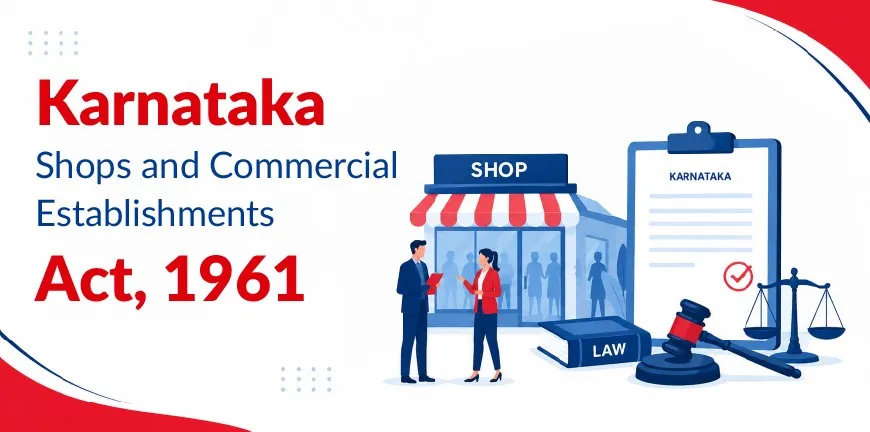
Most Karnataka employers get the basics right: payroll runs like a well-oiled machine, the office is functional, & the team is growing. But compliance? That’s often the last thing anyone looks at until a labour inspector walks in.
The Karnataka Shops & Commercial Establishments Act, 1961, rules the roost for nearly every non-factory workplace in the state: offices, retail stores, IT companies, startups, & service businesses. It sets the precedent on man-hours, leave entitlements, employee welfare, & business registration, & non-compliance can mean penalties, licence suspension, or worse.
If you run any kind of commercial establishment in Karnataka, this law applies to you.
Key Takeaways
- Most Karnataka commercial establishments must register under the Shops & Establishments Act.
- Employers must maintain employee records, leave policies (PL, CL, LOP, etc), & overtime documentation properly.
- Non-compliance can trigger penalties, inspections, operational stoppages, & reputational business risks.
- IT companies, retail businesses, consultancies, & offices generally fall under the Act.
- Regular compliance audits help businesses reduce labour law & documentation-related compliance risks.
What is the Karnataka Shops & Commercial Establishments Act, 1961?
The Karnataka Shops & Commercial Establishments Act covers working hours, overtime, leave entitlements, public holidays, wage obligations, and even the hours your establishment can open and close. In short, if it affects how your employees work, this Act likely has something to say about it.
What are the Objectives of Karnataka Shops & Commercial Establishments Act, 1961?
The primary objective of the legislation is to protect employee welfare while ensuring businesses maintain proper statutory compliance practices.
Ex: There is an absolute prohibition on employing anyone under the age of 14 (defined legally as a “child”). (Source: Karnataka Shops & Commercial Establishments Act)
The Act generally applies to:
• Shops & retail establishments
• Corporate offices
• IT and ITES companies
• Startups & service businesses
• Restaurants & hospitality establishments
• Warehouses and commercial facilities
• Consultancies and agencies
For most employers operating in Karnataka, Shops & Establishment compliance forms a key part of overall labour law compliance management.
Which Businesses Need Shops & Establishment Registration in Karnataka?
Businesses operating commercial establishments in Karnataka are generally required to obtain Karnataka Shops and Establishment Registration within the prescribed timelines.
Entities commonly covered under the Act include:
- Retail stores
- E-commerce offices
- IT companies
- Marketing agencies
- Financial service providers
- Healthcare clinics
- Educational consultancies
- Shared office spaces
- Logistics & warehousing offices
Even startups and small businesses employing a limited workforce may be required to register under the Act.
Are Any Businesses Exempt?
Certain factories governed under the Factories Act and specific government establishments may fall outside the direct scope of the Shops & Commercial Establishments Act. However, many office-based operations connected to manufacturing businesses may still require separate compliance coverage.
Businesses should evaluate applicability carefully to avoid registration gaps or inspection risks.
What are the Key Compliance Requirements Under the Act?
Employers covered under the Karnataka Shops & Commercial Establishments Act must comply with several operational & employee-related obligations.
1. Registration & Certificate Display
Once your establishment is up and running, the clock starts. Eligible businesses must apply for registration within the designated timeline: delays don’t come with grace periods under this Act.
Once issued, the registration certificate isn’t a document to file away. It needs to be displayed prominently at the workplace, visible & accessible.
And registration isn’t a one-time task. Any change in ownership, address, or employee strength needs to be reflected promptly. The businesses that treat updates as optional tend to remember that lesson only when a notice arrives.
2. Working Hours & Overtime
Time isn’t just money in a compliant workplace: it’s a liability if managed poorly.
The rules around working hours aren’t complicated. Daily limits, weekly caps, mandatory rest intervals, overtime thresholds, the Act spells all of it out clearly. Employers are expected to keep records covering hours worked, weekly offs, overtime clocked, and shift schedules.
Where businesses stumble isn’t usually the hours themselves. It’s the paper trail. Improper overtime management is one of the most common compliance gaps flagged during labour inspections. In most cases, the problem isn’t that the rules were broken. It’s that nobody wrote anything down.
3. Leave & Holiday Compliance
Leaves aren’t a perk: under Karnataka law, they’re an entitlement.
The Act defines entitlements across earned leave, casual leave, and sick leave, alongside national and festival holidays. Businesses don’t get to interpret these differently or quietly round them down.
The obligation is clear: policies must align with Karnataka labour compliance requirements, and employee leave records must be maintained accurately, not just during audits, but throughout the year.
A well-documented leave policy protects employees & shields employers during audits. The two aren’t in conflict.
4. Maintenance of Registers & Records
If it isn’t documented, it didn’t happen: at least not as far as a labour inspector is concerned.
Commercial establishments are required to maintain statutory records covering attendance, wage registers, leave records, employee details, and holiday notices. These aren’t administrative formalities; they’re the paper trail that proves compliance when it’s questioned.
For IT companies and multi-location businesses managing larger workforces, digital recordkeeping has become the practical standard, easier to maintain, easier to produce.
5. Women Employee Regulations
Compliance here goes beyond paperwork: it’s about workplace culture and basic safety.
The Act includes specific provisions for women employees, with conditions governing night shift employment in applicable sectors. Employers operating extended business hours are expected to establish clear workplace safety and transportation policies wherever required.
Businesses that treat these provisions as a checklist miss the point. Those who build them into standard operations rarely must think about them twice.
What are the Penalties for non-compliance?
Non-compliance with the Karnataka Shops & Commercial Establishments Act doesn’t come with a warning; it comes with a notice.
Labour authorities can act on a range of violations:
- Failure to obtain registration
- Poor record maintenance
- Improper overtime practices
- Working hour breaches
- Unpaid or denied statutory leave.
Each one is a gap that inspections are specifically designed to find.
But the penalties don’t stop at fines. Repeated violations invite inspection-related disruptions that derail operations, employee disputes that damage internal trust, & reputational exposure that’s harder to recover from than any financial penalty. The cost of non-compliance is rarely just the number on the notice.
Common Compliance Challenges for Karnataka Businesses
Regulations shift. Workforces expand. And somewhere between scaling operations and managing day-to-day priorities, compliance documentation falls behind. For most Karnataka businesses, the challenges are predictable:
- Missed registration renewals
- Incomplete documentation
- Multi-location workforce tracking
- Inconsistent leave policies
- Managing hybrid and shift-based employees
- Handling labour inspections
SMEs & rookie startups that are looking to accelerate growth in Bengaluru face this tension acutely, moving quickly enough to compete while building compliance frameworks solid enough to hold. For businesses operating across multiple states, the challenge exacerbates further.
Karnataka-specific requirements must align with broader national HR & payroll compliance frameworks, & the gaps between them are where most violations quietly pile up.
How Businesses Can Stay Compliant?
Registration gets you through the door. What keeps you compliant is everything that happens after.
Shops & Establishments compliance isn’t a milestone: it’s an ongoing discipline. Businesses that manage it well don’t wait for inspections to find the gaps. They build systems that close them first:
- Conducting periodic labour compliance audits
- Digitising statutory records
- Reviewing employee policies regularly
- Monitoring leave and overtime practices.
- Tracking renewal timelines
- Coordinating HR & legal compliance functions
For many organisations, the more practical route is outsourcing labour law and statutory compliance services altogether to a top payroll compliance agency like Alp Consulting: reducing administrative risk while keeping regulatory readiness sharp.
The businesses that treat compliance as a continuous function rather than a calendar notification are the ones that rarely make the front page for the wrong reasons.
Conclusion
Compliance under the Karnataka Shops & Commercial Establishments Act isn’t a one-time obligation: it’s an ongoing commitment to running a business that holds up under scrutiny.
The Karnataka Shops & Commercial Establishments Act sets the foundation. What businesses build on top of it in documentation, policy, and monitoring determines whether compliance is a liability or just another part of running well.
Frequently Asked Questions
1. Is Shops & Establishment registration mandatory in Karnataka?
Yes. Most commercial establishments operating in Karnataka are required to obtain Karnataka Shops and Establishment Registration under the Act.
2. Does the Karnataka Shops & Commercial Establishments Act apply to IT companies?
Yes. IT & ITES companies operating commercial establishments in Karnataka are generally covered under the Act, subject to applicable exemptions and conditions.
3. What are the penalties for non-compliance?
Businesses may face fines, labour notices, inspection-related actions, & operational risks for failing to comply with statutory requirements under the Act.
4. Are businesses required to register under the Karnataka Shops & Establishments Act?
Yes. Most commercial establishments operating in Karnataka must register and maintain ongoing statutory compliance.
5. What records should employers maintain under the Act?
Employers are generally expected to maintain attendance records, wage registers, leave records, employee details, & statutory notices.
Contact Us For Business Enquiry

Hariharan Iyer
Hariharan Iyer is the Vice President – Operations at ALP Consulting, bringing over 40+ years of experience in HR outsourcing and labour law compliance. He leads end-to-end HRO operations, ensuring process efficiency, statutory compliance, and seamless service delivery for clients across industries. With a strong background in labour law governance and workforce management, Hariharan plays a key role in driving operational excellence and compliance-led HR solutions at ALP Consulting.