
Which Indian Cities Offer the Best Opportunities for Software Developers Right Now
17/06/2026
What Are the Best Strategies to Hire in India for Tech Roles?
18/06/2026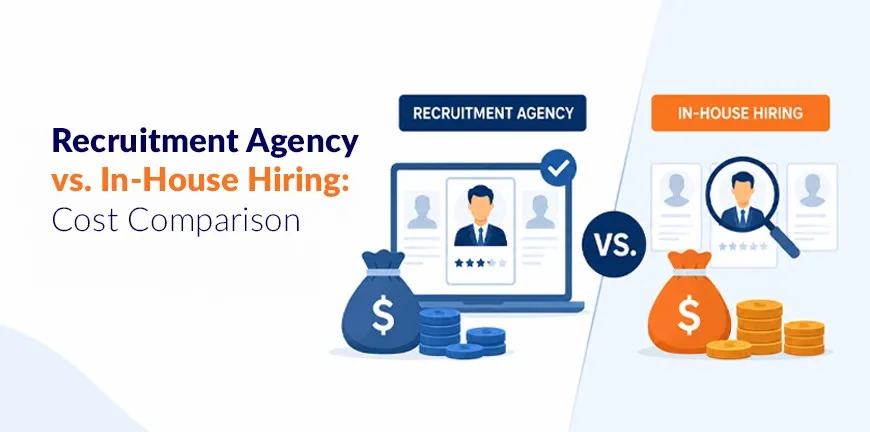
Hiring the right talent can cost you 30-50% more than you expect without a robust plan. The talent landscape in India has become fiercely competitive, driving up hiring costs. This is where the recruitment agency vs. in-house hiring dilemma comes into the picture.
A latest study states that “On average, companies spend Rs 30,000 to Rs 1.5 lakh per hire in India, depending on the role, industry and hiring method (Source: The Economic Times)
If you are looking to adopt a recruitment model, then learn about the cost impact of both approaches, determining the most cost-efficient way to manage your hiring cycle.
Key Takeaways
- Recruitment costs in India can be significantly higher without a structured hiring strategy
- In-house hiring is more cost-effective for steady, predictable hiring and entry-to-mid-level roles
- Recruitment agencies offer faster hiring and better access to niche talent
- Hidden costs like time-to-hire, productivity loss, and bad hires can make in-house hiring more expensive
- A hybrid hiring model combines cost efficiency, speed, and quality
What is recruitment outsourcing vs in-house Recruitment Cost Comparison?
Recruitment outsourcing is an approach where organisations partner with external agencies to manage hiring, usually on a pay-per-hire basis, while in-house hiring utilises internal teams with fixed costs. The cost difference is influenced by hiring volume, speed, and complexities related to job roles.
What is In-House Hiring?
In-house or internal hiring is a method in which organisations handle their recruitment cycles and hiring functions with the help of their own HR teams and managers.
What is a Recruitment Agency?
A recruitment agency is a third-party partner connecting businesses and job seekers, and helps organisations in finding, screening, and placing candidates in suitable roles.
Recruitment Agency vs In-House Hiring: Cost Breakdown Table
| Cost Component | In-House Hiring | Recruitment Agency Hiring |
| Recruiter Salaries | ₹4L–₹12L per annum per recruiter | Not applicable |
| Job Portals & Ads | ₹1L–₹5L annually | Included in the agency fee |
| ATS & Hiring Tools | ₹50K–₹3L annually | Included |
| Sourcing Costs | Internal team initiative and tools | Included |
| Cost per Hire | Approximately ₹30K–₹1.5L (avg., depending on role) | Approximately 8%–25% of annual CTC |
| Upfront Investment | High | Low |
| Time to Hire | Approximately 30–60 days | Approx 15–30 days |
| Access to Passive Talent | Limited | High (pre-vetted talent pools) |
| Scalability | Limited (depends on team size) | High (can scale quickly) |
| Replacement Guarantee | Not applicable | Approximately 60–90 days |
| Hidden Costs | Steep | Lower |
| Cost for Bulk Hiring (50+) | Cost-efficient over time | Can become expensive |
| Cost for Niche/Tech Roles | Expensive & time-consuming | More cost-effective due to expertise |
| Employer Branding Costs | Separate investment required | Not required |
| Overall Cost Efficiency | Better for steady, long-term hiring | Better for urgent, specialised, or high-volume hiring |
Note: The data mentioned above are a compilation of industry benchmarks extracted from publicly available research, industry reports, and hiring market analyses. Actual costs vary by industry, role, seniority, location, and hiring volume. (Source: ET, SRHM Reports, ISO)
When is In-House Hiring More Cost-Effective?
1. Consistent & Sturdy Hiring Plans
When the hiring demand is constant and consistent, and workforce planning prediction is stable, in-house hiring teams can smoothly and effectively function utilising proper tools, a sound budget, and preventing steep fees charged by agencies.
2. Mid & Entry Level Job Roles
Internal teams find is cost effective to hire for roles that can be sourced easily, have a huge talent bank, and are not too niche. Recruitment capacity of the recruiters aims to fill these roles at a lower cost and faster through internal networks, job portals, and referrals.
3. Robust Employer Image
A business with a robust brand reputation automatically draws best-in-class talent, building a strong and sustainable skilled professional pool, cutting down on sourcing expenses.
4. Access to Hiring Tech
In-house hiring can be economical if teams can utilise advanced and automated HR tools that can speed up hiring and make it more efficient. Tools like ATS or HRMS platforms can structure work systems, eliminate manual work, and enhance recruiter productivity.
When is a Recruitment Agency More Cost-Effective?
1. Large-scale & Rapid Hiring Needs
If your business wants to scale rapidly and facilitate bulk hiring, then partnering with recruitment agencies is beneficial in terms of cost. You can utilise readily available talent pools, driving fast hiring, lower vacancy expenses, and agile project execution.
2. Niche Job Role Hiring
If your internal teams are finding it difficult to find professionals for specialised roles, you can team up with recruitment agencies and get access to niche talent instantly. This prevents longer hiring cycles, eliminating the chances of incurring overhead costs.
3. Restricted Internal Recruitment Ability
If your internal team is small and lacks the capacity to handle multiple HR activities, partnering with an agency is a smart move. Agencies provide instant scalability and get paid only when hired, reducing overhead.
4. Requirement for Better Candidate Quality
Weak hiring plans and decisions result in constant rehiring, increasing costs, and time. Recruitment agencies ensure access to skilled, pre-vetted professionals and an appropriate cultural fit. This leads to cutting down on replacement and attrition expenses.
Recruitment Agency vs In-House Hiring Cost: Case Study
A reputable Bangalore-based tech company was looking to expand rapidly due to new projects. The organisation needed to hire more than 120 tech professionals in 4 months’ time. They faced challenges like steep in-house hiring costs, slow recruitment cycles, and frequent candidate drop-offs.
The company partnered with Alp Consulting Ltd, one of the leading recruitment and staffing companies with 30 years of experience and serving over 30 + diversified sectors with expertise in providing seamless recruitment solutions. Alp offered a hybrid recruitment model that was a combination of RPO and agency support.
Dedicated recruiters were placed on-site along with the offshore sourcing team. They provided the tech firm with access to pre-evaluated talent and activated passive talent. Facilitated swifter screening and candidate shortlisting, and provided real-time updates to candidates.
Outcomes
- Hiring costs reduced by 33%
- Hiring time significantly decreased
- Improved candidate engagement
- 92% of hires cleared probation
Frequently Asked Questions
1. What is the difference between recruitment agencies and in-house hiring?
Recruitment agencies are third-party firms hired to source and filter candidates and are paid a commission upon a successful hire. While In-house hiring uses the company’s internal HR or talent acquisition team, who are paid a fixed salary.
2. Which hiring model is more cost-effective for growing businesses?
For growing businesses, the most effective hiring model depends on hiring volume, urgency, and internal capabilities.
3. How do recruitment costs compare between agencies and internal teams?
Recruitment costs differ significantly between agencies and internal teams based on structure and scale. In-house hiring involves fixed expenses while recruitment agencies typically charge a percentage of a candidate’s annual salary, depending on role complexity and seniority.
4. What hidden costs are associated with in-house hiring?
Hidden costs associated with in-house hiring usually include costs for job board subscriptions, Applicant Tracking Systems (ATS), employer branding campaigns, and interview coordination.
5. When does it make sense to use a recruitment agency instead of hiring internally?
It makes sense to use a recruitment agency when speed, specialisation, or scale is critical. Agencies are ideal for urgent hiring needs, niche or hard-to-fill roles, and leadership positions.
6. How does time-to-hire differ between recruitment agencies and internal recruitment teams?
Time-to-hire is typically shorter when using recruitment agencies compared to internal recruitment teams. Agencies maintain ready talent pipelines, pre-screened candidates, and industry networks, while internal teams usually start from posting jobs, sourcing, screening, and coordinating interviews.
7. Which hiring approach delivers faster access to talent?
Recruitment agencies deliver faster access to talent compared to internal hiring teams by maintaining extensive databases of pre-screened candidates and active talent pipelines.
8. How do recruitment agencies help reduce hiring risks?
Recruitment agencies help reduce hiring risks by using structured, multi-layered screening processes to evaluate candidates beyond just resumes.
9. Can organisations combine agency recruitment with in-house hiring?
Combining agency recruitment with in-house hiring through a hybrid model can be an effective approach that organisations can adopt.
10. Which model works better for high-volume hiring requirements?
For high-volume hiring requirements, recruitment agencies or Recruitment Process Outsourcing (RPO) models generally work better than purely in-house hiring.
Contact Us For Business Enquiry

Amit Saproo
Amit Saproo is the Head of Operations at ALP Consulting with nearly 17 years of experience in Executive Search, RPO, Leadership, and IT & Engineering recruitment. He leads nationwide recruitment programs across Technology, BFSI, and R&D domains, driving strategic hiring solutions for diverse client needs. Amit excels in building and managing high-performance teams that deliver scalable, end-to-end recruitment and consulting services.