Manual Payroll Process: Step-by-Step Guide
17/03/2026
GCC Industry Growth Report: Trends & Strategies
18/03/2026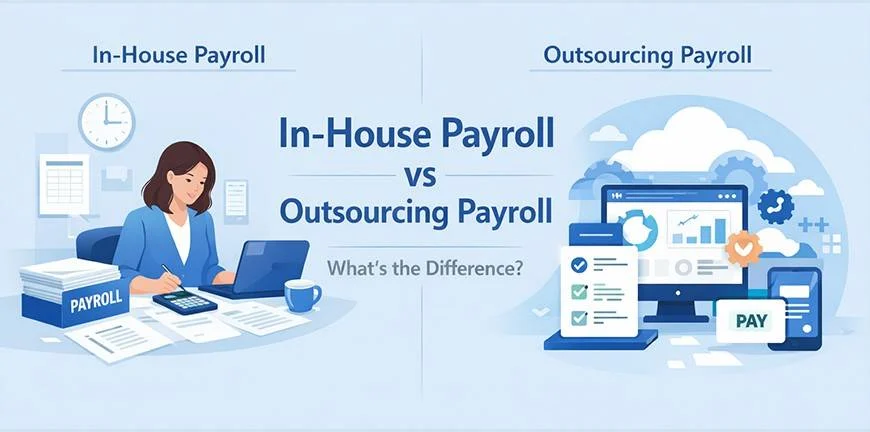
“When businesses delegate operational complexity, they gain strategic clarity.”
In general, every business task can be outsourced, but companies don’t go for this option due to certain constraints. Employers brainstorm with leadership, HR, and the technical team and decide which processes can be outsourced. Does payroll come under this category? Or can companies continue to manage it in-house?
To make an informed decision, we must first realise the difference between in-house payroll and outsourcing from a business and compliance standpoint. With the rise in remote working, drastic changes to the Indian labour codes, a strong need to prove compliance, and elevating employee experience, employers can’t just sit on the fence and wait for things to happen. Proactiveness is the need of the hour, and deciding whether to manage payroll in-house or take the route of outsourcing becomes critical.
Let’s make employers life easy and help them make the right call by conducting an in-depth qualitative comparison between in-house payroll vs outsourcing payroll.
What is In-House Payroll?
Before commencing the tug of war between in-house payroll vs outsourcing payroll, we must understand how each process works individually. Let’s understand in-house payroll first.
In-house payroll is the process where a company runs all payroll-related tasks, including employee salary calculations, deductions, tax compliance, payslip generation, and salary disbursement using its own HR or by deploying a trained internal payroll team.
Here is the process flow involved in managing payroll in-house
1. Employee Information Consolidation
Gather employee personal details, salary structure, tax declarations, & bank information.

2. Keep Tabs on Attendance & Leave
Track employee login & logout (working hours as per company policy), OT hours, paid leave, & unpaid leave promptly via manual or software-driven attendance management systems.
3. Calculating Gross Earnings
Calculate total earnings comprising basic salary, allowances, bonuses, & incentives.
4. Processing Statutory & Voluntary Deductions
Apply deductions like PF, ESI, income tax, & professional tax.
5. Computing Net Salary
Churn out the net or final take-home salary after deducting all applicable deductions.
6. Generating Employee Payslips
Create monthly payslips that entail details such as earnings, deductions, & final salary.
7. Disbursing Employee Salaries
Transfer salaries to employee bank accounts through secure banking systems.
8. Managing Payroll Compliance Filings
Submit statutory returns and maintain payroll records for compliance.
9. Maintaining Payroll Records and Reports
Store payroll documents & generate reports for auditing purposes.
What Is Payroll Outsourcing?
Before we make a detailed payroll outsourcing comparison with in-house, let’s get a gist about payroll outsourcing as a standalone:
Payroll outsourcing is a service model where a principal employer hires an external agency with a dedicated team of experts & technology to manage end-to-end payroll, including ensuring compliance with government mandates. As of 2026, the global payroll outsourcing market is valued at nearly $11.17 billion to $13.85 billion, reflecting a considerable shift toward specialized management.

There are different payroll outsourcing options available for employers to choose from, as per their business and workforce needs. Some of the models include:
- Full-Service Payroll Outsourcing
- Partial Payroll Outsourcing
- Managed Payroll Services
- Payroll Processing Outsourcing
- Payroll Administration Outsourcing
- Cloud-Based Payroll Outsourcing
- Global/ International Payroll Outsourcing
- Local / Domestic Payroll Outsourcing
- Project-Based Payroll Outsourcing
- Co-Sourced Payroll Model
- Payroll BPO (Business Process Outsourcing)
- Payroll SaaS-Based Outsourcing
- End-to-End Payroll Outsourcing
- Compliance-Focused Payroll Outsourcing
- Payroll Managed Services Model
Payroll outsourcing services include:
- Employee salary & wage calculations
- Payroll tax calculation & filing.
- Statutory compliance & regulatory management
- Payroll processing & salary disbursement.
- Payslip generation & distribution
- Employee payroll data management
- Payroll reporting & analytics preparation.
- Year-end payroll tax reporting
- Payroll query handling & employee support.
- Multi-country payroll & compliance handling
What Is the Difference Between In-House Payroll and Outsourcing Payroll?
Here are the 10 key differences b/w in-house payroll vs outsourcing payroll:
| Parameter | In-House Payroll | Payroll Outsourcing |
| Management | Managed internally by the HR or finance team | Managed by an external payroll service provider |
| Control | The company retains full control over payroll processes | Control shared with third-party provider |
| Cost Structure | Necessitates investment in payroll staff & software | Service fees paid to the outsourcing provider |
| Expertise | Depends on internal payroll knowledge and experience | Access to specialized payroll experts |
| Compliance Management | Internal team handles statutory compliance updates | Provider manages compliance and regulatory changes |
| Technology Requirements | The company must purchase and maintain payroll software | Provider uses their own payroll platforms |
| Time and Administrative Effort | Requires significant internal administrative time | Reduces administrative workload for internal teams |
| Scalability | Scaling payroll operations may require additional staff | Easily scalable through service provider support |
| Risk of Errors | Higher risk if internal expertise is limited | Lower risk due to experienced payroll professionals |
| Focus on Core Priorities | Internal resources diverted to payroll operations | Businesses can focus on strategic activities |
What Are the 5 Advantages of In-House Payroll?
Here are the 5 perks of managing payroll through a designated internal team:

1. Greater Operational Control
Companies maintain complete command over payroll calculations, approvals, & salary disbursement as the entire operational team is managed in-house.
2. Data Confidentiality and Security
Employee Payroll data, which is sensitive for the most part, remains intact within the internal system. This brings down risks associated with third-party data access.
3. Direct Communication With Employees
HR teams can tackle employee payroll queries quickly, perform corrections on the spot, & address concerns bypassing intermediary involvement.
4. Customization of Payroll Policies
Companies can make tweaks to their payroll structures with less ambiguity. Also, allowances, deductions, & policies can be amended according to internal requirements.
5. Better Integration With Internal Systems
In-house payroll integrates seamlessly with internal HR, accounting, attendance, & workforce management systems.
What Are the 5 Benefits of Payroll Outsourcing?
Here are 5 major benefits of payroll outsourcing:
1. Reduced Administrative Workload
Businesses can relinquish payroll calculations, reporting, compliance, & every other payroll-related responsibility to specialists, allowing HR teams to direct all their efforts on accomplishing strategic tasks.
2. Improved Payroll Accuracy
Well-rounded payroll management systems offered by service providers bring down calculation errors in salaries, deductions, taxes, & statutory contributions.
3. Better Regulatory Compliance
Expert payroll agencies stay ahead of the curve by constantly upgrading their acumen with changing labour laws, tax rules, & statutory payroll regulations.
4. Lower Operational Costs
Businesses save costs by avoiding payroll software investments, training expenses, & maintaining dedicated payroll staff.
5. Enhanced Data Security
Professional outsourced payroll setup protects sensitive employee information via secure platforms, restricted access, & advanced data protection measures.
What Are the Challenges of Managing Payroll In-House?
1. Complex Compliance Management
Keeping up with changing tax laws, labour regulations, & statutory requirements can be chaotic, making in-house payroll management much more challenging.
2. Higher Administrative Burden
HR teams may have to spend a significant chunk of their working hours on payroll calculations, deductions, reporting, & straighten out payroll-related employee queries. This can hamper the progress in their other activities, like strategic workforce planning, employee engagement, etc.

3. Increased Risk of Errors
Payroll processing done manually with little to no automation can inevitably cause calculation mistakes in salaries, taxes, deductions, & statutory contributions.
4. Higher Operational Costs
Maintaining payroll systems, trained staff, & compliance resources increases operational costs for businesses and may eat into the profits.
5. Data Security Concerns
Handling sensitive employee payroll information internally increases risks related to data breaches & unauthorized access.
What Are the Potential Risks of Payroll Outsourcing?
1. Limited Direct Control
Outsourcing payroll may diminish direct supervision of processes. This requires clear communication & defined service expectations.
2. Dependency on External Provider
Businesses may become complacent & rely heavily on the provider’s systems, expertise, & responsiveness for smooth payroll operations.
3. Data Security Considerations
Sharing employee payroll information externally requires strong security protocols and trusted providers to ensure data protection.
4. Integration with Internal Systems
Payroll outsourcing may necessitate system integration with existing HR or accounting platforms, which can consume time.
5. Service Quality Variations
The quality of payroll services may vary across providers, making careful selection & service evaluation important & tricky at the same time.
How Do Businesses Decide Between In-House Payroll and Payroll Outsourcing?
Here are 5 ways to make informed decisions to choose between in-house payroll vs outsourcing payroll:
1. Assess Internal Payroll Expertise
Evaluate whether your internal HR team has the exact expertise warranted to manage payroll compliance and regulations efficiently.
2. Compare Operational Costs
Compare the total costs of payroll management systems, staff training, & compliance with outsourcing service expenses.
3. Consider Business Growth Plans
Growing businesses may necessitate flexible payroll systems that can counter a constantly changing workforce & regulatory complexity with relative ease.
4. Evaluate Compliance Requirements
Businesses operating across regions must take into account evolving tax laws & statutory requirements before deciding payroll management approach.
5. Review Time and Resource Allocation
Determine whether internal teams can dedicate sufficient time to payroll without affecting strategic HR priorities.

How Alp Consulting Can Help Businesses Manage Payroll Better?
Alp Consulting Ltd, a top-tier payroll service provider in India with 30 years of experience, helps businesses manage payroll more efficiently by taking care of salary processing, statutory compliance, tax computations, & reporting with 100% accuracy. Moreover, Alp’s payroll experts make sure timely salary credit while minimizing errors & compliance risks to almost zero. With streamlined processes & secure systems, Alp Consulting enables HR teams to reduce administrative workload and focus on strategic initiatives that support overall business growth.
Verdict
In the above fierce debate between internal payroll vs external payroll, it seems like payroll outsourcing has an edge over internal payroll when it comes to expertise & compliance management. Businesses must contemplate whether their operations demand control or efficiency.
In-house payroll brings direct oversight & customization to the forefront, while external payroll offers expertise, scalability, & world-class compliance support, which is the need of the hour in the current regulatory mayhem.
For rookies or organizations on the cusp of expansion facing regulatory complexity & operational demands, outsourcing payroll often acts as a catalyst to streamline processes while empowering HR teams to focus on strategic business priorities.
Key Takeaways
- In-house payroll offers control but demands expertise, resources, & continuous compliance attention.
- Payroll outsourcing brings along expert support, boosting compliance accuracy & operational efficiency.
- Businesses must weigh costs, scalability, & internal capabilities with apt metrics before choosing between in-house payroll vs outsourcing payroll.
- Regulatory complexity & workforce expansion create a need for professional payroll outsourcing solutions.
- Outsourcing payroll to top players like Alp Consulting Ltd helps HR teams focus more on strategic workforce priorities.
Contact Us For Business Enquiry
Frequently Asked Questions
1. What is in-house payroll processing?
In-house payroll processing refers to managing employee salaries, deductions, taxes, compliance, & payslips internally, utilising company HR staff or payroll software.
2. What are the advantages of payroll outsourcing?
When a payroll outsourcing comparison is done with in-house, the former offers benefits like reduced administrative workload, improved accuracy, ensures regulatory compliance, lowers operational costs, & allows HR teams to focus on strategic priorities.
3. Is payroll outsourcing worth it for small businesses?
Yes, payroll outsourcing helps small businesses bring down compliance risks, save time, minimize errors, and manage payroll efficiently without hiring dedicated specialists.
4. How does outsourced payroll work?
In outsourced payroll, businesses share employee payroll data with providers who calculate salaries, manage compliance, generate payslips, & process payments.
5. Which is better: in-house payroll or outsourcing payroll?
When we compare in-house payroll vs outsourcing payroll, the choice depends on business size, compliance complexity, internal expertise, & resources required to manage payroll efficiently.
6. Why do companies outsource payroll?
Companies outsource payroll to improve accuracy, reduce administrative workload, ensure compliance, save costs, and focus internal resources on core business operations.

Yugandhara V. M
Yugandhara V. M serves as the Assistant Vice President – HRO at Alp Consulting Ltd., bringing over 14 years of rich experience in Human Resource Outsourcing, payroll management, and statutory compliance. He specializes in driving process excellence across HR operations, ensuring seamless service delivery and compliance with labor laws. Yugandhara’s expertise lies in managing large-scale client engagements, optimizing HR processes, and implementing efficient workforce management systems that enhance organizational performance. He also leads comprehensive payroll services, ensuring accuracy, timeliness, and compliance for diverse client portfolios.