
Top 7 RPO Strategies for Successful Mass Hiring
10/03/2026
A New Milestone for Software Offshore Development Center Collaboration.
12/03/2026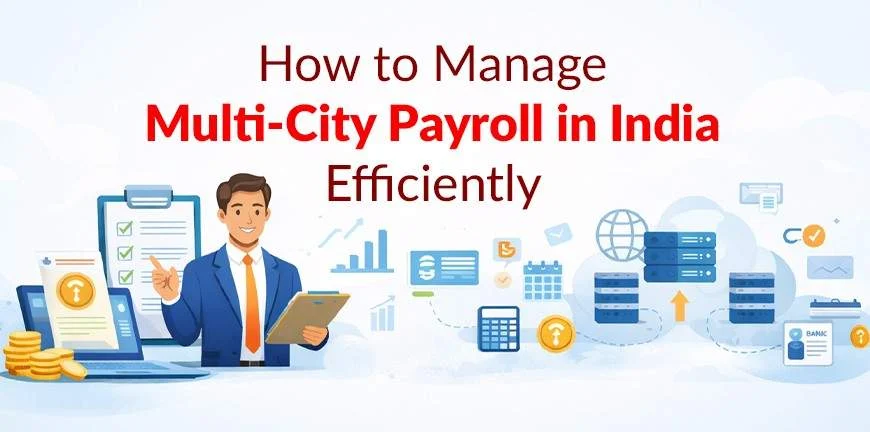
Navigating the complex mesh of multi-city payroll can be daunting, especially for companies that manage payroll in-house and operate in multiple Tier 1 & Tier 2 cities. For example, in Bangalore, which is Zone-1 (Metro / High-Cost Zone), the minimum wages under COW (Code of Wages 2019) for skilled, semi-skilled, & unskilled employees are relatively higher.
On the other hand, in a tier-2 city like Mysuru, a Non-Metro Zone-2, the minimum wages applicable plummet drastically, making it slightly easier to manage the living expenses.
Such imbalances make it arduous for companies to standardise their payroll processes across cities, leading to higher payroll errors resulting in hefty penalties. This is not good news, right? especially for budding enterprises.
Let’s create a solid roadmap to optimise multi-city payroll for Indian companies that will help them deliver better outcomes & elevate the employee experience.

What Is Multi-City Payroll Management?
Similar to multi-state payroll management, multi-city payroll management is a specific process of managing employee salaries, taxes, & statutory compliance across different cities where a company is running business operations with varying labour laws & wage regulations. The key steps involved in multi-location payroll management include:
- Note down city-specific labour laws, tax rules, & statutory compliance requirements.
- Initiate employee classification based on work location, role, wage category, & regulations.
- Configure payroll management system for city-based salary structures, deductions, & taxes.
- Ensure compliance is water-tight with local minimum wages, benefits, & labour laws.
- Process payroll accurately while managing city-wise tax filings & reports.
- Review payroll data regularly to maintain compliance across multiple locations.
Multi-City Payroll Complexity Matrix
| Feature | Impact of Multi-City Management |
| Professional Tax (PT) | Applicability varies state-wise (e.g., Karnataka has PT for above Rs. 25k salary; Delhi has no window for PT). |
| Labour Welfare Fund | Different deduction cycles (monthly vs. annual) across states. |
| Holiday Calendars | Must be geo-tagged based on the local Shops & Establishment Act. |
| Minimum Wage | Dependent on City Zone (Tier 1 vs. Tier 2) and skill level. |
Why is Multi-City Payroll Management Important?
1. Compliance with Local Labour Laws
Multi-city payroll ensures compliance is achieved w.r.t city-specific labour laws, tax regulations, & statutory payroll requirements.
2. Accurate Salary Structuring
Effective multi-city payroll management via immensely experienced service providers like Alp Consulting Ltd brings down payroll errors to almost zero as they adapt salary structures, minimum wages, allowances, & deductions to suit local regulations.
3. Reduced Legal & Compliance Risks
Multi-location payroll management mitigates legal risks & penalties sprouting from incorrect payroll tax filings or labour law violations.
4. Enhanced Payroll Process Efficiency
Multi-city payroll management takes payroll efficiency to the elite-level via process standardisation while effectively fulfilling city-specific payroll compliance requirements.
5. Better Employee Experience
Multi-city payroll enhances employee satisfaction via accurate salary processing aligned with local statutory rules & compensation norms.

What are the 5 Key Challenges Affecting Multi-City Payroll?
1. Varying Local Labour Laws
Different cities enforce labour laws with unique guidelines that can affect multi-city payroll compliance processes.
2. Complex Tax and Statutory Rules
Multiple tax structures & statutory deductions complicate payroll calculations across cities.
3. Minimum Wage Variations
City-based minimum wage differences necessitate location-specific payroll configurations.
4. Payroll System Integration Issues
Integrating payroll management systems across multiple city operations creates data inconsistencies.
5. Compliance Monitoring Difficulties
Tracking regulatory updates across cities increases multi-location payroll compliance management complexity.
What Role Does the Payroll Management System Play in Multi-City Payroll Execution?
Here are 5 ways payroll management systems help smooth the execution of multi-city payroll:
1. Automates City-Specific Payroll Rules
Payroll management systems run city-specific tax calculations, statutory deductions, & compliance requirements with reduced human intervention across locations.
2. Ensures Regulatory Compliance
Payroll systems keep organizations on high alert & remain compliant with fluctuating labour laws, minimum wages, & statutory regulations across cities at all times.
3. Centralizes Payroll Data Management
Payroll management systems centralize employee payroll data from multiple cities, ensuring accuracy, consistency, & streamlined reporting processes.
4. Reduces Payroll Errors
Payroll execution systems minimize calculation errors by applying automated validations for city-based salary structures & deductions.
5. Simplifies Reporting and Audits
Payroll processing systems generate location-specific payroll reports, simplifying statutory filings, audits, & compliance monitoring for organizations.

Multi-City Payroll vs Centralized Payroll: What are the Differences?
Here are the 5 key differences between multi-city Payroll vs centralized payroll:
| Aspect | Multi-City Payroll | Centralized Payroll |
| Regulatory Compliance | manoeuvres city-centric labour laws, taxes, & statutory compliance requirements. | Applies payroll policies across all locations that are standardised with minimal to zero localization. |
| Payroll Configuration | Configured differently for each operating city based on local regulations. | A single payroll structure is applied universally across all business locations. |
| Minimum Wage Management | Adjusts payroll according to city-based minimum wage classifications. | Uses common wage structures regardless of city-level variations. |
| Operational Complexity | Higher complexity since it has to satisfy multiple city regulations & compliance. | Lower complexity with centralized payroll processes and uniform rules. |
| Reporting and Administration | Requires city-wise payroll reporting, compliance tracking, & localized administration. | Generates consolidated payroll reports managed from one central payroll system. |
What are the Top 5 Multi-City Payroll Mistakes Businesses Make in India?
1. Ignoring City-Specific Labour Law Requirements
Sometime multi-city payroll executive may fail to diligently follow city-specific labour laws & payroll compliance regulations.
2. Incorrect Minimum Wage Application
Applying uniform minimum wages without considering city-wise wage classifications & revisions is a possibility.
3. Mismanaging Professional Tax Deductions
Incorrect professional tax deductions due to varying state or city payroll rules can occur from time to time while executing multi-city payroll.
4. Poor Payroll System Configuration
Payroll systems may not be configured for location-specific tax, compliance, and salary structures.
5. Delayed Statutory Filings Across Locations
Missing deadlines for statutory filings due to decentralized payroll processes can be detrimental.

How Can Companies Standardize Payroll Across Multiple Cities?
Here are 5 ways to standardize multi-city payroll:
1. Deploy a Unified Payroll Policy
Create a robust standardised payroll policy that accommodates city-specific labour laws, tax regulations, & statutory compliance requirements.
2. Use the Advanced Payroll Management System
Adopt advanced payroll management systems that innate ability to manoeuvre city-based rules, salary structures, and statutory deductions with minimum fuss.
3. Maintain Centralized Payroll Data Systems
Centralize employee payroll data to bring consistency, accuracy, & streamlined reporting across multiple city operations.
4. Track Regulatory Changes
Keep tabs on labour law updates, minimum wage revisions, & compliance requirements on a continuous basis across different cities.
5. Partner with Professional Payroll Experts
Collaborate with a leading payroll agency like Alp Consulting Ltd, who have wealth of experience in managing multi-city compliance, tax filings, & statutory reporting.
How Should Startups Handle Payroll When Expanding to New Cities?
Here are 5 steps startups must take to manage payroll when expanding to new cities:
1. Research Local Payroll Regulations
Multi city payroll team must study city-specific labour laws, tax rules, & statutory payroll compliance requirements.
2. Update Payroll Policies
Adjust payroll policies to accommodate city-based wage structures & compliance rules.
3. Configure Payroll Systems
Configure the payroll management system to take care of city-wise salary structures, deductions, and taxes.
4. Ensure Statutory Registrations
Obtain required labour registrations & tax registrations before hiring employees locally.
5. Monitor Compliance Regularly
Set up diligent tracking of payroll compliance updates & maintain accurate records for audits.

What are the Key Payroll Trends for Multi-City Operations in 2026?
1. AI in Payroll
Artificial intelligence in payroll automates calculations, detects errors like Sherlock in a jiffy, & improves compliance across complex multi-city payroll operations.
2. Real-Time Payroll and Earned Wage Access
Organizations are installing real-time payroll systems to speed up salary processing & flexible employee wage access.
3. Cloud-Based Payroll Systems for Distributed Teams
Cloud payroll centralizes multi-location payroll management operations while satisfying the local compliance checklist.
4. Advanced Compliance & Regulatory Monitoring
Advanced payroll systems trace regulatory updates like GPS relentlessly across regions, making sure statutory compliance goals are consistently hit with 100% precision.
5. Integrated HR, Finance, & Payroll Ecosystems
Cutting-edge payroll ecosystems are looped with HR, finance, & time systems for seamless data synchronization.
How Can Alp Consulting’s Payroll Outsourcing Help Manage Multi-City Payroll Efficiently?
Alp Consulting Ltd.’s payroll outsourcing services help organizations manage multi-city payroll operations with ease and accuracy. Our multi-city payroll experts handle city-specific labour laws, tax regulations, minimum wage requirements, & statutory filings across locations.
With advanced payroll management systems & standardized processes, we make sure consistent salary processing, accurate deductions, and timely compliance reporting are executed.
Alp Consulting also monitors regulatory updates, manages employee records centrally, & reduces administrative burden. This enables companies to scale operations across multiple cities while maintaining complete payroll compliance & operational efficiency.
Streamline multi-city payroll with Alp Consulting’s expert compliance management, automated payroll systems, & centralized processes, ensuring accuracy, scalability, and zero penalties.
Key Takeaways
- Multi-city payroll necessitates managing varying labour laws, wages, & compliance requirements.
- City-based minimum wage differences significantly impact payroll structuring and salary calculations.
- Advanced payroll systems help in fine-tuning compliance, deductions, & city-specific payroll processes.
- Standardized payroll policies bring consistency to the forefront while adapting to city-level regulatory differences.
- Payroll outsourcing experts like Alp Consulting Ltd simplify multi-city compliance, reduce errors, & improve payroll efficiency.
Contact Us For Business Enquiry
FAQS
1. What is multi-city payroll management?
Multi-city payroll management involves handling salaries, taxes, and statutory compliance for employees working across different cities with varying labour regulations.
2. How does payroll differ across cities?
Payroll differs across cities due to variations in minimum wages, labour laws, professional tax rules, & statutory compliance requirements.
3. Is Professional Tax different in every city?
Professional Tax is state-specific, not city-specific, but payroll applicability varies depending on employee salary thresholds & state regulations.
4. How can companies ensure compliance across multiple locations?
Companies ensure compliance by using sophisticated multi-city payroll systems, monitoring regulatory updates, & standardizing payroll policies across locations.
5. Should companies outsource multi-city payroll?
Outsourcing multi-city payroll to top agencies like Alp Consulting Ltd reduces compliance risks, improves payroll accuracy, & helps businesses manage complex statutory requirements efficiently.

Yugandhara V. M
Yugandhara V. M serves as the Assistant Vice President – HRO at Alp Consulting Ltd., bringing over 14 years of rich experience in Human Resource Outsourcing, payroll management, and statutory compliance. He specializes in driving process excellence across HR operations, ensuring seamless service delivery and compliance with labor laws. Yugandhara’s expertise lies in managing large-scale client engagements, optimizing HR processes, and implementing efficient workforce management systems that enhance organizational performance. He also leads comprehensive payroll services, ensuring accuracy, timeliness, and compliance for diverse client portfolios.